The Seeds You Don’t Get To Keep
Maybe the old woman in the garden knew exactly what she was doing.
Article · 6 min read · ·
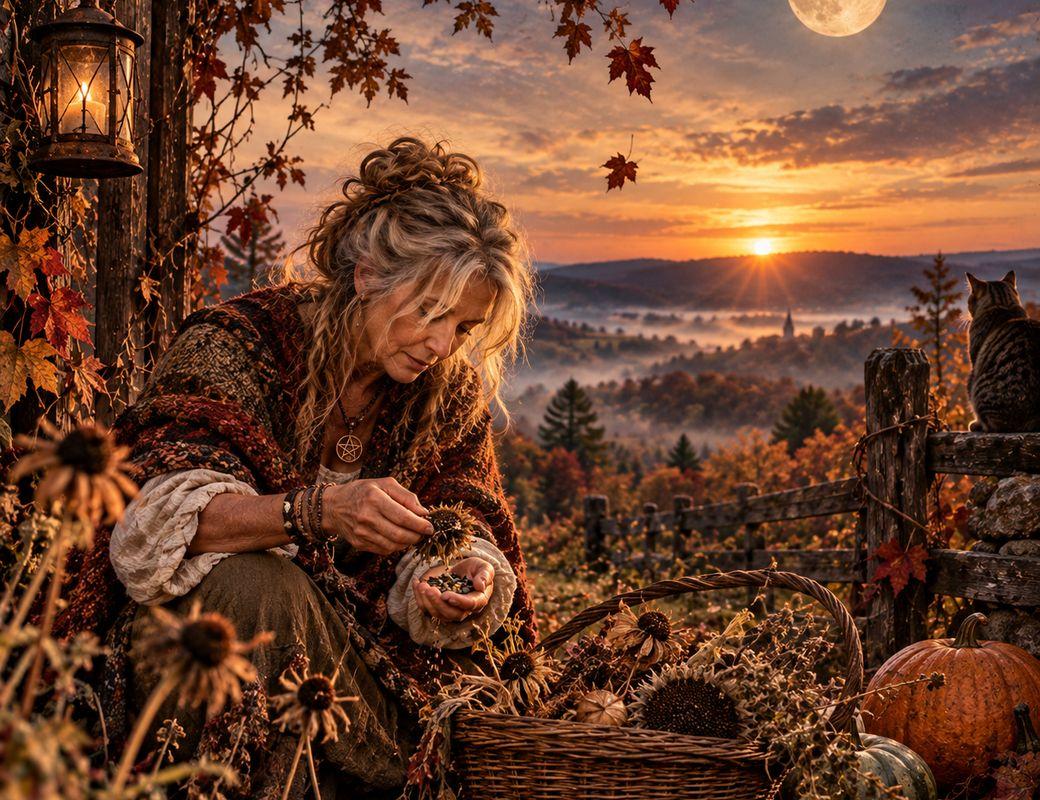
There comes a point every fall when the garden stops being charming and starts looking like somebody should probably call the authorities.
In August, everything is still lush and impressive. Tomatoes are hanging everywhere, herbs are spilling over their pots, flowers are showing off, and even those of us with questionable gardening credentials can wander around feeling ridiculously accomplished because we managed to grow something without killing it.
Then October happens.
By the time the Wheel begins turning toward Samhain, the flowers are brown, the vines have collapsed, the herbs are woody, and half the garden is lying sideways under a pile of leaves. Something that was absolutely beautiful six weeks ago now looks like it owes you an explanation.
Long ago, though, this was exactly when a woman might walk back into that apparently ruined garden carrying a basket or a little cloth bag.
She wasn’t there to admire it or make an autumn centerpiece. She had work to do. She’d move among the dead plants looking for dried flower heads and brittle pods, breaking them apart with her fingers and shaking the seeds into her palm. Some would be stored, some scattered now, and others kept safely through winter until the earth warmed again.
I like imagining her because I doubt she thought there was anything particularly mystical about what she was doing. She probably wasn’t floating around in a beautiful linen dress while woodland creatures gathered respectfully at her feet. More likely her hands were cold, her shoes were muddy, something was boiling over inside the house, and she was muttering because she couldn’t remember where she’d put the other damn basket.
But she knew things.
She knew that a garden looking dead didn’t mean there was nothing left in it. She knew the dried flower somebody else might throw away could contain hundreds of beginnings. And she knew you couldn’t consume everything the land gave you just because technically it belonged to you.
Some of the harvest became dinner. Some went into storage. Some was traded or shared. But some absolutely had to remain seed, because eating everything this year was a remarkably efficient way to make sure there was nothing to eat next year.
We don’t think about that very often anymore. If I want strawberries in February, I can walk into a grocery store and buy some that have apparently traveled farther than most people I know.
She couldn’t.
She lived by the Wheel whether she called it that or not. Spring wasn’t a decorating theme. Summer wasn’t vacation season. Autumn wasn’t pumpkin-spice everything. The seasons told her what could be done, what needed to be done and what would have to wait.
Imagine how many years she must have spent watching the same strange pattern. Seeds disappeared into dark soil and somehow became food. Trees spent months making leaves only to drop every damn one of them. Fruit fell and rotted. Dead plants disappeared into the earth and somehow made it richer. Animals carried seeds away, and months later something grew somewhere else.
Nothing in nature seemed particularly interested in hanging onto everything it had made.
I wonder if eventually she started seeing more than gardening in that.
Maybe one October afternoon, standing there rubbing a dried flower head between her fingers, she understood something about God that nobody needed to explain to her. Maybe she realized creation had been built around movement. Things came in and things went out. Something grew, something fed something else, something died, something returned, and somehow life continued.
The blessing wasn’t that everything stayed exactly where it started.
It was that there was enough to keep the whole thing going.
That’s a different kind of abundance than the one we’ve become accustomed to. We’re pretty good at thinking abundance means having a lot: more money, more food, more security, more tucked away in case something goes sideways.
There’s nothing wrong with keeping what we need. The woman saving seed certainly understood preparation. Winter was coming whether anybody felt spiritually ready for it or not.
But she also knew that if every seed stayed safely in the jar forever, there would never be another garden.
Eventually, something had to leave her hand.
And maybe that’s where her old lesson becomes surprisingly familiar, because we still have things passing through our hands even if most of us aren’t depending on a sack of grain to survive until spring.
Sometimes it’s money or food. Sometimes it’s an afternoon, a truck, a warm coat or the ability to fix something another person doesn’t know how to fix. Sometimes it’s experience earned by screwing something up so spectacularly that the least we can do is save somebody else from repeating it.
Sometimes we’re the ones with extra.
Sometimes we’re the ones who need somebody else to have extra.
The old woman would have understood that too. Some harvests were plentiful and others weren’t. Some winters arrived with full shelves and some probably arrived with everyone quietly counting what was left. One person had grain. Somebody else had firewood. Another knew herbs. Someone could repair things. Someone remembered to check on the person down the road who hadn’t been seen for a few days.
Nobody had everything.
But together, there was often enough.
And now here we are again, moving toward Samhain while the earth begins doing what it has always done. Leaves are falling, gardens are collapsing, nights are stretching longer, and the ridiculous abundance of summer is being dismantled right in front of us.
It can look like everything is being lost.
The old woman knew better.
She was still out there gathering seeds.
I can picture her standing for a moment with one resting in her palm. There wouldn’t have been anything impressive about it. No flower, no fruit, no evidence whatsoever that this tiny dry thing could become much of anything.
Still, she’d save it.
She’d carry it through winter and eventually put it into dark soil where she couldn’t see what was happening. Then she’d wait.
Honestly, when you think about it, the entire system sounds ridiculous.
But thousands of years of gardens say otherwise.
Somebody always saved something. Somebody shared something. Somebody planted again. And somewhere along the way, perhaps one of those old women realized that God had been saying the same thing through creation all along.
Not everything that comes into our hands is meant to remain there. Some of it is ours to enjoy. Some should absolutely be stored for winter. Some will sustain us when things get lean. And every once in a while, something lands in our hands that looks like it belongs to us but doesn’t.
It belongs to what comes next.
Maybe that’s why I like imagining that woman so much as Samhain approaches. Everyone else could look at her garden and see the end of another growing season.
She could stand in exactly the same place and see hundreds of beginnings.
She wasn’t holding the remains of this year’s garden.
She was holding next year’s.
And maybe that was the blessing all along.