Let the Wind take the Chaff
Apparently we’ve have been separating the useful from the bullshit for centuries.
Article · 6 min read · ·
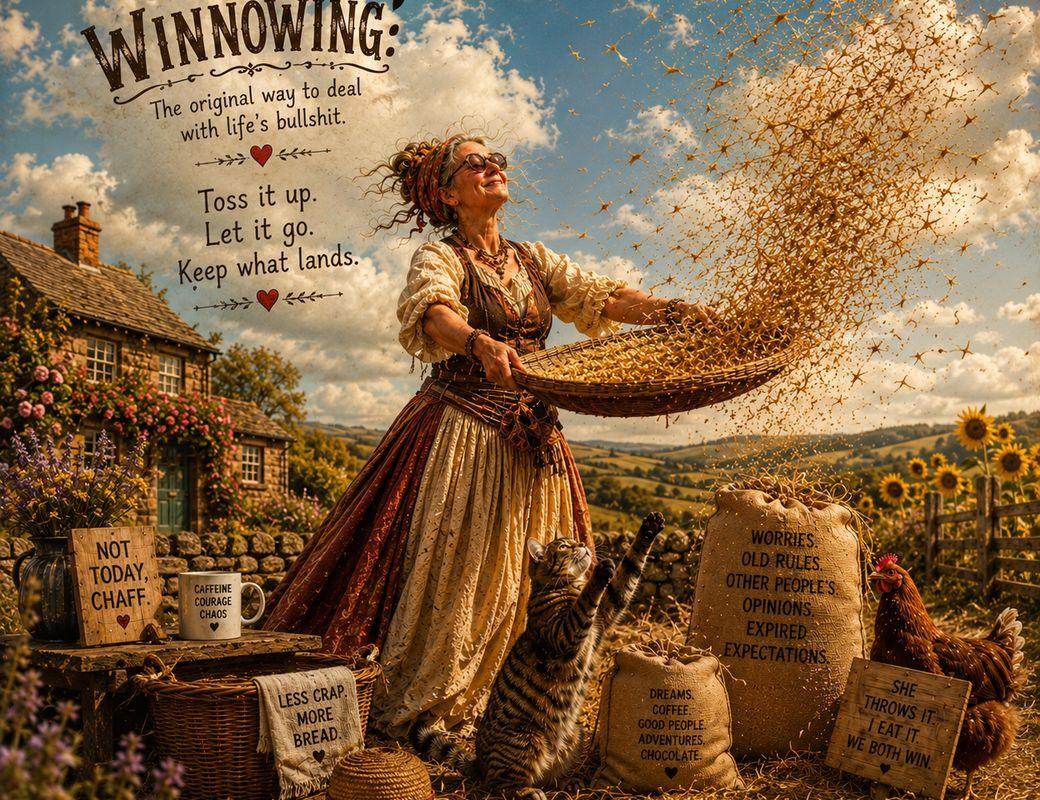
Somewhere a very long time ago, a woman stood outside with a basket of grain and a problem. The harvest had been brought in, the stalks had been cut, the grain had been threshed, and after all that work she was still left with a basket containing the part she wanted mixed together with a considerable amount of stuff she didn’t.
I imagine she stared at it for a minute, because this is what women have always done when presented with the final irritating step of a job that should already have been finished. Maybe she stuck her hand into the basket and tried picking through it. Maybe she muttered something about having other things to do. Maybe somebody nearby offered a helpful suggestion and narrowly escaped being hit with the basket.
Then the wind came through.
The lighter husks lifted while the grain stayed put. Eventually people figured out that if you tossed the whole mixture into the air, the wind would carry off the light chaff while the heavier grain fell back down. There were different tools and methods for doing it, but the principle was beautifully simple: throw it up and let the air separate what had substance from what merely happened to be mixed in with it.
They called it winnowing, and I think we may have abandoned the practice a little too soon.
Not the grain part. I’m perfectly happy buying flour in a bag and would like civilization to continue providing that service. It’s the sorting part I’m interested in, because I recently realized I own three vegetable peelers.
I do not need three vegetable peelers. There is one I actually use, one I don’t particularly like, and one that has apparently been granted permanent residency in the drawer because throwing away a functioning vegetable peeler feels wasteful. Never mind that I don’t use it. It works, therefore it stays. Apparently my kitchen drawers are now a retirement community for marginally useful utensils.
Once I noticed the peelers, I started noticing everything else. There are drinking glasses nobody reaches for, serving bowls waiting for an occasion important enough to justify their existence, clothes that survive every closet cleaning because there is technically nothing wrong with them, and a collection of electrical cords whose original devices may no longer exist anywhere on Earth.
And then there is the junk drawer. Every house has one because every civilization eventually needs a place for batteries of questionable strength, loose screws, tiny instruction manuals and keys to unknown kingdoms.
There is a key in mine that I have moved from one house to another.
I have no idea what it opens.
This should make it useless. Instead, it has somehow made the key more powerful. I can’t throw it away now because what if I suddenly discover what it belongs to? Apparently somewhere there is a lock patiently waiting for me to reunite it with a key I have protected for half my adult life.
Standing there looking at that drawer, I thought about the woman with the grain.
She didn’t sit down and establish the emotional history of each husk. She didn’t keep some because they’d been together since spring. She didn’t create a special basket marked THINGS I MAY NEED LATER.
She tossed everything into the air.
And here’s the part I hadn’t really thought about before: winnowing wasn’t primarily about throwing things away. It was about discovering what was worth keeping.
The grain came back.
Life has a funny way of filling our baskets without asking permission. We start with a few things we actually chose, and then all kinds of other things get mixed in. Habits arrive. Responsibilities arrive. Other people’s ideas arrive. Somebody tells us the proper way something should be done, and twenty years later we’re still doing it that way despite having absolutely no recollection of who appointed that person Supreme Authority of Properly Folded Towels.
We accumulate rules almost as easily as kitchen utensils. Use the good dishes only when company comes. Keep that because you might need it. Don’t waste money. Finish what you start. Be sensible. Have a backup plan. Then apparently have a backup plan for the backup plan, because adulthood mostly consists of preparing for catastrophes that never occur while being completely surprised by the ones that do.
The problem is that most of those things aren’t necessarily bad. Chaff wasn’t bad either. It was part of the plant. It served a purpose. It simply wasn’t going into the bread.
Maybe that’s where the old practice becomes useful again.
There are things in our lives we’d choose again without hesitation. People, ideas, ridiculous plans, favorite objects, odd little traditions and dreams that keep landing back in the basket no matter how many times life tosses everything around.
Then there are things we’ve been carrying mostly because they happened to grow beside us.
That’s different.
I don’t think this requires a dramatic life purge where we rent a dumpster and announce we’re entering a new season. We’ve all seen how that goes. Three weeks later you’re standing in Target buying attractive baskets to organize the new things you purchased after getting rid of the old things.
Maybe winnowing is quieter than that. Maybe every once in a while we simply hold something up and ask whether it still has any weight for us.
Because I think we already know more of those answers than we realize. We know which people make time disappear when we’re talking. We know which ideas keep returning after we’ve dismissed them as impractical. We know the things we haven’t done in years that still make us think, every single time we see somebody else doing them, I loved that.
Those are the grain.
And perhaps that’s the wisdom hiding inside these old ordinary practices. The women doing them weren’t trying to create metaphors for people thousands of years in the future. They were trying to get dinner on the table before dark. But when your life was tied closely to seasons, weather, food and the physical work of keeping everyone alive, you probably noticed certain things we’ve gotten very good at overlooking.
Not everything is meant to remain, and the things worth keeping usually have some weight.
So I went back to the kitchen drawer and threw away two vegetable peelers.
I kept the good one.
I also found four dried-up pens, seventeen cents, a tiny screwdriver and that mystery key.
The key is still there.
I’m new at this.
The women in the fields had years of practice, and apparently the wind and I still have some work to do. But I like the idea that somewhere between harvest and bread there was once this ordinary moment when everything was tossed into the air and allowed to sort itself out.
Maybe we don’t need to reinvent our lives every time something starts feeling cluttered. Maybe we just need to remember an old trick.
Every now and then, take what you’ve gathered, loosen your grip a little and give it some air.
Whatever has real weight has a funny way of finding its way back to you.
Responses (3)

More from the Magazine
21 DE OCTUBRE
LA VELA DE MIEL, UN RITUAL PARA ABRIR LAS PUERTAS A LA ABUNDANCIA

Stop Healing and Start Living
What if your biggest obstacle to moving forward wasn’t your past, but the need to keep going back to it?

EL APOCALIPSIS HA LLEGADO… Y MUY POCOS SE HAN DADO CUENTA
No habrá necesariamente trompetas en el cielo ni señales de fuego en el horizonte.