Background Chatter
Be careful who you let become a main character in your story.
Article · 4 min read · ·
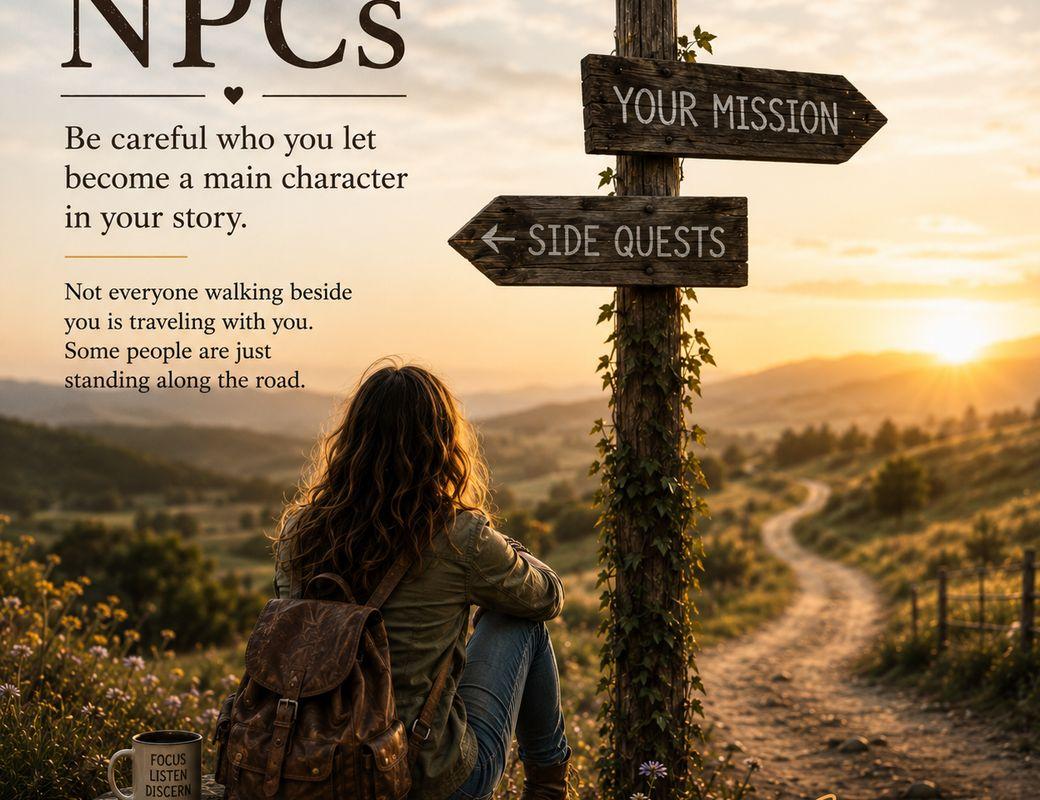
I’ve known the term NPC for years. I think the first time it really registered was watching one of the Jumanji movies. If you’ve seen it, you know exactly what I’m talking about. NPC stands for Non-Player Character. They’re the people wandering around in the background. They stand behind counters, sweep the same porch, walk the same streets, and repeat the same handful of lines every time the player walks past. Every once in a while one of them points the player toward a side quest, and then they go right back to whatever they were doing before. They make the world feel alive, but they aren’t actually playing the game. They’re part of the scenery while someone else is carrying the mission.
The more I thought about it, the more I realized life isn’t much different.
Every day we’re surrounded by people who drift in and out of our lives. Some we know well, some we barely know at all, and some we only encounter because social media has convinced us that everyone deserves a front-row seat to everyone else’s business. None of these people are necessarily bad. Most aren’t trying to sabotage us. They’re simply living their own lives. They have opinions, they share observations, they tell us what they would do if they were in our shoes, even though they aren’t. Then they move on with their day while we’re left carrying around something they probably forgot five minutes after they said it.
That’s what finally clicked for me about NPCs. It’s not that they’re unimportant people. It’s that they’re not carrying the weight of your story. They don’t wake up worrying about your mortgage, your marriage, your health, your children, your business, or the dream that’s been sitting quietly in your heart for years. They aren’t lying awake at two in the morning trying to decide whether to take the leap or play it safe. Yet somehow those are often the very people we allow to redirect our thinking.
It’s remarkable how quickly that happens. You can wake up knowing exactly what you need to accomplish that day. You’ve finally decided it’s time to start the business, have the hard conversation, write the first chapter, apply for the job, or finally trust that still, quiet nudge you’ve been feeling for months. Then someone casually says, “I don’t know if I’d do that,” or “That seems risky,” or “Have you thought about…” Before you know it, you’re halfway down a trail you never intended to walk. The rest of your day is spent researching problems you didn’t have yesterday, defending decisions nobody asked you to defend, or trying to gain the approval of people who will never have to live with the outcome anyway.
Looking back over my own life, I don’t think the biggest detours came from disasters. They came from distractions. Rarely did I wake up and intentionally abandon what mattered most. More often, I simply got pulled away one conversation, one opinion, one unnecessary concern at a time. It’s amazing how easy it is to confuse activity with progress. We can spend an entire day feeling busy while accomplishing absolutely nothing that actually moves our life forward.
I think that’s why attention has become one of the greatest forms of stewardship. We usually think about stewardship in terms of money or possessions, but attention may be even more valuable because once a day is gone, we don’t get it back. Every minute spent trying to convince someone else to believe in our dream is a minute we’re not actually building it. Every ounce of emotional energy spent managing someone else’s opinion is energy that’s no longer available for the work we’ve actually been called to do.
That doesn’t mean we stop listening to wise counsel. Far from it. Some voices absolutely deserve to be heard. The people who have earned your trust, who have walked with you through success and failure, who genuinely care about your well-being, and who aren’t afraid to tell you the truth even when it’s uncomfortable… those voices are priceless. The mistake is treating every opinion as though it belongs in the same category. It doesn’t.
One of the healthiest things we can learn to do is quietly ask ourselves a simple question whenever someone offers advice or criticism: Does this person actually have skin in the game? Will they still be here if this falls apart? Are they helping carry the weight, or are they simply commenting from the sidewalk? There’s a profound difference between someone sharing your burden and someone narrating it.
Maybe that’s the real lesson hidden inside this funny little gaming term. NPCs aren’t the problem. They’ll always exist. People will always have opinions, predictions, warnings, and advice. The challenge isn’t getting rid of the background characters. The challenge is remembering they’re background characters.
At the end of the day, this is your life. God entrusted it to you, not to the crowd gathered along the roadside. Listen carefully to the voices that have earned a place in your life, but don’t confuse noise with direction. Otherwise you’ll spend years completing side quests for people who were never players in your story while quietly neglecting the mission that was yours all along.