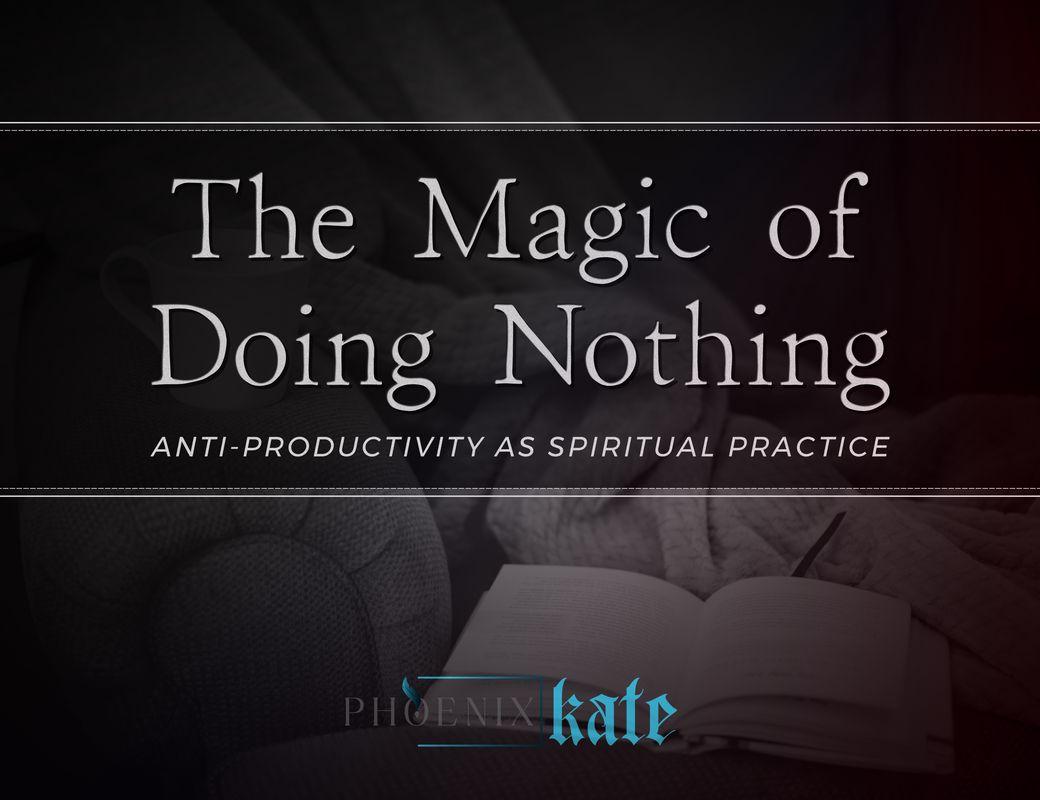
The Magic of Doing Nothing
Anti-Productivity as Spiritual Practice
Article · 7 min read · ·
I spent twenty years believing that rest was something I had to earn.
That productivity was the price of existence. That my value was directly proportional to my output, my usefulness, my constant forward motion.
Then my body made the decision for me. It said: sit down. Be still. Or I will make you.
And in that forced stillness, I discovered something the productivity cult doesn’t want you to know.
Doing nothing is magic.
The Lie We’ve All Swallowed
Somewhere along the way, we accepted a story that rest is laziness. That downtime is wasted time. That if you’re not producing, achieving, or improving yourself, you’re falling behind.
This story is everywhere. In your social media feed where everyone’s always grinding. In the selfhelp books that promise you can optimize every moment. In the spiritual spaces that turned meditation into another thing to achieve and mindfulness into another box to check.
We’ve taken something as fundamental as rest, as necessary as breathing, and turned it into a luxury. A reward. Something you get after you’ve done enough.
But here’s the truth: you don’t have to earn the right to exist without performing.
You already have it. You were born with it. It’s not conditional on your productivity, your usefulness, or your accomplishments.
What Happens in the Stillness
When you actually stop—really stop, not just scroll your phone on the couch while mentally cataloging tomorrow’s to-do list—something shifts.
At first, it’s uncomfortable. Your nervous system doesn’t know what to do with the lack of stimulation. Your mind races. You feel guilty, restless, like you should be doing something.
This discomfort is where most people turn back. They fill the space with another podcast, another scroll, another task. Anything to avoid the feeling of just… being.
But if you stay with it, if you let yourself be genuinely idle, the magic starts. Your nervous system begins to regulate. The constant hum of anxiety quiets. You notice things: the of light through the window, the sound of rain, the way your body feels when it’s not being pushed to perform. Ideas surface. Not the forced, straining-for-content ideas, but the ones that bubble up from somewhere deeper. The kind that feel true rather than clever. You remember what you actually like, separate from what you’re supposed to like or what’s productive to like.
You find yourself again.
The Productivity Trap
The productivity culture wants you on the hamster wheel. It profits from your belief that you’re never doing enough, that there’s always another level to reach, another optimization to implement, another way you’re falling short. It sells you planners and courses and systems, all promising that if you just organize your time better, work smarter, optimize harder, you’ll finally feel okay about resting.
But it’s a trap. Because there’s always more. The finish line keeps moving. The goalpost shifts. You’re never quite productive enough to deserve true rest.
I know this intimately. I’ve built businesses. I’ve created systems. I’ve optimized and strategized and pushed myself to produce more, better, faster. And you know what finally taught me about rest?
Burnout. Complete, system-crash, can’t-function-anymore burnout. The kind that makes you realize the productivity culture will gladly run you into the ground and then blame you for not having better boundaries.
Rest as Resistance
Doing nothing in a culture that demands constant productivity is a radical act. It’s refusal. It’s saying: I am not a machine. My worth is not measured in output. My existence doesn’t require justification.
When you rest without guilt, you’re breaking a chain. You’re stepping out of a system designed to extract everything from you and leave you feeling like it still wasn’t enough.
This isn’t about being lazy. It’s about reclaiming your humanity. It’s about understanding that fallow fields grow more abundant crops. That winter is necessary for spring. That the exhale is just as important as the inhale.
Your body already knows this. It’s your mind, trained by capitalism, conditioned by hustle culture, that forgot.
What Doing Nothing Actually Looks Like
Real rest isn’t passive. It’s intentional.
It’s sitting in your favorite chair without your phone, just watching the light change.
It’s lying on the floor and letting your thoughts wander where they want to go.
It’s saying no to plans because you’d rather do nothing, and not feeling guilty about it.
It’s a Sunday afternoon with no agenda, no improvement project, no should-be-doing.
It’s the space between activities where you’re not rushing to fill the gap.
It’s boring. It’s simple. It’s often uncomfortable at first. And it’s absolutely essential.
The Permission You’re Waiting For
If you’re reading this and thinking “I can’t afford to do nothing,” I want you to consider: can you afford not to?
What is this constant motion costing you? Your health? Your relationships? Your creativity? Your joy?
What would happen if you gave yourself permission to stop performing? To exist without justifying your existence through productivity? You don’t need to wait until you’re burned out. You don’t need to earn rest through suffering. You don’t need permission from anyone.
But if you’re the kind of person who needs to hear it from someone else: you have permission.
Take the afternoon off. Cancel the plans. Sit in the sun and do absolutely nothing useful. Let the dishes wait. Let the emails sit. Let the world spin without your input for a few hours.
The Magic Return
Here’s what I’ve learned in my seasons of forced and chosen stillness:
-
The magic doesn’t happen in the doing. It happens in the space between the doing.
-
The insights come when you stop searching for them. The creativity flows when you stop forcing it. The solutions appear when you stop grinding for them.
-
Your nervous system repairs itself in rest, not in motion. Your soul speaks in whispers, not in the noise of constant activity.
The best ideas, the deepest connections, the most authentic versions of yourself, they all emerge from stillness. Not from another productivity hack. Not from another optimization. Not from doing more.
From doing nothing.
Begin Here
You don’t have to overhaul your entire life. You don’t need a meditation practice or a ritual or a perfect setup.
You just need to stop. For five minutes. For an hour. For an entire Sunday.
Sit. Be still. Do nothing.
Let it be uncomfortable. Let the guilt arise and then let it pass. Notice what happens when you’re not performing, not producing, not proving your worth. Notice the magic that lives in the spaces you’ve been too busy to see.
Because doing nothing isn’t empty. It’s full of the life you’ve been too busy living to actually experience.
A Ritual for Reclaiming Rest
This isn’t a productivity ritual. There’s no goal, no outcome to achieve, no way to do it wrong.
What you need:
-
Yourself
-
A comfortable place to sit or lie down
-
15-30 minutes of uninterrupted time
What you do:
Find your spot. It can be your bed, your couch, a chair by the window, the floor. Wherever your body feels held.
Set a gentle timer if you need the boundary of knowing when it ends. (No judgment, sometimes we need permission to stop monitoring time.)
Close your eyes or soften your gaze.
Take three deep breaths. Not performative, Instagram-worthy breaths. Just air moving in and out of your body.
Then stop trying. Stop trying to meditate correctly. Stop trying to clear your mind. Stop trying to relax. Stop trying to feel peaceful.
Just be there. In your body. In this moment. Doing nothing.
When thoughts come, and they will, let them. You’re not trying to achieve mental silence. You’re just resting. When you feel restless, and you might, notice it. You don’t have to fix it. Just let your body be restless if that’s what it needs.
If you fall asleep, you fall asleep. If you don’t, you don’t. There’s no outcome here. No accomplishment. No way to succeed or fail. You’re simply practicing the revolutionary act of existing without performing.
After:
When your timer goes off (or when you’re ready to move), don’t rush back into motion. Take a moment to notice: How does your body feel? What shifted, even slightly?
You don’t need to journal about it or make it meaningful. Sometimes rest is just rest. But if you want to anchor this practice, you might whisper to yourself: “I am enough, exactly as I am, doing nothing.”
How often:
As often as you need it. Daily, if you can. Weekly, if that’s what’s possible. This isn’t another thing on your to-do list. It’s the absence of doing, which makes it the opposite of a task. The magic isn’t in doing the ritual perfectly. The magic is in giving yourself permission to stop.
Rest isn’t something you earn. It’s something you’re allowed to claim, right now, exactly as you are.
Responses (6)


More from the Magazine
The ADHD Witch's Guide to Practicing Magic When You Forget Everything
Build a practice around your actual brain, not the imaginary organized person you keep trying to be

The Trigger of Embarrassment
Let's tap into the Ego and how we can release the control it desires.
Protection Magic Is More Than a Jar of Salt
The folklore of warding, the psychology of safety, and the boundaries that matter in real life