The Family We Choose
What your longing for found family reveals about the belonging you've been waiting to receive
Article · 8 min read · ·
I need to tell you about the first time I realized I was starving for something I had never been given.
I was reading a book—the kind where a group of broken, unlikely people find each other against all odds. A thief, a runaway, a disgraced soldier, an orphan. None of them belonged anywhere. None of them had been chosen by the families they were born into.
And then, slowly, impossibly, they started choosing each other.
They bickered. They betrayed. They forgave. They stayed. Not because they had to—because they wanted to. Not because blood demanded it—because love insisted.
I closed the book and sat in the dark, and I felt something I couldn't name. Not envy. Not longing. Something rawer.
Grief.
Grief for the family I never had. Grief for the version of me that had been waiting, for decades, for someone to pull out a chair and say, "Sit down. You belong here."
I had spent my whole life performing independence. Telling myself I didn't need anyone. That I was fine on my own. That family was just a word, and I had outgrown the need for it.
But the books knew. The trope knew. Every time I stayed up too late reading about a ragtag group of misfits who became each other's home, my chest ached with a hunger I refused to name.
I wasn't reading for the plot. I was reading for the permission to need.
The Traditional Blueprint: The Architecture of Chosen Kinship
The found family trope has become one of the most beloved structures in modern fiction, particularly within fantasy, romance, and young adult genres. It's not simply a group of friends—it's a deliberate, intentional construction of kinship where none existed before.
What makes found family so powerful is the choice at its core. Unlike biological family, which is assigned, found family is earned. It's built through shared struggle, mutual vulnerability, and the slow, sacred work of showing up for each other. As Australian Psychological Society chief executive Dr. Zena Burgess notes, for some people, relationships with friends may bring more fulfillment and meet their emotional needs more than biological family relationships do.
The found family trope is not about replacing one family with another. It's about reclaiming the definition of belonging. It's about recognizing that kinship is not determined by DNA, but by who sees you, who stays, who chooses you back.
What This Trope Does to the Reader
Found family narratives are intensely personal to each reader, and the psychology behind their appeal is profound. They speak directly to the part of us that has felt adrift, unseen, or rejected by the families we were born into.
Researchers who study found family in fan culture have observed that the trope is so prevalent precisely because readers identify with the characters in these family groups and long for something similar in their own lives. It's a form of vicarious belonging—a way to experience, through fiction, the safety and acceptance that may have been absent in reality.
This trope resonates with our deepest human need: the need for secure attachment. Attachment theory, which emerged from the work of John Bowlby and Mary Ainsworth, suggests that our earliest relationships shape our expectations of safety, trust, and connection throughout our lives. When those early relationships are inconsistent, neglectful, or absent, our nervous systems learn to anticipate abandonment. We become hyper-independent, or anxiously clingy, or shut down entirely.
Found family stories offer a corrective experience. They show us what it looks like when people with wounded attachment patterns learn, slowly and imperfectly, to trust again. They model the possibility of repair—not through dramatic declarations, but through the quiet accumulation of small, consistent choices.
The Shadow Reflection: The Orphan Who Learned Not to Need
When the found family trope becomes a shadow mirror, it often reveals one of two hidden dynamics within us.
The Hyper-Independent One.
This part of you learned, early on, that needing was dangerous. Maybe your caregivers were inconsistent—present one moment, gone the next. Maybe you learned that asking for help meant disappointment, that vulnerability invited betrayal. So you built a fortress around your heart. You told yourself you didn't need anyone. You became the one who takes care of everyone else, never allowing yourself to be taken care of in return.
The Hyper-Independent One is not cold. It is terrified. It has equated need with weakness, and weakness with annihilation. It keeps you safe by keeping you alone. But the cost of that safety is the very belonging you crave.
The Starving One.
This part of you is ravenous for connection, but has learned to hide it behind a mask of competence and cheerfulness. It performs independence while secretly, desperately, hoping someone will see through the performance and stay anyway.
The Starving One has been waiting for a found family its whole life. It collects friendships, joins communities, seeks belonging in every room it enters—and often leaves feeling just as empty as before. Not because the connections weren't real. Because the Starving One doesn't know how to receive. It has spent so long performing worthiness that it has forgotten how to simply be worthy.
Both of these parts are not broken. They are exhausted. They learned strategies that once kept you safe—but those strategies are now keeping you separate. And the found family trope, in its most healing form, offers a blueprint for what integration could look like: not the eradication of these protective parts, but the slow, courageous act of letting them relax their grip.
The Sanctuary Question
"What if the found family I've been longing for in fiction is actually pointing at the parts of myself I've been too afraid to let anyone see—and what if I started by offering that belonging to myself?"
Not "what's wrong with me." Just: What would it feel like to stop performing independence and start practicing receiving?
The Integration Prompt: The Empty Chair Ritual
Your task is not to manifest a found family overnight. It is to practice holding space for the possibility of belonging—starting with yourself.
1. Name the Wound.
Be honest. Where did you learn that needing was dangerous? Not to assign blame—to understand. This wound is not your fault. It is your origin story. And origin stories can be rewritten.
2. The Empty Chair.
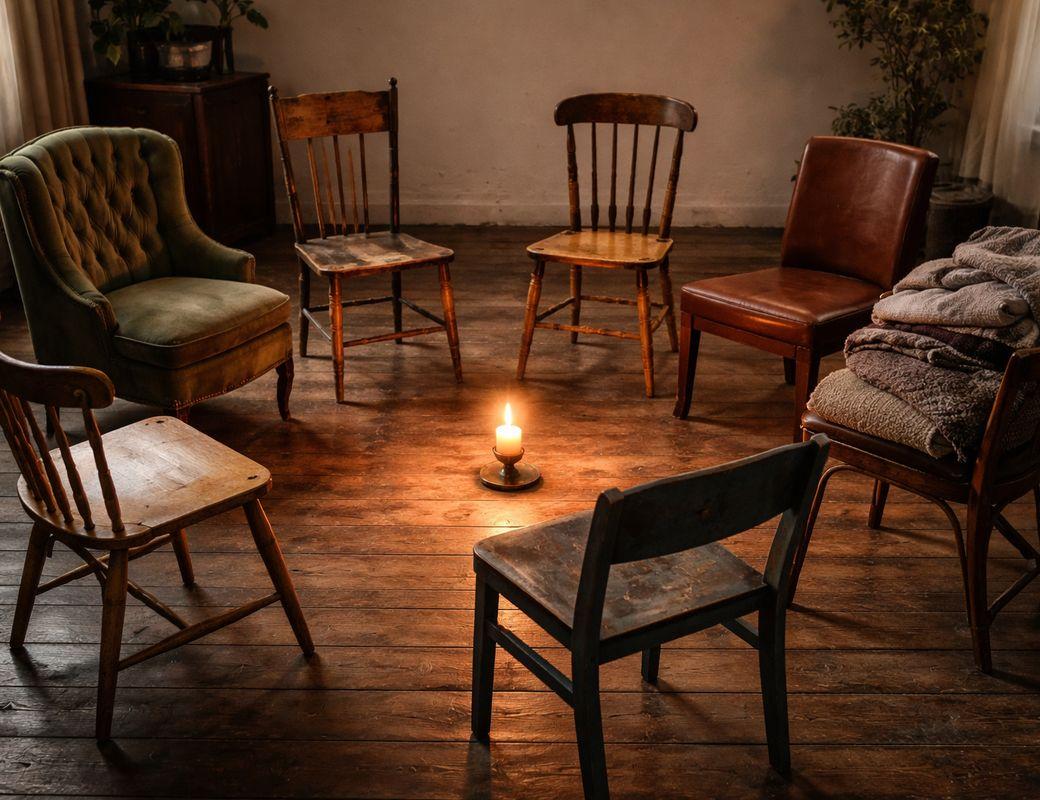
In your journal, draw a simple circle. In the center, write your name. Around it, draw empty chairs—as many as you need. For the people who should have been there and weren't. For the versions of yourself that were left waiting.
3. Ask the Question.
Look at the empty chairs. Ask softly: "What would I need to receive, from myself or from others, to finally feel like I belong?"
4. One Small Receiving.
Today, practice receiving one small thing. Not earning it. Not performing worthiness in exchange for it. Just… receiving.
-
If a friend offers help, say yes without explaining why you deserve it.
-
If someone compliments you, breathe and say "thank you" without deflecting.
-
If you feel lonely, sit with the feeling instead of scrambling to fill it. Let it be a visitor, not an emergency.
This is not about fixing the wound. It is about softening the armor. And softened armor, over time, becomes a door.
What I Know Now
I still read found family stories. I still cry when the broken characters finally let themselves be held. But I don't read them the same way anymore.
I read them as blueprints. Not for how to find a family—but for how to become the kind of person who can receive one when it arrives.
The found family trope taught me something my biological family never could: that belonging is not something you earn. It is something you allow. It is the slow, terrifying, miraculous act of letting down the walls you built to survive—and trusting that what's on the other side won't destroy you.
I haven't found my full found family yet. Not completely. But I have stopped running from the hunger. I have started practicing receiving. And I have learned, through the stories, that the first chair at the table belongs to the person who was always meant to sit in it.
Me.
This is what the Inhabitation is for. Not to teach you how to find people. To teach you how to become the kind of sanctuary that others feel safe entering—and to practice, every day, sitting in your own chair at the table of your own life.
And on my YouTube channel, I post free soundscapes designed for the lonely ones, the hyper-independent ones, the ones who have been performing strength for so long they forgot they were allowed to rest. Not to fix you. To hold space while you learn to let yourself be held.
No pressure. Just a practice. Just a door.
For the ones who have been waiting for someone to pull out a chair. For the hyper-independent ones who forgot they were allowed to need. For everyone who has ever closed a book and thought, "I want a family like that."
The first chair belongs to you. You don't have to earn it. You just have to sit down.
With you in the sacred belonging,
Star
Responses (4)

More from the Magazine

Protection Magic Is More Than a Jar of Salt
The folklore of warding, the psychology of safety, and the boundaries that matter in real life

Paws, Hooves, Fins & Furry Energy 🐙💕
How Animals Protect Your Aura & Heal Your Soul.

The Difference Between Incense and Smudge
Understand the distinction between everyday aromatic incense and culturally specific smoke-cleansing