The Daydreams That Dream Us Back
How immersive fantasy becomes a blueprint for healing
Article · 7 min read · ·
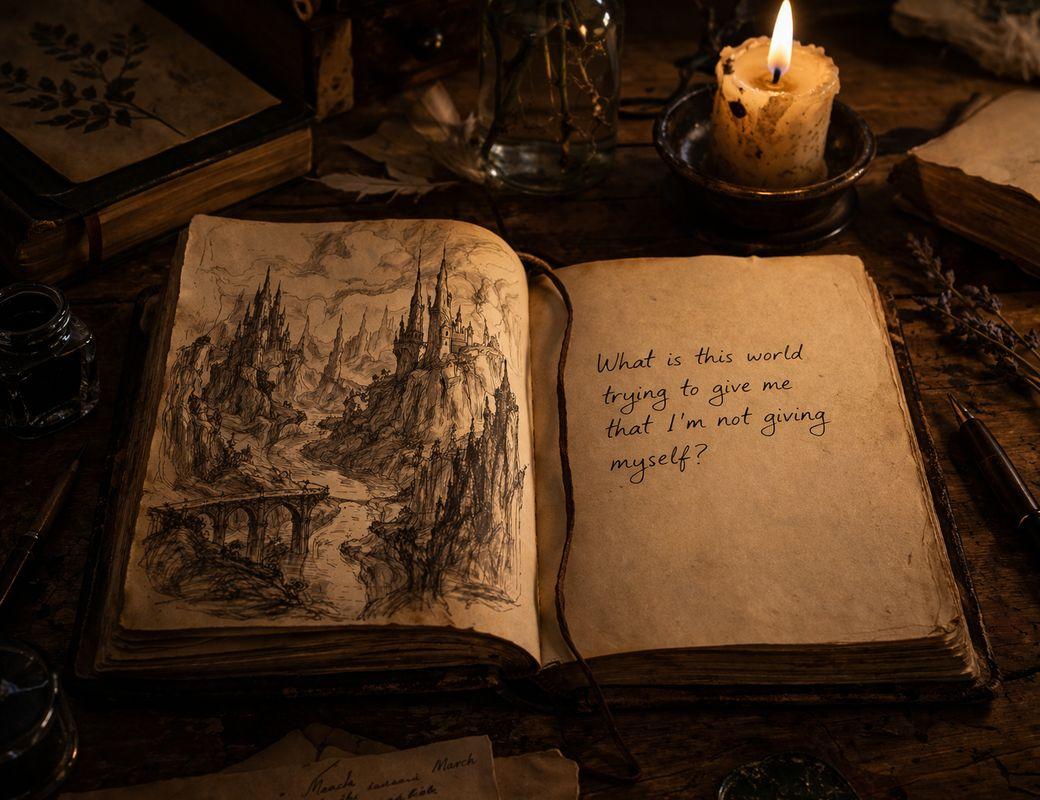
I want to tell you about the moment I stopped treating my daydreams like a guilty secret and started treating them like a sacred text.
It was late. I was lying on my couch, exhausted from the performance of being fine. My mind drifted—as it always did—into a familiar scene. A character I had been building for years was receiving something I had never received in real life. Unconditional welcome. Someone who saw her fully and didn't flinch.
I had played this scene hundreds of times. Maybe thousands. I knew every beat, every line of dialogue, every small gesture of tenderness.
But this time, I didn't just sink into it. I paused. And I asked myself a question I had never dared to ask:
"What is this scene giving me that I'm not giving myself?"
The answer came quietly. Not in words. In a memory. I was nine years old, sitting alone in a foster bedroom, waiting for someone to notice I was scared. No one came. So I learned to comfort myself. To build worlds where someone always came.
My daydreams were not the problem. They were the record of my own unmet needs, written in the language of imagination.
And once I understood that, everything shifted.
The Archive You've Been Ignoring
Most of us have a rich archive of daydreams we never think to examine.
The scenes we replay before sleep. The conversations we rehearse in the shower. The elaborate fantasies we slip into during long commutes or tedious tasks. We treat them as background noise—embarrassing, maybe, but harmless.
But here is what I learned when I finally stopped judging mine long enough to study them.
Your daydreams are not random. They are precise.
The same scene, replayed hundreds of times, is not a glitch. It is a signal. Your subconscious is trying to tell you something specific about what you need, what you fear, what you long for.
-
The fantasy where you're finally recognized for your work? It's pointing at a hunger for validation you may have been too ashamed to admit.
-
The daydream where someone fights for you, defends you, refuses to give up on you? It's mapping a wound around feeling unprotected or abandoned.
-
The elaborate world where you're powerful, capable, in control? It's sketching a blueprint for agency you may not feel in your actual life.
Your inner cinema is not an escape from your problems. It is an archive of them. And archives, once studied, become maps.
What the Repetition Is Trying to Teach You
I had one scene I replayed for years. A character was hurt—not dramatically, just tired, worn down, on the verge of giving up. And another character noticed. Not with grand gestures. Just by sitting beside her. By staying.
I played this scene so often I could have written the script from memory.
And one day, I finally asked myself: "Why this scene? Why this specific comfort?"
The answer surfaced slowly, reluctantly. Because I had never experienced anyone just… staying. Noticing. Not needing me to perform wellness before offering presence.
My daydream was not a fantasy. It was a memory of a need that had never been met. And my subconscious, loyal and relentless, was replaying it over and over, hoping that this time, the scene would become real.
This is not maladaptive. This is the psyche, trying to heal itself.
The repetition is not a glitch. It is a practice. Your mind is rehearsing the experience it needs, over and over, because it hasn't yet learned how to receive it in real life.
The task is not to stop rehearsing. The task is to study the rehearsal. To ask: "What is this scene trying to give me? And how can I start giving it to myself?"
The Shadow Reflection: When We Fear Our Own Blueprints
Even after I understood this, there was a part of me that resisted.
The Anti-Fantasy Part.
This part believes that anything not "real" is a waste of time. It measures healing in practical outcomes—boundaries set, conversations had, goals achieved. It doesn't understand that the inner work is also real. That the blueprint is as important as the building.
The Shame-Keeper, Again.
This part still whispers that daydreaming is childish. That if you were really healed, you wouldn't need those stories anymore. It confuses the presence of a coping mechanism with the absence of growth.
Both of these parts are not wrong that real life matters. They just don't know that the daydream is not separate from real life. It is the soil. The compost. The raw material from which real change grows.
The Sanctuary Question
"What emotional need is my favorite daydream actually meeting?"
Not "what's wrong with me." Just: What is this scene trying to give me? Safety? Recognition? Agency? Rest? Connection? And how can I start offering that to myself, in small ways, in my actual life?
The Integration Prompt: The Dream Audit
Your task is not to stop daydreaming. It is to study one recurring scene like an archaeologist studying a ruin.
1. Choose One Recurring Scene. Not the one you think you should analyze. The one that lives in your chest. The one you return to, again and again, even when you're trying to focus on something else.
2. Replay It, Slowly. Don't judge. Don't edit. Just watch. Notice the details. The setting. The dialogue. The emotional temperature.
3. Ask Four Questions.
-
"What is the character in this scene receiving that I'm not receiving in real life?"
-
"What is the character feeling that I'm afraid to feel?"
-
"If this scene is a blueprint, what is it trying to build?"
-
"What is one small way I could honor that need today, without waiting for someone else to fill it?"
4. Write Without Censoring. One sentence. Three sentences. A paragraph. Whatever comes. Don't edit. Don't judge. Just let the scene speak.
5. The Small Honor. Take one tiny action today that honors the need your daydream revealed. Not the whole solution. Just a nod.
-
If the scene is about being seen: send one honest text. Not performative. Just real.
-
If the scene is about safety: take three slow breaths. Feel your feet on the floor.
-
If the scene is about rest: give yourself ten minutes of deliberate, guilt-free nothing.
-
If the scene is about agency: make one small decision from your own authority, without checking with anyone else.
This is not about fixing everything. It is about listening. Your daydreams have been trying to tell you something for years. It's time to let them speak.
What I Know Now
I still daydream. I still slip into familiar scenes, especially when I'm tired or overwhelmed. But I don't shame myself for it anymore.
I listen. I ask questions. I let my inner cinema tell me what my conscious mind has been too busy to hear.
And slowly, over time, the gap between my daydreams and my real life has begun to close. Not because I abandoned my imagination. Because I learned to translate it. To take the emotional blueprint of the scene and build something small, real, and mine from it.
The sanctuary I live in now was first drafted in a daydream. On a park bench. In the back of my car. In the small hours when I had nothing else.
My daydreams were not my escape. They were my first architectural firm. And they are still drafting, every night, for the life I am still learning to inhabit.
This is what the Rendering is for. Not to teach you how to manifest. To teach you how to take the vivid, emotional, immersive power of your daydreams and point it toward your actual life. To help you distinguish between the fictional container and the real need. To give you the tools to build, not just imagine.
And on my YouTube channel, I post free soundscapes designed specifically for dreamers like us. For the ones who need a gentle anchor while they drift. Not to pull you back to reality. To help you carry the best of your inner world into it.
No pressure. Just a practice. Just a door.
For the scene-replayers and the world-builders. For everyone who has been told their imagination is a distraction. For the ones who are ready to stop judging their inner cinema and start studying it.
Your daydreams are not the problem. They are the archive. And archives, once opened, become maps.
With you in the sacred excavation,
Star
Responses
No responses yet — start the conversation.
More from the Magazine

The Trigger of Embarrassment
Let's tap into the Ego and how we can release the control it desires.
Protection Magic Is More Than a Jar of Salt
The folklore of warding, the psychology of safety, and the boundaries that matter in real life

Paws, Hooves, Fins & Furry Energy 🐙💕
How Animals Protect Your Aura & Heal Your Soul.