Talking to Grackles: A Case for Ordinary Magic
A gas station, a bossy bird, and the practice of just looking up
Article · 16 min read · ·
A gentle note before you read: this piece touches on grief and the pull to make meaning out of hard seasons. If any of it stirs something heavy, please be gentle with yourself, and reach out to a therapist or counselor if that would help.
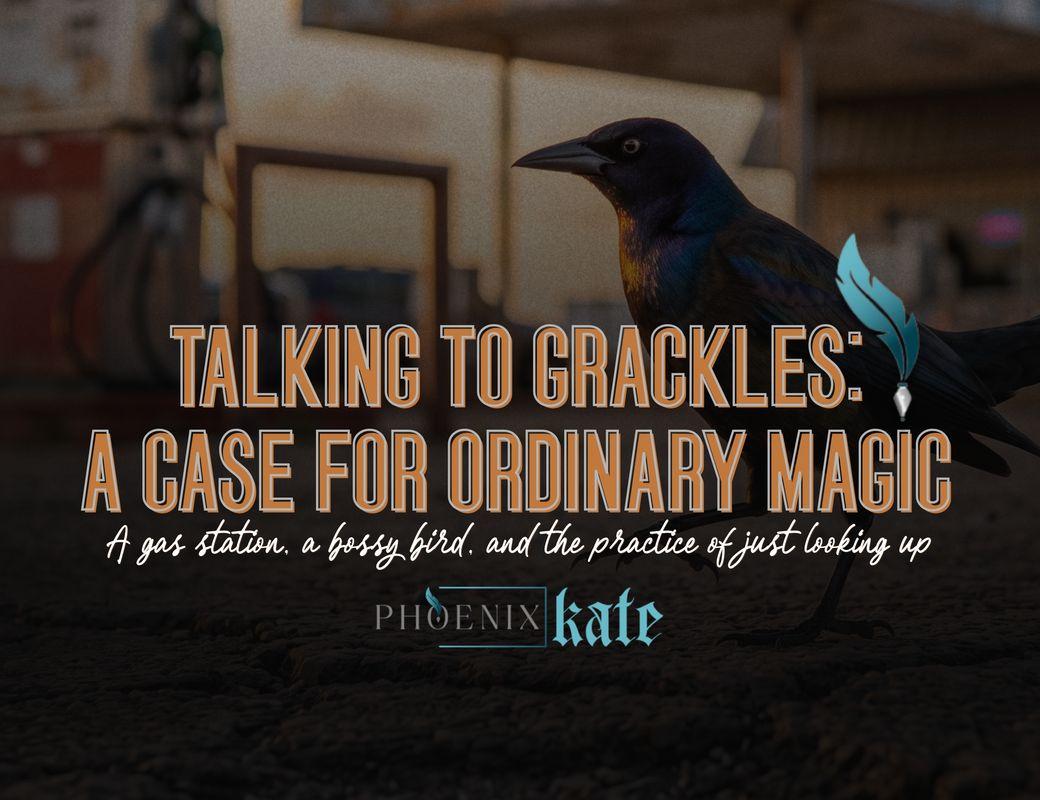
Yesterday, I found myself having a conversation with a grackle at a gas station. This isn't an unusual occurrence for me. I had stopped for fuel and there they were, working the parking lot in that very grackle way of theirs, strutting around like they had somewhere important to be while also looking like they might have stolen something five minutes earlier. I had some food with me, and because I was already watching them, I started noticing the usual social negotiations happening between them.
There was a bigger, louder grackle who seemed determined to run everybody else off. Every time another bird got close, it chased them off. It strutted, called, flapped, and generally behaved like it had been elected mayor of the gas station and was taking the responsibilities of office very seriously.
So I told it to knock it off.
I talk to birds. I talk to squirrels. I talk to horses. I have conversations with animals knowing perfectly well that most of them aren't going to answer me in a language I understand although, honestly, I sometimes wonder if they answer anyway.
That little exchange with the grackle wasn't some profound spiritual experience. There was no sudden sign from the universe. No feather appeared at my feet with a perfectly tailored message about my destiny. I was just standing beside a gas pump talking to a bird because I was paying enough attention to notice that it was being difficult and somehow, that is exactly the kind of thing I mean when I talk about ordinary magic. It’s not the kind that shows up on an altar, but the kind that shows up in a parking lot, uninvited, while you're just trying to get gas.
Watching birds has a funny way of pulling you out of your own head without requiring anything particularly mystical. You don't have to know the right correspondences or identify every species or understand bird symbolism. You don't need binoculars that cost more than your car. You don't even have to be especially good at it.
You just have to look up.
The birds aren't waiting for us
One of the things I love most about birds is that they are almost aggressively uninterested in whatever story I have going on. They don't care whether I'm having a productive day. They don't care about my inbox, my deadlines, my unfinished laundry, or whatever nonsense I have been replaying in my head for the last three hours.
A cardinal can be singing from the tree outside my window while I'm having the worst day imaginable, and the cardinal is still going to be a cardinal. There is something wonderfully rude about that.
We tend to think of nature as something that exists for our benefit. We go outside to clear our heads. We look for signs. We seek healing, inspiration, answers, and reassurance. We ask what the crow means, what the hawk means, or what the owl means.
Sometimes I do this too. I'm a spiritual writer and I would be lying if I pretended otherwise, but the longer I spend around wildlife, the more suspicious I become of the idea that every encounter needs to be translated into a message for me.
Sometimes the bird is just doing bird things and that realization opens a much more interesting door, because once I stop demanding that the bird mean something, I can actually watch the bird.
I can see what it is doing. I can notice who is chasing whom. I can see which bird hangs back from the group. I can notice the way a mockingbird chooses a particular branch or the way a grackle walks across a parking lot like it has a mortgage to pay. I can watch a bird change its behavior when a hawk appears overhead.
The bird becomes more interesting when I stop turning it into a symbol.
You don't have to know what a bird means
This is probably one of the biggest gifts birds have given me. They have made me much more comfortable with simply not knowing.
Spiritual spaces can get very invested in interpretation. A bird appears, and immediately we want to know what it means. We look it up. We search for symbolism. We ask what message this particular species is bringing us.
There's nothing inherently wrong with that. Symbolism can be beautiful, and humans have always made meaning from the natural world, but there is a difference between finding meaning and demanding one.
A bird doesn't owe me a message simply because I happened to notice it. Sometimes I see a crow and think about intelligence, adaptability, memory, or the strange relationship humans have had with crows for thousands of years. Sometimes a hawk catches my eye and I feel that old little spark of recognition that comes with seeing a predator doing what predators do.
Sometimes I see a sparrow and think, “There you are, little friend.”
That is enough. In fact, I think there is something deeply spiritual about allowing an encounter to remain unresolved. We are so accustomed to turning everything into information that mystery can feel almost uncomfortable. We want the answer. We want the lesson. We want to know what the universe was trying to tell us.
Birds don't seem particularly interested in helping us solve that problem. They keep being birds, and if we let them, they teach us how to be people who can experience something without immediately turning it into homework.
Watch the bird before you look up its meaning
There is another layer to this that matters to me, especially because I spend a lot of time around wildlife. Before you decide what a bird means, learn something about the bird itself.
Watch it. Learn how it moves. Learn what habitat it prefers. Learn what it eats. Learn what time of day you tend to see it. Notice whether it is alone or part of a flock. Notice what happens when another species enters the space.
If you are curious about a particular bird, look it up. Learn its actual natural history. Find out where it lives and what pressures it faces. There is something wonderfully grounding about replacing a page of spiritual symbolism with a field guide.
You might discover that the mysterious bird that appeared during a difficult season of your life is a northern mockingbird that has been living in your neighborhood for years. That doesn't make the encounter less meaningful. If anything, it makes it more meaningful.
You're no longer looking at a convenient symbol floating through your personal mythology. You're looking at a living animal with its own history, instincts, habits, territory, and problems, and once you start learning those things, something else tends to happen.
You start recognizing individuals.
The day I realized I knew the birds
This is one of the strange little pleasures of spending enough time outside. Eventually, the birds stop being "birds."
You start having regulars. You notice that one particular bird always shows up in a certain place. You recognize a familiar call before you even see who made it. You know which tree the mockingbird favors. You know which crow tends to arrive first.
The grackles at the gas station became like this for me. I started noticing their personalities and their relationships with each other. There was the loud one. There were the birds who seemed more cautious. There were the ones who would hang back until the bigger bird moved on.
I was also trying to keep an eye on a grackle who appeared to be limping. I wanted to get a closer look at it without automatically turning the situation into a capture if I didn't need to. That meant watching first, figuring out its behavior, seeing how it moved and whether the limp was something I needed to intervene in.
That is something wildlife rehabilitation has taught me over and over again. Observation comes before action. It is very easy for humans to see an animal behaving differently and immediately decide we know what is happening. Sometimes intervention is absolutely necessary. Sometimes it isn't. Learning the difference requires watching, and watching requires us to slow down enough to admit that we might not know yet.
That's a harder practice than it sounds like. Most of us were trained to act fast on our fear, not to sit with it long enough to see what's actually happening. The grackle doesn't care about your training. It just needs you to look first.
That lesson applies far beyond birds.
You don't need to make it a whole thing
I think we have a tendency, especially in spiritual spaces, to turn every meaningful experience into an event. We light the candle. We make the altar. We write the journal entry. We identify the animal. We research its symbolism. We take the photograph. We make the post.
Again, none of those things are inherently bad, but sometimes I think we miss the experience while documenting it. A bird lands on a fence. You notice. It hops twice, turns its head, and flies away. You watch it go.
That's it. No ritual, lesson, or spiritual significance is required. You were simply there for something that was happening.
I have come to value those moments more than I used to. Maybe it’s because they are so easy to overlook, or maybe it’s because they ask so little of us. There is pleasure in standing outside and realizing you have been watching a bird for ten minutes without checking your phone.
You didn't accomplish anything, optimize your morning, or become your best self. You watched a bird, and for a little while, that was enough.
There is something wonderful about being unproductive
This might be one of the more rebellious things about birdwatching in a culture that wants everything to be useful. We are constantly encouraged to make our hobbies productive. Learn a skill. Build a side hustle. Create content. Track your progress. Improve yourself.
Birds are terrible at personal development, thank goodness. A bird doesn't care if you become a better version of yourself while watching it. It may, however, teach you how to sit still.
That sounds simple until you try it. Sit outside without your phone. Pick a spot where you can see a little bit of sky, a tree, a fence, a patch of weeds, or whatever happens to be around you. Don't decide ahead of time what you are hoping to see.
Just wait.
At first, you will probably notice everything except the birds, like a car, a dog barking, the neighbor, a bug, or your own thoughts.
Then something moves. You look. Maybe it’s a sparrow. Maybe it’s a grackle. Maybe it’s a bird you can't identify at all, but now you’re watching. The longer you stay, the more the landscape begins to fill in. There are birds you didn't notice before. There is a particular rhythm to the place. There are sounds layered over other sounds.
You begin to realize the world was busy the entire time; you were simply busy somewhere else.
Let wild things stay wild
This is where my wildlife-rehab background is going to insist on having a word. Watching wildlife doesn't mean getting close enough to touch it. It doesn't mean feeding it because you want a better photograph. It doesn't mean trying to make a wild animal trust you. It doesn't mean turning an encounter into a relationship where the animal becomes dependent on you.
The grackle story I started with is a very particular circumstance, and I'm not suggesting that everyone should start feeding birds at gas stations. Please don't take "talk to birds" as "interfere with birds."
There is a difference between being connected to wildlife and trying to possess it. That difference matters. Some of the most beautiful encounters I have had with animals have happened because I stayed back.
I watched. I let the animal decide how close it wanted to be. There is intimacy in that distance. You're sharing a place without pretending that the place belongs to you. The world doesn't have to revolve around us in order to be sacred. Neither do wild animals.
Birds are very good at boundaries
Birds are also excellent teachers when it comes to boundaries, although I doubt they would describe themselves that way.
They leave when they want to leave. They move away when something makes them uncomfortable. They defend territory. They establish distance. They communicate when another bird has crossed a line.
The grackle at the gas station was, admittedly, taking this concept a little too far, but watching it interact with the others made me think about how much information is contained in behavior we might otherwise overlook.
Birds are constantly communicating with one another. Their bodies, calls, movements, proximity, and timing all matter. You don't have to understand every detail to appreciate the complexity, you just have to stay long enough to see it. There is something quietly useful about remembering that wild animals are allowed to have boundaries.
So are we. Maybe that's another reason I like watching birds. They remind me that existence doesn't require constant availability, neither does healing, and neither do you.
Sometimes you fly away. Sometimes you tell the loud, difficult one in the parking lot to back off. Sometimes you sit quietly in a tree and mind your own business.
I respect all three.
The ordinary birds are worth watching
One of the easiest traps in nature spirituality is becoming obsessed with the impressive animals. Owls. Eagles. Hawks. Ravens. Foxes. The creatures that arrive with mythology already attached to them. I love those animals, too, but I have a soft spot for the birds most people barely notice.
Sparrows. Starlings. Grackles. Doves. Mockingbirds. The birds that live alongside us so routinely that we stop seeing them. That, to me, is where this kind of reflection really lives. The point isn't to make the ordinary extraordinary through some elaborate spiritual interpretation. It’s to become curious enough to realize that the ordinary was never particularly ordinary in the first place.
A grackle isn't boring because it is common. A sparrow isn't less worthy of wonder because you see one every morning. Familiarity isn't the same thing as insignificance. Sometimes it simply means you have been given more opportunities to notice.
When a bird really does feel like a sign
And yes, sometimes a bird encounter does feel different. I'm not interested in pretending otherwise. There are moments when an animal appears at exactly the right time and something in you shifts. You may never be able to explain why. You may not even want to.
I think that is fine. The important thing, for me, is keeping enough humility around the experience to leave room for the bird itself. If a crow feels meaningful to you, learn about crows. If a hawk feels like a powerful encounter, watch the hawk. If an owl appears during a strange season of your life and you want to hold that experience close, hold it close.
You don't have to choose between reverence and reality. You can let something feel sacred while remembering that the animal has its own life completely separate from your interpretation of it. That makes the encounter richer, not poorer. Mystery doesn't need to be solved to be real.
Keep a little bird diary
If you want to make birdwatching part of your own reflective practice, I recommend doing something very low-tech. Keep a little notebook. Write down what you saw, not what it supposedly meant, just what happened.
Where were you? What did the bird look like? What was it doing? What did you hear? Was it alone? Were there other birds nearby?
If you know the species, write it down. If you don't know, write "small brown bird doing something suspicious."
That counts.
Over time, you will begin to notice patterns. You will learn which birds live around you. You'll recognize calls. You'll start seeing seasonal changes. You'll notice when certain species arrive or disappear. Eventually, you may find yourself carrying a little map of your own landscape inside your head.
That is a lovely kind of knowledge. It isn’t the sort that makes you an expert, but it makes you belong to a place a little more deeply.
Look up
That is probably what I love most about watching birds. It changes the scale of things. A bird can interrupt a thought that has been circling your brain for hours. A flock can pull your eyes toward the sky. A strange call can make you stop halfway through whatever you were doing.
For a few minutes, the thing that seemed enormous becomes smaller. The problem hasn't moved; the world around it just got bigger.
There are birds moving through the trees while we answer emails. There are crows arguing on rooftops while we worry about tomorrow. There are tiny brown birds scratching through weeds while we rush past them on our way somewhere else.
The world is happening around us all the time. Watching birds is one way of remembering that we are inside it, not above it, not at the center of it. Just inside it, same as the grackles, same as the grief, and the same as everything else that keeps moving whether we're paying attention or not.
Maybe that's the little spell. It isn't about finding a message in every feather, or turning every animal into an omen, or asking nature to perform some spiritual trick for us. It's just looking up often enough to notice that there's far more going on than whatever happens to be occupying our minds.
Sometimes the grackle is being difficult. Sometimes a sparrow disappears into the hedge. Sometimes a hawk crosses the sky and leaves you standing there with your mouth half open. Sometimes you don't know what you saw at all.
I think we could use more of that kind of uncertainty.
We could use more looking, more listening, and more moments where we let the world remain strange without demanding that it explain itself.
So the next time you hear wings in the yard, pause. See who is there. Watch what they do, and if you happen to find yourself talking to a grackle at a gas station, well, I'm certainly not going to judge you.
Just remember that it was there first.
Phoenix Kate writes about mythology, grief, and the long way home. More reflections like this live at The Feathered Chronicles on Substack. If you want to go further into the natural world itself, Thicket and Bone covers investigative conservation journalism on the wild places and animals most of us drive right past.
If you're moving through something heavier than a bird at a gas station, please reach out. In the US, you can call or text 988 to reach the Suicide & Crisis Lifeline, any time, day or night.
Responses (2)


More from the Magazine
The ADHD Witch's Guide to Practicing Magic When You Forget Everything
Build a practice around your actual brain, not the imaginary organized person you keep trying to be

The Trigger of Embarrassment
Let's tap into the Ego and how we can release the control it desires.
Protection Magic Is More Than a Jar of Salt
The folklore of warding, the psychology of safety, and the boundaries that matter in real life