PHS Series | Week 3, Monday
The Mind Has a Sense: Understanding Cognition through clarity & understanding
Article · 8 min read · ·
Every teacher you ever had was probably wrong about how you learn best.
Not maliciously wrong, simply operating from a model that assumed all minds receive information through the same channel, that clarity arrives the same way for everyone, that the student who thrives under fluorescent lights in a silent examination hall and the student who can only think properly when there is music playing are essentially the same organism running different preferences. They are not. They are running different sensory intelligences, and the difference is not stylistic. It is biological.
Cognition in Human Design describes the specific sensory channel through which your mind is designed to receive clarity. Not the channel through which you can receive information, because every sense receives information constantly. The channel through which understanding actually arrives. The frequency at which the mind opens. Ra called it the Moisture of the Mind, which is one of those phrases that sounds strange until you sit with it long enough to feel what it is pointing at: the particular quality of inner atmosphere in which genuine knowing becomes available to you.
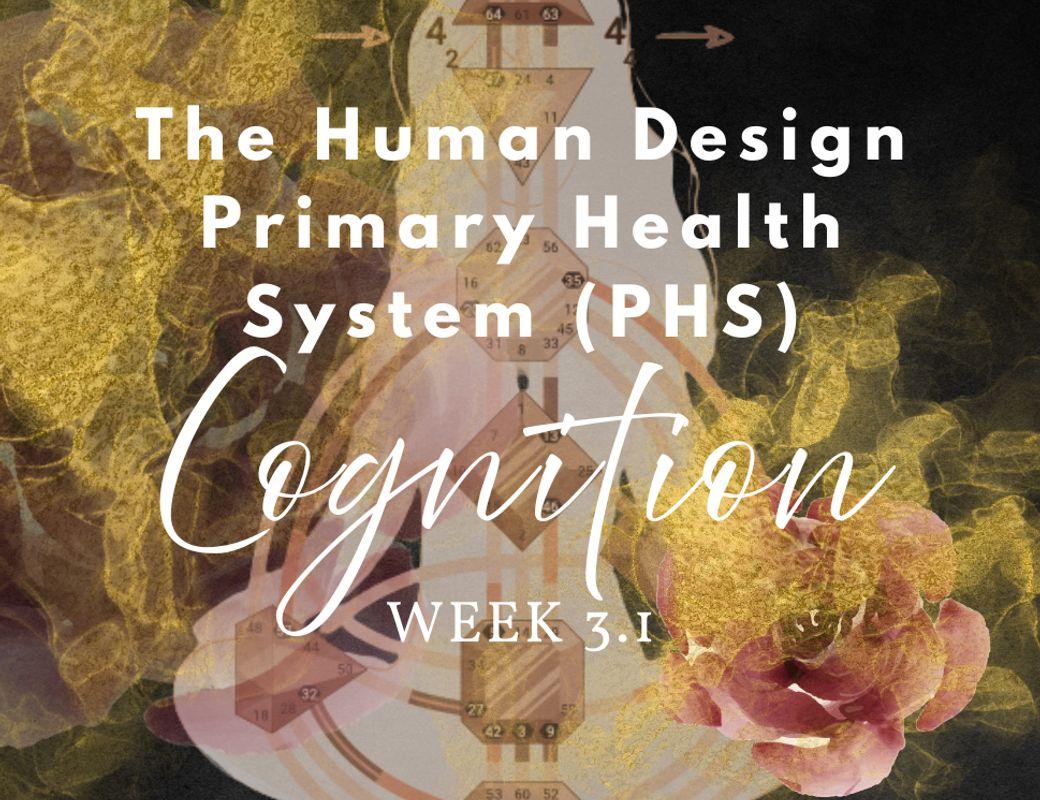
Cognition is the lower left arrow in your chart, sitting alongside Environment, and the two are not unrelated. Environment describes the physical space the nervous system needs. Cognition describes the sensory quality within that space that allows the mind to receive. You can be in a correct Environment and still be operating through the wrong sensory channel, receiving through sight when you are designed to receive through sound, or through smell when you are designed to receive through taste. The result is a mind working harder than it needs to, processing constantly without arriving at the clarity it is looking for.
The Six Cognitions
Like all Variables, Cognition carries a left or right orientation. Left Cognition is active: the mind goes toward what it needs, seeks the correct sensory stimulus, initiates contact with the channel of clarity. Right Cognition is receptive: the correct sensory stimulus needs to come to the mind, to arrive in the environment, to be present without the mind having to reach for it. This distinction matters enormously in practice, because it tells you something about whether you need to curate your sensory environment deliberately or whether you need to simply place yourself in the right conditions and allow them to work on you.
Colour 1: Smell
Smell Cognition people receive clarity through the olfactory channel. This is not merely about liking nice smells. It is about the way the olfactory nerve, which is the only sense that bypasses the thalamus and connects directly to the limbic and memory centres of the brain, carries a kind of knowing that other senses do not. For Smell Cognition people, the sense of whether something is right or wrong, true or false, safe or not, often arrives as a quality of atmosphere that precedes any rational analysis. Something smells right. Something smells off. This is not metaphor for these people. It is their primary instrument of discernment.
Left Smell people actively need to put themselves in environments where they can smell what is true. They may find themselves sniffing things, drawn to particular scents, needing fresh air or natural environments to think properly. Right Smell people need the correct olfactory atmosphere to arrive around them. They are exquisitely sensitive to the quality of air, to chemical environments, to the smell of other people's states, and they need those around them to understand that this sensitivity is intelligence rather than hypersensitivity.
Colour 2: Taste
Taste Cognition people receive clarity through the gustatory channel. The mind opens through what is taken in orally, which means that eating, drinking, and even the act of speaking can all function as clarifying mechanisms. For Taste Cognition people, some of their clearest thinking happens at the table, and some of their most important insights arrive during or immediately after eating. The body and mind are not running on separate tracks. The act of nourishment is also an act of knowing.
Left Taste Cognition people actively seek the clarifying flavour or experience. They may find that they think best over a meal, that walking and talking simultaneously helps them process, that oral stimulation of some kind is almost always present when genuine insight arrives. Right Taste Cognition people need the correct gustatory experience to be offered to them, to arrive naturally in their environment, and are often surprisingly attuned to the quality and integrity of what they consume, not just nutritionally but energetically.
Colour 3: Outer Vision
Outer Vision Cognition people receive clarity through sight directed outward, toward the world. The mind opens through what is seen in the external environment, through visual input from the world beyond the self. For Outer Vision people, looking is a primary cognitive act. Beauty, pattern, colour, form, the visual organisation of space: these are not decorative concerns. They are the medium through which understanding arrives.
Left Outer Vision people actively look for the clarifying visual experience. They are often highly attuned to their visual environment and need it to be aesthetically aligned in order to think clearly. They may have a compulsive need to arrange their space visually, or to look out of a window, or to move to a different location when stuck in their thinking. Right Outer Vision people need visual clarity to be present around them without having to construct it themselves. They are often highly sensitive to visual disorder or ugliness in ways that affect cognitive function, and they need their environments to carry a baseline of visual coherence.
Colour 4: Inner Vision
Inner Vision Cognition people receive clarity through the inner visual field, through images, imagination, and the mind's eye rather than through external sight. Where Outer Vision looks out, Inner Vision looks in. For these people, closing the eyes can actually sharpen thinking rather than blur it. Dreams are often significant. Visualisation is not a technique to learn but a natural cognitive mode. The mind processes through imagery rather than through linear language or external sense data.
Left Inner Vision people actively cultivate the inner visual field, tend toward daydreaming or visual imagination as a default cognitive mode, and often need periods of eyes-closed processing to arrive at clarity. Right Inner Vision people need the conditions around them to be still enough for the inner visual field to come forward. Overstimulating external environments can drown out the inner visual channel completely, leaving these people cognitively stranded in spaces that appear perfectly functional to everyone else.
Colour 5: Sound
Sound Cognition people receive clarity through the auditory channel. The mind opens through what is heard, and this includes not just music or spoken language but the full acoustic texture of the environment: the quality of silence, the presence or absence of particular frequencies, the sound of natural environments versus constructed ones, the tone in which something is said as distinct from the words themselves.
Left Sound Cognition people actively seek the clarifying acoustic environment. They may need to hear something said aloud before they understand it, need music playing to think clearly, or process ideas most effectively by talking them through rather than writing them down. They often think in rhythm or cadence. Right Sound Cognition people need the correct acoustic atmosphere to arrive around them. They are frequently highly sensitive to sound in ways that are not simply about volume: a particular quality of sound, or a particular quality of silence, is the medium through which their thinking becomes available to them.
Colour 6: Touch
Touch Cognition people receive clarity through the tactile and kinaesthetic channel. The mind opens through physical sensation, movement, and the body's contact with its environment. For Touch Cognition people, thinking is not a purely mental event. It happens in and through the body. Walking generates ideas. Physical contact with materials, textures, or living things clarifies what abstract thinking cannot reach. Stillness can actually impede cognitive function for these people in ways that look, from the outside, like restlessness or inability to concentrate.
Left Touch Cognition people actively need to move, to handle things, to bring the body into motion or contact in order to think. The walk that solves the problem. The hands that need to be making something. The physical experiment that arrives at what the thought experiment could not. Right Touch Cognition people need to be in environments that carry the right quality of physical sensation, that hold them in a particular tactile atmosphere, temperature, texture, the quality of surfaces and materials around them, that allows the body to relax into knowing.
Working With Your Cognition
Your Cognition type is perhaps the most quietly radical of all the Variables, because it directly challenges the assumption that there is a universal best practice for thinking, learning, and arriving at understanding.
Find your Cognition in your chart. Then consider the environments in which you have your clearest thinking, the moments when understanding arrived without effort, when something simply became obvious that had been opaque before. Almost always, if you trace it back, the correct sensory channel was present. The smell of rain, the right piece of music, a particular quality of light or silence, the act of walking, the meal that somehow coincided with the insight.
You were not lucky in those moments. You were in alignment.
The invitation is to stop treating those conditions as incidental and begin treating them as requirements. Not rigidly, not as rules, but as genuine intelligence about what your mind needs to do what it is actually designed to do.
Understanding does not arrive the same way for everyone. Yours arrives through a specific door. The work is simply to learn which one it is, and to leave it open.
Responses (2)


More from the Magazine

Paws, Hooves, Fins & Furry Energy 🐙💕
How Animals Protect Your Aura & Heal Your Soul.

The Difference Between Incense and Smudge
Understand the distinction between everyday aromatic incense and culturally specific smoke-cleansing
The Reluctant Kitchen Witch
Five-minute rituals, everyday ingredients, and zero recipes, for those who would rather never cook