PHS Series | Week 2, Thursday
The Body Knows Where It Belongs: Understanding Environment
Article · 7 min read · ·
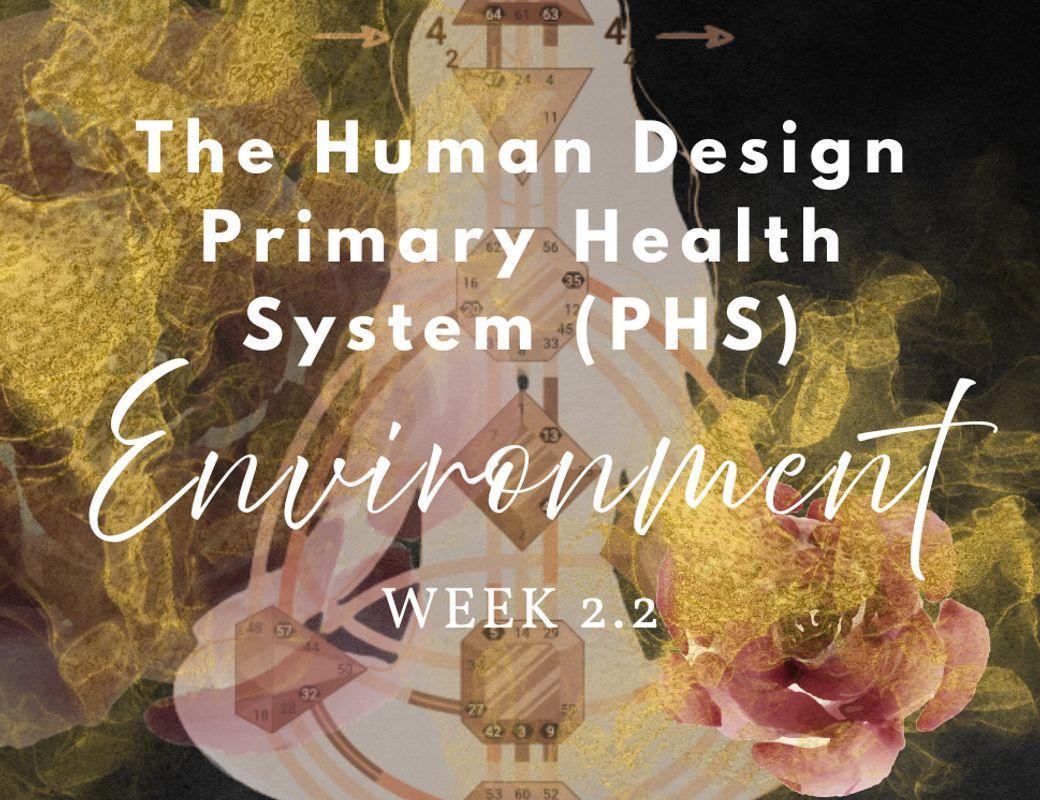
Before you understood anything about Human Design, your body already had opinions about space.
The apartment that felt wrong from the first night, regardless of how perfect it looked on paper. The café where you could suddenly think clearly. The open-plan office that slowly drained something out of you that you could not name. The forest, or the market, or the high ridge with the long view, where something in you exhaled in a way it rarely did anywhere else. You probably filed these responses under preference, or mood, or the vague category of things that are simply inexplicable about yourself.
Human Design calls it Environment. And it is not preference in the casual sense. It is a precise biological requirement, the specific quality of space your nervous system needs in order to regulate, to receive, to function at the frequency you were actually designed for. Getting your Environment right does not merely make life more comfortable. It changes what becomes possible. Synchronicities increase. Decisions clarify. The body stops spending its energy managing the friction of being in the wrong place, and that energy becomes available for everything else.
Environment is the lower left arrow in your chart. Like Determination, it carries both a type and a tonal quality, left or right facing, active or receptive. The left-facing Environments are ones you actively engage with and move through. The right-facing Environments are ones that work on you, that you need to be received by rather than to navigate. Both are valid. Neither is more sophisticated than the other. They are simply different relationships between a particular nervous system and the world it inhabits.
The Six Environments
Caves
Caves Environment is designed for spaces that offer privacy, containment, and control over access. This is not about being a hermit or being antisocial, though it is often misread that way. The nervous system of a Caves person genuinely regulates through the experience of a bounded, controlled space where they determine who enters and when. The home office with a door that closes. The studio that is theirs alone. The private corner of the restaurant rather than the centre table.
Left-facing Caves (Active) people need to be the ones setting the conditions of their space. They need to manage the threshold themselves. Right-facing Caves (Receptive) people need to be received into a contained, private space, to be held by it rather than holding it. The distinction is subtle but experientially real: one is about authoring the boundaries, the other is about inhabiting them.
For Caves people working in open-plan environments, or living in shared spaces with no room of their own, the cumulative cost to the nervous system is significant. This is an Environment type that genuinely needs walls.
Markets
Markets Environment is designed for spaces of exchange, circulation, and human activity. The nervous system of a Markets person calibrates through the movement of people, goods, ideas, and energy around them. Busy public spaces, trading environments, social hubs, anywhere that human commerce in its broadest sense is happening: these are where the Markets person comes alive and thinks most clearly.
Left-facing Markets people need to be actively in the flow of exchange, participating, circulating, engaging directly with the movement around them. Right-facing Markets people need to be situated within that flow without necessarily being the ones driving it, present in the market but not running the stall, receiving the energy of exchange rather than generating it.
For Markets people who work from home in isolation, or who live in environments with very little human circulation, there is often a creeping sense of stagnation that is not psychological in origin. The nervous system is simply not getting the calibration it requires.
Kitchens
Kitchens Environment is designed for spaces of production, transformation, and making. Not necessarily literal kitchens, though the archetype is apt: a space where raw materials become something, where processes are underway, where things are being actively created or transformed. Workshops, studios, laboratories, actual kitchens, construction sites: anywhere the primary activity is the conversion of one thing into another.
Left-facing Kitchens people need to be actively engaged in the production process themselves. Right-facing Kitchens people need to be in proximity to transformation without necessarily being the transformer. The assistant in the kitchen rather than the chef, the researcher in the lab rather than the lead scientist, present within the productive field without driving it.
Kitchens Environment people placed in purely administrative, static, or bureaucratic spaces, where nothing is visibly being made or changed, tend to find the environment quietly deadening in ways that affect not just mood but cognitive clarity.
Mountains
Mountains Environment is designed for elevation, literally or metaphorically. The nervous system of a Mountains person calibrates through height, overview, and the experience of physical or perceptual distance from the density of human activity below. High ground, open views, the vantage point from which patterns become visible that are invisible at ground level.
Left-facing Mountains people need to actively seek elevation, to place themselves at the high point, to be the one with the view. Right-facing Mountains people need the quality of elevation to come to them, to be positioned somewhere that naturally offers overview without requiring them to climb toward it.
Mountains people in dense urban environments, working at ground level with no access to height or open sky, frequently experience a compression of thinking that lifts immediately when they get above the city, or above the treeline, or simply onto a hill with a long horizon. This is not metaphor. The nervous system is quite literally more available at altitude.
Valleys
Valleys Environment is the complement to Mountains. Where Mountains seeks the overview, Valleys needs to be in the heart of human settlement and activity, embedded in the flow of daily civilisation, surrounded by the evidence of human life being lived. Towns, villages, the inhabited centres of cities, anywhere that the full spectrum of human community is present and functioning.
Left-facing Valleys people need to be actively participating in that community fabric, known within their locale, embedded in the social geography of a place. Right-facing Valleys people need to be held within community, present in the valley of human life without necessarily being a central node of it, surrounded by the warmth of inhabited space.
Valleys people who find themselves in remote or isolated environments, however beautiful those environments might be, often feel a subtle but persistent disconnection that no amount of natural beauty resolves. The nervous system needs the hum of inhabited human life around it.
Shores
Shores Environment is designed for the edges, the thresholds, the places where one thing becomes another. Coastlines, riverbanks, the borders between ecosystems, between urban and rural, between land and water, between settled and wild. The Shores person’s nervous system calibrates through transition zones, places of movement and liminality where neither one thing nor another fully dominates.
Left-facing Shores people need to actively inhabit and move through these transitional spaces. Right-facing Shores people need to be situated at a threshold, to have the quality of liminality held around them, to live or work somewhere that carries the energy of the in-between.
Shores people in deeply fixed, stable, unchanging environments frequently feel a restlessness that looks from the outside like dissatisfaction or inability to commit, but which is simply the nervous system looking for its edge.
Working With Your Environment
Your Environment type is not necessarily telling you to upend your life immediately. It is an invitation to map what you already know about yourself against a framework that can help you understand why certain spaces have always felt like oxygen and others have always felt like slow suffocation.
Begin by looking at your chart and finding your Environment. Then look honestly at where you spend the majority of your time: where you work, where you live, where you rest. Notice the distance, or the resonance, between that space and what your design is calling for.
For some people, the alignment is already closer than they realised. For others, the gap is significant, and naming it is itself a kind of relief, because misalignment with Environment is one of those things that is easy to pathologise or to take personally when it is actually neither. The body is not broken. It is just not in its right territory.
Small adjustments often yield disproportionate results. Moving a desk to face a window. Choosing the corner table. Finding one morning a week to work from the café, or the garden, or the high point in the park. The nervous system notices even partial alignment. It does not require perfection. It requires direction.
The body knows where it belongs. Following that knowing, even incrementally, is an act of genuine self-respect.
Responses (2)


More from the Magazine

The Trigger of Embarrassment
Let's tap into the Ego and how we can release the control it desires.
Protection Magic Is More Than a Jar of Salt
The folklore of warding, the psychology of safety, and the boundaries that matter in real life

Paws, Hooves, Fins & Furry Energy 🐙💕
How Animals Protect Your Aura & Heal Your Soul.