Meeting Hecate
Walking with Hecate at Life’s Crossroads (Part 2 of 5)
Article · 10 min read · ·
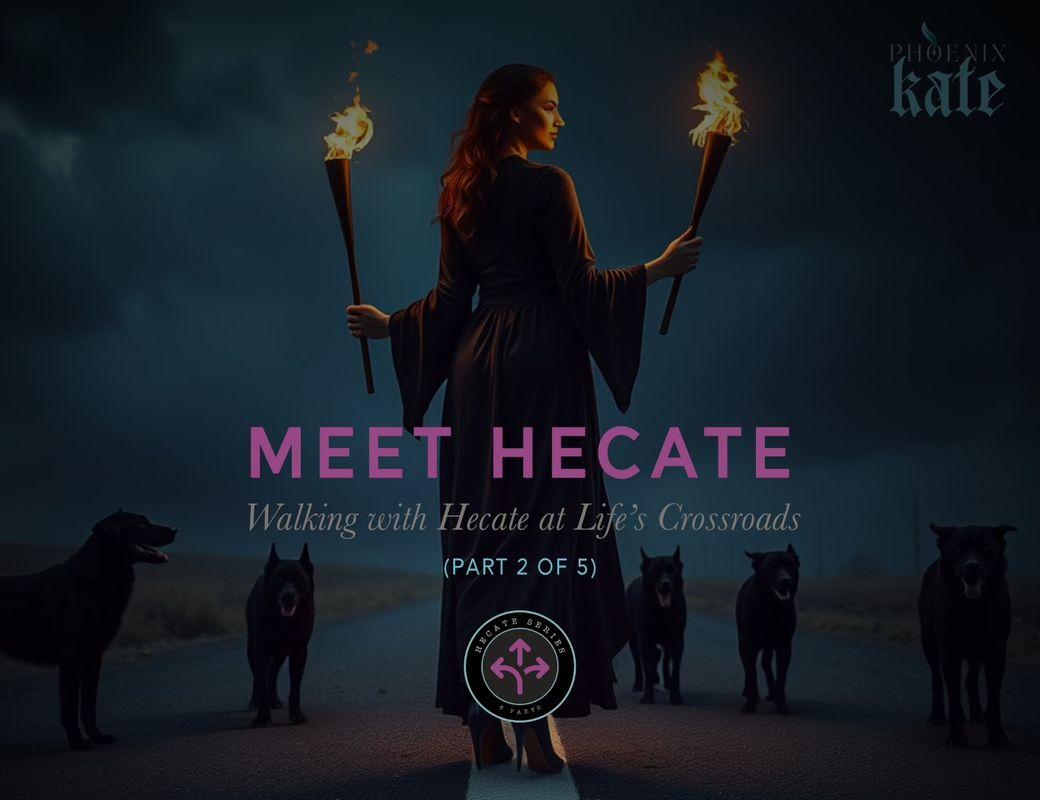
You’re standing at a crossroads.
Not metaphorically. Actually. A decision that will change everything sits in front of you, and you can’t see clearly which direction to take. Stay in the relationship or leave. Accept the job offer or decline. Speak the truth or keep the peace. Move across the country or stay where your roots are.
The paths stretch out before you in the dark, and you don’t know which one leads where you need to go.
This is Hecate’s primary territory. Not the decision itself; that’s yours to make. But the crossroads where you stand, uncertain and exposed, trying to see clearly when there’s no good light.
She’s the goddess who shows up here. At the intersection. In the liminal space between what was and what will be.
If you’ve been feeling paralyzed at a major life crossroads, unable to move forward because you can’t see the right path, this is the work. This is where Hecate’s guidance becomes practical, not just mythological.
Understanding the Crossroads
In ancient Greece, crossroads weren’t just intersections of roads. They were sacred spaces. Dangerous spaces. Places where worlds overlapped and boundaries thinned.
Hecate was worshipped at these literal crossroads. Offerings were left at three-way intersections: food, wine, or cakes. These weren’t casual gestures. They were acknowledgments that crossroads were powerful, liminal places where human and divine could meet.
Travelers would leave offerings before making a journey, asking Hecate for protection and clear passage. Those facing difficult decisions would seek her guidance at these threshold spaces.
Why crossroads mattered:
-
They represented choice. Stand at a crossroads and you must choose a direction. There’s no moving forward without deciding.
-
They represented uncertainty. You can’t see down all paths simultaneously. Some choice must be made without complete information.
-
They represented danger. Crossroads were believed to be places where hostile spirits gathered, where the dead wandered, where the boundaries between worlds were thin enough to slip through.
-
They represented transformation. You arrive at a crossroads as one thing. You leave as someone who has chosen, and choosing changes you.
This is still true.
When you stand at a life crossroads (career change, relationship decision, geographical move, identity evolution) you’re in sacred, dangerous, transformative territory. You’re in a liminal space where the old structures no longer hold but new ones haven’t formed yet.
You’re in Hecate’s domain.
Why We Get Stuck at Crossroads
If making decisions was simple, we wouldn’t need Hecate. We’d just choose and move forward.
But crossroads paralyze us for specific reasons, and understanding why we’re stuck is the first step toward movement.
-
Fear of the wrong choice. We convince ourselves there’s one right path and all others lead to disaster. This binary thinking keeps us frozen, analyzing endlessly, seeking perfect information we’ll never have. We fear that choosing wrong will destroy everything, so we choose nothing.
-
Inability to see clearly. We’re standing in the dark, trying to evaluate paths we can’t fully see. We don’t know what each choice will actually bring. We can’t predict outcomes with certainty. So we wait for clarity that never comes.
-
Loyalty to the past. One path leads forward into unknown territory. Another leads back to what’s familiar, even if it’s no longer serving us. We know the old path. We’ve invested in it. Walking away feels like admitting failure or betraying what we built.
-
External pressure. Other people have strong opinions about which path we should take. Family expectations. Societal norms. Professional pressure. We’re trying to make a decision that honors our truth while navigating everyone else’s investment in our choice.
-
Shadow material we’re avoiding. Sometimes what’s actually keeping us stuck isn’t the decision itself but what the decision will force us to confront. Choosing one path means acknowledging something about ourselves we’ve been avoiding. So we stay stuck rather than look at it.
This is where Hecate’s work becomes practical.
She doesn’t make the decision for you. She doesn’t remove the fear or uncertainty. But she illuminates what’s actually happening at your crossroads, including the shadow material that’s keeping you stuck.
What Hecate Offers at the Crossroads
When you invoke Hecate at a life crossroads, here’s what she provides:
-
Illumination, not answers. Her torches show you what’s actually there: your real motivations, your shadow fears, the truth you’re avoiding. She doesn’t tell you which path to take. She lights up what you need to see to make the choice yourself.
-
Witness, not judgment. Hecate stands with you at the crossroads without telling you you’re doing it wrong. She doesn’t judge you for being stuck, for being afraid, for taking time to decide. She simply holds space while you figure it out.
-
Protection in liminal space. Crossroads are dangerous because you’re vulnerable there, between identities, between certainties, exposed. Hecate’s presence offers protection while you’re in that threshold space. You can take the time you need.
-
Keys to what you’ve locked away. Often what’s keeping us stuck at a crossroads is something we’ve hidden from ourselves. A truth we don’t want to speak. A desire we’ve been taught to suppress. A fear we’re ashamed to acknowledge. Hecate holds the keys to those locked places.
-
Permission to choose for yourself. In a culture that constantly tells you to consider everyone else’s needs first, Hecate reminds you that your sovereignty matters. You’re allowed to make the choice that serves your truth, even if others disapprove.
Shadow Work at the Crossroads
Here’s what makes crossroads work with Hecate different from standard decision-making advice:
She makes you look at what you’re avoiding.
Most decision-making frameworks focus on pros and cons lists, logical analysis, weighing outcomes. That’s useful. But it doesn’t address the shadow material that’s actually keeping you stuck.
Questions Hecate asks at the crossroads:
-
What are you pretending not to know? Often we already know which path we need to take, but we’re pretending we don’t because the truth is uncomfortable. What decision would you make if you stopped pretending?
-
What are you afraid will be revealed if you choose this path? Sometimes we avoid a choice not because of where it leads but because of what it will reveal about us. What truth are you afraid this decision will force you to acknowledge?
-
Who are you protecting by staying stuck? We convince ourselves we’re stuck because we need more information. But sometimes we’re stuck because choosing would disappoint someone, challenge a relationship, or force others to confront their own choices.
-
What would you choose if you weren’t afraid? Fear is real and should be acknowledged. But sometimes we let fear make our decisions for us. If fear wasn’t the primary driver, what would you choose?
-
What are you gaining by remaining at this crossroads? There are secondary gains to being stuck: avoiding responsibility, maintaining victim status, staying safe in indecision. What’s the benefit of not choosing?
This is uncomfortable work.
Hecate doesn’t let you hide from yourself. Her torches illuminate what you’ve kept in shadow, including the ways you’re complicit in your own stillness.
But this is also the work that creates movement.
Practical Crossroads Ritual
If you’re at a major crossroads and ready to work with Hecate’s guidance, here’s a ritual that brings her energy into practical decision-making.
What you’ll need:
-
Three candles (any color, though black or white work well)
-
A quiet space where you won’t be interrupted
-
Journal and pen
-
Optional: offerings (wine, honey, bread, or something else you’d give freely)
The ritual:
-
Create the crossroads. Arrange your three candles in a Y-shape on a table or the floor, creating a three-way intersection. This represents the crossroads. Sit at the center where the paths meet.
-
Light the candles and invoke Hecate. Light each candle, saying: “Hecate, keeper of crossroads, holder of torches, I stand at the intersection of paths. I ask for your presence, your witness, your illumination. Show me what I need to see.” You don’t need fancy language. Speak honestly.
-
Name your crossroads. State clearly what decision you’re facing. Don’t hedge or soften it. Name the actual choice:
-
“I’m deciding whether to leave this relationship or stay and try to repair it.” “I’m choosing between accepting this job offer across the country or staying in the career I’ve built here.” “I’m facing whether to speak this truth or continue keeping the peace.”
-
Ask the shadow questions. Now work through Hecate’s questions. Write your answers honestly. Don’t perform for an imaginary audience. Write the truth:
-
What am I pretending not to know?
-
What am I afraid will be revealed if I choose?
-
Who am I protecting by staying stuck?
-
What would I choose if I weren’t afraid?
-
What am I gaining by remaining at this crossroads?
-
Sit with what’s revealed. Don’t immediately try to fix what you’ve written. Don’t rationalize it away. Just sit with it. Let Hecate’s torches illuminate what’s been in shadow. This might be uncomfortable. That’s the point.
-
Ask for one next step. You don’t need to make the full decision right now. Ask Hecate to show you one clear next step. “What’s one action I can take to move forward from this crossroads?” It might be a conversation you need to have. Research you need to do. A truth you need to speak. A boundary you need to set. One thing.
-
Thank Hecate and close. Thank her for her presence and witness. Blow out the candles. If you brought offerings, leave them outside at an actual crossroads if possible, or dispose of them respectfully.
-
Take the next step. Within three days, do the one action that was revealed. This is crucial. Asking for guidance and then ignoring it tells Hecate you’re not serious about the work.
After the Crossroads
Here’s what people often don’t tell you about working with Hecate at crossroads:
Making the choice doesn’t end the discomfort.
You’ll stand at the crossroads, do the work, get the illumination, make the decision, and you’ll still feel uncertain. You’ll still doubt yourself. You’ll still wonder if you chose wrong.
This is normal.
Hecate doesn’t offer certainty. She offers clarity about what’s true for you right now and trust in your own capacity to navigate what comes next.
The path you choose will have challenges. The path you didn’t choose will sometimes look appealing in retrospect. That’s not evidence you chose wrong. That’s evidence you’re human.
What Hecate teaches at crossroads:
-
You can make hard choices without complete information
-
Your sovereignty is worth protecting, even when others disapprove
-
The fear doesn’t go away; you walk forward with it
-
Choosing transforms you; that’s the point
-
You can trust yourself to navigate what comes
Moving Forward
If you’re reading this from a crossroads, whether you’re stuck between paths, unable to see clearly, or afraid to choose, know this:
Hecate doesn’t judge you for being here. Crossroads are meant to be places of pause, consideration, transformation. You’re not doing it wrong by taking time.
But there comes a moment when staying at the crossroads becomes its own choice. When remaining stuck is more comfortable than moving forward. When the fear of choosing wrong outweighs the cost of not choosing at all.
That’s when you need Hecate’s torches most.
Not to make the choice for you. But to show you what you’re actually avoiding, what you already know, what’s keeping you stuck, so you can choose from a place of truth rather than fear.
The crossroads is sacred space. Dangerous space. Transformative space.
And Hecate stands with you there, holding her torches steady, until you’re ready to move.
Responses (3)
More from the Magazine
The ADHD Witch's Guide to Practicing Magic When You Forget Everything
Build a practice around your actual brain, not the imaginary organized person you keep trying to be

The Trigger of Embarrassment
Let's tap into the Ego and how we can release the control it desires.
Protection Magic Is More Than a Jar of Salt
The folklore of warding, the psychology of safety, and the boundaries that matter in real life