Hecate as Psychopomp
Guide Between Worlds (Part 4 of 5
Article · 11 min read · ·
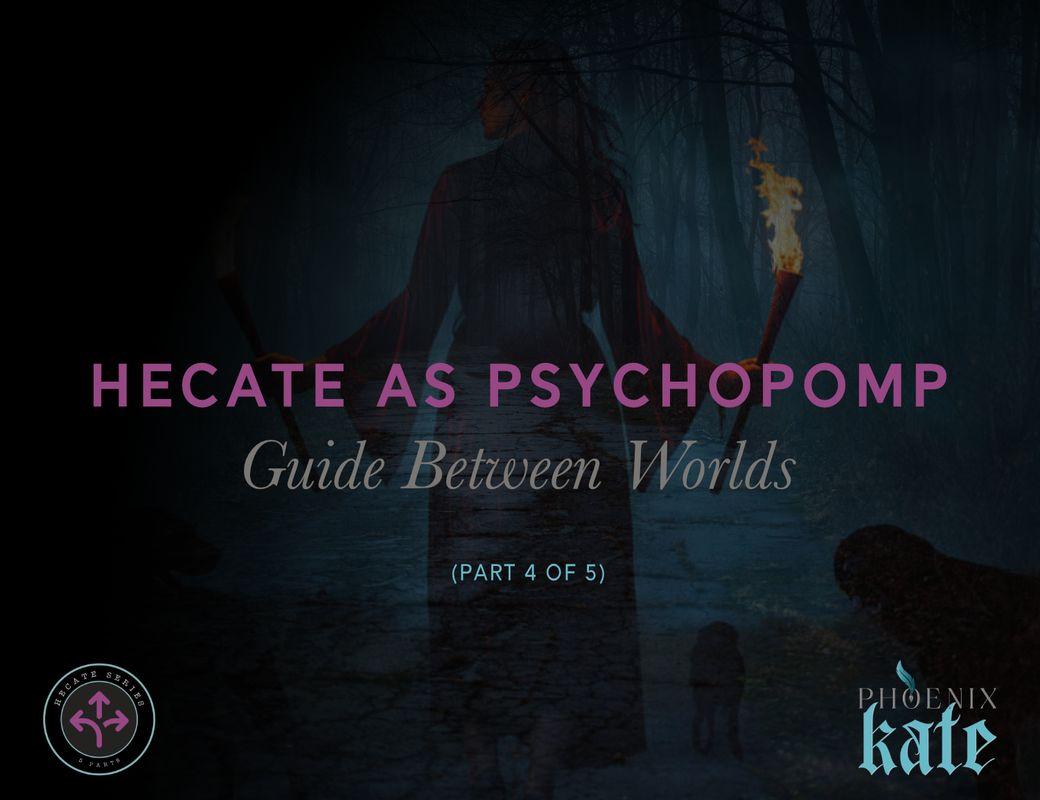
Hecate walks between worlds.
Not metaphorically. In her oldest role, she is psychopomp, a guide of souls from life to death, from the upper world to the underworld, through the transitions that unmake and remake us.
She doesn’t prevent death. She doesn’t make loss easier. She doesn’t promise that transformation will be gentle.
She stands at the threshold and says: I will walk with you through this. You will not cross alone.
If you’re in a liminal space right now, between identities, between life phases, between who you were and who you’re becoming, this is Hecate’s territory. If you’re grieving something that can’t be fixed or returned, if you’re navigating an ending that will change everything, if you’re in the uncomfortable space of not-yet, this is the work.
This is where Hecate’s role as psychopomp becomes devastatingly practical.
Understanding the Psychopomp
In Greek mythology, a psychopomp is a guide of souls. The word literally means “soul guide”, someone who escorts the dead from the world of the living to the realm of the dead.
Hermes is probably the most famous Greek psychopomp. Charon ferries souls across the river Styx. But Hecate holds a unique role: she guards the thresholds themselves. She stands at the boundaries between worlds and witnesses who crosses.
What makes Hecate different as a psychopomp:
-
She doesn’t just guide souls after death; she guides through all transitions that involve a kind of death. The death of an identity. The death of a relationship. The death of who you thought you’d be. The death of a life phase, a belief system, a version of self.
-
She specializes in liminal spaces. Not the destination on either side, but the threshold itself. The uncomfortable in-between. The space where you’re no longer who you were but not yet who you’re becoming.
-
She doesn’t rush the process. Other psychopomps move souls efficiently from one realm to the next. Hecate holds space for you to linger at the threshold as long as you need. To grieve. To witness. To integrate what you’re leaving behind.
-
She witnesses without judgment. She doesn’t tell you you’re doing it wrong, taking too long, grieving too much, or resisting too hard. She simply stands with you while you make the crossing in your own time.
The Liminal Space
The word “liminal” comes from the Latin limen, meaning threshold. A liminal space is a transitional or in-between state, neither here nor there, but somewhere suspended between.
Liminal spaces in life:
-
Between jobs, after leaving one but before starting another
-
After a relationship ends but before you’ve fully released it
-
In gender transition, between assigned identity and authentic self
-
During serious illness, between health and whatever comes next
-
After a major loss, between the life you had and the life you must now build
-
In spiritual awakening, between old beliefs and emerging truth
-
During geographical moves, between home and not-yet-home
-
In creative work, between vision and manifestation
These spaces are deeply uncomfortable because humans crave certainty. We want to know who we are, where we stand, what comes next. Liminal spaces offer none of that.
You’re suspended. Unformed. Becoming.
Why liminal spaces are sacred:
-
This is where transformation actually happens. Not in the comfortable certainty of before or after, but in the uncertain, formless space between. You can’t become new while clinging to old forms. You have to cross the threshold.
-
This is where ego defenses break down. In the structured world of before, you knew who you were. You had roles, identities, certainties. Liminal space strips those away. You’re raw. Exposed. Real.
-
This is where you’re most vulnerable, and most powerful. Without the old structures to hide behind, you meet yourself honestly. And that honest meeting is where real power is reclaimed.
Grief as a Liminal Space
Grief is one of the most profound liminal spaces we navigate. And it’s where Hecate’s psychopomp energy becomes most relevant.
Not the sanitized, time-limited grief that modern culture allows. The messy, ongoing, transformative grief that changes who you are.
What Hecate understands about grief:
-
Grief isn’t linear. We’re told grief has stages, and if we move through them correctly we’ll arrive at “acceptance” and be done. This is a lie that serves people who are uncomfortable with others’ pain. Real grief circles, spirals, returns. Hecate doesn’t ask you to move through it on a timeline. She holds space while you spiral.
-
Grief isn’t just sadness. It’s rage at what was taken. It’s guilt about what you did or didn’t do. It’s relief, sometimes, mixed with shame about feeling relieved. It’s the disorientation of a world that kept spinning when your world stopped. Hecate witnesses all of it without asking you to perform the “right” kind of grief.
-
Grief transforms you. You don’t grieve and then return to who you were. You grieve and become someone else, someone who has survived this loss, integrated this pain, crossed this threshold. Hecate knows you’re dying to who you were. She walks with you through that death.
-
Grief requires witness. Not fixing. Not solutions. Not “everything happens for a reason.” Just someone who can stand with you in the devastation and say: I see this. I witness what you’ve lost. You’re not alone here.
That’s what Hecate offers.
Working with Hecate Through Transitions
If you’re in a liminal space, Hecate’s psychopomp energy can guide you through.
Not by making it easier. By making it real.
What to ask for from Hecate as psychopomp:
-
Witness for what you’re leaving behind. Before you can fully cross the threshold, you need to acknowledge what you’re leaving. The relationship that ended. The identity you’re shedding. The belief system you’re releasing. Ask Hecate to stand with you while you witness what’s ending.
-
Protection in vulnerability. Liminal spaces leave you exposed. Your defenses are down. Your new structures haven’t formed yet. Ask Hecate to hold the boundaries while you’re in this raw, formless state.
-
Permission to grieve. Even when the transition is positive such as with a new job, new relationship, new location, there’s grief for what’s left behind. Hecate gives you permission to feel it all, not just the parts that fit the expected narrative.
-
Guidance through the threshold. Not “here’s the answer” guidance. But “take this next step” guidance. When you’re in liminal space, you can’t see the full path. Hecate shows you where to step next.
-
Patience with the process. Liminal spaces can’t be rushed. Hecate reminds you that transformation requires time in the threshold. You can’t skip this part.
Ritual: Threshold Crossing
If you’re navigating a major life transition and ready to work with Hecate’s psychopomp energy, here’s a ritual for threshold work.
What you’ll need:
-
A doorway or threshold in your space
-
Two candles
-
Something that represents what you’re leaving behind (photo, object, written words)
-
Something that represents what you’re moving toward (can be symbolic or aspirational)
The ritual:
1. Prepare the threshold. Choose an actual doorway in your space. Place one candle on each side of the threshold. On one side of the doorway, place the representation of what you’re leaving behind. On the other side, place what represents what you’re moving toward. The doorway itself is Hecate’s territory, the liminal space between.
2. Stand at the threshold. Stand in the doorway, literally in the threshold. Not on either side. In between. Light both candles, saying: “Hecate, guide between worlds, psychopomp, threshold guardian, I stand in the space between. I ask for your witness, your protection, your guidance as I cross.”
3. Witness what you’re leaving. Turn toward the side that represents what you’re leaving behind. Speak aloud what you’re releasing: “I’m leaving behind the marriage that ended.” “I’m releasing the identity of who I thought I’d be.” “I’m grieving the version of myself I killed to survive.” Be specific. Don’t soften it or spiritualize it. Name what’s actually ending. Allow yourself to feel the grief, anger, relief, guilt, whatever arises. Hecate witnesses it all.
4. Honor the crossing. Turn toward the side that represents what you’re moving toward. Acknowledge that you can’t fully see what’s ahead. Say: “I don’t know who I’m becoming. I don’t know what this path holds. But I’m crossing the threshold anyway.”
5. Sit in the liminal space. Sit down in the doorway itself. Right in the threshold. Between worlds. This is uncomfortable. That’s the point.
Write about what it feels like to be here:
-
What are you afraid of as you cross?
-
What are you hoping for?
-
What feels unresolved?
-
What do you need to bring with you?
-
What must be left behind?
6. Ask for guidance. Ask Hecate: “What do I need to know as I cross this threshold?” Sit quietly. Write whatever comes: images, words, feelings, knowing. Don’t edit or rationalize. Just receive.
7. Make the crossing. When you’re ready, not before, stand up and step through the doorway to the other side. As you cross, say: “I cross this threshold witnessed by Hecate. I step into becoming.”
8. Ground on the other side. Stand on the other side. Feel your feet on the ground. You’ve crossed. You’re not done transforming; threshold crossings are beginnings, not endings. But you’ve made the movement from one realm to the next. Thank Hecate for her witness and guidance.
9. Honor the liminal. Leave the candles burning for a while if it’s safe to do so. The liminal space remains sacred even after you’ve crossed. When you’re ready, blow them out. Keep what you wrote. The threshold crossing continues; this ritual marks a moment in an ongoing process.
Living in the Liminal
Here’s the truth about major life transitions that work with Hecate reveals:
You don’t cross the threshold once and arrive. You live in liminality for a while.
After the relationship ends, you’re in liminal space, no longer partnered but not yet fully single. After you leave the job, you’re between professional identities. After the loss, you’re between the life you had and the life you must build.
This in-between space can last months. Sometimes years.
What Hecate teaches about living liminally:
-
You don’t have to know who you’re becoming yet. The pressure to quickly form a new identity, to know what’s next, to have it figured out, that’s not how transformation works. Hecate gives you permission to exist formlessly for a while.
-
The discomfort is part of the work. You’re supposed to be uncomfortable in liminal space. It means you’re actually transforming, not just performing change while clinging to old structures.
-
You can function while being in transition. You don’t have to have everything figured out to take care of yourself, show up for your life, make decisions. Hecate holds space for you to be both in-process and functional.
-
This is where your power is rebuilt. Not in the comfortable certainty of before. Not in the eventual stability of after. But here, in the raw, formless space between, where you meet yourself honestly and reclaim what you gave up.
As psychopomp, Hecate also bridges the world of the living and the world of the dead. This makes her particularly powerful for ancestor work and communication with those who have crossed.
If you work with ancestors:
-
Hecate can facilitate communication across the threshold. She guards the boundary but can allow passage when the work is honored.
-
She protects you in this work. Not all spirits have your best interest in mind. Hecate as threshold guardian ensures that what crosses the boundary is appropriate.
-
She helps you navigate complicated ancestral relationships. Not all ancestors deserve veneration. Some caused harm. Hecate holds space for the complexity, honoring the dead while acknowledging the truth of what they did in life.
If you’re grieving someone who has died:
Hecate stands at the threshold they crossed. She witnessed their passing. Invoke her when you need to feel close to someone who has died, not to bring them back, but to stand at the boundary between worlds and honor their crossing.
After the Crossing
What Hecate teaches us as psychopomp:
-
Not all deaths are physical. Some of the most profound deaths are the ones where your body survives but your identity, your certainty, your old self dies. Hecate guides through these deaths too.
-
The threshold is sacred space. The discomfort of transformation, the rawness of grief, the formlessness of becoming, these aren’t obstacles to get through as quickly as possible. They’re sacred territory where real change happens.
-
You don’t cross alone. Even when it feels like you’re navigating this transition in isolation, even when no one around you understands, Hecate stands at the threshold. You have a witness. You have a guide.
-
Transformation requires death. Not the sanitized, spiritual version of letting go. Actual death of who you were, what you believed, the life you built. Hecate doesn’t make this easier. She makes it witnessed.
If you’re in liminal space right now, between worlds, between identities, between who you were and who you’re becoming, know that Hecate stands at the threshold.
She’s not here to rush you through. She’s here to walk with you while you cross.
However long it takes.
Responses (3)

More from the Magazine

Protection Magic Is More Than a Jar of Salt
The folklore of warding, the psychology of safety, and the boundaries that matter in real life

Paws, Hooves, Fins & Furry Energy 🐙💕
How Animals Protect Your Aura & Heal Your Soul.

The Difference Between Incense and Smudge
Understand the distinction between everyday aromatic incense and culturally specific smoke-cleansing