THE FIRST HUMAN ON THE MOON
WHAT CHANGES WHEN YOU TOUCH WHAT YOU'VE ALWAYS WORSHIPED FROM AFAR
Article · 4 min read · ·
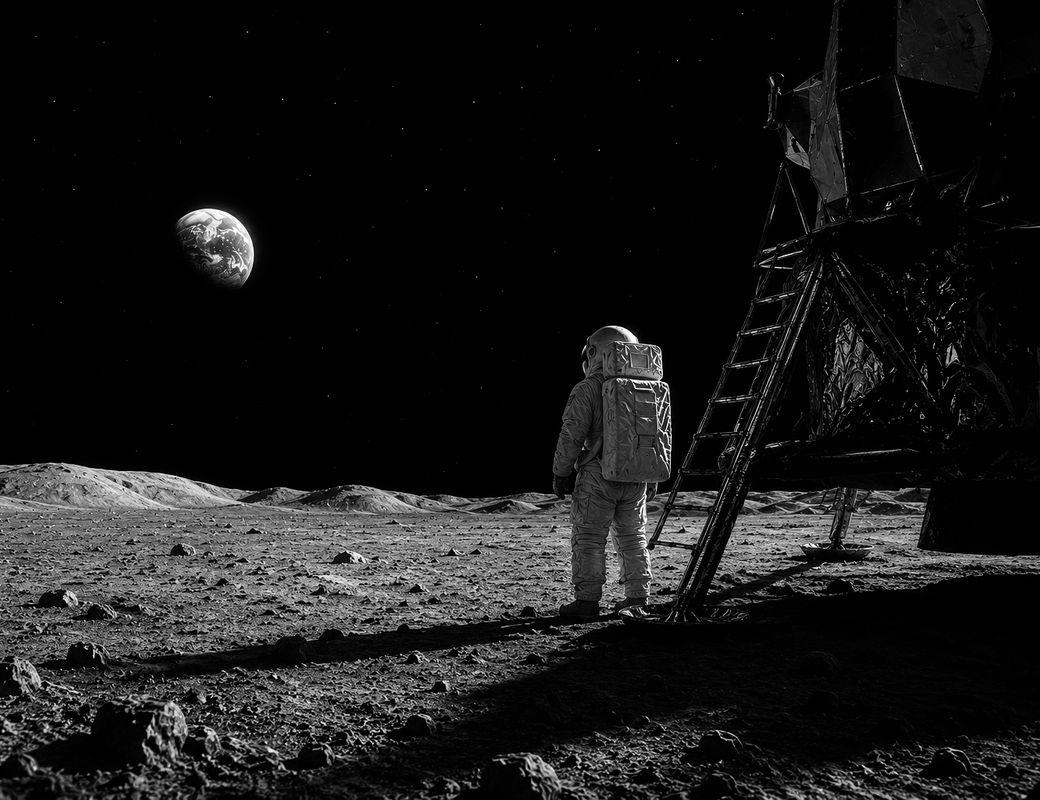
July 20, 1969 | 02:56 UTC
57 years later
Neil Armstrong descended the final rungs of the lunar ladder and stood still for a few seconds before taking the step. This rarely appears in descriptions of the event. Most go straight to the famous phrase. But he stood still. Looking at the surface of another world before touching it for the first time.
What happened next contained an error that no one could solve for decades. Armstrong said: "That's one small step for man, one giant leap for mankind." The phrase doesn't make sense grammatically. "Man" and "mankind" are synonyms. He always insisted he said "one small step for a man," the indefinite article that changes the entire meaning, from generic to personal. But the "a" was never found in the original recordings.
The most-heard moment of the twentieth century reached us with a hole in the middle.
What the Moon Was Before Being Touched
Throughout recorded human history, the Moon was the only celestial object that changed shape in a manner visible to the naked eye. It grew, became full, waned, disappeared, returned. No other point in the sky did this with such clarity.
This produced a relationship that distant planets never had with humanity: an intimacy of scale. The Moon fit within the field of vision. It had a size comparable to the Sun. It could be observed directly, for hours, without an instrument.
From tides to agricultural calendars, from fertility rites to navigation calculations, it was the most reliable clock in existence. Civilizations that never communicated independently arrived at the same conclusion: the lunar cycle of approximately 29.5 days organized time better than any other available reference.
And then, in July 1969, two people stepped on it.
What Buzz Aldrin Did That No One Broadcast
Before leaving the Eagle, Aldrin asked the astronauts and personnel in Houston to remain silent for a moment. Then he opened a small kit he had secretly brought: a miniature silver chalice, a pouch of wine, and a wafer.
He took communion on the Moon. Alone, 384 thousand kilometers from Earth, before stepping on the lunar surface for the first time.
NASA suppressed the broadcast of this moment after a legal dispute with Madalyn Murray O'Hair, who had sued the agency after the Apollo 8 astronauts read Genesis live during the previous mission. Aldrin never repeated the ritual on subsequent missions. But the fact remains: the first religious rite performed on another world was Christian communion, practiced inside a space capsule, before any human left a footprint on the surface.
The Esoteric Meaning: What Happens When the Symbol Is Touched
The Moon, in virtually all traditions that took it seriously, governed the realm of the unconscious, the feminine, that which lies beyond solar reason. In the Tree of Life, the Moon's domain is Yesod, the foundation, the mirror of reality that filters what arrives before being manifested. Yesod is the field of what is not directly touched. Of what is perceived, dreamed, felt, but not handled.
When Armstrong stepped on the lunar surface, he touched what for millennia had been treated as untouchable. Modern science reached the territory that traditions reserved for myth.
What this produced collectively is measurable: the Moon after 1969 never again occupied exactly the same place in human imagination. The satellite that generated reverence for being mysterious revealed itself to be covered in gray dust and silence. "Magnificent desolation," in Aldrin's own words.
Magnificent desolation. Not wonder. Desolation.
July 1969 Fell in Cancer
July 20, 1969 was in the season of Cancer. The only sign ruled by the Moon. The sign of memory, of roots, of what remains after everything changes.
That the first human touched the Moon during the season of the sign it governs has a symbolic coherence that goes beyond the calendar. The step was taken in the month when humanity most frequently revisits what was left behind. In the month when the emotional and ancestral come closest to the surface.
In 2026, we're still in Cancer on July 20th. And humanity's return to the Moon is being planned by multiple space programs, with plans to land astronauts in the south polar region within this decade. For the first time, among them will be a woman.
The symbol will be touched again. This time with the intention to stay.
Reflection
Carl Jung wrote that the human unconscious projects onto the night sky what it cannot process otherwise. The Moon, in this reading, is the address of something daytime consciousness cannot reach.
Aldrin took communion before going out. Armstrong stood still before taking the step. There was no protocol for this. Aeronautical engineering training had not prepared either of them for that specific moment.
Fifty-seven years later, the Moon continues to orbit with the same precision as always. The tides continue to respond. The cycles continue to be used by farmers, fishermen, and astrologers around the world.
What changed was a layer of distance that had existed since the first human looked at the sky and wanted to know what that was. That layer was crossed. What was on the other side was dust, silence, and Aldrin with a silver chalice.
O que você venerou de longe muda quando finalmente toca. O sagrado não some. Ele fica mais próximo do que você estava preparado para aguentar.
Responses
No responses yet — start the conversation.