Algol, the Demon Star of Perseus
Exploring the astronomy, mythology, and astrological legacy of the sky’s most infamous star
Article · 10 min read · ·
Most stars seem reassuringly steady in the night sky.
Night after night, they return to familiar places, their light appearing constant against the darkness. But in the constellation Perseus, one star behaves a little differently.
Algol seems to blink.
For most of the time, it shines brightly enough to attract little unusual attention. Then, over the course of several hours, its light noticeably fades before gradually returning. Wait a few nights, and it happens again.
Today, astronomers understand exactly what is occurring. Algol is part of a multiple-star system, and the regular fading we see from Earth is produced by stars passing in front of one another.
For early skywatchers, however, that changing light was a mystery.
Over centuries, people attached stories, names, mythological associations, and astrological interpretations to this unusual star. Algol became connected with Medusa through its position in the constellation Perseus, while different generations interpreted its changing light through the knowledge and beliefs available to them.
Those interpretations tell us almost as much about humanity as they do about the star.
Because Algol offers something unusual: a chance to see how one object in the night sky can move through science, mythology, astrology, and cultural imagination while remaining exactly what it has always been.
A star whose light changes before our eyes.
The Star That Blinks
Algol lies about 90 light years from Earth in the constellation Perseus. Its scientific designation is Beta Persei, and although it appears to the naked eye as a single point of light, Algol is actually a multiple-star system.
The reason for its famous dimming lies primarily with two stars orbiting one another very closely.
From our viewpoint on Earth, their orbit is aligned so that one star periodically passes in front of the other. When the dimmer star crosses in front of its brighter companion, the combined light we see temporarily decreases.
Algol appears to fade.
Several hours later, as the eclipse passes, it brightens again.
The entire cycle repeats approximately every 2.87 days, making Algol one of the best-known examples of an eclipsing binary. It is also the prototype for a class of eclipsing binary stars known as Algol variables.
Imagine observing that without telescopes, spectroscopy, orbital models, or any understanding of binary stars.
Most stars appear remarkably constant. Algol does not.
Its changing brightness would have been noticeable to careful observers, although exactly when ancient cultures first recognized its repeating cycle remains debated. By the seventeenth century, astronomers were documenting Algol’s variability, and in 1783, the young English astronomer John Goodricke proposed that its dimming might be caused by another body passing in front of it.
That explanation came remarkably close to what astronomers later confirmed.
Before science could explain Algol’s changing light, however, people had another way of making sense of the sky.
They told stories.
A Star With an Ancient Reputation
Algol occupies a memorable position within the constellation Perseus.
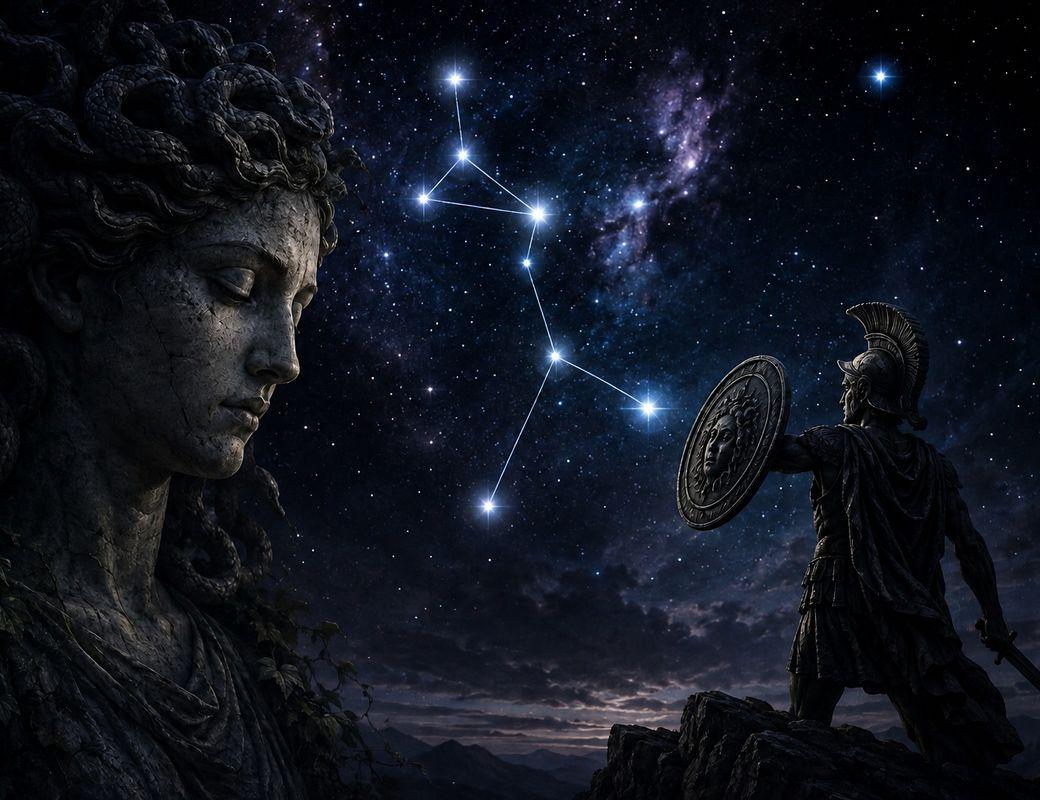
In traditional representations, Perseus carries the severed head of Medusa. Algol marks the region associated with the Gorgon’s head, often represented as one of her eyes.
Its familiar name came through Arabic astronomical tradition from ra’s al-ghul, commonly translated as “the head of the ghoul.” Later European traditions also gave Algol the dramatic nickname “Demon Star.”
These historical names can sound startling to modern ears, but they are better understood within the cultural and astronomical traditions that produced them. They do not describe anything scientifically dangerous or malevolent about Algol itself.
Instead, they preserve part of the history of how people mapped stories onto the night sky.
Algol also acquired a challenging reputation within traditional astrology. Earlier astrologers sometimes interpreted unusual celestial objects through ideas about fate, temperament, fortune, and human events that were common within their own historical systems.
Modern astrology is not required to treat those older interpretations as fixed predictions.
That distinction is important.
Astronomy tells us what Algol is and why its brightness changes. Traditional astrology tells us how some people historically interpreted it. Mythology tells another story still.
Each is a different lens.
And one of the most interesting lenses through which to understand Algol belongs to Medusa herself.
Medusa: Power, Protection, and Changing Meaning
Most people recognize Medusa immediately.
Snakes coil through her hair, and her gaze has the power to turn those who meet it to stone. Perseus eventually defeats her by avoiding her direct gaze, traditionally using a reflective shield to approach her safely.
Yet there is more than one layer to Medusa’s story.
In early Greek tradition, the Gorgons were three sisters: Stheno, Euryale, and Medusa. Hesiod describes them as daughters of the sea deities Phorcys and Ceto. Unlike her immortal sisters, Medusa was mortal.
The familiar account in which Medusa begins as a beautiful young woman and is transformed after an encounter with Poseidon comes considerably later, most famously through the Roman poet Ovid in the Metamorphoses.
That distinction matters.
Medusa’s story changed across centuries, and even in the ancient world her image carried meanings more complicated than simple fear.
The Gorgoneion, an image of the Gorgon’s face, was used as an apotropaic symbol intended to ward away harm. Gorgon imagery appeared on shields, armor, architecture, coins, temples, and other objects throughout the Greek world.
Athena herself is frequently depicted carrying the Gorgon’s image on her aegis.
This gives us a very different way of looking at Medusa.
The same image capable of representing formidable power could also represent protection.
Something that appeared frightening could stand guard.
Something powerful did not have to be understood as evil.
And that complexity has helped Medusa remain meaningful long after the ancient stories that first introduced her.
Reclaiming Medusa
Modern readers have increasingly returned to Medusa and asked new questions about her story.
What happens when we consider Medusa as more than an obstacle in the story of Perseus?
This is a modern interpretation, not a forgotten meaning recovered from antiquity. Contemporary readings of Medusa, particularly those influenced by Ovid’s version of her story, have increasingly explored themes of survival, boundaries, autonomy, protection, and personal power.
That distinction between ancient tradition and modern interpretation is important.
But stories can acquire new meanings without pretending those meanings were always there.
For some modern readers, Medusa’s gaze can symbolize a boundary. Her protective associations can speak to the difference between shutting out the world and learning when it is healthy to say no. Her continued cultural presence can become a reminder that a person or story does not have to remain confined to the meaning someone else once assigned to it.
There is room here for anger, too, but not as something inherently destructive.
Anger can sometimes tell us that a boundary has been crossed or that something important needs our attention. The challenge is not to surrender to it, but to listen to what it reveals and decide what we want to do with that information.
Healing does not require pretending difficult experiences never happened.
Neither does it require allowing them to define everything that follows.
Sometimes healing is quieter than that. It can mean recognizing what we have survived, understanding what we need now, and choosing which parts of an old story we are ready to carry forward.
Medusa’s modern reclamation speaks to that possibility.
Her strength does not have to disappear for her story to become compassionate.
Her boundaries do not have to disappear for healing to occur.
And perhaps most importantly, the meaning assigned to her thousands of years ago does not have to be the only meaning available today.
The same can be true when we return our attention to Algol.
From Prediction to Reflection
Traditional astrology developed in cultures very different from our own.
Older astrological texts could be strikingly direct in their interpretations of celestial signs. Fate, fortune, temperament, and major life events were sometimes described in ways that can sound rigid to a modern reader.
We do not have to practice astrology that way today.
A modern reflective approach can treat astrological symbolism as an invitation to self-examination rather than a prediction of what must happen.
That shift is particularly useful with Algol.
Rather than asking, “What terrible thing does this star mean?” we can ask a very different question:
What might its symbolism invite us to notice?
Algol’s long history contains themes of intensity, visibility, changing perception, protection, and transformation. Medusa’s evolving story adds questions about boundaries, power, and who gets to determine what a story means.
Those themes can become prompts for reflection rather than warnings.
Where do I need stronger boundaries?
What emotion have I been avoiding because it feels uncomfortable?
What old label am I still carrying even though it no longer describes who I am?
Where have I mistaken strength for hardness?
What would change if I approached a difficult part of myself with curiosity rather than judgment?
There is nothing fatalistic about those questions.
They return the power to the person asking them.
Astrology, approached this way, becomes less about being told what the sky has decided for us and more about using an old symbolic language to consider our own choices, patterns, and possibilities.
Algol does not have to predict anything.
It can simply invite us to look.
The Wisdom of Looking Again
There is something appropriate about contemplating Algol during the darker part of the year.
Not because Algol belongs to Scorpio. It does not. The connection is symbolic rather than astrological.
Autumn naturally brings visible change. Leaves fall. Gardens retreat. Daylight shortens. The world around us offers a reminder that release and renewal are parts of the same larger cycle.
That can make this season a natural time for reflection.
Most of us carry things we would rather not examine too closely. An old hurt. A difficult emotion. A story about ourselves that may once have served a purpose but no longer fits.
Looking at those things does not mean becoming consumed by them.
Sometimes the opposite happens.
Understanding can make something less frightening.
That is precisely what happened with Algol.
For generations, people could see its light change without knowing why. Today we know that one star periodically passes in front of another, temporarily reducing the amount of light reaching Earth.
The star is not disappearing.
Its light has not been destroyed.
Something is simply passing in front of it.
As astronomy, that is straightforward.
As metaphor, it is beautiful.
Darkness can pass across the light without becoming the light itself.
A difficult season can affect us without becoming our entire identity.
An old story can shape us without determining everything that comes next.
A label can follow us for years and still fail to contain the whole truth of who we are.
And sometimes understanding what once frightened us changes our relationship with it completely.
Looking Again at Algol
Algol has been changing its brightness for far longer than human beings have been watching it.
Across generations, people gave that changing light different meanings. Astronomers studied it. Storytellers connected it with Medusa. Astrologers interpreted it through the beliefs of their time.
Eventually, science explained its remarkable rhythm.
Yet understanding Algol did not make the star less fascinating.
If anything, knowing what is happening makes it more extraordinary.
Two distant stars move through their celestial dance, and from roughly 90 light years away, we can watch their alignment change the light that reaches our eyes.
The stories remain part of Algol’s history, too.
We can understand why earlier cultures interpreted the star differently without inheriting every interpretation ourselves. We can encounter Medusa through ancient mythology while also recognizing why her image has acquired new meanings of protection, boundaries, resilience, and personal power.
Knowledge does not have to erase mystery.
Healing does not have to erase history.
And growth does not require pretending that difficult things were never difficult.
Sometimes it begins simply by looking again.
So when you find Perseus in the night sky and locate Algol, you are looking at more than one remarkable star system.
You are looking at thousands of years of human beings trying to understand what they saw above them.
And perhaps there is something worth carrying away from that long history.
Our first interpretation does not always have to be our final one.
Sometimes a mystery becomes knowledge. Sometimes an old story reveals another side. Sometimes what once inspired apprehension becomes an invitation to curiosity.
And sometimes, when something passes between us and the light, we discover that the light was there all along.
Responses
No responses yet — start the conversation.