The Eternal Twins: Castor and Pollux
A Journey Through Astronomy, Mythology, and Humanity’s Fascination With Gemini
Article · 14 min read · ·
Introduction: Two Lights in the Winter Sky
On clear winter nights, when Orion rises over the horizon and the Milky Way stretches like frost across the darkness, two bright stars appear close together in the constellation of Gemini. They are not the most brilliant stars in the heavens, nor the most dramatic. Yet there is something unmistakable about them. Ancient observers looked upward and immediately saw companionship.
These are Castor and Pollux, the celestial twins of Gemini. For thousands of years they have inspired stories about brotherhood, mortality, protection, sacrifice, and the mysterious relationship between the human and divine. Sailors prayed to them during storms. Poets turned them into symbols of devotion. Astronomers eventually discovered that the stars themselves were stranger than mythology had imagined.
What makes Castor and Pollux enduring is not simply their mythological importance. It is the extraordinary way science and story seem to echo one another. One twin became associated with immortality, and today Pollux remains the brighter and more dominant star. The other became associated with mortality and hidden complexity, and modern astronomy revealed Castor to be not one star, but six bound together in an intricate gravitational system.
The story of Gemini exists at the intersection of astronomy, mythology, religion, literature, and cultural memory. To study these stars is to encounter one of humanity’s oldest instincts: the urge to look into the night sky and find meaning written among the lights.
Gemini in the Winter Sky
Gemini occupies a prominent place in the northern celestial hemisphere and is one of the twelve zodiac constellations first catalogued by the Greek astronomer Claudius Ptolemy in the second century. Spanning more than five hundred square degrees of sky, it ranks among the larger modern constellations and is especially visible during the winter months in the Northern Hemisphere.
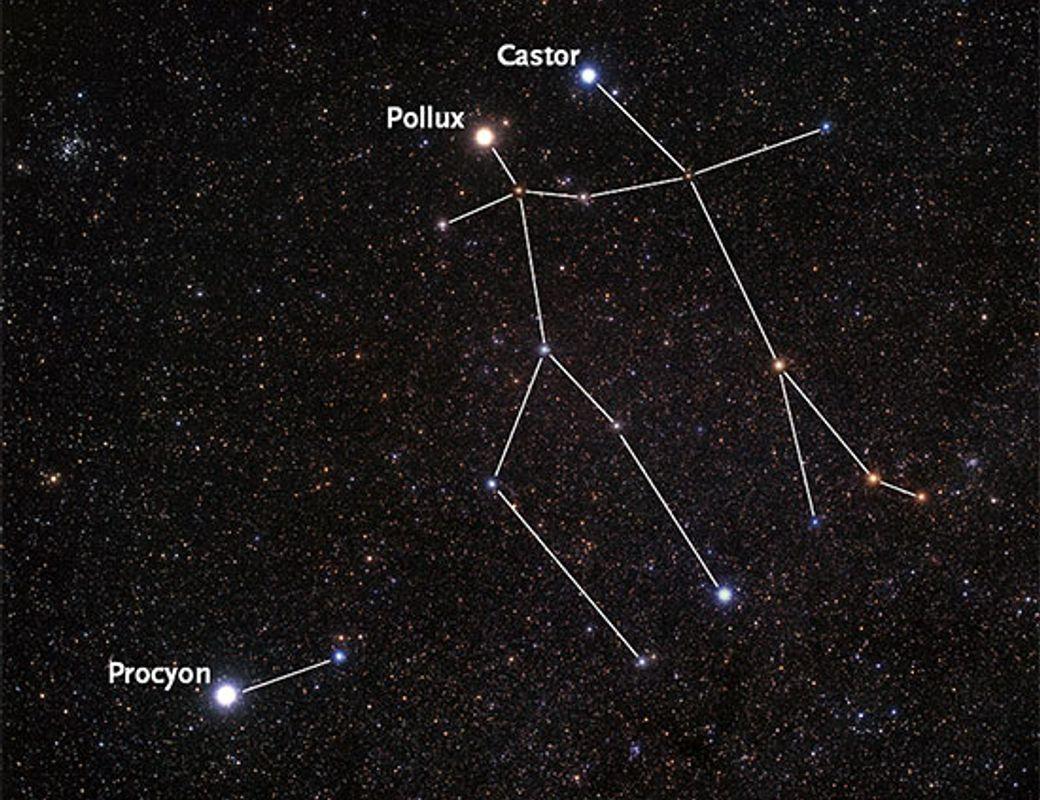
The easiest way to locate Gemini is by first finding the constellation of Orion. By tracing a line upward from Orion’s Belt toward the northeast, observers eventually arrive at the twin stars of Castor and Pollux. Pollux shines with a warm golden hue while Castor appears cooler and whiter, a subtle contrast visible even to the naked eye under dark conditions.
The stars form the heads of the mythological twins, while fainter surrounding stars outline their bodies below. The pattern is simple enough that ancient sailors and travelers could recognize it quickly, which helped make Gemini one of the most enduring constellations in human history.
The constellation contains numerous named stars, many preserving Arabic origins passed through medieval astronomy. Yet despite this larger stellar population, Castor and Pollux have always remained the defining figures. Across civilizations and centuries, they were understood not as isolated lights but as a pair.
That idea, two celestial beings connected to one another, became the foundation for nearly every tradition associated with Gemini.
Pollux, The Immortal Twin
Pollux, formally designated Beta Geminorum, lies approximately 34 light-years from Earth and is the brightest star in Gemini. Despite its “beta” designation, Pollux outshines Castor, a naming inconsistency inherited from earlier astronomers who lacked modern methods for measuring stellar brightness.
The irony is fitting. In mythology, Pollux was the immortal twin, the son of Zeus. In the sky, he dominates the pair.
Pollux is an orange giant star, significantly larger than the Sun and nearing the later stages of stellar evolution. Although cooler than the Sun at roughly 4,600 Kelvin, it shines dozens of times more brightly because of its enormous size. Over hundreds of millions of years, the star exhausted the hydrogen fuel in its core and expanded outward into a giant.
Astronomers consider Pollux particularly important because its spectrum became one of the standard reference points for classifying giant stars. In practical terms, Pollux helped scientists better understand how aging stars evolve.
Yet the star’s greatest surprise was discovered only recently.
Pollux b and the Discovery of an Alien World
In 2006, astronomers confirmed the existence of Pollux b, a massive exoplanet orbiting the star. The discovery came after years of observing subtle shifts in Pollux’s motion, caused by the gravitational pull of the unseen planet.
The world, also called Thestias, is more than twice the mass of Jupiter and orbits Pollux roughly every 590 days. Its mythological name honors the family lineage of Leda, the mother of Castor and Pollux in Greek mythology.
The existence of Pollux b transformed the star into an important object of scientific study. It demonstrated that planetary systems can survive around aging giant stars, offering astronomers insight into the long-term evolution of solar systems.
There is also something strangely poetic about the discovery. The immortal twin, elevated to the heavens in myth, possesses a companion world of his own, circling steadily around an aging amber star.
Castor and the Six-Star System
If Pollux is impressive, Castor is astonishing.
To the naked eye, Castor appears as a single pale star. Through a telescope, however, it resolves into something far more complicated. Castor is actually a system of six stars arranged in three separate binary pairs, all gravitationally bound together.
What appears simple from Earth is, in reality, an intricate stellar architecture.
The discovery unfolded gradually over centuries. Early astronomers first recognized Castor as a double star in the eighteenth century. Later spectroscopic observations revealed that each visible component was itself composed of two stars. What had once seemed like a solitary light became a miniature stellar community.
The system contains hot A-type stars alongside cooler red dwarfs, orbiting one another in layered gravitational relationships. Altogether, the stars possess a combined mass several times greater than the Sun.
The symbolism is difficult to ignore. In mythology, Castor was the mortal twin, the vulnerable counterpart to Pollux’s divinity. Yet the star bearing his name turned out to contain hidden multiplicity, six stars bound together in a relationship of extraordinary complexity.
Even the naming of the pair reflects this paradox. Castor carries the designation Alpha Geminorum, despite Pollux being brighter. The mortal twin received the primary title, and astronomy never corrected the mistake.
Centuries later, the sky still preserves the contradiction.
The Myth of the Dioscuri
The mythology of Castor and Pollux begins with one of the most famous stories in Greek tradition.
Their mother, Leda, attracted the attention of Zeus, who approached her in the form of a swan. According to myth, Leda later bore children fathered by both Zeus and her mortal husband, Tyndareus.
As a result, the twins possessed different destinies. Pollux inherited immortality through Zeus, while Castor remained mortal.
Together they became known as the Dioscuri, the “sons of Zeus,” and developed reputations as heroic protectors associated with horsemanship, warfare, and seafaring.
The Argonauts and the Heroic Age
Castor and Pollux joined Jason and the Argonauts in the quest for the Golden Fleece. Ancient traditions describe the twins as brave and dependable companions whose presence helped guide the expedition safely through danger.
Their connection to sailors became especially important after stories emerged linking the twins to mysterious lights seen during storms at sea, a phenomenon later identified as St. Elmo’s fire. Ancient mariners interpreted the glowing lights as signs that the Dioscuri were protecting their ships.
The Death of Castor
The emotional center of the myth arrives with Castor’s death.
Accounts differ regarding the exact cause, but most traditions describe a violent conflict between the Dioscuri and rival twins named Idas and Lynceus. During the battle, Castor was killed.
Pollux, unable to bear the separation, begged Zeus to allow his brother to share immortality. Rather than remain eternal alone, he chose companionship over divine privilege.
Moved by the request, Zeus transformed the twins into the constellation Gemini. In some versions, they divide their existence between Olympus and the underworld. In others, they remain forever among the stars.
The story endured because it transformed grief into permanence. The heavens themselves became a monument to brotherhood.
Rome and the Cult of the Twins
The mythology of the Dioscuri did not end in Greece. The Romans adopted Castor and Pollux enthusiastically, integrating them into state religion and military tradition.
According to Roman legend, the twins appeared during the Battle of Lake Regillus in the early Republic. Two mysterious horsemen riding white horses were said to have aided the Roman army before later appearing in the Forum to announce victory.
The figures were identified as Castor and Pollux.
In response, Rome constructed the Temple of Castor and Pollux in the Roman Forum, where the twins became associated with cavalry, military ceremony, and civic identity.
The Dioscuri also developed connections to the festival of Saturnalia, a celebration marked by feasting, gift-giving, and reversals of social order. Their role within Roman religion emphasized loyalty, protection, and partnership, themes that remained central to their mythology from the Greek world onward.
As Roman influence spread across the Mediterranean, so too did the symbolism of the celestial twins.
Twin Stars Across Cultures
One of the most striking aspects of Castor and Pollux is how consistently cultures interpreted them as paired figures, even when separated by geography and language.
The ancient Babylonians identified the stars as the “Great Twins,” associating them with underworld deities connected to death and transition. Egyptian traditions represented Gemini through paired figures symbolizing unity and complementarity. Arabian astronomers imagined twin peacocks, while Vedic traditions linked the stars to the Ashvins, divine horsemen associated with healing and dawn.
In Norse mythology, scholars have proposed connections between the stars and stories surrounding Loki and the giant Þjazi. Indigenous traditions across the world likewise interpreted the stars as paired beings, animals, or symbolic counterparts.
What emerges from this global pattern is not coincidence but convergence. Human beings repeatedly looked at the same two lights and arrived at similar conclusions. The stars suggested relationship. They implied balance. They invited stories about partnership, mortality, and the tension between opposing forces.
The idea of divine twins may reach back into the earliest layers of Indo-European mythology and perhaps even deeper into prehistoric storytelling traditions. Long before formal astronomy existed, humanity was already using the heavens to think about duality itself.
Gemini and Astronomical Discovery
Gemini has also played an important role in the history of scientific discovery.
In 1781, William Herschel observed an unfamiliar object near the star Propus while studying the constellation. That object eventually proved to be Uranus, the first planet discovered in modern history.
The discovery permanently changed humanity’s understanding of the Solar System. For centuries, astronomers believed the known planets represented a complete cosmic order. Uranus shattered that assumption and expanded the boundaries of the known universe.
Gemini later became connected to another major discovery. Near the star Wasat, astronomers identified Pluto in 1930, opening the door to our understanding of the distant Kuiper Belt beyond Neptune.
These discoveries reinforced Gemini’s longstanding association with revelation and transition. The constellation repeatedly became a place where old assumptions ended and new knowledge began.
Deep-Sky Objects in Gemini
Beyond its mythology and famous twin stars, Gemini contains several remarkable deep-sky objects.
Messier 35
Messier 35 is one of the finest open clusters visible from Earth. Located near the feet of Gemini, the cluster contains hundreds of stars scattered across a region nearly the size of the full Moon in the night sky.
Through binoculars or a telescope, M35 appears as a glittering spray of young blue-white stars. At roughly 150 million years old, it remains relatively youthful by cosmic standards.
The Eskimo Nebula and Medusa Nebula
Gemini also contains the Eskimo Nebula and the Medusa Nebula, both remnants of dying stars expelling their outer layers into space.
These glowing nebulae offer a glimpse into the future awaiting stars like Pollux. Eventually, giant stars shed their outer atmospheres and leave behind compact white dwarfs surrounded by expanding shells of gas.
The mythology of Gemini often focused on mortality and transformation. In an unexpected way, the constellation’s astronomy reflects those same themes.
The Geminid Meteor Shower
Every December, Gemini becomes the radiant point for one of the most spectacular meteor showers visible from Earth.
The Geminids peak around December 13 and 14, producing bright meteors that streak outward from a point near Castor.
Unlike most meteor showers, which originate from comets, the Geminids come from an asteroid called 3200 Phaethon. As the asteroid approaches the Sun, extreme heating causes debris to break away. Earth passes through this material each year, creating the meteor shower.
The association with Phaethon is mythologically fitting. In Greek mythology, Phaethon was the son of Helios who lost control of the Sun’s chariot and set the heavens ablaze.
Today, the Geminids remain one of the most reliable celestial events of the year. Under dark skies, observers can sometimes witness more than one hundred meteors per hour.
There is something unforgettable about standing beneath a December sky while streaks of light flare outward from the constellation of the twins. The spectacle feels ancient, almost ceremonial, as though the mythology of Gemini briefly returns to life overhead.
Gemini in Astrology
Gemini occupies the third sign of the zodiac and is traditionally associated with communication, adaptability, curiosity, and intellectual movement. Ruled by Mercury, the sign inherited much of its symbolic identity from the mythology of Castor and Pollux.
Ancient astrologers often interpreted the twins as representations of complementary forces: mortal and divine, intellect and instinct, movement and reflection. Later traditions expanded these associations into broader ideas about versatility and dual perspective.
The symbolism proved remarkably durable. Even outside formal astrology, Gemini continues to function culturally as shorthand for complexity, multiplicity, and the coexistence of contrasting qualities within a single identity.
The constellation’s enduring power lies in this flexibility. The twins are not opposites locked in conflict. They are partners whose differences create balance.
Project Gemini and the Space Age
The mythology of Gemini eventually followed humanity into space.
During the 1960s, NASA named its two-person spacecraft program Project Gemini after the constellation. The name reflected both the spacecraft’s dual crew and the program’s emphasis on orbital rendezvous, cooperation, and partnership.
Project Gemini served as the bridge between the early Mercury missions and the Apollo Moon landings. Astronauts learned how to perform spacewalks, dock spacecraft together, and survive extended missions in orbit.
The symbolism was appropriate. Just as Castor and Pollux journeyed together through myth, Gemini astronauts entered the unknown in pairs.
Pollux also maintained a practical navigational role. Among the stars selected for celestial spacecraft navigation, Pollux became the sole representative from Gemini.
Across thousands of years, the immortal twin continued guiding travelers.
Castor and Pollux in Art and Literature
The story of the Dioscuri has inspired artists, poets, and musicians for centuries.
Ancient Greek pottery frequently depicted the twins alongside Leda, Helen of Troy, and scenes from the Argonaut expedition. Roman sculpture celebrated them as cavalry heroes, while Renaissance and Baroque artists emphasized the emotional drama of Castor’s death and Pollux’s sacrifice.
In music, Jean-Philippe Rameau transformed the myth into the opera Castor et Pollux, one of the masterpieces of French Baroque composition.
Literary references to the twins appear throughout classical and modern traditions, from Pindar and Virgil to William Shakespeare. Again and again, writers returned to the same emotional core: devotion strong enough to challenge mortality itself.
The mythology endured because it speaks to experiences larger than astronomy. At its center is a simple human fear, the terror of separation, and an equally human hope that love might survive beyond death.
The Stars That Remain Together
On winter evenings, Castor and Pollux still rise together above the horizon exactly as they did for the ancient world.
Modern astronomy has transformed our understanding of these stars, revealing exoplanets, giant stellar evolution, and hidden multiple-star systems. Yet scientific discovery has not diminished the mythology surrounding them. If anything, it has deepened it.
The ancient Greeks imagined two brothers bound so closely that neither could endure separation from the other. Centuries later, astronomers discovered that Castor is literally a system of stars held together by gravity in an immense celestial dance, while Pollux possesses a planetary companion orbiting nearby.
The symbolism survived because it continues to feel true.
Across civilizations, humanity repeatedly looked upward and saw the same thing: partnership, balance, and connection. The names changed. The stories evolved. But the emotional interpretation remained remarkably consistent.
Every December, the Geminids streak across the sky near Castor’s pale light. Every winter, Pollux glows above the horizon with its steady amber brilliance. Sailors, priests, astronomers, poets, and astronauts have all looked toward the same constellation and found meaning there.
The stars remain where they have always been, side by side in the winter sky.
Still together after all this time.
Responses (1)