Regulus: The Heart of the Lion
The Royal Star That Has Guided Kings, Mystics, and Stargazers for More than 2000 Years
Article · 10 min read · ·
Introduction: A King Among the Stars
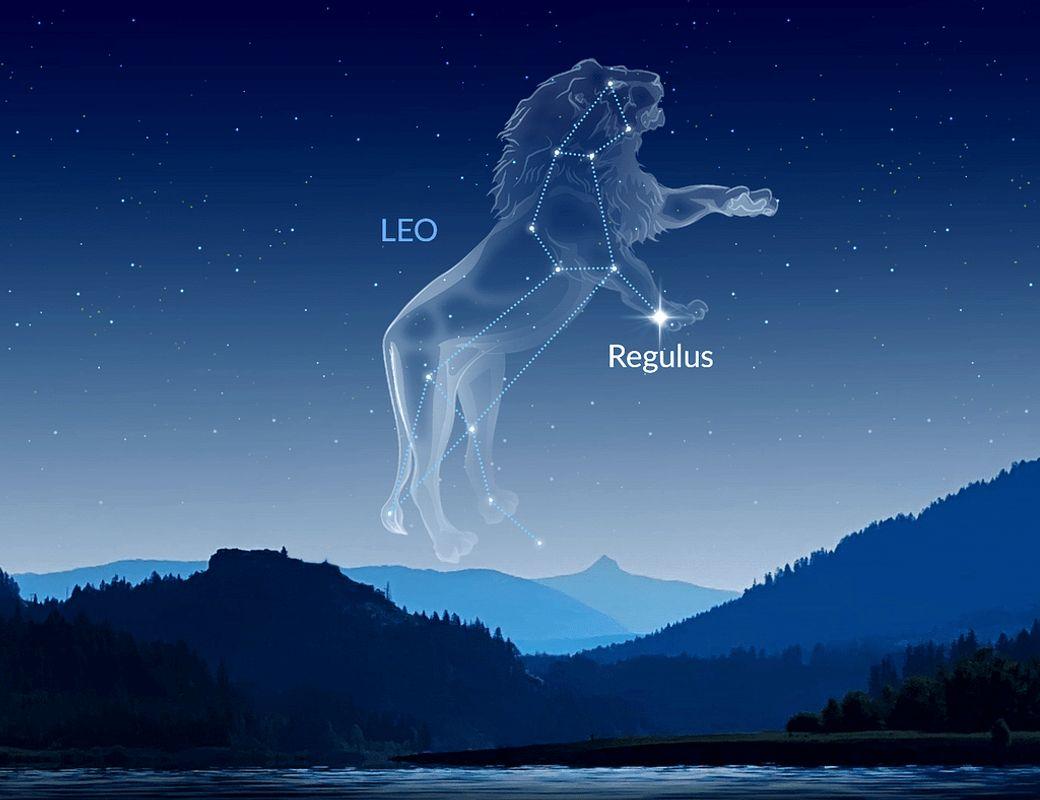
When spring arrives in the Northern Hemisphere and the last traces of winter fade from the evening sky, a great lion rises above the eastern horizon. Its body stretches across nearly a hundred degrees of sky, anchored at the heart by a single brilliant point of light. Ancient observers across civilizations looked at this pattern and arrived at the same conclusion: here was a king, crouched and watchful, ruling the heavens as lions ruled the earth.
This is Leo, and at its center burns Regulus, the Little King. For thousands of years, the star has been associated with royalty, power, and authority. Babylonian astronomers tracked it as a marker of kingship. Persian sky watchers placed it among the Four Royal Stars. Medieval astrologers ranked it among the most influential fixed stars in the heavens, believed to grant honor, leadership, and visibility, while also carrying the risk of pride and reversal.
What makes Regulus endure is not only mythology, but the way modern astronomy has revealed a reality even more complex than the symbolic one built around it. What appears as a single steady point of light is, in fact, a rapidly evolving multiple star system shaped by extreme rotation, past stellar interaction, and long gravitational history. The lion in the sky has always been more intricate than it appears, and each layer we uncover only deepens the sense of structure behind the myth.
To understand Leo fully, we first have to begin with what it physically is, before moving into what it has meant to human imagination across time.
Leo in the Spring Sky
Leo is one of the twelve zodiac constellations and among the most recognizable patterns in the night sky. It spans a wide region of the celestial sphere and was formally cataloged by Claudius Ptolemy in the second century, preserving traditions that were already ancient in his time.
The constellation is easiest to locate using the Big Dipper as a guide. The two outer stars at the end of its bowl point downward toward a curved arc of stars known as the Sickle of Leo. This pattern outlines the lion’s head and mane, forming one of the clearest seasonal silhouettes in the sky. At the base of the Sickle shines Regulus, marking the heart of the lion. From there, the pattern extends outward into a faint triangular arrangement of stars that suggest the lion’s body and tail.
Leo also forms part of the Spring Triangle alongside Arcturus in Boötes and Spica in Virgo, a seasonal configuration that becomes especially prominent in the Northern Hemisphere as winter constellations begin to fade. For ancient sky watchers, this shifting geometry was not only visual but temporal, marking the slow transition from cold to renewal.
Unlike many other zodiac figures, Leo is visually anchored by a single dominant star. Regulus outshines every other star in the constellation by a significant margin, and that imbalance of light helped shape its symbolic identity. One bright center surrounded by fainter structure naturally suggests hierarchy, and in Leo that hierarchy becomes the image of a throne.
Regulus, the Heart of the Lion
Regulus, formally designated Alpha Leonis, lies approximately 79 light-years from Earth and holds the distinction of being both the brightest star in Leo and the twenty-first brightest star in the night sky. Its name comes from the Latin Regulus, meaning “little king,” a name that reflects both its brilliance and its historical role in astrology and early astronomy. Earlier traditions referred to it as Cor Leonis, the Heart of the Lion, while Arabic astronomers called it Qalb al-Asad.
Regulus is a blue-white B-type star, significantly hotter and more massive than the Sun. It contains about 3.8 solar masses and emits nearly 300 times the Sun’s luminosity. This intensity gives it a sharp, steady appearance in the night sky, even though at its distance it is fundamentally no more than a point of light to the naked eye.
What makes Regulus especially unusual is its rotational behavior.
The star spins at extreme speed, completing a full rotation in just under 16 hours. By comparison, the Sun takes roughly 27 days. This rapid motion has fundamentally altered its structure, flattening it into an oblate shape with a pronounced equatorial bulge and compressed poles. The difference is not subtle at stellar scales. Regulus is visibly distorted when measured through astrophysical modeling.
It is estimated to rotate at roughly 86 to 90 percent of its breakup velocity. At that threshold, centrifugal force would overcome gravitational cohesion and the star would begin shedding material into space. Regulus exists, in a very literal sense, at the edge of structural stability.
This creates a compelling contrast with its symbolic identity. The “heart of the lion,” long associated with stability and authority in human interpretation, is physically a system defined by tension, rotation, and near-critical balance.
The Hidden Quadruple System
For most of human history, Regulus appeared as a single star. Only with advances in spectroscopy and high-resolution observation did its internal structure become visible.
Today it is understood as a quadruple star system composed of two gravitationally bound binary pairs.
The inner system, Regulus A, consists of the visible blue-white primary star and a close companion believed to be a white dwarf. These two orbit each other roughly every 40 days, locked in a tight gravitational relationship that significantly influences the dynamics of the system.
Evidence suggests that the white dwarf was once a more massive star that expanded and transferred material to its companion during a later stage of stellar evolution. This mass transfer likely accelerated Regulus A’s rotation, providing a physical explanation for its extreme spin rate and distorted shape. In this sense, the star’s current behavior is not isolated but the result of a long and interactive history.
Farther out lies Regulus B and Regulus C, a pair of red dwarf stars orbiting the central system at a vast distance. Their orbital period stretches across tens of thousands of years, making their motion so slow that it is essentially static on human timescales.
Taken together, Regulus is not a single object but a compact stellar system bound across multiple gravitational scales. What appears as unity from Earth is in reality a layered structure of interacting bodies separated by immense distances.
Algieba and the Structure of the Lion
Within the Sickle of Leo lies Algieba, also known as Gamma Leonis, another important point in the constellation’s architecture.
Algieba is a binary star system located approximately 130 light-years away. It consists of two evolved giant stars in a long orbit lasting around 500 years. Through telescopic observation, the pair appears as two golden suns nearly matched in brightness, separated by a delicate but measurable gap.
The primary star has expanded dramatically to more than 20 times the diameter of the Sun, while its companion is slightly smaller but similarly luminous. Their shared evolution produces a warm golden hue that contrasts strongly with Regulus’s blue-white intensity.
In 2009, astronomers confirmed a massive exoplanet orbiting one of the stars, expanding the system into a multi-layered structure that includes both stellar and planetary components.
Where Regulus represents compression, speed, and energetic tension, Algieba represents expansion, balance, and long-term orbital rhythm. Together they form complementary expressions of stellar behavior within the same constellation.
Deep Sky Structures Within Leo
Beyond its bright stars, Leo opens onto deeper layers of the universe, revealing galaxies and systems far beyond the Milky Way.
The Leo Triplet consists of galaxies Messier 65, Messier 66, and NGC 3628, located about 35 million light-years away. These galaxies are gravitationally interacting, slowly distorting one another’s shapes over cosmic time. NGC 3628 is especially notable for its prominent dust lane and extended tidal tail, evidence of repeated gravitational encounters.
Leo also contains the Leo I Galaxy Group, including Messier 95, Messier 96, and Messier 105. These galaxies display distinct evolutionary paths, ranging from tightly wound spirals rich in star formation to smooth elliptical systems dominated by older stellar populations.
Closer to our own galaxy, Leo I and Leo II are faint dwarf satellite galaxies orbiting the Milky Way. Leo I, in particular, is one of the most distant known satellites and provides valuable insight into early galaxy formation and the structure of the local group.
Seen together, these structures transform Leo from a simple constellation into a cross section of cosmic scale, linking nearby stars to galaxies tens of millions of light-years away.
The Leonid Meteor Cycle
Each November, Earth passes through a stream of debris from Comet Tempel-Tuttle, producing the Leonid meteor shower.
In most years, the shower is modest. However, on a roughly 33-year cycle, it can intensify into meteor storms. The most famous occurred in 1833, when observers recorded thousands of meteors per minute radiating from Leo. The event was so dramatic that it became one of the first major catalysts for understanding meteor showers as astronomical, not atmospheric, phenomena.
Significant storms followed in 1866, 1966, and again around 1999 to 2001, each reinforcing the pattern of periodic intensity tied to the comet’s orbit.
These events add a dynamic layer to Leo’s identity, connecting the static stars of the constellation with episodic bursts of motion and light.
The Myth of the Nemean Lion
In Greek mythology, Leo represents the Nemean Lion, a creature whose hide could not be pierced by any weapon.
Heracles ultimately defeated it during the first of his twelve labors by strangling it in its cave after weapons proved useless. He then used its own claws to remove its invulnerable hide and wore it as armor.
Zeus placed the lion among the stars, transforming it into a permanent celestial form.
The myth centers on endurance and transformation, emphasizing that certain forces require adaptation rather than force.
A King Before the Greeks
Long before Greek mythology, Leo appeared across multiple ancient cultures as a symbol of authority and power.
In Babylonian tradition, it was the Great Lion, with Regulus associated with kingship and fate. In Egypt, lion imagery reflected solar power and protection. Persian astronomers included Regulus among the Four Royal Stars. In Vedic and Chinese systems, this region carried associations with lineage, fire, and seasonal transition.
Across these traditions, the same symbolic structure emerges independently, a bright central star within a lion shaped pattern consistently interpreted as authority and sovereignty.
Rome and the Royal Star Tradition
Roman and Hellenistic astrologers formalized Regulus as one of the Four Royal Stars alongside Aldebaran, Antares, and Fomalhaut.
Regulus was associated with leadership, honor, and success, but also carried warnings about downfall when pride or revenge dominated behavior.
In medieval astrology, it became part of talismanic traditions and was symbolically linked with gold and protective herbs.
Across time, its meaning remained structurally stable, centered on elevation paired with consequence.
Leo in Astrology
Leo is the fifth sign of the zodiac, associated with confidence, creativity, leadership, and self-expression. Ruled by the Sun, it reflects vitality, visibility, and presence.
It represents the archetype of the sovereign and performer, emphasizing both expression and responsibility.
The Lion in Human Culture
Across civilizations, lions appear as symbols of authority, protection, and strength.
From the Great Sphinx of Giza to the winged lion of Venice, the image of the lion has been used to represent divine and royal power. In European heraldry, it became one of the most enduring symbols of monarchy.
Across myth and literature, the lion persists as a figure of vigilance and nobility, mirroring the steady presence of Regulus in the night sky.
The King That Never Fades
On spring evenings, Leo rises as it always has, with Regulus burning steadily at its heart.
Modern astronomy reveals a system of remarkable complexity, but that complexity only deepens its symbolic resonance rather than diminishing it.
Across civilizations and centuries, observers have seen the same pattern: a lion, a throne, and a star that appears to hold its center.
Regulus continues to rise each year in the same place, marking the heart of Leo, reminding us that even in a universe governed by physics, meaning still emerges from structure, repetition, and light.
The lion remains in the sky, patient, watchful, and unchanged to the human eye, even as the cosmos moves quietly beneath it.
Responses
No responses yet — start the conversation.