Ophiuchus: The Serpent Bearer
The Lost Constellation of the Zodiac, and the Ancient Mystery Written in the Stars
Article · 14 min read · ·
The Serpent Bearer, the Forgotten Constellation Along the Zodiac, and the Ancient Mystery Written in the Stars
Most people grow up believing there are twelve constellations of the zodiac. Aries, Taurus, Gemini, Cancer, Leo, Virgo, Libra, Scorpio, Sagittarius, Capricorn, Aquarius, and Pisces have become so deeply woven into popular culture that they seem fixed and unquestionable. Yet each year, as the Sun makes its annual journey across the sky, it briefly passes through a thirteenth constellation, one that has been recognized by astronomers for more than two thousand years. That constellation is Ophiuchus, the Serpent Bearer.
Its existence often comes as a surprise. Every few years, headlines proclaim the discovery of a “new zodiac sign,” prompting debates about whether astrology has been wrong all along. In reality, Ophiuchus is neither new nor forgotten by astronomers. It has appeared on star charts since antiquity and has long occupied a place along the Sun’s apparent path through the heavens. The real mystery is not whether Ophiuchus exists, but why it never became one of the twelve traditional signs of the zodiac.
The answer takes us back thousands of years to the earliest civilizations of Mesopotamia, where priest-astronomers first mapped the movements of the Sun, Moon, and planets with remarkable precision. Their observations laid the foundation for the zodiac, a system that would later be refined by Greek scholars and preserved through Roman and medieval astronomy. Along the way, Ophiuchus remained a familiar constellation, even as the zodiac itself evolved into the twelve-sign system that continues to shape Western astrology today.
Yet astronomy tells only part of the story. Like many constellations, Ophiuchus inspired myths that reflected the values and beliefs of the cultures that studied it. To the Greeks, it became the image of Asclepius, the legendary physician whose extraordinary skill in healing earned him a place among the stars. Earlier civilizations saw different meanings in the same region of the sky, connecting it with divine guardianship, renewal, and the pursuit of knowledge. Although these stories varied across cultures, they reveal a shared human desire to understand the heavens through both careful observation and imagination.
Today, Ophiuchus occupies a unique position in the conversation between astronomy and astrology. It reminds us that the night sky is more complex than it first appears and that the history of the zodiac is richer than the familiar twelve signs suggest. Far from being a recently discovered constellation or a forgotten chapter of astronomy, the Serpent Bearer offers a fascinating window into humanity’s earliest attempts to measure time, interpret the heavens, and find meaning among the stars.
To understand why Ophiuchus continues to spark curiosity in the modern world, we must first become acquainted with the constellation itself before tracing the remarkable journey that carried it from the astronomers of ancient Mesopotamia to the star charts we use today.
Ophiuchus at a Glance
Before exploring why Ophiuchus has occupied such a unique place in the history of the zodiac, it is worth becoming familiar with the constellation itself. Although it rarely receives the same attention as Orion, Scorpius, or Ursa Major, Ophiuchus is one of the largest and most impressive constellations in the night sky.
Its name comes from the ancient Greek words ophis, meaning “serpent,” and ekhein, meaning “to hold” or “to bear,” giving rise to the title “the Serpent Bearer.” Officially abbreviated as Oph, it belongs to the Hercules family of constellations and spans nearly 950 square degrees of the sky, making it the eleventh largest of the eighty-eight modern constellations recognized by the International Astronomical Union.
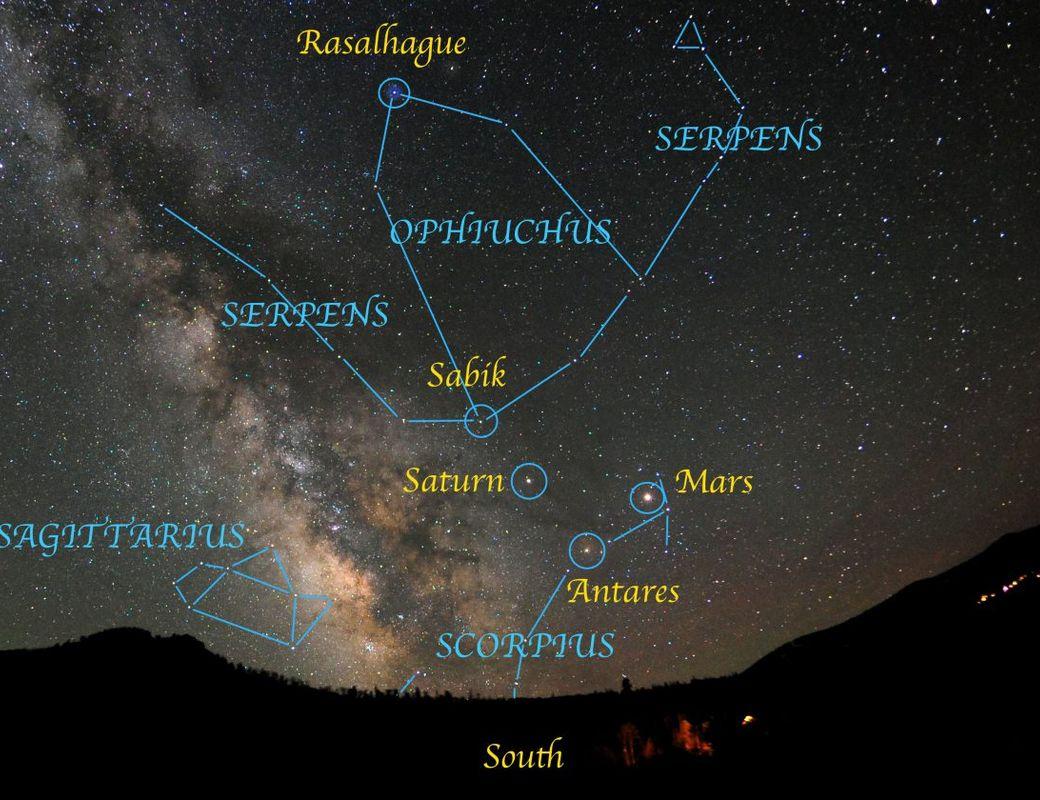
The constellation’s brightest star is Rasalhague, whose Arabic name translates as “the Head of the Serpent Bearer.” Positioned at the figure’s head, it serves as an excellent guide for identifying the constellation. Ophiuchus is visible from much of the world and is best observed during the Northern Hemisphere summer, when it reaches its highest point in the evening sky.
Unlike many constellations that are easy to recognize at first glance, Ophiuchus reveals itself gradually. Its stars form a broad human figure standing between the two halves of the constellation Serpens, creating the striking image of a person grasping a great serpent in both hands. This unusual arrangement is unique among the modern constellations and has helped make the Serpent Bearer one of the most recognizable figures in celestial mythology.
Beyond its distinctive appearance, Ophiuchus occupies one of the richest regions of the Milky Way. Within its boundaries lie ancient globular clusters, nearby stars, and the remnants of historic stellar explosions, making it a rewarding destination for both casual skywatchers and experienced observers.
Its true distinction, however, is not its size or beauty, but its location. Ophiuchus lies directly along the Sun’s annual path across the sky, a position that has fueled centuries of curiosity and one of astronomy’s most enduring misconceptions.
Among the Stars: Exploring Ophiuchus
Every constellation tells a story, but before those stories were ever written, they were simply patterns of stars observed by generations of skywatchers. Ophiuchus is no exception. Long before it became associated with legendary healers or debates about the zodiac, it was a familiar landmark for those who carefully watched the changing seasons and the nightly movement of the heavens.
Ophiuchus is located near the celestial equator, nestled between the constellations of Scorpius and Sagittarius. These neighboring constellations provide the easiest way to locate the Serpent Bearer. Scorpius is readily identified by the brilliant red star Antares, while Sagittarius is famous for the distinctive pattern known as the “Teapot.” Between them rises the broad outline of Ophiuchus, stretching across one of the brightest and most densely populated regions of the Milky Way.
Because the constellation lies close to the Milky Way’s central plane, it is filled with remarkable celestial treasures. Its brightest star, Rasalhague, lies approximately forty-seven light-years from Earth and shines as a luminous white giant. Another notable star, Sabik, is a binary system whose two stars orbit one another in a celestial dance that has fascinated astronomers for generations.
The constellation is also home to Barnard’s Star, one of the Sun’s nearest stellar neighbors. Although invisible to the naked eye, this faint red dwarf has one of the fastest apparent motions across the sky, making it an important object of study for astronomers investigating the dynamics of nearby stars.
For observers using binoculars or a small telescope, Ophiuchus offers an abundance of deep-sky objects. Among its most celebrated are the globular clusters Messier 10, Messier 12, and Messier 14, each containing hundreds of thousands of ancient stars packed tightly together by gravity. The constellation also contains the dark Pipe Nebula, a vast cloud of interstellar dust silhouetted against the glowing backdrop of the Milky Way, and the remnants of Kepler’s Supernova, the brilliant stellar explosion observed in 1604 that helped transform humanity’s understanding of the universe.
Yet one feature of Ophiuchus stands above all the others. Each year, as Earth journeys around the Sun, the Sun appears to pass directly through the constellation for approximately eighteen days, from late November into mid-December. This simple astronomical fact has sparked countless debates, inspired sensational headlines, and led millions of people to ask the same question: if the Sun travels through Ophiuchus every year, why isn’t it one of the zodiac signs?
To answer that question, we must journey back more than three thousand years to the earliest civilizations of Mesopotamia, where the zodiac itself first began to take shape.
The Making of the Zodiac: Why Ophiuchus Was Never Truly Lost
The story of Ophiuchus cannot be told without first understanding the origins of the zodiac itself. Although many people associate the zodiac with astrology, it began as an astronomical tool, one developed by some of the earliest civilizations to track the passage of time and make sense of the changing sky.
More than three thousand years ago, the priest-astronomers of ancient Mesopotamia carefully observed the movements of the Sun, Moon, and the five visible planets. They noticed that these celestial bodies all appeared to travel across the same narrow band of the sky, a pathway now known as the ecliptic. By recording these movements over centuries, they created one of humanity’s earliest and most sophisticated systems for measuring the heavens.
These observations eventually led to the creation of the zodiac. Rather than representing a collection of myths, the zodiac originally served as a practical celestial calendar. It allowed astronomers to predict the changing seasons, regulate agriculture, establish religious festivals, and improve the accuracy of their calendars. In many ways, it became one of the world’s first scientific frameworks.
The Babylonians recognized numerous constellations along and near the ecliptic, many of which were preserved in astronomical texts such as the MUL.APIN tablets. Among them was the region of the sky we now call Ophiuchus. Its stars were familiar to these early observers, and its position along the Sun’s annual path was well understood.
Yet when Babylonian astronomers formalized the zodiac, they chose a system of twelve equal divisions, each spanning thirty degrees of the sky. The decision was both practical and mathematical. Their base-sixty numbering system divided naturally into twelve, while a twelve-part zodiac corresponded closely with the twelve lunar cycles that occur during a solar year. This elegant arrangement produced a calendar that was both orderly and remarkably effective.
The constellations themselves, however, were never equal in size. Virgo stretches across a vast portion of the sky, while Scorpius occupies a comparatively small region. Ophiuchus also extends across the ecliptic, but its irregular shape did not fit neatly into the standardized system the Babylonians had created. Rather than redesigning the zodiac to accommodate every constellation touched by the Sun, they retained twelve equal divisions that were easier to calculate and apply.
This distinction is crucial because it dispels one of the most persistent myths surrounding Ophiuchus. The constellation was never removed from the zodiac because it was never part of the zodiac’s twelve symbolic divisions to begin with. Ancient astronomers knew it was there. They mapped its stars, recorded its position, and incorporated it into their understanding of the heavens. The difference lay not in its existence, but in the purpose of the zodiac itself.
Centuries later, Greek scholars inherited Babylonian astronomy and refined it through mathematics and observation. During the second century BCE, the astronomer Hipparchus discovered the precession of the equinoxes, the slow wobble of Earth’s rotational axis that gradually shifts the apparent positions of the constellations over thousands of years. His discovery transformed astronomy and revealed that the relationship between the stars and the seasons changes over immense spans of time.
Building upon this knowledge, the astronomer Claudius Ptolemy formalized what is now known as the tropical zodiac, dividing the ecliptic into twelve equal signs beginning at the spring equinox. Rather than following the exact boundaries of the constellations, this system tied the zodiac to the seasonal cycle. It became the foundation of Western astrology and remains in widespread use today.
This is where much of the modern confusion begins. In astronomy, a constellation is a precisely defined region of the sky. In astrology, a zodiac sign is a symbolic thirty-degree division of the ecliptic. Although the two once broadly corresponded, they are not the same thing. As a result, the Sun genuinely passes through thirteen constellations each year, including Ophiuchus, while Western astrology continues to use the traditional twelve signs established more than two millennia ago.
Understanding this distinction reveals that Ophiuchus was never hidden, erased, or forgotten. Instead, it has occupied a unique place between two complementary traditions: one concerned with measuring the physical heavens and the other with interpreting their symbolic meaning. That dual identity has helped preserve the Serpent Bearer as one of the most intriguing constellations in the night sky.
The Ancient Story of the Serpent Bearer
While astronomers measured the stars with remarkable precision, the civilizations of the ancient world also filled the heavens with stories that reflected their beliefs, values, and understanding of nature. Like many prominent constellations, Ophiuchus gradually became woven into mythology, with each culture finding its own meaning in the figure holding a serpent.
Some of the earliest connections appear in ancient Mesopotamia, where scholars have drawn parallels between Ophiuchus and the deity Ningishzida. Often depicted with intertwined serpents, Ningishzida was associated with vegetation, renewal, and the sacred knowledge believed to connect the human world with the divine. Although historians continue to debate whether this figure directly inspired the later constellation, the shared imagery demonstrates that the serpent had already become an important symbol long before the rise of classical Greece.
In Egypt, serpents carried equally complex meanings. They appeared as guardians of temples, protectors of pharaohs, and emblems of royal authority through the sacred cobra known as the uraeus. Egyptian religion also celebrated Imhotep, the renowned physician and architect whose wisdom eventually led to his deification. While no surviving Egyptian text identifies Imhotep with Ophiuchus, his legacy illustrates how healing and knowledge were already closely linked in the ancient imagination.
It was the Greeks, however, who gave the constellation the identity by which it is still recognized today. They saw among its stars the figure of Asclepius, the legendary physician and son of Apollo. Trained by the wise centaur Chiron, Asclepius became so skilled in medicine that myths claimed he could heal even the gravest illnesses. One famous legend tells how he learned the secrets of healing after observing a serpent use a medicinal herb to revive another serpent, a story that forever linked the reptile with the medical arts.
According to Greek mythology, Asclepius’s abilities eventually grew so extraordinary that he could restore the dead to life. Fearing that this power threatened the natural order, Zeus struck him down with a thunderbolt. Yet his remarkable gifts were not forgotten. Instead, the king of the gods honored the physician by placing him among the stars, where he would forever stand as Ophiuchus, holding the serpent that had revealed nature’s healing wisdom.
When Rome absorbed Greek culture, Asclepius became known as Aesculapius, and his influence spread throughout the empire. Temples dedicated to the healing god served as centers where medicine, religious practice, and compassionate care came together. The image of a staff entwined by a single serpent, now known as the Rod of Asclepius, survived the centuries and remains the internationally recognized symbol of medicine and healthcare.
The Constellation That Never Truly Disappeared
For more than three thousand years, Ophiuchus has occupied its place along the Sun’s path through the heavens. Ancient astronomers charted its stars, Greek storytellers transformed it into the legendary healer Asclepius, and generations of skywatchers looked to the Serpent Bearer with curiosity and wonder. Yet despite its long history, Ophiuchus remains one of the least understood constellations in the night sky.
Much of its mystery stems from a simple misconception. Ophiuchus was never a “lost” zodiac sign waiting to be rediscovered, nor was it removed from the zodiac by ancient scholars. Instead, it has always occupied a unique position between astronomy and astrology. The constellation exists along the ecliptic, and the Sun passes through it each year, but the twelve-sign zodiac was created as a symbolic system of equal divisions rather than a literal map of every constellation along the Sun’s path. Understanding that distinction does not diminish Ophiuchus. If anything, it makes its story even more fascinating.
Its enduring appeal also reminds us that the night sky has always served two purposes. It has been a subject of careful scientific observation and a source of stories that helped people explain the world around them. Ancient civilizations measured the heavens with remarkable precision, but they also found meaning in the patterns they observed. Ophiuchus stands at the intersection of those two traditions, where astronomical knowledge and cultural imagination meet.
Today, anyone with a clear summer sky can look between Scorpius and Sagittarius and find the stars of the Serpent Bearer stretching across the Milky Way. The constellation may not reveal itself immediately, but there is something fitting about that. Ophiuchus has never been defined by first impressions. Its significance emerges through closer observation, much like the history behind the zodiac itself.
Perhaps that is the greatest lesson of Ophiuchus. The universe often proves more complex, and more fascinating, than our first assumptions suggest. A constellation that many people have never heard of has quietly occupied one of the most important regions of the sky for millennia, reminding us that even familiar traditions can hold forgotten chapters waiting to be explored.
Whether you approach Ophiuchus as an astronomer, a student of history, an admirer of mythology, or simply someone who enjoys looking up at the stars, the Serpent Bearer offers a powerful reminder that the heavens are more than a backdrop to our lives. They are a living archive of human curiosity, preserving the observations, discoveries, and stories of countless generations. Long before telescopes revealed the vastness of the universe, people looked toward these same stars in search of understanding. In many ways, we are still doing the same today.
The next time you find yourself beneath a clear night sky, take a moment to look beyond the familiar constellations. There, between the Scorpion and the Archer, stands the quiet figure of the Serpent Bearer, a constellation that was never truly lost, only waiting for a new generation to rediscover its remarkable story.
Responses (1)