Working with Tarot and Your Shadow
The tarot is not a fortune-telling system. It never was, not really. It’s a mirror.
Article · 6 min read · ·
A note before we begin: This piece moves through shadow work, emotional exile, and the parts of the self we’ve had to put away to survive. It is written for those who are ready to look, not to destabilize, but to illuminate. If you are navigating acute grief, trauma, or crisis, please read this alongside a trusted therapist or support person, or save it for when you have steadier ground. There is no rush. This work has been here a long time. It will wait.
The tarot is not a fortune-telling system. It never was, not really. It’s a mirror. And like most mirrors, it’s only useful if you’re willing to look at what’s actually reflected back.
Most people use the cards to ask about the future. When will things get better? Will he come back? Is this the right path? These are human questions and there’s nothing wrong with them. But they also let us keep the focus outward, which means we never have to turn around and face what’s behind us.
Shadow work changes that ask. When you bring your shadow to the cards, you’re not looking forward. You’re looking down into the parts of yourself you’ve managed, exiled, or forgotten. The cards don’t create that material. They just name what’s already there.
What the Shadow Actually Is
Carl Jung gave us the concept but he didn’t own it. Every wisdom tradition has a version: the parts of the self that don’t fit the acceptable story. The rage you learned to call anxiety. The grief you were told was self-pity. The hunger for power you were taught was unfeminine, inappropriate, too much.
The shadow isn’t your evil twin. It’s not the villain version of you waiting to take over if you slip. It’s the pieces that got cut off, usually early, usually because keeping them meant losing something more essential, like belonging or safety or love.
The problem is that what gets exiled doesn’t disappear. It goes underground and runs things from there. That’s why your most baffling patterns, the ones you can’t logic your way out of, often feel like they belong to someone else. They do. They belong to the part of you that didn’t make it into the approved version of yourself.
The tarot can find them.
Why Tarot Works for This
Tarot is symbolic, which means it speaks in images before it speaks in words. The shadow communicates the same way, in gut responses, in what makes your jaw tighten, and in what you can’t stop looking at even when you’re trying not to.
When a card lands and you have a visceral reaction, not intellectually interesting, but uncomfortable, defensive, that-doesn’t-apply-to-me, that’s the signal. The shadow doesn’t wave its hand calmly. It flinches. It contracts. It says _not that_with a force that’s out of proportion to a piece of illustrated cardboard.
That disproportionate response is data.
Shadow work with tarot isn’t about interpreting what the cards mean according to any book. It’s about noticing what they provoke. The resistance is the reading.
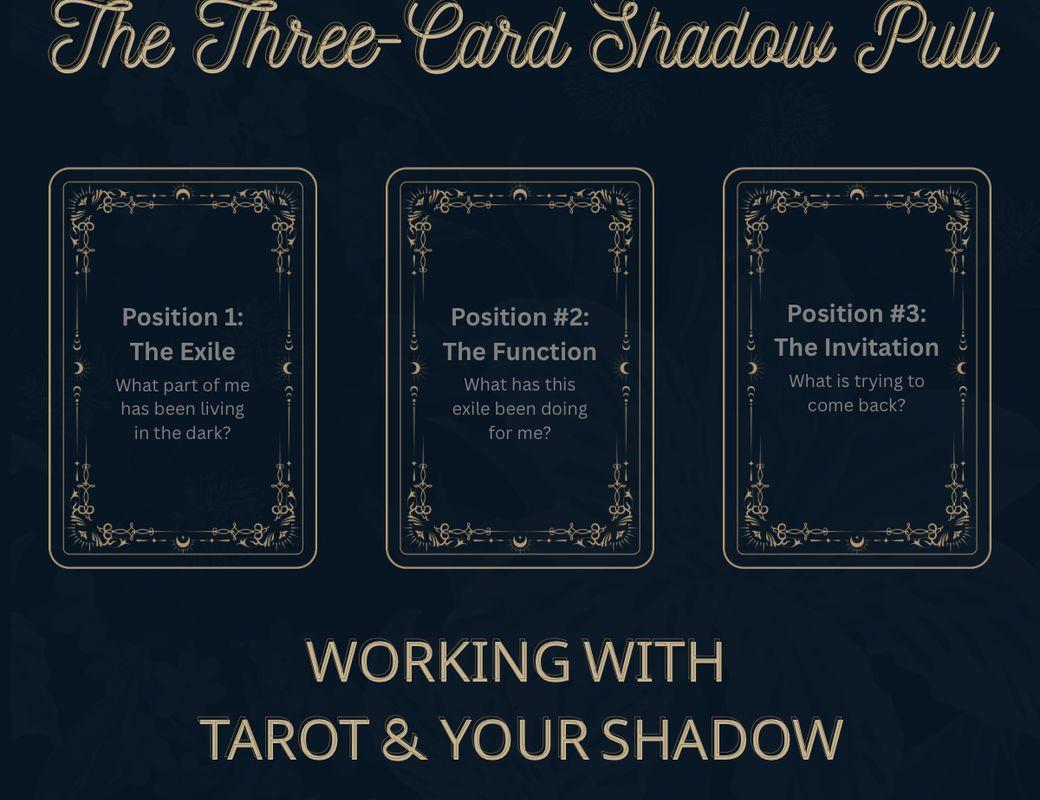
The Three-Card Shadow Pull
This spread has three positions. Use it when you want to begin or deepen shadow work, at a new moon, at a personal turning point, or whenever you sense something running underneath that you can’t name.
Shuffle with intention. Hold the question: Show me what I’ve been looking away from. Pull three cards when you’re ready.
These prompts are honest and direct. Go at your own pace. If something surfaces that feels too large to hold alone, that’s useful information and a therapist or trusted support person is the right place to bring it.
Position 1: The Exile What part of me has been living in the dark?
This card names the quality, emotion, or way of being that you’ve split off. Don’t look for confirmation of what you already know you’ve suppressed. Look for what the card says even if it surprises you, even if it seems too positive (yes, gifts get exiled too: ambition, sensuality, wildness, the desire to be seen).
What is this card naming that you haven’t let yourself be?
Position 2: The Function What has this exile been doing for me?
This is the card people skip, and it’s the most important one. The shadow doesn’t exist by accident. Every part that got exiled got exiled for a reason; it was protecting you, buying you belonging, or keeping something more essential safe. This card names what your shadow has been managing on your behalf, usually without your awareness.
Resist the urge to make this card a villain. Even the most difficult energies here served something real. Ask: what did I need this shadow to carry so I didn’t have to?
You don’t have to resolve this today. You just have to name it. That’s enough to start.
Position 3: The Invitation What is trying to come back?
This card names the movement and offers an invitation. The shadow doesn’t want to stay underground forever. It wants integration. It wants to stop running things sideways and start running things openly, with your full knowledge and consent.
This card tells you what’s ready. Not what you have to do today. What’s knocking.
If what this card surfaces feels connected to deep grief, trauma, or loss that you haven’t had space to process, that material deserves more than a journaling prompt. It deserves real support. Naming that is not weakness; it’s accurate assessment.
Reading the Spread
Sit with each card before you move to the next. Write. Don’t rush toward a clean narrative or a tidy conclusion. The shadow gives you a direction, not a resolution.
Pay particular attention to:
-
Repetition. If a card or archetype keeps appearing across multiple pulls over time, that’s the shadow marking its territory. It will keep showing up until you’re willing to look directly at it.
-
The card you don’t want. If your first response to any card is that doesn’t apply to me, stay there. Resistance is the shadow defending its position.
-
Reversals. If you read with reversals, a reversed card in any of these positions often signals the blocked or disowned version of that energy, something that’s present but not moving freely.
-
What you avoid writing about. You’ll notice a pull to skip certain cards quickly and linger on others. The ones you rush past are usually the ones with the most to say.
This Is Not a One-Time Event
Shadow work is not a project you complete. The shadow isn’t a room you clean out once. It’s a relationship you enter with the parts of yourself that predate your adult reasoning, that learned to survive before they learned to be understood.
The cards give you a language. They give you an image to hold when the work feels too abstract, a symbol to return to when you’ve forgotten what you were looking at. Use them that way. Not as a shortcut but as a companion.
The shadow has been patient with you for a long time. When you are ready, you can afford to be patient with it too.
If you are currently experiencing a mental health crisis or need immediate support, please reach out to a crisis line or mental health professional in your area.
Phoenix Kate is hosting a very small workshop for the first time ever on June 14th. You can find all the details on her new website at phoenixkate.com.
Responses (3)