The Wheel of Fortune's Blueprint
The Shadow of the Spin
Article · 8 min read · ·
After The Hermit's lantern-lit solitude—after you've sat in your own quiet long enough to recognize the shape of your own voice—you emerge from the cave, blink in the open air, and realize:
The ground beneath you is moving.
I used to believe The Wheel of Fortune was about luck. Good luck, bad luck, the cosmic lottery I somehow always lost. I'd pull this card and feel a familiar nausea—here we go again, another turn of the screw, another cycle I didn't ask for.
I was right about the cycle. I was wrong about the luck.
The Wheel isn't about fortune. It's about pattern recognition. It's the card that asks, with the patience of a thousand turning revolutions: "How many times are you going to live the same year before you notice it's the same year?"
I spent a decade spinning. Not moving forward, not moving backward—just rotating. The same type of unavailable partner. The same collapse after the same overextension. The same New Moon vows I'd forgotten by the next Full. I thought I was growing. I was just repeating with better lighting .
The Wheel doesn't punish. It reveals. And what it revealed to me, eventually, was not a curse. It was a curriculum.
The Traditional Blueprint: The Law of Return
The Wheel of Fortune is Card X—the number of completion, of cycles fulfilled, of one door closing so another can open . It is the only Major Arcana card with no human figure at its center. No hero, no guide, no lover. Just the wheel itself, turning in the indifferent sky .
And yet—look closer.
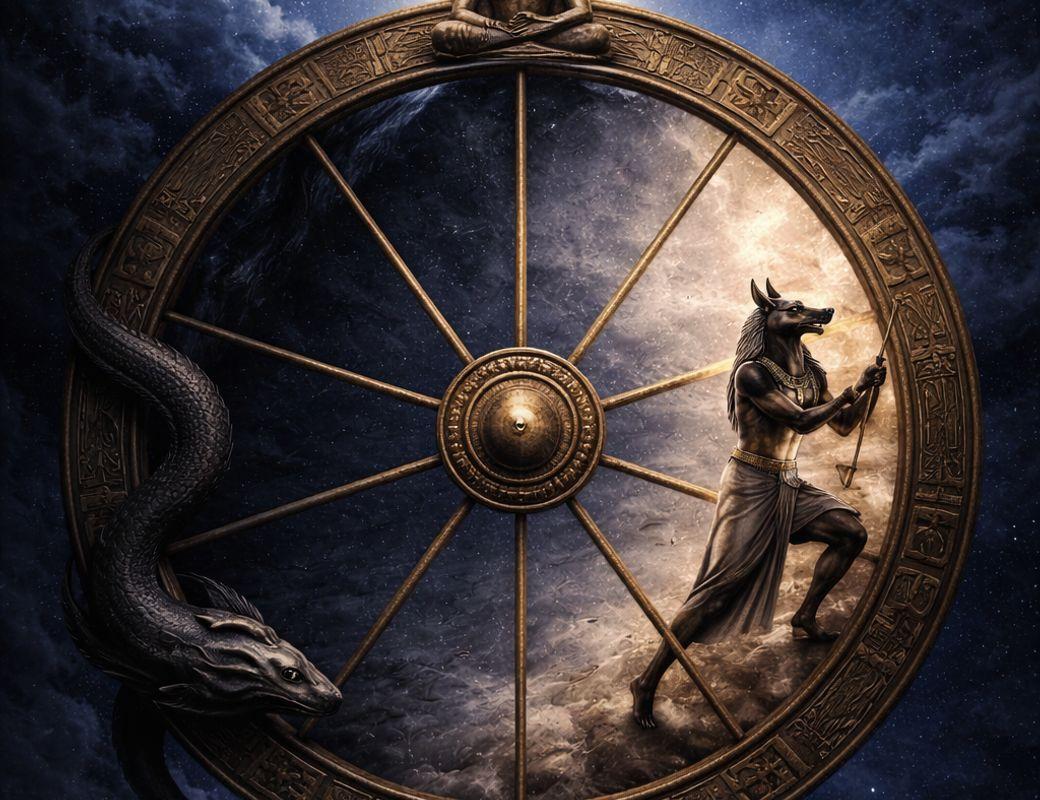
The sphinx sits at the top, sword drawn, waiting. Not to attack. To test. In Egyptian mythology, the sphinx posed riddles at the threshold of sacred spaces. You could not enter without answering. The Wheel asks its own riddle, the same one it has asked every soul who ever stood beneath it: "What in your life is cycling because you haven't learned its lesson?"
Anubis ascends on the right, toward light and consciousness. Typhon descends on the left, toward attachment and forgetfulness. Neither is punished. Neither is rewarded. They simply move with the wheel, as we all do .
The four creatures in the corners—lion, eagle, bull, angel—are the fixed signs of the zodiac, the guardians of stability within the turning. They remind us: the wheel spins, but the center holds .
This card is not about fate. It's about what we do with the spin.
The Shadow Reflection: The Victim and the Controller
When The Wheel of Fortune appears in your shadow, it reveals your relationship with the one thing you cannot control: the turning itself.
Your "Wheel Shadow" manifests in two positions on the same cycle:
1. The Victim.
This shadow sits at the bottom of the wheel, arms wrapped around its knees, watching the world ascend without it. It says: "This always happens to me." "I have bad luck." "The universe has it out for me."
The Victim collects evidence. It can show you every time the wheel turned against you, every door that closed, every cycle that returned. It mistakes pattern recognition for prophecy. It believes that because something happened before, it will happen forever .
The Victim is not lying. It is traumatized into certainty. But its certainty is a cage.
2. The Controller.
This shadow perches at the top of the wheel, white-knuckling the spokes, convinced that if it just grips hard enough, the turning will stop. It says: "If I plan perfectly, I can avoid the fall." "If I do everything right, I'll never have to be at the bottom again."
The Controller exhausts itself trying to outsmart gravity. It researches, optimizes, anticipates every variable—and still, the wheel turns. When it inevitably descends, it does not rest. It immediately begins clawing its way back up, calling it "growth" .
Both shadows are terrified of the same thing: surrender to the curriculum.
The Victim surrenders but learns nothing—it just waits for rescue. The Controller learns but never surrenders—it just accumulates strategies for avoiding pain. Neither has discovered what the sphinx knows: the wheel is not the enemy. It is the teacher.
What I Learned About My Own Wheel
My shadow lived in the space between these two positions.
I'd spend months as the Controller—moon journaling, shadow mapping, building my inner sanctuary with meticulous precision. I'd feel myself rising. I'd think: "Finally. I've cracked the code. I'll never have to feel that way again."
And then the wheel would turn.
A trigger. A collapse. A familiar darkness. And suddenly I was the Victim again, sobbing on my bathroom floor, convinced that all my work had been for nothing, that I was the same terrified girl on the bench, that the wheel was a liar and I was its fool.
It took me years to understand what was actually happening.
I wasn't regressing. I was rotating.
Each turn of the wheel brought me back to the same terrain—but at a higher elevation. The same fear of abandonment, but now I could name it. The same collapse into people-pleasing, but now I could feel it in my body before I acted. The same grief, but now I could hold it without drowning.
The wheel wasn't punishing me with repetition. It was giving me repetition as a gift. Each cycle was a final exam I hadn't yet passed. And I would keep taking it until I did .
This is the secret the sphinx won't tell you outright: you don't escape the wheel. You graduate from it.
The Sanctuary Question:
"What cycle in my life keeps repeating—not because I'm cursed, but because I haven't yet learned what this particular turn is here to teach me?"
And the deeper question, the one that trembles beneath it:
"What would it mean to stop seeing the repetition as failure, and start seeing it as the slow, patient unfolding of my own curriculum?"
The Integration Prompt: The "Cycle Map" Ritual
Your task is not to stop the wheel. It is to read the pattern it is tracing.
-
Name the Repeating Plot. Identify one area of your life where you experience the same cycle. It could be relational, professional, emotional, somatic. Not every detail—the skeleton. "I overextend, I collapse, I isolate, I recover, I overextend again."
-
Chart the Terrain. Draw a simple circle. Divide it into the phases of your cycle. Label them not with judgment ("failure," "weakness") but with neutral, curious observation ("giving," "emptying," "resting," "gathering").
-
Identify the Exam. At each phase, ask: "What is this turn asking me to learn?" The collapse may be asking for rest without guilt. The overextension may be asking for boundaries without apology. The isolation may be asking for connection without self-abandonment.
-
One Small Shift. Choose one phase of the cycle and one tiny, concrete action that responds to its lesson this time. Not a grand transformation. A single different turn of the spoke.
The Wheel Does Not Stop. But You Can Learn to Ride It.
Here is what I know now, after dozens of cycles, after hundreds of journal pages documenting the same patterns with slightly different handwriting:
The goal is not to escape the wheel.
The goal is to stop being surprised by the turn.
The Victim is surprised every time. "How did I get here again?" The Controller is also surprised—"How did I not prevent this?" Both are caught off guard because both believe, at some level, that the wheel should eventually stop turning for them.
It won't. That's not a punishment. It's physics.
But you can learn to ride it.
You can learn to feel the shift in momentum before the descent begins—not because you've mastered control, but because you've finally stopped fighting gravity. You can learn to rest at the bottom instead of panicking. You can learn to enjoy the ascent without clinging to it. You can learn to watch the sphinx as you pass, and eventually, to meet her gaze without flinching.
This is what the guides are for.
Not to stop your wheel. To teach you how to ride it.
The Cornerstone teaches you to stay in your body when the wheel turns sharply—to breathe through the drop, to feel your feet on the floor even when the world tilts .
The Blueprint teaches you to recognize the terrain you keep circling—to map the old wounds that rise with each rotation, to greet your exiled parts as familiar fellow travelers rather than terrifying strangers.
The Rendering teaches you to envision what lies beyond this particular cycle—not as escape, but as the next turn of the wheel, at higher ground.
And The Inhabitation—the Inhabitation teaches you to live inside the spin. To wake up each morning, feel the wheel moving beneath you, and know: "I am not at the mercy of this cycle. I am a student of it. And one day, I will graduate."
If you recognize your own wheel in these words—
If you've been spinning in the same orbit, collecting the same wounds, swearing each time will be the last and finding yourself back at the bottom again—
I need you to hear this:
You are not failing. You are circling a truth you aren't ready to land on yet. And that's okay.
But you don't have to circle alone. And you don't have to decipher the curriculum from scratch.
The Sanctuary was built for riders. For people who are tired of being surprised by their own cycles, tired of the whiplash, tired of mistaking rotation for progress. The tools there won't stop your wheel. Nothing can. But they will teach you how to sit on it with grace, how to read the symbols engraved on its surface, how to meet the sphinx at the top and finally, finally answer her riddle.
Not because you've mastered the wheel.
Because you've stopped fighting it.
For the riders. For the spinners. For everyone who's ever looked up at the turning sky and whispered: "How many more times?"
The answer is: Until you learn. And then, the next lesson begins.
That's not cruelty. That's the curriculum.
With you on every turn,
Star