The Tower
The Shadow of the False Foundation
Article · 11 min read · ·
I built my first sanctuary on a fault line.
Not metaphorically—I mean I literally, physically, chose an apartment on the cheapest block I could afford, signed a lease with shaking hands, and celebrated my first home while the foundation beneath it slowly, silently shifted.
But I'm not talking about that building.
I'm talking about the sanctuary I built inside myself. The walls I constructed from sheer will and disciplined practice. The beliefs I cemented into place, one by one, until they formed a structure I believed was unshakeable. I had done the work. I had regulated my nervous system, dialogued with my shadows, released my chains. I was safe.
And then, one Tuesday afternoon, with no warning and no mercy—
Lightning struck.
Not a crisis I could name. No sudden tragedy, no dramatic betrayal, no collapse of an external structure. Just… a crack. A hairline fracture in the foundation I had poured with such painstaking care. A thought I could not unthink. A question I could not answer. A silence where certainty used to live.
And within hours, the entire tower I had built to protect my healing began to crumble.
The Traditional Blueprint: The Lightning That Reveals
The Tower is Card XVI—the number of the Devil's chains (XV) followed by sudden, catastrophic release . It is the most feared card in the deck, and also, paradoxically, one of the most liberating.
In the Rider-Waite-Smith deck, a towering stone structure crowns a mountain peak. Lightning strikes its pinnacle, igniting the crown—symbol of mortal authority, ego, false sovereignty—and two figures plummet from the collapsing walls . Behind them, the sky is dark with chaos. Before them, the abyss.
And yet, if you look closely: the lightning bolt is shaped like a letter. Some see it as yod, the first letter of the Tetragrammaton, the ineffable name of God . The tower is not being destroyed by a random act of violence. It is being struck by the divine .
The Tower is not God's punishment. It is God's intervention—the force that shatters our carefully constructed false selves so that something more real can emerge .
Waite himself described the card as representing "the ruin of the House of Life, when evil has prevailed therein" . But the evil is not external. The evil is the tower itself. The rigid, brittle structure we have mistaken for safety. The identity built on a lie. The belief system that has become a prison.
Astrologically, The Tower is associated with Mars, the planet of sudden, forceful action . It is the unexpected surgery, the car crash that reroutes your life, the email that ends an era. It is not gentle. It is not patient. It is not Temperance's slow alchemy or The Hanged Man's patient suspension.
It is the emergency that saves your life.
The Shadow Reflection: The Ruin-Denier and The Ruin-Worshiper
When The Tower appears in your shadow, it reveals your relationship with the one thing you cannot control: collapse itself.
Your "Tower Shadow" manifests in two postures, both rooted in the same terror:
1. The Ruin-Denier.
This shadow has experienced collapse before—and has spent every subsequent year trying to ensure it never happens again. It reinforces the walls. It installs lightning rods. It studies structural engineering obsessively, believing that if it just plans perfectly enough, the next strike will never come.
The Ruin-Denier mistakes rigidity for strength. It cannot distinguish between a healthy, flexible structure that can weather storms and a brittle, over-reinforced prison that will shatter at the first tremor. It has forgotten that the purpose of a sanctuary is to inhabit, not to fortify.
2. The Ruin-Worshiper.
This shadow has been so wounded by the Tower's strikes that it has made collapse its identity. It waits for the next disaster with grim certainty, scanning every horizon for lightning. It has become addicted to the adrenaline of crisis, the dark romance of surviving yet another fall.
The Ruin-Worshiper mistakes vigilance for wisdom. It cannot distinguish between healthy discernment and the compulsive rehearsal of catastrophe. It has made a home in the rubble and forgotten that there are other landscapes.
Both shadows are terrified of the same thing: the vulnerable, undramatic work of building on true ground.
The Ruin-Denier believes that if it ever stops reinforcing, the next strike will be fatal. The Ruin-Worshiper believes that if it ever stops preparing, it will be caught unaware and destroyed. Neither has experienced what it feels like to inhabit a structure that is flexible enough to bend, strong enough to stand, and humble enough to admit it is not invincible.
What I Found in the Rubble of My Own Tower
The lightning that struck my carefully constructed sanctuary arrived in the form of a single, unbearable question:
"What if healing is not a destination? What if you never 'arrive'?"
I had built my entire practice—my identity, my purpose, my sense of safety—on the assumption that there was a finish line. A point at which I would be done. The shadows integrated. The nervous system regulated. The blueprint perfected. After that, life would be… peaceful. Manageable. Safe.
But what if there was no finish line? What if the work never ended? What if I was building a tower that, by its very nature, could never be completed?
The question struck like lightning. And my tower, which I had believed was my greatest achievement, began to crumble.
I didn't lose my tools. I didn't lose my practice. I didn't lose the nervous system regulation or the shadow work protocols or the capacity to sit with my own pain. Those weren't the tower. Those were the ground beneath it.
The tower was my attachment to being finished. The tower was my belief that healing had an endpoint. The tower was the ego structure that said, "I am one of the ones who figured it out."
When it fell, I didn't lose my sanctuary. I lost the lie that my sanctuary was permanent.
And in the rubble, still standing on the same foundation, I realized something I had never been able to see from inside the tower:
The lightning was not the enemy. It was the architect.
The Sanctuary Question:
"What tower have I built in the name of healing—a belief, an identity, a rigid certainty—that is now keeping me from the very wholeness I sought?"
And the question beneath it, the one the lightning waits in patient silence to answer:
"What might I find in the rubble that I could never see from inside the walls?"
The Integration Prompt: The "Deliberate Hairline Fracture" Ritual
Your task is not to wait for lightning. It is to identify one small, false foundation and gently, consciously, begin to loosen your attachment to it.
1. Locate the Load-Bearing Lie.
What belief about yourself, your healing, or your life feels most like non-negotiable truth—but might, upon examination, be a tower you built rather than ground you stand on?
-
"I am the person who has healed their attachment wounds."
-
"I don't need anyone else to complete me."
-
"My sensitivity is my gift and I've fully integrated it."
-
"I will never make that mistake again."
Not false. Not wrong. Just… complete. A structure that served you, but now may be limiting you.
2. Place a Single Finger on the Wall.
You do not need to demolish the entire belief. You just need to acknowledge, quietly, to yourself:
"This is true. And it is also not the whole truth."
"I have healed my attachment wounds. And I still sometimes crave reassurance in ways that surprise me."
"I don't need anyone to complete me. And I deeply, honestly long for partnership."
3. Feel the Crack.
Breathe into the space between these two truths. Notice how your body responds. Does it tighten? Relax? Flinch? This is not failure. This is the hairline fracture that lets light enter.
4. Do Not Reinforce.
For the next 24 hours, resist the urge to "fix" this crack. Do not immediately integrate it, resolve it, or add a new story that smoothes over the contradiction. Just let it be. Let the wall breathe.
The Lightning Is Not the Enemy. The Rigidity Is.
We have been taught to fear The Tower because we have been taught that collapse is synonymous with destruction.
But collapse is also revelation. The lightning does not create the fault line; it illuminates it. The tower does not fall because it is attacked; it falls because it was built on ground that could not hold it.
The lightning is not the enemy. The enemy is the belief that your current structure is the only possible structure.
I have been struck many times since that first Tuesday. Each strike reveals another false foundation, another belief I mistook for ground, another wall I built to contain the vast, untamable wilderness of being alive.
Each time, I lose something. Each time, I grieve. Each time, I sift through the rubble and find, to my astonishment, that I am still here. The tools are still in my hands. The ground beneath my feet—not the tower, but the earth itself—is still solid.
And each time, I rebuild. Not a tower. Not a fortress. Something more humble. Something with windows. Something with a door I can open from the inside.
Something that can breathe.
The Sanctuary Was Built for the Ones Who Have Been Struck
I know what it is to watch your carefully constructed world crumble in an afternoon. I know the shame of realizing the foundation you poured with such devotion was never as solid as you believed. I know the exhaustion of rebuilding, again and again, while the voice inside whispers: "What if the next strike is the one that finally destroys you?"
It won't be.
Not because you will build an unshakeable tower. You won't. No one does. The towers always fall. It is their nature.
But you are not your tower. You are the ground beneath it. And the ground—the nervous system you regulated, the shadows you integrated, the blueprints you drafted, the sanctuary you learned to inhabit—that ground does not collapse. It shifts. It settles. It adapts.
This is what The Cornerstone taught me: not how to build a tower that would never fall, but how to feel my feet on the earth while the walls crumbled around me.
This is what The Blueprint gave me: not a guarantee that I would never build on false ground again, but the capacity to recognize, after the dust settled, which parts of the structure were worth rebuilding and which needed to remain rubble.
This is what The Rendering showed me: not a perfect vision of my future sanctuary, but the courage to draft a new blueprint without knowing if it would survive its first storm.
And this is what The Inhabitation taught me: that living in your sanctuary means accepting that you will repair cracks, replace load-bearing walls, and occasionally watch lightning shatter everything you thought was permanent—and still, each morning, wake up and call this broken, beautiful structure home.
If you are sifting through rubble right now—
If the lightning has struck and you are standing in the wreckage of something you believed would last forever—
I need you to hear this:
You did not fail. The foundation was never yours to perfect.
The tower was always going to fall. Not because you built it poorly, but because you built it at all. And building, for creatures like us, is not a one-time act. It is a lifelong practice.
The question is not "How do I build a tower that will never fall?"
The question is "What do I keep in my hands while the walls crumble?"
Your breath. Your body. Your capacity to feel the ground beneath your feet. Your willingness, after the dust settles, to look at the rubble and ask: "What here is worth rebuilding? What here is ready to remain rubble? And what new structure is waiting to be drafted, now that I can see the sky?"
The lightning is not the end. It is the beginning of the next architecture.
For the ones standing in the rubble. For the ones who thought they were done rebuilding. For the ones who are terrified of the next strike and the ones who are, secretly, a little relieved that the tower finally fell.
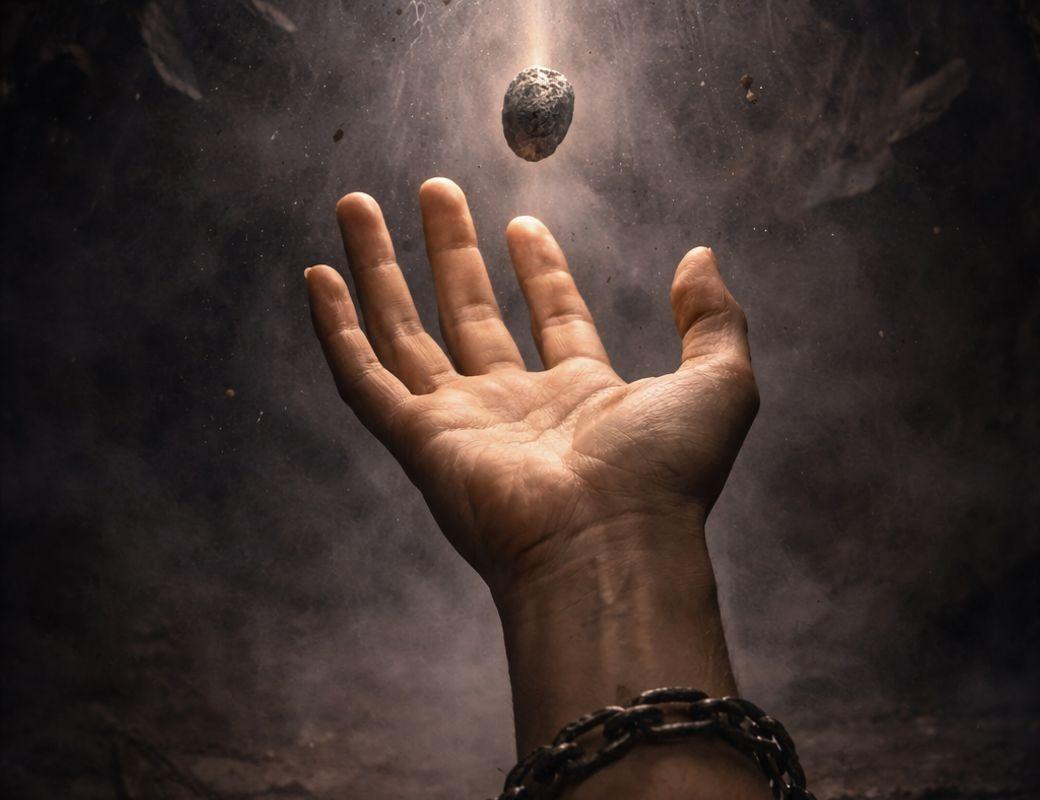
The ground is still here. Your hands are still here. The tools are scattered around you, glowing faintly in the dust.
Pick one up. Not to rebuild the tower. Just to feel its weight in your palm.
The lightning always passes. What remains is you.
With you in the sacred rubble,
Star