The Moon🌕
The Shadow of the Path You Cannot See
Article · 11 min read · ·
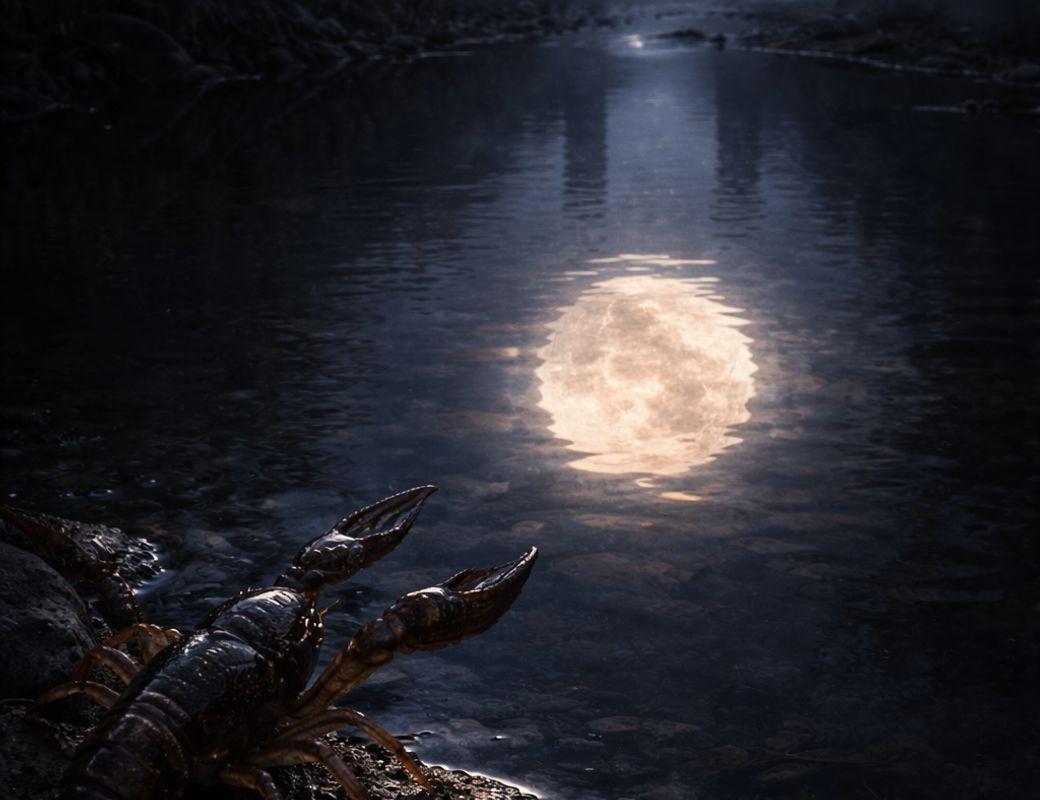
After The Star—after you've opened your empty hands and received the light that asks nothing of you—the journey does not end.
It descends.
Not downward into failure. Downward into depth. Into the vast, shimmering, terrifying ocean of everything you have never allowed yourself to know about yourself.
The Moon.
I avoided this card for years, and I avoided it for the same reason I avoided still water at night: I was afraid of what I might see looking back at me.
Not monsters. Not demons. Not the shadow I had already befriended in Strength, nor the chains I had loosened in The Devil. Something worse.
My own reflection, distorted by the ripples of every fear I had ever refused to name.
The Traditional Blueprint: The Threshold of the Unconscious
The Moon is Card XVIII—the number of reflection, of cycles, of the threshold between what is known and what is sensed but never fully seen .
She follows The Star not as its opposite but as its completion. The Star pours water onto the earth and back into the pool, the sacred circulation of hope and renewal. The Moon is the pool. The still, dark water where everything we have repressed, forgotten, or refused to feel waits in patient suspension .
In the Rider-Waite-Smith deck, there are no human figures on this card. No hero, no guide, no Fool taking his first step. You are the perspective. You are the dreamer, standing at the edge of the pool, looking into the depths of your own unconscious .
The moon itself is not full, not new, not single. It is a face—the compassionate, mysterious face of the divine feminine, reflecting the sun's light across impossible distance . Its sixteen major rays and sixteen minor rays represent the thirty-two paths of wisdom on the Tree of Life, the complete architecture of spiritual evolution . But those paths are not illuminated. They are suggested. You cannot see the whole map. You can only see the next step.
The two towers flanking the path are not prisons or threats. They are thresholds. They mark the boundary between the conscious and unconscious, the known self and the vast, uncharted interior . In some interpretations, they represent the summer and winter solstices—the turning points of the year, the sacred pauses where one cycle ends and another begins .
The wolf and the dog howl at the moon, one wild, one tame. They are not enemies. They are both you—the instinctual self and the domesticated self, the primal hunger and the civilized restraint, the part that runs free and the part that guards the gate . Their howls are not cries of pain. They are recognition. They see the moon and remember something they had forgotten: that they are not separate from the darkness, but creatures of it.
And the crawdad—the crayfish, the lobster, the scorpion in some decks—emerges from the water, pincer raised, halfway between the depths and the shore .
This is the exiled self. The part that has been submerged so long it has forgotten it was ever meant to walk on land.
The Shadow Reflection: The Drowner and the Shore-Dweller
When The Moon appears in your shadow, it reveals your relationship with the one thing you cannot outrun: your own depths.
Your "Moon Shadow" manifests in two postures, both rooted in the same ancient terror:
1. The Drowner.
This shadow has fallen into the water and cannot find the surface. It is overwhelmed by its own unconscious—flooded with fears it cannot source, anxieties that attach to everything and nothing, dreams that feel prophetic and paralyzing. It does not trust its intuition because it cannot distinguish intuition from panic.
The Drowner believes that if it looks into the water, it will be pulled under and never resurface. It has experienced trauma that made the depths feel like drowning, not diving. It is not wrong about the pain. But it has mistaken the ocean for the enemy, rather than the part of itself that has been holding its breath for years.
2. The Shore-Dweller.
This shadow refuses to approach the water at all. It builds its sanctuary far from the shoreline, on high, dry ground where the tides cannot reach. It prides itself on its clarity, its logic, its refusal to "drown in emotion." It says, "I trust my mind. I don't get lost in feelings."
But the Shore-Dweller is not peaceful. It is thirsty. It has exiled its own intuition, its dreams, its capacity for depth, and it does not understand why its life feels so shallow, so parched, so relentlessly dry. It has mistaken avoidance for mastery.
Both shadows are terrified of the same thing: the vulnerability of not knowing what you will find when you look into your own depths.
The Drowner has looked and found only chaos. The Shore-Dweller has never looked at all. Neither has experienced what The Moon teaches: the water is not empty. It is full of everything you have been too afraid to claim.
What I Found When I Finally Stopped Holding My Breath
I was a Shore-Dweller for most of my life.
I had learned, in the foster homes where emotions were liabilities and needs were burdens, that depth was dangerous. To feel deeply was to risk disappointment. To trust intuition was to risk being wrong. To dream was to risk waking up.
So I stayed on the shore. I built my sanctuary on high ground, far from the waterline. I learned to regulate my nervous system, to dialogue with my shadows, to release my chains—but I never learned to swim.
And then, one night, I dreamed of a crawdad.
It was small and ancient, its shell crusted with sediment, its movements slow and deliberate. It emerged from water so dark I could not see the bottom. It looked at me—really looked, the way only dream-creatures can look—and then it turned and began to climb onto the shore.
I woke up gasping, my heart racing, my skin cold.
And I understood, with the terrible clarity that only comes from dreams: the crawdad was me. The part of myself I had left in the water so long ago I had forgotten it existed. The part that had been waiting, patient as sediment, for me to return to the shore and meet it.
I didn't dive into the water that night. I didn't suddenly access decades of repressed memory or achieve perfect intuitive clarity. I just… knelt at the edge of the pool. Looked into the dark water. And for the first time, I didn't flinch at my own reflection.
I stayed.
The Sanctuary Question:
"What have I left in the water—intuition I stopped trusting, dreams I stopped following, depths I refused to explore—because I was afraid of what I might find there?"
And the question beneath it, the one the crawdad waits in patient silence for you to ask:
"What would it mean to stop holding my breath, and simply… float?"
The Integration Prompt: The "Two Feet in the Water" Ritual
Your task is not to dive into the abyss. It is to approach the water's edge and stay there long enough to realize you are not drowning.
1. Locate Your Shoreline.
What area of your life have you been avoiding because it feels too deep, too unclear, too emotional? A decision you can't logic your way through? A relationship that defies simple categorization? A grief you haven't allowed yourself to feel?
2. The Five-Minute Float.
For five minutes tonight, sit in the dark. No candle, no journal, no phone. Just you and the silence. You are not trying to solve anything, figure anything out, or access any profound truth. You are just… floating. Letting your mind drift. Not directing the current.
3. One Question, No Answer.
When the five minutes are complete, whisper one question into the darkness:
"What have I been afraid to see?"
Do not demand an answer. Do not analyze the silence. Just let the question hang there, suspended in the dark water of your own consciousness.
4. The Dreamer's Log.
Keep a notebook by your bed. For the next week, upon waking, write down whatever fragments of dreams you remember—no matter how strange, trivial, or incomprehensible. Do not interpret. Do not analyze. Just witness.
The Moon Does Not Illuminate. It Reflects.
We have been taught to fear The Moon because we have been taught that clarity is the only acceptable state. To not know is weakness. To feel without understanding is failure. To walk a path you cannot see is recklessness.
But The Moon is not the absence of light. It is light, reflected.
Her glow is not the sun's fierce, revealing blaze. It is softer, dimmer, more forgiving. It does not demand that you see everything at once. It simply shows you the next step, and the next, and the next—just enough to keep walking.
The path between the towers disappears into fog. The crawdad hesitates at the water's edge. The wolf and the dog howl at a face they cannot fully comprehend.
This is not failure. This is the nature of depth.
You cannot see the bottom of the ocean from the surface. You cannot map the unconscious from the safety of the rational mind. You cannot know, before you descend, what you will find in the depths.
But you can learn to trust that the water will hold you.
This is what The Cornerstone taught me: that my nervous system could learn to tolerate not-knowing. That I could breathe through the panic of uncertainty and discover, beneath it, a deeper, steadier rhythm.
This is what The Blueprint gave me: not the eradication of my Drowner and Shore-Dweller parts, but the capacity to sit with them at the water's edge and say, "I understand why you're afraid. But I am here now. We can learn to float together."
This is what The Rendering showed me: that the future is not a destination I arrive at through perfect clarity and unwavering certainty. It is a dream I learn to trust, a vision I follow through the fog, a path that reveals itself only as I walk it.
And this is what The Inhabitation taught me: that living in your sanctuary means accepting that some rooms will always be dimly lit. Some chambers will always be partially submerged. Some doors will open not onto sunlit gardens, but onto the vast, dark ocean of everything you have not yet explored within yourself.
That ocean is not the enemy. It is the source.
If You Have Been Standing on the Shore, Afraid to Wet Your Feet—
I need you to hear this:
The water is not waiting to drown you. It is waiting to hold you.
The crawdad does not emerge from the depths because it has conquered the ocean. It emerges because the time has come to integrate what it learned in the darkness with the life waiting on the shore. It does not leave the water behind. It carries the water within it.
You are not here to abandon your depths. You are here to become fluent in their language.
That language is not spoken in words. It is spoken in dreams that linger long after waking. In intuitions you cannot justify but cannot ignore. In fears that attach themselves to the present but originate in rooms of your inner sanctuary you have never fully explored.
The Moon does not ask you to see clearly. It asks you to trust that the path is there, even when you cannot see it.
For the Drowners who have been underwater so long they've forgotten what air feels like.
For the Shore-Dwellers who have stayed dry so long they've forgotten they were ever meant to swim.
For everyone standing at the water's edge, one foot suspended, heart hammering, wondering: "What if I don't know how?"
You don't need to know how. You just need to be willing to learn.
The water is not your enemy. It is your origin. Your intuition is not broken. It is waiting, patient as sediment, for you to stop demanding clarity and start trusting the reflection.
The crawdad is climbing onto the shore. It has been climbing for years. It will keep climbing until you are ready to meet it.
When you are ready—not certain, not fearless, not fully illuminated, just ready—I will be here. With the lantern, with the tools, with the map I drafted while I was learning to float.
Not to lead you through the fog. Just to remind you that you are not the first one to walk this path in darkness.
And you will not be the last.
With you in the sacred depths,
Star
Responses
No responses yet — start the conversation.