The Magician: From Potential to Power
Broomsticks & Basics of Tarot
Article · 25 min read · ·
If The Fool represents the moment before becoming, then The Magician marks the instant when becoming turns toward intention. Where the Fool leaps into experience guided by trust alone, The Magician stands firmly within it, aware of his agency and prepared to act. This is the point in the Major Arcana where consciousness begins to recognize itself not merely as a participant in the world, but as a co-creator within it.
Numbered One, The Magician follows the unnumbered openness of the Fool by introducing focus, direction, and will. This is the transition from possibility to practice, from raw potential to deliberate expression. The Magician does not abandon the Fool’s innocence; rather, he refines it. What p once instinct becomes skill. What was once faith becomes intention. What was once unformed now seeks shape.
In tarot, The Magician is the archetype of action, communication, and conscious manifestation. He stands between heaven and earth, channeling unseen forces into tangible form. His tools lie before him, not as ornaments, but as extensions of his awareness. Unlike the Fool, who trusts the journey to reveal itself, The Magician understands that creation requires participation. He acts, not blindly, but with purpose.
In this article, we will examine The Magician as the first true architect of the Major Arcana journey. Through symbolism, numerology, psychology, philosophy, astrology, elemental and esoteric correspondences, and comparative deck analysis, we will trace how this archetype transforms openness into power. We will explore how The Magician operates in readings, how his energy manifests upright and reversed, and how his role shifts across traditions such as the Rider–Waite–Smith, Marseille, and Thoth decks.
If The Fool teaches us how to step into the unknown, The Magician teaches us what to do once we arrive. This is the card of conscious will, disciplined imagination, and the recognition that intention shapes reality. The journey has begun, but now, the work truly starts.
The Symbolism of The Magician Card
If The Fool teaches us how to stand at the threshold of becoming, The Magician reveals what it means to act within the world once that threshold has been crossed. The symbolism of The Magician card marks a decisive shift in the Major Arcana: consciousness no longer drifts in openness, but gathers itself into focus. Every visual element of the card reinforces this movement from potential into purposeful expression.
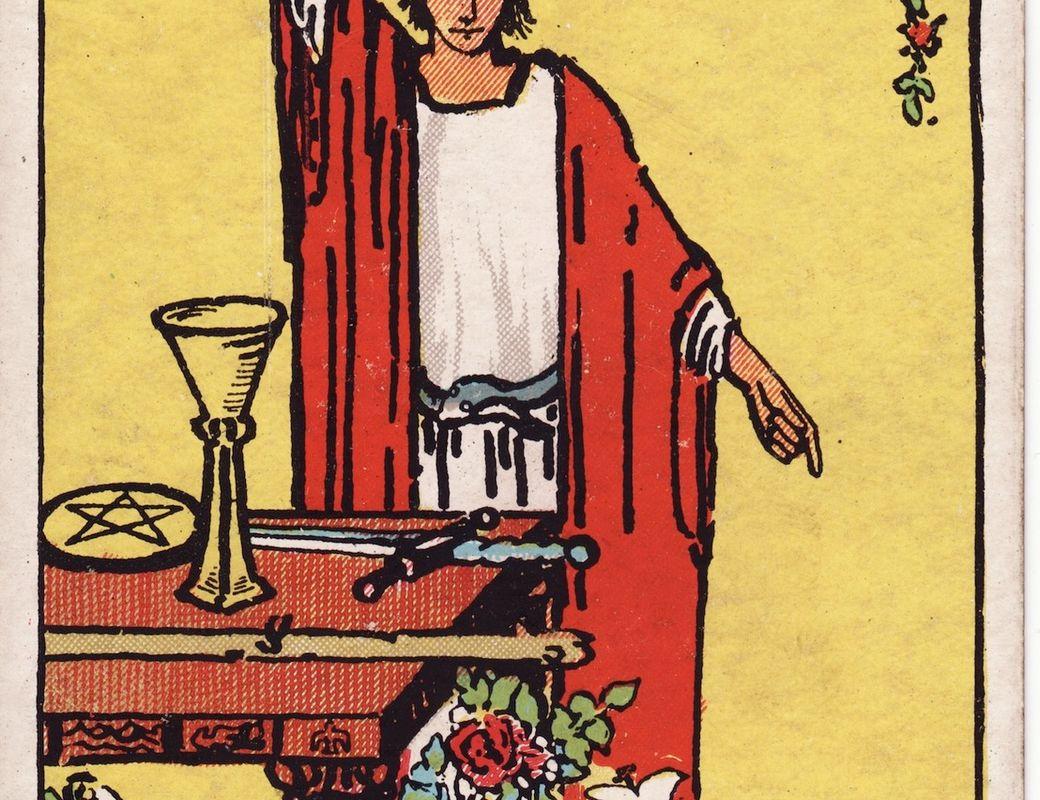
At the center of the image stands The Magician himself, upright and grounded, unlike the Fool’s precarious stance at the cliff’s edge. His posture is deliberate, balanced between heaven and earth. One hand reaches upward, often holding a wand, while the other points downward toward the material plane. This iconic gesture embodies the Hermetic axiom “as above, so below.” The Magician is not a passive conduit; he is an active intermediary, consciously channeling spiritual force into tangible form. Where the Fool trusts the universe, The Magician collaborates with it.
Above The Magician’s head floats the lemniscate, the symbol of infinity. This figure-eight does not represent limitless chaos, but sustained flow, energy that can be directed without depletion. Unlike the Fool’s Zero, which contains infinite possibility without shape, the Magician’s infinity symbol suggests mastery through alignment. Power is not borrowed; it is accessed through awareness, intention, and discipline.
Before The Magician lies the table, upon which rest the four tools of the tarot: the wand, the cup, the sword, and the pentacle. These correspond to the four elements, fire, water, air, and earth, and represent the full spectrum of human capability: will, emotion, intellect, and material action. Their presence affirms that the Magician lacks nothing. All necessary resources are already available; what matters now is how they are used. The table itself serves as a liminal surface, bridging inner intention and outer manifestation.
The Magician’s clothing further reinforces this theme of conscious embodiment. He often wears white beneath a red outer robe. White symbolizes purity of intent and clarity of consciousness, while red signifies vitality, passion, and action. Together, they suggest that true power arises when intention is aligned with action, when inner awareness is matched by external movement. Unlike the Fool’s bright, carefree garments, the Magician’s attire signals readiness rather than innocence.
Surrounding the Magician are symbols of growth and cultivation, flowers, vines, or a garden in bloom. These elements speak to intentional creation. Growth here is not wild or accidental; it is tended. This imagery contrasts sharply with the Fool’s untouched landscape. The Magician does not wander through the world; he shapes his environment through sustained engagement.
Even the ground beneath his feet carries symbolic weight. The Magician stands firmly on solid earth, rooted and present. This grounding emphasizes that manifestation is not an abstract concept but a lived process. Spiritual energy must be anchored in reality to take form. The Magician’s power is not escapist, it is incarnational.
Taken as a whole, the symbolism of The Magician card illustrates the moment when awareness recognizes its own agency. The Fool’s leap initiates the journey, but The Magician defines its direction. This card teaches that creation is neither accidental nor effortless. It requires clarity, presence, and responsibility. The Magician does not ask whether something is possible; he asks how it will be done.
In this way, The Magician stands as the first true architect of the Major Arcana. He reminds us that once the fall has been taken, the work begins, not through force, but through alignment. Power is not seized; it is directed. And meaning is not discovered by chance, but shaped through conscious will.
Numerology and the Sacred Meaning of One
If The Fool’s Zero represents infinite potential before form, then The Magician’s One marks the moment that potential condenses into intention. Numerologically, One is the first act of differentiation, the emergence of identity, direction, and will from the undivided whole. In the Major Arcana, this shift is not merely numerical; it is ontological. With One, existence begins to recognize itself as an actor within the world.
The number One is traditionally associated with unity, origin, and initiation, yet unlike Zero, which contains all things without distinction, One selects. It defines. It establishes a center from which action radiates outward. In this way, The Magician does not negate the Fool’s openness; he refines it. Where Zero holds possibility in suspension, One chooses a path.
In esoteric numerology, One is the number of consciousness made active. It represents the moment when awareness becomes self-directed, when the mind no longer drifts but focuses. This is reflected in The Magician’s posture and tools: he does not observe the elements before him; he arranges them. The wand is raised not in reverence, but in command. The table is not an altar of supplication, but a workspace of creation.
Philosophically, One introduces the concept of agency. It is the number of the self as a locus of will. In Platonic and Neoplatonic traditions, the One is the source from which all multiplicity flows, yet in tarot, this abstraction becomes embodied. The Magician is the living expression of the One made visible, an individual through whom intention moves into form.
This numerological shift also establishes the ethical dimension of the Major Arcana. With Zero, there is no responsibility; the Fool acts without knowledge of consequence. With One, responsibility emerges alongside power. The Magician’s ability to manifest implies accountability for what is created. This is why One is often linked to leadership, authorship, and innovation, but also to ego, control, and misuse of will when unbalanced.
Within the arc of the Major Arcana, One functions as the organizing principle. It sets the tone for all that follows. The Magician does not complete the journey; he initiates its structure. Every subsequent card builds upon the premise that intention matters, that choices shape outcomes, and that consciousness participates in reality rather than merely encountering it.
In practical terms, the number One emphasizes beginnings that arise from decision rather than chance. In readings, The Magician often appears at moments when the querent must claim agency, define a goal, or recognize their capacity to influence circumstances. This is not the spontaneous beginning of the Fool’s leap, but the deliberate beginning of purposeful action.
The transition from Zero to One within the Major Arcana mirrors a fundamental human experience: the realization that potential alone is insufficient. Creation requires focus. Power requires direction. And transformation begins not when all possibilities are held, but when one is chosen.
Thus, numerologically, The Magician stands as the embodiment of the first act of creation, the moment when the universe says not merely I am, but I will.
The Meaning of the Act: Will, Creation, and Conscious Direction
Where The Fool’s defining moment is the fall, The Magician’s defining moment is the act. This is the precise point in the Major Arcana where motion becomes intentional and energy is shaped through will. If the Fool teaches us how to trust the unknown, The Magician teaches us how to engage it deliberately. The act is not reckless, nor is it guaranteed; it is chosen.
In esoteric terms, the act represents the moment when consciousness asserts itself as an organizing force. The Magician does not leap blindly, he stands, assesses, and directs. His power lies not in movement alone, but in purposeful motion. This distinction is critical. Action without awareness belongs to the Fool’s domain; action guided by intention belongs to the Magician.
The act, symbolically, is the first application of will to reality. The tools on the Magician’s table are inert until he engages them. Fire does not burn without direction, air does not speak without thought, water does not move without emotion, and earth does not take shape without effort. The Magician’s role is to unify these elements through conscious focus. In this way, the act becomes a synthesis, will aligning with capability.
Philosophically, this moment reflects the transition from potential existence to authored existence. The Magician accepts that the world does not merely happen to him; it responds to him. This recognition carries both empowerment and risk. To act is to alter circumstances, to invite consequence, and to accept responsibility for outcomes. The Magician’s gesture, one hand raised, one lowered, captures this tension perfectly: creation always occurs between inspiration and manifestation.
Unlike the Fool’s fall, which is transformative through surrender, the Magician’s act is transformative through engagement. It requires clarity of intention and belief in one’s capacity to influence reality. Doubt fractures power; distraction disperses it. This is why the Magician archetype is often associated with mastery, skill, and focused attention. Magic, in this context, is not illusion, it is disciplined alignment.
In lived experience, the act represented by The Magician often appears at moments of conscious initiation: speaking a truth aloud, committing to a path, beginning a project, or asserting one’s will after a period of hesitation. These acts may seem small, but their significance lies in intention. A single deliberate choice can reorganize an entire trajectory.
Importantly, the act is not a guarantee of success. The Magician does not control outcomes, only participation. What distinguishes him from the Fool is not certainty, but ownership. He understands that creation requires effort, refinement, and sustained engagement. The act begins the process, but mastery unfolds over time.
In this way, The Magician reframes power not as dominance, but as alignment. To act is not to force reality into submission, but to collaborate with it consciously. The Fool trusts the universe to catch him; the Magician learns how to shape the ground beneath his feet.
Thus, the act becomes the Major Arcana’s first true expression of authorship. It is the moment when the journey stops happening to the seeker and begins happening through them.
Neurological, Psychological, and Philosophical Dimensions of The Magician
If The Fool represents openness of consciousness and the willingness to enter experience without preconception, then The Magician represents the moment when consciousness begins to organize itself around intention. Neurologically, psychologically, and philosophically, this card reflects the transition from diffuse awareness to directed cognition, from possibility to purposeful thought.
From a neurological perspective, The Magician aligns with the activation of executive function within the brain. This includes regions responsible for planning, decision-making, impulse regulation, and goal-oriented behavior, particularly the prefrontal cortex. Where the Fool corresponds to exploratory states associated with novelty and openness, The Magician corresponds to focus, selection, and control. Attention narrows. Distraction recedes. Energy is allocated toward a chosen objective.
This shift is essential for manifestation. The brain cannot act on every possibility at once; it must prioritize. The Magician archetype mirrors this neurological reality. His power lies not in having infinite options, but in committing to one. This is why The Magician is so often associated with clarity, confidence, and communicative ability. Thought becomes structured, language becomes intentional, and action follows cognition rather than impulse.
Psychologically, The Magician represents the emergence of the agentic self, the internal recognition that one’s thoughts, words, and actions carry weight. This is the stage at which an individual begins to see themselves as capable of influencing outcomes rather than merely responding to circumstances. In depth psychology, this aligns with the development of ego strength: the capacity to act with coherence, intention, and self-trust.
However, this ego is not inherently negative. In its balanced form, the Magician’s ego functions as a necessary organizing principle. Without it, intention dissolves into chaos. With it, desire becomes direction. This is why The Magician is both a creator and a communicator. He understands that ideas must be articulated, internally and externally, to take form.
Philosophically, The Magician embodies the tension between free will and responsibility. To recognize oneself as an agent is to accept accountability for what one brings into being. Existential philosophy echoes this theme: once awareness awakens, neutrality becomes impossible. Choice defines existence. The Magician cannot return to the Fool’s innocence; knowledge of agency cannot be undone.
This card also reflects the philosophical concept of logos, the principle of order, reason, and meaningful speech. The Magician does not merely act; he names, defines, and structures reality through language and symbol. In this way, he stands at the crossroads of thought and manifestation. What is conceived internally becomes expressed externally.
In lived experience, The Magician often surfaces during periods of intentional self-definition: choosing a direction after exploration, asserting one’s voice, or learning to wield skill with confidence. These moments require focus and belief, not blind faith, but informed trust in one’s ability to act.
Ultimately, The Magician teaches that consciousness is not passive. Awareness alone is not enough. To think is to shape. To speak is to create. To act is to alter the field of possibility.
If the Fool asks us to experience life, The Magician asks us to participate in its creation.
Astrological, Elemental, and Esoteric Correspondences of The Magician
If The Fool exists outside of structure, moving freely through the liminal spaces between worlds, then The Magician operates within structure, translating invisible forces into form through conscious alignment. His correspondences reflect this role as mediator between realms, bridging intellect and matter, spirit and action.
Astrologically, The Magician is most commonly associated with Mercury, the planet of communication, cognition, dexterity, and exchange. Mercury governs language, thought, learning, and movement between states, making it a natural ruler for the Magician’s domain. Just as Mercury travels swiftly between the worlds of gods and humans in myth, the Magician moves between intention and manifestation, idea and execution.
Mercurial energy emphasizes adaptability and skill. The Magician does not rely on brute force or emotional overwhelm; he persuades, calculates, and refines. In readings, this correspondence often highlights moments requiring clarity of thought, articulate expression, or strategic action. When the Magician appears under strong Mercurial transits, themes of negotiation, learning, and intentional communication are amplified.
Elementally, The Magician is often aligned with Air, the element of intellect, language, and conceptual organization. Air governs thought before emotion, logic before intuition, and articulation before embodiment. This alignment reinforces the Magician’s role as the thinker who shapes reality through understanding and expression. However, unlike purely abstract Air archetypes, the Magician integrates all four elements, as evidenced by the tools on his table. Air initiates the process, but fire, water, and earth complete it.
Esoterically, this integration places the Magician at the center of elemental harmony. He does not privilege one force above the others; instead, he balances them through will. This balance is what distinguishes magic from chaos. To act magically is not to dominate the elements, but to coordinate them through awareness and intention.
In ceremonial and occult traditions, the Magician is associated with the path of Beth on the Tree of Life, connecting Kether (the divine source) to Binah (understanding). This path emphasizes the transmission of divine potential into structured comprehension. The Magician becomes the channel through which abstract divinity gains intelligible form. Knowledge, in this sense, is sacred, not as accumulation, but as application.
Color symbolism further supports these correspondences. Reds and whites dominate the Magician’s imagery, reflecting the interplay between vitality and clarity, action and intention. Gold accents often appear, signifying illumination and conscious power rather than inherited authority. These colors reinforce the Magician’s role as a self-made conduit rather than a passive recipient of power.
Timing and seasonal correspondences also emerge. The Magician often aligns with periods of initiation that require mental acuity rather than emotional readiness, beginnings rooted in planning, learning, or communication. These are not the spontaneous starts of the Fool, but calculated beginnings that arise from preparation.
Taken together, the Magician’s correspondences paint a picture of power that is neither mystical nor mundane, but intentional. His magic lies in understanding how forces interact and choosing how to direct them. Where the Fool trusts the cosmos, the Magician learns its language.
Thus, astrologically and esoterically, The Magician stands as the first translator of divine energy into human action, a reminder that manifestation begins not with desire alone, but with clarity, alignment, and conscious participation.
The Magician Across Tarot Traditions
While The Magician retains a consistent core identity across tarot traditions, the way his power is framed, and the emphasis placed upon his role, shifts subtly from deck to deck. These variations reveal how different lineages understood will, knowledge, and the ethics of manifestation. By examining The Magician across major traditions, we gain a fuller picture of the archetype as both creator and intermediary.
In the Rider–Waite–Smith deck, The Magician is depicted as a conscious orchestrator of reality. He stands before a table bearing the four elemental tools, clearly labeled and deliberately arranged. His upward and downward gesture explicitly communicates mediation between spiritual and material realms, reinforcing the Hermetic principle of correspondence.
This version emphasizes clarity and accessibility. The Magician’s power is visible, organized, and ethical, rooted in awareness rather than deception. The blooming garden surrounding him suggests that manifestation is a living process, one that flourishes when intention and action are aligned. In readings, this Magician often indicates readiness, capability, and the conscious use of one’s skills.
In the Marseille decks, The Magician, often titled Le Bateleur, appears younger, less composed, and more ambiguous. His table is cluttered rather than ordered, and his tools are less clearly defined. This ambiguity introduces an important shift: here, the Magician exists in a liminal state between potential mastery and illusion.
The Marseille Magician may be a street performer, a trickster, or an apprentice rather than a master. This portrayal emphasizes experimentation and learning rather than control. Power is present, but unrefined. In readings, Le Bateleur can indicate raw talent, beginnings in skill development, or the need to discern between genuine ability and sleight of hand. Unlike the RWS Magician, this figure asks whether intention has matured into responsibility.
Aleister Crowley’s Thoth Magician represents the archetype at its most cosmic and abstract. Here, the Magician is Mercury in motion, fluid, luminous, and dynamic. The figure dissolves into symbols of vibration, frequency, and transformation. Tools are no longer static objects but energetic expressions of force.
This Magician embodies communication at all levels: speech, thought, ritual, and divine transmission. The emphasis shifts from personal agency to universal intelligence acting through the individual. In Thoth readings, the Magician often signals alignment with higher knowledge, magical speech, or the transmission of ideas that alter consciousness itself. The danger here lies not in illusion, but in fragmentation, power scattered through excess motion.
In Golden Dawn–influenced and modern esoteric decks, The Magician often synthesizes these traditions, balancing clarity with mystery. Some decks emphasize craftsmanship and skill, portraying the Magician as an artisan or alchemist. Others highlight the shadow aspects of the archetype, exploring manipulation, ego inflation, or misuse of knowledge.
In contemporary psychological or intuitive decks, the Magician may appear as a communicator, healer, or innovator, reflecting modern understandings of manifestation through mindset and intention. Despite stylistic differences, the core theme remains: the Magician marks the moment when awareness claims its capacity to shape reality.
Across all traditions, The Magician stands at the threshold between knowing and doing. Whether portrayed as master, apprentice, trickster, or cosmic messenger, he embodies the tension inherent in power itself. Knowledge alone does not sanctify action; intention must be tempered by awareness.
Where The Fool varies in innocence and openness across decks, The Magician varies in responsibility and refinement. Together, these depictions remind us that power is learned, tested, and earned over time.
Thus, the Magician across tarot traditions reflects humanity’s evolving relationship with will, skill, and creation. He is never static. He is always in the process of becoming capable.
The Magician in Readings, Spiritual Practice, and Liminal Encounters
When The Magician appears in readings, he rarely arrives quietly. Unlike the Fool, whose presence often signals openness or a threshold moment, The Magician enters as a call to action. His appearance suggests that conditions are already present for movement, creation, or decision, what remains is the querent’s willingness to engage intentionally with their circumstances.
In divinatory contexts, The Magician frequently emerges during moments of initiation that require conscious participation rather than surrender. This may include starting a project, articulating a truth, asserting personal boundaries, or claiming one’s authority after a period of hesitation. The message is clear: potential exists, but it will not activate itself. The Magician does not ask what could happen; he asks what will you do.
In practical spreads, The Magician often indicates skill, preparedness, and mental clarity. When placed in a position of influence or advice, he emphasizes strategy, communication, and focused intent. For example, in career or creative readings, his presence may point to the need to leverage existing talents more deliberately or to take ownership of one’s role as a creator rather than a participant. In relational readings, the Magician can signal the power of words, what is spoken, withheld, or intentionally shaped carries weight.
Spiritually, The Magician functions as a teacher of applied mysticism. Where the Fool initiates the seeker into mystery through experience, the Magician introduces discipline. Ritual, spellwork, prayer, and intentional meditation all fall within his domain, not as acts of superstition, but as structured engagements with meaning. The Magician reminds the practitioner that spirituality is not only received; it is practiced.
In magical traditions, this card often corresponds to moments when intention crystallizes into form. Setting an altar, crafting a spell, learning a system, or committing to a daily practice are all expressions of Magician energy. The emphasis is not on belief alone, but on execution. Power flows where attention is sustained.
Liminally, the Magician occupies a different threshold than the Fool. The Fool stands at the edge of the unknown; the Magician stands at the edge of capability. Encounters with this archetype often arise when an individual becomes aware of their influence, sometimes uncomfortably so. The realization that words shape outcomes, that choices ripple outward, and that silence itself can be an act of will marks a profound psychological crossing.
In shadow contexts, the Magician may also appear as a warning. Manipulation, self-deception, or the misuse of knowledge can distort his energy. In such cases, the card invites examination of motive. Is intention aligned with integrity, or is power being exercised without accountability? Unlike the Fool’s risks, which stem from innocence, the Magician’s risks arise from knowing better.
Ultimately, in readings and spiritual work alike, The Magician demands presence. He does not permit passivity. To encounter him is to be asked to recognize one’s role as an active participant in unfolding reality.
If the Fool teaches us how to step into the journey, the Magician teaches us how to work within it, deliberately, skillfully, and with awareness of consequence.
The Magician Reversed: Distorted Will, Fragmented Focus, and Misaligned Power
When The Magician appears reversed, the issue is rarely an absence of ability. More often, it is a disruption in alignment, a fracture between intention, belief, and action. Unlike the upright Magician, who channels power through clarity and purpose, the reversed Magician reveals what happens when will becomes scattered, misdirected, or unconsciously manipulated.
In contrast to the Fool reversed, which often signals fear of the unknown or refusal to step forward, the Magician reversed suggests hesitation rooted in self-doubt or overcompensation rooted in ego. The tools are still present, but they are unused, misused, or wielded without coherence. Knowledge exists, but confidence falters, or worse, confidence exists without integrity.
Symbolically, the reversal interrupts the Magician’s vertical axis. The connection between above and below becomes unstable. Inspiration may fail to ground itself in action, or action may proceed without meaningful intention. This can manifest as procrastination, miscommunication, or the sense that one is “going through the motions” without authentic engagement.
In readings, the Magician reversed often appears when a querent underestimates their capabilities or refuses to claim agency. This may present as learned helplessness, reliance on external validation, or the belief that circumstances alone dictate outcomes. In such cases, the card does not deny power, it exposes avoidance of responsibility. The question becomes not can you act? but why won’t you?
Conversely, the Magician reversed can indicate the shadow expression of will: manipulation, deception, or the misuse of language and intellect. Words may be used to obscure rather than clarify, charm rather than communicate, control rather than collaborate. Here, the Magician resembles the trickster of the Marseille tradition pushed to excess, skill divorced from ethics.
Psychologically, this reversal reflects fragmented focus. Energy disperses across too many intentions, none of which are fully realized. The mind knows what must be done, yet action stalls. Alternatively, action proceeds compulsively, disconnected from reflection. Both expressions reveal the same core issue: intention and execution are no longer synchronized.
Spiritually, the reversed Magician warns against performative practice, ritual without meaning, spellwork without clarity, or belief without embodiment. Power cannot flow where attention is divided. The card invites recalibration rather than force. Alignment must be restored before manifestation can resume.
Importantly, the Magician reversed is not a permanent state. Like the Fool reversed, it represents a pause for correction, not a condemnation. The lesson is refinement. Focus must be reclaimed. Motive must be examined. Will must be realigned with integrity.
In this way, the reversed Magician teaches a crucial truth: power without awareness becomes distortion, and awareness without action becomes stagnation. Creation requires both.
Where the upright Magician declares I will, the reversed Magician asks why am I not acting, or why am I acting against myself? The answer to that question determines whether power remains blocked or is restored to conscious flow.
The Magician as Living Energy: Embodying Conscious Creation
To encounter The Magician as a living archetype is to recognize that his power is not confined to symbol, ritual, or card placement. He is not merely an idea to be interpreted, but an energy to be embodied. Where earlier sections examined his symbolism, numerology, psychology, and function, this stage asks a more intimate question: what does it mean to live as the Magician?
As living energy, The Magician manifests wherever intention meets action. He is present in the moment someone claims their voice after silence, commits to a discipline after wandering, or chooses to shape circumstances rather than endure them. His magic is not theatrical; it is deliberate. It resides in focus, follow-through, and the quiet authority of knowing one’s capacity to act.
Unlike the Fool, whose living energy expresses itself through openness and trust, the Magician’s vitality emerges through engagement. He learns by doing. His mistakes are instructive, not paralyzing. Each act refines his understanding of cause and effect. Over time, this cultivates mastery, not as domination, but as fluency in working with reality’s currents.
Living as the Magician also requires discernment. Power must be tended carefully. Intention unchecked can become manipulation; confidence untethered from reflection can inflate into ego. The Magician’s task is ongoing calibration, aligning thought, word, and deed so they reinforce rather than contradict one another.
In spiritual practice, this embodiment appears as consistency. Prayer becomes practice. Insight becomes application. Knowledge becomes lived wisdom. The Magician does not hoard understanding; he tests it, refines it, and expresses it through action. His altar is not only ritual space, it is daily life.
Importantly, the Magician’s living energy is not static. It evolves as skill deepens and awareness expands. What begins as effort gradually becomes fluency. What begins as intention becomes habit. In this way, the Magician prepares the seeker for the next phase of the journey, one that requires stillness rather than action, receptivity rather than assertion.
Conclusion: From Will to Wisdom
The Magician stands as the first architect of the Major Arcana, transforming the Fool’s boundless potential into conscious direction. Through will, focus, and intention, he teaches that creation is not accidental, it is participatory. To exist is not merely to experience, but to choose, to shape, and to respond with awareness.
Across symbolism, numerology, psychology, astrology, and tradition, the Magician reveals a consistent truth: power flows where attention is sustained. His lesson is neither mystical escapism nor rigid control, but alignment, between thought and action, intention and outcome, self and world.
Yet the Magician’s mastery is incomplete. He knows how to act, but not yet when to wait. He understands how to shape energy, but not yet how to listen to its deeper currents. His tools are external; the next lesson turns inward.
With Card Two, the journey shifts from expression to perception, from will to wisdom. Where the Magician speaks, the High Priestess listens. Where he acts, she knows. The path now moves from conscious creation into hidden knowledge, intuition, and the mysteries that cannot be commanded, only received.
The Magician opens the door.
The High Priestess waits beyond it.
The journey continues,
Responses
No responses yet — start the conversation.