The Fool: Beginning the Journey
Broomsticks & Basics of Tarot
Article · 29 min read · ·
Before there is mastery, before wisdom is earned through trials and triumphs, there is a moment of pure becoming. A breath held at the edge of the unknown. A step taken not because the path is clear, but because the soul is ready.
The Fool stands at the very beginning of the tarot’s great initiatory cycle—not as a warning, but as an invitation. Numbered Zero, The Fool exists outside of sequence and certainty, representing the soul before it is shaped by experience, expectation, or fear. This is the archetype of sacred innocence, divine curiosity, and trust in the unseen hand of the universe. The Fool does not yet know the lessons that await; and it is precisely this unknowing that makes the journey possible.
In tarot, The Fool is the traveler, the seeker, the witch at the crossroads, the spirit on the brink of incarnation. He carries little, yet contains everything. His fall is not a failure, but a leap—an act of faith that transforms potential into lived experience. Where others hesitate, The Fool listens to instinct, intuition, and an inner call that defies logic.
In this deep dive, we will explore The Fool through every lens available to us: mythic, neurological, astrological, esoteric, and symbolic. We will examine the imagery of the Rider–Waite–Smith deck, trace the card’s evolution through the Marseille and Thoth traditions, and uncover how this archetype has been understood across occult systems and spiritual philosophies. More than a “beginner” card, The Fool is the eternal beginning—the place we return to again and again whenever life asks us to start anew.
To step into The Fool is to step onto the path of becoming. And every journey, no matter how long or winding, begins right here—at the edge of the unknown, with trust as our only companion.
The Symbolism of The Fool Card
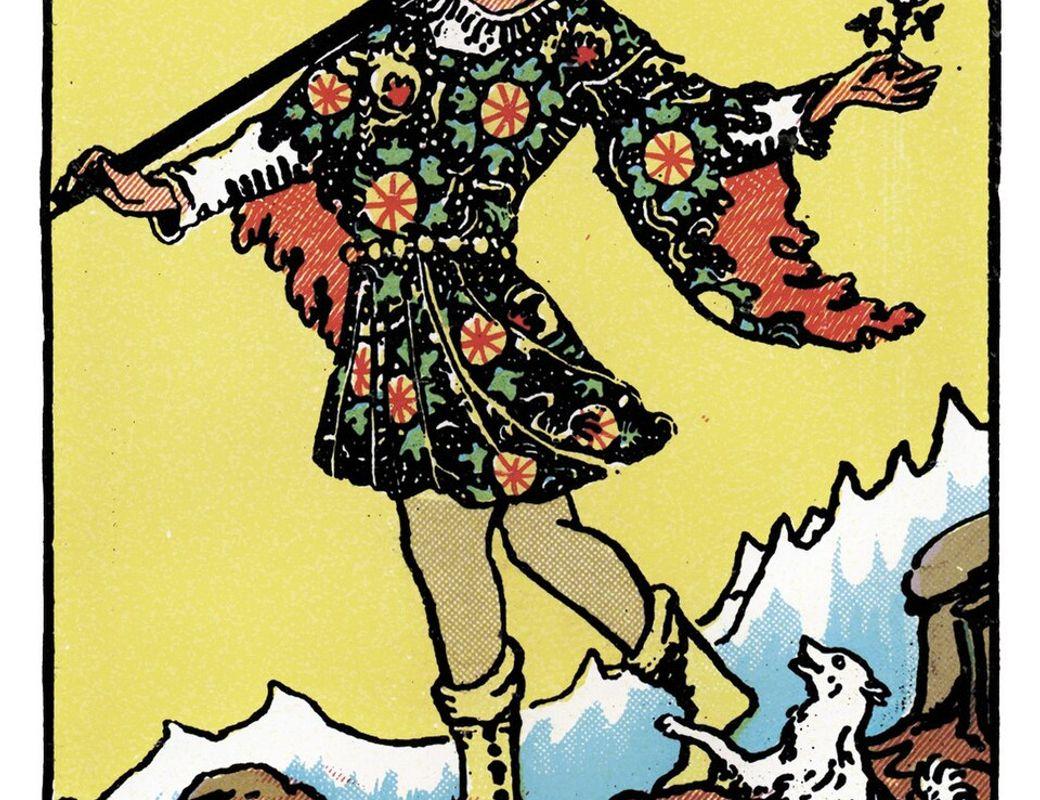
Tarot speaks first through image, not intellect. Before The Fool is understood through systems—astrology, numerology, or esoteric doctrine—he must be encountered visually. The symbolism of The Fool card is deliberate and layered, each element acting as a key to the archetype’s deeper meaning. Nothing here is accidental; every detail contributes to the story of beginnings, risk, and sacred trust.
At the center of the card stands The Fool himself, poised at the edge of a cliff. This cliff is often misinterpreted as danger alone, but symbolically it represents a threshold—the moment between what has been and what has not yet come to be. It is the liminal space of initiation, the pause before incarnation, the instant before consciousness descends into experience. The Fool does not fall unknowingly; he stands willingly at the edge, eyes lifted toward the sky rather than fixed on the ground below.
Above him shines the sun, radiant and unwavering. This is not merely a source of light, but a symbol of divine awareness and protection. Even as The Fool steps into uncertainty, he does so under illumination. The sun reminds us that while the path may be unknown, it is not unguarded. Consciousness accompanies the leap, even when outcomes remain unclear.
In The Fool’s hand blooms a white rose—an emblem of purity, innocence, and unconditioned intention. White, in esoteric symbolism, is not emptiness but totality: all possibilities held in balance. The rose suggests that The Fool’s actions are not driven by corruption or calculation, but by sincerity of spirit. This is the soul acting before it learns fear.
Slung casually over his shoulder is a small knapsack. Though The Fool appears unburdened, he is not empty. The bag represents latent knowledge: ancestral memory, past lives, inherited wisdom, and unconscious awareness. He carries everything he needs, even if he does not yet know how to access it. This is the paradox of The Fool—appearing naïve while containing immense, untapped depth.
At his heels leaps a small dog, often interpreted as both companion and guardian. The dog embodies instinct, intuition, and the animal self—those inner signals that warn, guide, and protect. Whether the dog is urging caution or encouraging movement forward depends on the reader, but its presence reinforces a central theme of the card: The Fool is not alone. He moves in relationship with instinct, not logic.
His bare feet touch the earth, signaling vulnerability, openness, and a direct connection to lived experience. There is no armor here, no separation between the self and the world. The Fool’s brightly colored clothing further emphasizes joy, spontaneity, and spiritual nakedness. He does not yet conceal who he is; he has nothing to hide and nothing to defend.
Taken together, the imagery of The Fool card reveals an archetype of conscious beginning. This is not reckless ignorance, but sacred openness—the willingness to enter life fully, without guarantees. The Fool teaches that every journey begins not with certainty, but with trust, and that wisdom is born only after the leap has been taken.
Numerology and the Sacred Meaning of Zero
In tarot, numbers are not merely identifiers; they are metaphysical states. The Fool’s designation as Zero is not an absence of value, but an intentional declaration of boundlessness. Where other Major Arcana cards are anchored to progression and sequence, The Fool exists outside the linear order of becoming. Zero is the space before the count begins—the pause before motion, the inhale before the first word is spoken.
Numerologically, Zero represents pure potential. It is the void from which all numbers emerge and to which they ultimately return. Unlike One, which signifies individuality and manifestation, Zero remains unformed. It is possibility without direction, power without expression. In this sense, The Fool embodies consciousness before it chooses shape, identity, or purpose. He is not yet defined by experience, yet he contains every experience within him.
Across mystical traditions, Zero is understood as the womb of creation. In Kabbalistic thought, it mirrors the concept of Ain—nothingness that is not empty, but limitless. In Eastern philosophy, it echoes the Tao: nameless, formless, and inexhaustible. The Fool’s Zero aligns him with these cosmological understandings of origin—not as a point, but as an infinite field from which all points arise.
This placement also explains why The Fool may appear anywhere within a reading. As Zero, he is not bound to beginning or end. He can mark the start of a journey, the disruption of an established pattern, or the necessary dissolution that precedes renewal. When The Fool enters a spread, he often signals that the situation cannot be resolved through conventional progression alone. Something must return to openness, to unknowing, before movement can resume.
Importantly, Zero challenges the human discomfort with uncertainty. Unlike numbered cards that offer direction through structure, Zero offers none. It asks the querent to step into a space where outcomes are undefined and certainty is unavailable. This is why The Fool can feel exhilarating or unsettling depending on context. Zero does not promise success or failure; it promises experience.
The relationship between Zero and the rest of the Major Arcana further reinforces this role. Every card that follows—The Magician through The World—can be understood as an elaboration of what is already contained within The Fool. Each lesson, trial, and transformation is a refinement of raw potential into lived wisdom. Yet, at the completion of the cycle, the seeker returns once more to Zero, transformed but still open. The journey does not eliminate The Fool; it deepens him.
Thus, The Fool’s numerology reveals a profound truth: beginnings are not linear events, but recurring states of consciousness. Zero is not behind us; it is beneath everything. Whenever life demands surrender, risk, or faith, The Fool re-emerges—not because we have failed to learn, but because growth always requires a return to possibility.
The Meaning of the Fall
If the symbolism of The Fool establishes who he is, and numerology reveals the field from which he arises, then the fall is where potential meets experience. In every depiction of The Fool—Rider-Waite-Smith, Marseille, or Thoth—the figure teeters at the edge of a cliff, a precipice that simultaneously invites and threatens. This is not a cautionary tale; it is initiation. The fall represents the sacred descent from innocence into the crucible of life, where consciousness encounters challenge, risk, and transformation.
The cliff, in both literal and metaphorical terms, is a threshold. To step forward is to surrender control, to trust forces unseen, and to embrace the unknown. Psychologically, the fall mirrors the process of ego dissolution. The Fool leaves behind certainty, habitual thought, and the illusion of mastery to enter the liminal space where growth becomes possible. It is here, in the moment of free-fall, that the soul first confronts its own vulnerability and discovers resilience, curiosity, and courage.
Esoterically, the fall is a ritual act, echoing archetypes across mythology and spiritual practice. Consider Persephone’s descent into the Underworld, a necessary passage that brought transformation and balance. Or the Shaman’s descent into the cave or underworld, where darkness is not a threat but a teacher. Even in Christian mysticism, the archetype of Adam’s fall carries dual significance: the introduction of limitation and the awakening of consciousness. The Fool’s fall is of the same order—it is an intentional initiation into the fullness of experience, where innocence encounters reality and, through that encounter, gains wisdom.
In Tarot readings, this concept of the fall manifests in both timing and counsel. The Fool encourages action before preparation is complete—not reckless abandonment, but trust in the process. It signals that leaps of faith are necessary, that the next stage of growth cannot be intellectualized or fully controlled. Examples are everywhere: a new business venture begun without guarantees, a spiritual practice embarked upon without certainty, or the decision to follow love or calling into uncharted territory. The fall asks: Will you move forward despite fear? Will you trust your instincts, your guides, and the unseen forces that support you?
The Fool’s fall also carries subtle esoteric dimensions. In Kabbalah, he corresponds to the path between Kether and Chokmah, a leap from pure potential into the first conscious expression of wisdom. In Hermetic and alchemical thought, the fall is akin to the prima materia—the undifferentiated matter before transformation. Here, descent is sacred, chaos is fertile, and apparent loss is in fact the necessary condition for creation. The Fool does not fail by falling; he manifests the divine paradox: to rise, one must first surrender to gravity.
Even in deck variations, the fall maintains its central narrative. In the Thoth Tarot, Crowley’s Fool exudes cosmic exuberance, leaping with full awareness into the chaotic energies of Uranus, reflecting both liberation and the generative potential of controlled madness. In the Marseille deck, the Fool’s precarious stance emphasizes social liminality—the outsider stepping into society, risking misinterpretation and ridicule, yet fulfilling a sacred role in the cycle of transformation. Across traditions, the fall is both literal and symbolic, inviting the seeker to embrace uncertainty as a teacher, rather than a threat.
Ultimately, the fall is a meditation on trust, surrender, and initiation. It transforms potential (Zero) into lived experience, guiding the soul from untested possibility to conscious engagement. It is the heartbeat of The Fool card: that moment when innocence encounters reality, when the soul begins to walk the path of growth, and when sacred curiosity propels action. To understand The Fool without recognizing the fall is to admire a figure frozen in potential, but never alive in the journey. The fall is the leap, the risk, and the sacred activation of everything the Fool represents.
Neurological, Psychological, and Philosophical Dimensions of The Fool
Beyond symbolism and esoteric doctrine, The Fool represents a distinct state of consciousness and psychological orientation—one that modern neuroscience, depth psychology, and ancient philosophy alike recognize as essential to growth, creativity, and transformation. The Fool is not merely a figure on a card, but a living archetype of the mind in its most open and unconditioned state, poised between instinct and insight, innocence and awareness.
Neurologically, The Fool corresponds to moments when the brain privileges novelty over prediction. Human cognition is largely oriented toward minimizing uncertainty, governed by the prefrontal cortex, which evaluates risk, consequence, and social conditioning. Yet when an individual encounters the unfamiliar—new environments, identities, or belief systems—the brain releases dopamine, activating circuits associated with curiosity, motivation, and learning. This neurological openness mirrors The Fool’s stance at the cliff’s edge: alert, vulnerable, and oriented toward possibility rather than fear.
Psychologically, The Fool embodies the beginner’s mind, a concept shared by both Buddhist philosophy and contemporary cognitive psychology. This mental posture suspends assumption and expectation, allowing experience to be encountered freshly rather than filtered through habit. In tarot, The Fool often appears when the querent is asked to relinquish certainty—when old narratives no longer apply and new meaning must be formed through lived experience rather than prior knowledge.
From a Jungian perspective, The Fool aligns with the archetype of the Puer Aeternus, the eternal youth. This archetype represents both promise and peril: spontaneity, imagination, and spiritual openness on one hand; avoidance of limitation, responsibility, or commitment on the other. Tarot does not moralize this state—it contextualizes it. The Fool is neither praised nor condemned; he is understood as necessary. Without this archetypal phase, individuation cannot begin. The danger lies not in being The Fool, but in refusing to grow beyond him when the time comes.
Developmental psychology offers another layer of insight. The Fool reflects early stages of human psychological development, when curiosity outweighs fear and exploration precedes evaluation. Children learn not by certainty, but by trial, error, and trust in their environment. The Fool mirrors this process on a symbolic level, suggesting that growth—whether spiritual, emotional, or intellectual—requires a return to exploratory vulnerability. In readings, this often emerges during life transitions: new careers, spiritual awakenings, identity shifts, or periods of personal rebirth.
Philosophically, The Fool resonates deeply with existential thought. Thinkers such as Kierkegaard and Nietzsche emphasized that authentic existence demands risk and personal responsibility in the absence of absolute certainty. Kierkegaard’s “leap of faith” is, in essence, The Fool’s fall—an action taken not because the outcome is guaranteed, but because meaning requires participation. The Fool does not wait to understand before acting; understanding emerges because he acts.
The psychological dimension of the fall itself is equally significant. Moments of transformation often coincide with temporary dissolution of identity structures—what psychology terms ego loosening. Research into creativity, spiritual experience, and altered states shows reduced activity in brain regions associated with self-monitoring and rigid control, allowing new insight and perception to emerge. This aligns with mystical traditions worldwide, where surrender—not force—initiates change. The Fool’s leap represents this surrender: the willingness to release control and allow experience to shape wisdom.
In tarot readings, these neurological and psychological layers explain why The Fool often appears at moments of profound inner transition. It may signal readiness rather than preparation, curiosity rather than certainty, and trust rather than control. The card invites the querent to engage life experientially, recognizing that psychological growth rarely occurs through avoidance of risk, but through conscious participation in uncertainty.
Ultimately, The Fool teaches that wisdom is not the absence of fear, but the willingness to move forward despite it. Neurologically, psychologically, and philosophically, The Fool represents the mind unburdened by final answers, capable of growth precisely because it has not yet decided what it must become. In this way, The Fool stands as both origin and recurring companion on the tarot journey—reminding us that transformation begins not with knowledge, but with openness.
Astrological, Elemental, and Esoteric Correspondences of The Fool
While The Fool’s journey begins within the psyche, it is ultimately governed by forces far larger than the individual. In tarot, astrological and elemental correspondences place The Fool within a cosmic context, revealing how this archetype functions as a catalyst for change, disruption, and awakening. The Fool is not passive; he is propelled by invisible currents that shape beginnings, endings, and sudden shifts in direction.
Astrologically, The Fool is most commonly associated with Uranus, the planet of revolution, innovation, and divine disruption. Uranus governs moments of awakening that arrive without warning, breaking existing structures to reveal new possibilities. This planetary influence mirrors The Fool’s unpredictable nature and explains why the card often appears during periods of sudden change—unexpected opportunities, abrupt endings that become beginnings, or insights that alter one’s path entirely. Under Uranian influence, stability is secondary to truth, and freedom becomes a spiritual imperative.
Uranus also governs themes of individuality and nonconformity. The Fool does not walk a prescribed road; he steps beyond it. In readings, this correspondence suggests that the querent may be called to act against convention, to follow an inner directive that defies societal expectations or logical planning. Like Uranus itself, The Fool disrupts not to destroy, but to liberate—clearing space for authenticity and growth.
Elementally, The Fool is aligned with Air, the element of intellect, breath, spirit, and movement. Air governs thought, communication, and perception, but in its purest form it represents potential in motion. Just as air cannot be contained, The Fool resists confinement. His presence signals mental flexibility, openness to new ideas, and the willingness to reconsider established beliefs. The winds of Air carry him forward, often before the destination is known.
This elemental association also reinforces the neurological and psychological dimensions previously explored. Air governs the mind, yet The Fool’s air is not analytical—it is intuitive, inspired, and receptive. This is the breath taken before action, the spark of insight before articulation. In practical terms, when The Fool appears in a spread, it often suggests that overthinking will hinder progress, and that trust in intuition and spontaneous insight is required.
Beyond astrology and elements, The Fool is richly embedded in esoteric correspondences. In Kabbalah, he is linked to the path between Kether (Crown) and Chokmah (Wisdom)—a leap from divine unity into conscious expression. This placement reinforces The Fool’s role as the descent of spirit into form, where infinite potential first becomes active awareness. The Fool does not yet shape reality, but he initiates the process by moving energy out of stasis.
Hermetically, The Fool corresponds to prima materia, the raw, unrefined substance from which all alchemical transformation begins. Chaos, in this sense, is sacred. Without disorder, there can be no reorganization; without uncertainty, no revelation. The Fool’s chaotic quality is not randomness, but fertility—the necessary condition for creation.
These correspondences also clarify why The Fool transcends linear time. Uranus operates outside predictable cycles, Air moves freely across boundaries, and the Kabbalistic Crown exists beyond form. The Fool, therefore, can appear at any stage of life or reading. He is not bound to beginnings alone, but emerges whenever stagnation must be broken and possibility restored.
Taken together, the astrological, elemental, and esoteric correspondences of The Fool reveal him as a force of cosmic initiation. He embodies the winds of change, the spark of awakening, and the moment when spirit chooses motion over stillness. Through Uranus, Air, and sacred chaos, The Fool reminds us that transformation often arrives without certainty—and that alignment with the greater currents of the universe requires trust, courage, and the willingness to step forward before the path is fully revealed.
The Fool Across Tarot Traditions: A Comparative Analysis
Although The Fool is a universal archetype within tarot, his appearance and emphasis shift subtly across different decks, reflecting the philosophical, cultural, and esoteric priorities of their creators. By comparing the Rider–Waite–Smith, Marseille, Thoth, and select modern decks, we gain a deeper understanding of how The Fool’s core meaning remains intact even as its expression evolves. These variations do not contradict one another; rather, they illuminate different facets of the same eternal principle.
In the Rider–Waite–Smith (RWS) deck, The Fool is depicted as a youthful traveler standing at the edge of a cliff, face lifted toward the sun, seemingly unaware—or unconcerned—of the drop before him. This portrayal emphasizes innocence, optimism, and spiritual trust. Pamela Colman Smith’s imagery invites the reader to interpret the moment as conscious openness rather than ignorance. The white rose, the small knapsack, and the attentive dog all suggest preparation without burden, guidance without control. In RWS readings, The Fool often carries a tone of hopeful beginnings and intuitive alignment, highlighting faith in the unseen rather than chaos or madness.
By contrast, the Marseille Tarot presents a more ambiguous and socially liminal Fool. Often unnumbered and sometimes unnamed, the Marseille Fool appears disheveled, wandering, and frequently harassed or followed by an animal tugging at his clothing. Here, the emphasis shifts from divine innocence to outsider status. This Fool is not protected by idealism but exposed to the world’s roughness. The imagery reflects medieval conceptions of madness, exile, and holy folly, where wisdom and insanity were not easily separated. In readings, the Marseille Fool may suggest marginalization, social nonconformity, or the risks inherent in walking an unconventional path. Yet even here, the Fool remains sacred—existing beyond societal norms and therefore capable of revealing uncomfortable truths.
The Thoth Tarot, designed by Aleister Crowley and illustrated by Lady Frieda Harris, reimagines The Fool as a force of cosmic dynamism. Crowley’s Fool is explicitly associated with Uranus and radiates controlled chaos, creative power, and generative energy. The figure is no longer a passive traveler but an active expression of universal life force. Imagery within the card—such as spirals, abstract forms, and embryonic symbolism—suggests the moment before creation solidifies into form. In Thoth readings, The Fool represents divine madness, ecstatic freedom, and the spiritual necessity of disruption. It is less about personal innocence and more about the universe expressing itself through radical motion.
Modern and themed tarot decks further expand The Fool’s expression while retaining his essential role. In many contemporary decks, The Fool appears as a witch, traveler, artist, or seeker—often explicitly gender-neutral and culturally diverse. Pagan and nature-based decks emphasize the Fool’s connection to the land, the elements, and cyclical time, portraying him as a soul stepping into alignment with natural rhythms. Psychological and minimalist decks strip the image down to motion, light, or abstract form, reinforcing the idea that The Fool exists beyond narrative detail. Across these interpretations, the core themes remain consistent: beginning, openness, risk, and trust.
What unites these varied depictions is not visual consistency, but archetypal coherence. Whether innocent, chaotic, marginalized, or cosmic, The Fool always occupies the threshold between worlds. Each deck highlights a different tension inherent in the archetype: faith versus folly, freedom versus instability, potential versus consequence. These variations allow the reader to adjust interpretation based on context, deck philosophy, and the querent’s situation.
Ultimately, examining The Fool across tarot traditions reinforces a central truth: the archetype is resilient because it is fundamental. Culture, era, and ideology may alter its clothing, posture, or tone, but the essence remains unchanged. The Fool is the beginning that precedes all beginnings, the sacred risk that makes transformation possible, and the reminder that every journey—no matter how complex—starts with a single, uncertain step.
The Fool in Readings, Spreads, and Spiritual Contexts
When The Fool appears in a tarot reading, it rarely does so quietly. Unlike more directive or outcome-oriented cards, The Fool resists fixed conclusions. Instead, it reframes the question itself, asking the querent to consider not where they are going, but how they are entering the experience. In readings, The Fool functions less as an answer and more as a state of engagement—an invitation to step into uncertainty with awareness, curiosity, and trust.
In general spreads, The Fool often signals a threshold moment. This may coincide with new beginnings—relationships, careers, spiritual paths—but it can also emerge mid-journey, indicating the need to release assumptions and approach a situation with renewed openness. For example, in a career reading, The Fool may suggest leaving behind rigid expectations of success in favor of experimentation or unconventional opportunities. In relational spreads, it often appears at the start of new emotional dynamics, or when vulnerability and authenticity are required for growth.
As advice, The Fool does not encourage recklessness, but conscious risk. It suggests that preparation has reached its limit and that understanding must now come through experience. In this sense, The Fool asks the querent to trust intuition over analysis, instinct over strategy. When pulled in an advice position, the card frequently accompanies moments where fear disguises itself as logic, and where remaining still poses a greater risk than moving forward.
In positional spreads, The Fool’s meaning shifts subtly depending on placement. In a past position, it may reflect a time of innocence, naïveté, or spiritual openness that shaped the present situation. In the present, it often indicates that the querent is standing at the edge of a significant transition, whether they consciously recognize it or not. In future positions, The Fool suggests an unpredictable unfolding—one that cannot be fully planned, only entered.
When The Fool appears repeatedly across readings, it often points to a pattern of initiation. The querent may be cycling through beginnings without integration, or conversely, resisting growth by clinging to certainty. In such cases, The Fool asks whether the lesson lies in learning how to leap—or how to land.
In spiritual readings, particularly those involving ancestral work, spirit communication, or hauntings, The Fool carries additional nuance. Its presence may indicate a liminal state, where boundaries between worlds are thin. The Fool’s association with thresholds and in-between spaces makes it a frequent messenger in readings involving spirits, guides, or unexplained phenomena. In these contexts, the card may suggest a spirit that has not fully crossed, an energy that exists between attachment and release, or a message that requires openness rather than fear to be understood.
In hauntings or energetic disturbances, The Fool can point to unresolved movement—energy that has not completed its journey. This does not always imply danger; often, it suggests curiosity, confusion, or unfinished transition rather than malice. The card advises approaching such situations with grounding, respect, and awareness rather than panic. Just as the Fool trusts the path ahead, the reader is encouraged to maintain calm presence, strong boundaries, and discernment.
In spreads focused on spiritual development, The Fool frequently marks the call to initiation. This may manifest as the beginning of a magical practice, a shift in belief systems, or the first awareness of intuitive or psychic sensitivity. Importantly, The Fool reminds the seeker that mastery is not immediate. Spiritual growth unfolds through trial, misstep, and discovery, and the willingness to be a beginner is essential.
Ultimately, The Fool in readings teaches that tarot is not solely a tool for prediction, but for participation. The card does not promise outcomes; it demands engagement. Whether appearing in practical spreads, spiritual inquiries, or moments of psychic liminality, The Fool invites the querent to meet the unknown with courage, curiosity, and trust. In doing so, it reaffirms its central role within the Major Arcana—not as a warning against folly, but as the sacred reminder that all wisdom begins with the willingness to step forward.
VIII. The Fool Reversed: When the Fall Is Resisted or Unconscious
When The Fool appears reversed, the imagery of the fall does not disappear—it internalizes, delays, or distorts. Rather than representing a conscious leap into experience, the reversed Fool often reflects resistance to movement, fear of the unknown, or a fall that occurs without awareness or trust. The archetype remains intact, but its energy is obstructed, misdirected, or misunderstood.
Symbolically, the reversed Fool shifts the narrative of initiation. Upright, the Fool stands at the edge willingly, guided by instinct and faith. Reversed, the cliff becomes a site of hesitation or denial. The fall still exists, but it is either postponed indefinitely or experienced as destabilization rather than transformation. This may manifest as clinging to safety despite inner restlessness, or as impulsive action taken without reflection or grounding.
Psychologically, the reversed Fool often points to fear masquerading as caution. Where the upright Fool trusts intuition, the reversed Fool doubts it. Overanalysis, self-sabotage, and avoidance become dominant patterns. In readings, this may indicate a querent who senses the need for change but remains immobilized by uncertainty, social conditioning, or past failure. The card asks not whether a leap is needed, but why it is being resisted.
In contrast, the reversed Fool can also indicate the opposite extreme: unconscious recklessness. Here, the fall occurs without awareness, preparation, or intention. Rather than a sacred leap, the descent is chaotic and disorienting. This may show up in situations where the querent repeatedly enters new cycles without learning from previous ones—relationships begun impulsively, spiritual practices adopted without grounding, or risks taken without reflection. The reversal suggests not too much caution, but too little consciousness.
Esoterically, the reversed Fool represents a blockage in the descent of spirit into form. Where the upright Fool aligns with divine flow and initiation, the reversed Fool indicates disrupted movement—potential trapped in stasis or scattered through excess. In Kabbalistic terms, the path between Kether and Chokmah becomes unstable, either collapsing inward or failing to manifest wisdom through experience. The soul hesitates to incarnate fully into the lesson being offered.
In spreads, the reversed Fool is highly sensitive to placement. In an advice position, it often warns against acting prematurely or, conversely, against remaining paralyzed by fear. For example, in a career spread, the reversed Fool may suggest that the querent is either clinging to security at the cost of fulfillment, or repeatedly jumping into ventures without sustainable planning. In relational readings, it may point to emotional guardedness or patterns of impulsive attachment that lack depth and accountability.
When appearing in spiritual or psychic readings, the reversed Fool can indicate misalignment during initiation. This may involve opening energetically without proper grounding, engaging in spiritual practices without discernment, or resisting a genuine calling due to fear of social or personal consequence. In more liminal contexts—such as spirit communication or energetic disturbances—the reversed Fool may suggest confusion, fragmented energy, or an inability to fully cross thresholds. The message here is not alarm, but the need for clarity, boundaries, and conscious engagement.
Importantly, the reversed Fool does not negate the possibility of transformation. Instead, it highlights where awareness must be restored. The remedy is rarely external; it lies in recalibrating trust—either learning to trust oneself enough to move forward, or learning to trust discernment enough to slow down. The reversal invites the querent to examine their relationship with risk, freedom, and responsibility, and to realign their actions with intention.
Ultimately, The Fool reversed teaches that initiation cannot be avoided—only delayed or distorted. The fall will come, whether chosen or resisted. The wisdom of the reversed Fool lies in recognizing that transformation is most gentle when entered consciously. By restoring awareness, grounding instinct with reflection, and aligning courage with discernment, the Fool’s energy can be reclaimed—not as chaos or fear, but as purposeful becoming.
The Fool as Living Energy: Walking the Path of the Fall
The Fool is not an idea confined to a card, nor a lesson learned once and left behind. He is a living energy, a recurring posture of the soul that emerges whenever life calls for renewal, courage, and trust. To live the Fool is to recognize that initiation is not a single event, but a cyclical experience—one that returns each time certainty dissolves and possibility reopens.
Living the Fool’s path means learning to discern when a fall is necessary and when hesitation serves growth. This discernment is itself an act of wisdom. The Fool does not leap indiscriminately; rather, he listens to instinct, intuition, and the subtle alignment between inner readiness and external timing. In practice, this may appear as choosing to leave a familiar but stagnant situation, beginning a spiritual discipline without full mastery, or allowing oneself to be vulnerable in the face of emotional risk. The Fool’s energy does not promise safety, but it does promise authenticity.
To consciously embody the Fool is to cultivate openness without naïveté. This requires grounding as much as trust. Just as the Fool carries his knapsack—small but sufficient—those walking this path are asked to honor past experience without being constrained by it. Wisdom is not abandoned; it is carried lightly. In magical and spiritual practice, this may involve approaching rituals, divination, or new paths with reverence and curiosity rather than rigid expectation or fear of error.
Living the fall also means understanding failure differently. Within the Fool’s paradigm, missteps are not proof of unworthiness but essential data—experiential knowledge gathered through movement. When a leap does not land as expected, the lesson lies not in retreat, but in integration. The Fool teaches that growth emerges not from avoiding mistakes, but from engaging with them consciously and compassionately.
As a living energy, the Fool often announces himself through restlessness, longing, or the quiet sense that “something must change.” These signals are not disruptions to be silenced, but invitations to examine where life has become overly predictable or constrained. When honored, the Fool’s presence restores vitality, creativity, and spiritual momentum. When ignored, his energy may manifest as dissatisfaction, stagnation, or unconscious risk-taking.
Ultimately, to live as the Fool—if only for a moment—is to accept that the path is made by walking. It is to trust that clarity follows action, not the other way around. In this way, the Fool remains an active companion throughout life, reappearing whenever transformation asks for courage rather than certainty.
Conclusion: From the Edge of Possibility to the Act of Creation
The Fool stands at the beginning of the Major Arcana not because he is simple, but because he is essential. He represents the raw state of becoming—the moment before identity solidifies, before intention takes form, before power learns how to wield itself. Through symbolism, number, fall, psyche, cosmos, and lived experience, The Fool reveals a singular truth: every meaningful journey begins in uncertainty.
Across tarot traditions and esoteric systems, the Fool teaches that innocence is not ignorance, and that risk is not recklessness when guided by intuition and awareness. His fall is not a failure, but an initiation—a descent into experience that transforms potential into wisdom. Whether upright or reversed, whether encountered in readings or lived through personal transition, the Fool asks us to examine our relationship with trust, fear, and freedom.
Yet the Fool does not remain at the edge forever. His leap sets the journey in motion, but motion alone is not mastery. Having stepped into experience, consciousness must now learn to shape it. The spark must become intention. Potential must be directed. What begins as openness must evolve into action.
And so, from the Fool’s leap, we move toward the next great lesson of the Major Arcana: the moment when awareness learns not only to experience the world—but to create within it.
The journey has begun.
Responses
No responses yet — start the conversation.