The Feather and the Sword
Justice, Libra, and the Archetype of Sacred Balance
Article · 34 min read · ·
The Feather and the Sword
Justice, Libra, and the Archetype of Sacred Balance
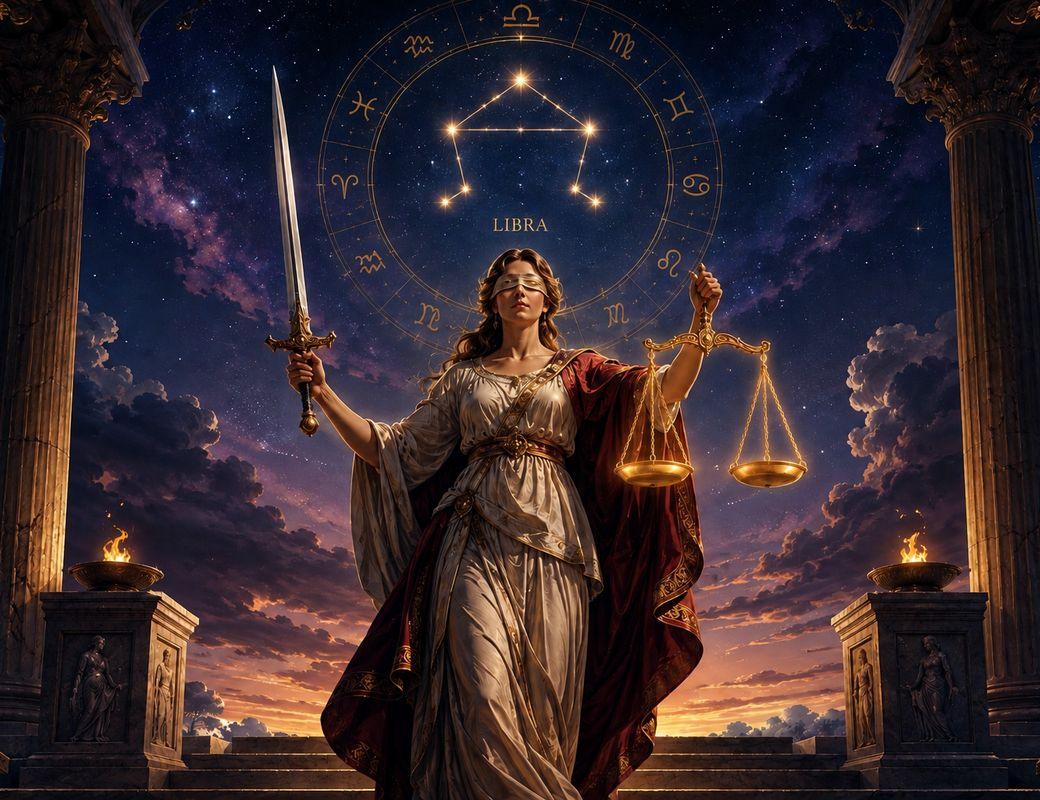
There is a figure who appears wherever human beings have wrestled with questions of fairness, truth, and consequence. She sits between opposing forces, holding a pair of scales in one hand and a sword in the other. She does not rush to judgment. She weighs what has been placed before her, knowing that every choice carries weight and every action eventually asks for an accounting.
That figure is Justice.
In the tarot, Justice is the keeper of equilibrium, the archetype who reminds us that balance is not passive and fairness is not always simple. Her scales represent the careful weighing of competing truths, while her sword reminds us that reflection must eventually become decision. She asks us to see clearly, choose consciously, and accept responsibility for what follows.
In astrology, her closest counterpart is Libra, the cardinal Air sign ruled by Venus and symbolized by the scales. Beneath Libra’s familiar reputation for charm, beauty, diplomacy, and partnership lies a deeper concern with reciprocity. Libra understands that no relationship exists in isolation. Every desire encounters another desire. Every boundary meets another boundary. The challenge is not simply to keep the peace, but to discover what genuine balance requires.
Together, Justice and Libra reveal an archetype far older than either tarot or astrology alone.
Across cultures, religions, and philosophies, human beings have returned again and again to the image of the scales. We find them in myths of divine judgment, in stories of wise rulers, in philosophical ideas about cosmic order, and eventually in the familiar figure of Justice herself. The details change, but the question remains remarkably consistent: how do we live fairly in a world where needs, desires, responsibilities, and consequences rarely carry equal weight?
This is why Justice and Libra belong together so naturally. Both understand that harmony is not the absence of tension. Both ask us to consider more than our own position. And both recognize that balance cannot be maintained by avoiding difficult choices.
The scales weigh.
The sword decides.
Between them lies the deeper lesson shared by Justice and Libra: sacred balance is not a state of perfect stillness. It is the continual practice of recognizing when something has tipped, understanding what has caused the imbalance, and having the courage to respond.
The Measure of Truth
Justice is the eleventh card of the Major Arcana in the Rider-Waite-Smith Tarot, positioned between the Wheel of Fortune and the Hanged Man. Its place in the Fool’s journey is significant. The Wheel has introduced forces beyond our control, the turns of circumstance and fortune that can alter a life without warning. Justice asks a more difficult question: once the wheel has turned, what remains our responsibility?
The traditional Rider-Waite-Smith image presents a crowned figure seated upright between two stone pillars. In one hand she holds a pair of scales. In the other, she raises a sword. Her gaze is direct, her posture composed, and unlike many figures in the tarot, she faces us without turning away.
Every element of the card speaks the language of balance and consequence.
The scales are perhaps its most recognizable symbol. They represent the weighing of evidence, actions, motives, and competing claims. Nothing exists entirely on its own. Choices create consequences, and what is placed on one side of the scales inevitably affects the other.
The sword, however, is equally important.
Held upright in Justice’s right hand, the double-edged blade represents reason, discernment, and the decision that follows careful consideration. It belongs symbolically to the element of Air, strengthening the card’s connection with Libra. The scales may weigh what is true, but eventually the sword must act upon what has been revealed.
This is Justice’s central tension.
Fairness requires consideration, but consideration without decision can become avoidance. Justice does not ask us to judge impulsively, nor does she permit us to remain forever suspended between possibilities. Her wisdom lies in knowing when enough has been weighed.
The figure herself reinforces this message. Her red robe suggests that judgment is not an abstract intellectual exercise. Decisions enter the living world and carry real consequences. One foot extends from beneath her robes, suggesting readiness to move forward once the weighing is complete. Behind her hangs a veil, a reminder that perfect knowledge may remain beyond us even when a choice must still be made.
Justice is sometimes interpreted narrowly as a card of courts, contracts, or legal affairs. Those associations belong to it, but its meaning reaches further. The card concerns cause and effect, accountability, integrity, and the relationship between what we choose and what those choices create.
It does not promise that life will always be fair.
It asks whether we are willing to be fair within it.
Here the connection with Libra begins to emerge.
Libra also weighs. It considers opposing positions, searches for proportion, and recognizes that our choices exist within relationships. Yet Justice adds something essential to Libra’s scales.
She carries the sword.
Balance is not indecision. It is the ability to consider what deserves consideration, discern what carries the greatest weight, and choose when the moment for weighing has passed.
The Scales of Relationship
Libra is the seventh sign of the zodiac, a cardinal Air sign ruled by Venus and symbolized by the scales. At first glance, the symbolism seems straightforward: balance, fairness, and harmony. Yet the scales reveal something more fundamental about Libra.
A scale only has meaning when there is something on both sides.
That distinction lies at the heart of the sign.
The first six signs of the zodiac are largely concerned with developing the individual. Aries declares the self, Taurus establishes value, Gemini discovers thought and language, Cancer creates belonging, Leo develops identity, and Virgo refines what has been cultivated. With Libra, the zodiac reaches a turning point. Attention shifts toward the space between the self and another.
The question is no longer simply, Who am I?
It becomes, Who am I in relation to you?
This is why Libra’s association with partnership extends far beyond romance. Libra concerns agreements, boundaries, cooperation, and the compromises that become necessary when one person’s needs encounter those of another.
Modern astrology often reduces Libra to charm, indecision, people-pleasing, or an appreciation for beauty. While these qualities may appear in certain personalities, they are surface expressions of a deeper impulse. Libra weighs possibilities because it recognizes that decisions rarely affect only one person. Another perspective exists. Another set of needs must be considered.
Yet Libra is not passive.
It is cardinal Air.
Cardinal signs initiate. Where Aries acts through instinct and assertion, Libra initiates through dialogue, negotiation, and relationship. Its strength lies in discovering whether opposing positions can meet without either being erased.
Venus, Libra’s ruling planet, deepens this symbolism.
Venus is commonly associated with love, beauty, pleasure, and attraction, but beneath these qualities lies the principle of value. Venus asks what we desire, what we consider worthy, and what draws separate things into relationship.
In Taurus, Venus expresses itself through the tangible world: the body, the senses, security, pleasure, and material value. In Libra, Venus becomes relational. Beauty becomes proportion. Attraction becomes exchange. Value becomes the question of what we owe ourselves and what we owe one another.
Here we begin to understand why Libra and Justice have been linked within the Western esoteric tradition.
Their scales speak the same symbolic language. Both ask us to weigh competing needs, consider perspectives beyond our own, and recognize when one side has begun carrying too much.
But Justice adds something Libra cannot afford to forget.
She carries a sword.
There is a shadow within the desire for harmony. When peace becomes more important than truth, balance can become avoidance. A relationship may appear calm because no one is arguing while one person quietly carries more of the burden. Compromise can preserve connection, but compromise without limits can also preserve an injustice.
The scales can weigh forever.
The sword eventually requires a choice.
At its highest expression, Libra is not the sign that keeps everyone happy. It is the sign that learns to remain in relationship without abandoning truth. It listens without surrendering judgment, compromises without surrendering itself, and understands that sometimes restoring balance requires disturbing the peace.
Seen together, Justice and Libra reveal two expressions of the same archetype.
Libra teaches us to consider the other side.
Justice teaches us what to do once we have.
The Weight of the Heart
Long before Justice sat upon her throne in the tarot, another set of scales appeared in the sacred imagination of ancient Egypt.
They belonged to Ma’at.
Ma’at represented truth, justice, balance, and the cosmic order upon which both human society and the universe depended. She was often depicted with an ostrich feather upon her head, an image that became central to one of ancient Egypt’s most enduring visions of judgment: the weighing of the heart.
According to Egyptian funerary tradition, the heart of the deceased was weighed against the feather of Ma’at.
On one side of the scales rested a human heart.
On the other, a feather.
The simplicity of the image disguises the magnitude of what was being measured.
For the ancient Egyptians, the heart was closely associated with thought, memory, character, and moral identity. It carried the record of the person who had lived. The feather represented Ma’at, the standard of truth and right order against which that life would be weighed.
The question was not merely what a person claimed to be.
The scales revealed what the heart actually carried.
In the judgment scene preserved in the Book of the Dead, Anubis oversees the weighing while Thoth records the result. Nearby waits Ammit, the fearsome devourer associated with the fate of a heart that fails the test. The scene transforms justice from an abstract principle into something intensely personal. Eventually, every excuse and outward appearance falls away, leaving only the heart and the measure against which it must answer.
Yet Ma’at belonged to the world of the living as much as to the dead.
To live according to Ma’at was to participate in the proper order of existence. Truthfulness, justice, right conduct, and the honoring of obligations helped preserve harmony, while deception and wrongdoing threatened to disturb it. Balance was therefore not simply an individual preference. It was part of the structure that allowed the world to function.
Here, the connection with Libra becomes especially powerful.
Libra also understands balance as something created through relationship. What one person does places weight somewhere else. What we take, withhold, promise, or fail to honor affects the scales between ourselves and others. Harmony depends upon reciprocity, and an imbalance does not disappear simply because acknowledging it would be uncomfortable.
But the weighing of the heart adds something more.
The scales are not only instruments with which we judge other people.
Eventually, our own heart is placed upon them.
It is easy to recognize unfairness when someone else has caused it. It is far more difficult to examine the weight of our own choices with the same clarity. Justice demands both.
Perhaps that is why the feather of Ma’at remains such a compelling image.
A feather appears almost weightless.
Yet when placed opposite the human heart, it becomes the measure of a life.
Long before the sword was raised in the hand of Justice, the scales were already asking their ancient question:
What does the heart weigh when measured against truth?
The Wisdom of the Sword
Few stories embody the archetype of Justice more vividly than the judgment of King Solomon.
In the biblical account, two women come before the king, each claiming to be the mother of the same infant. They live in the same house, both have recently given birth, and one child has died during the night. With no witnesses capable of resolving the dispute, each woman insists that the living child belongs to her.
Solomon listens to both claims.
Then he calls for a sword.
His command is shocking. Divide the living child in two, he says, and give half to each woman.
Immediately, one of them begs him not to do it. She would rather surrender the child to the other woman than see him killed. The second woman accepts the proposed division.
Solomon now knows what he needed to know.
The woman willing to surrender her claim in order to save the child is identified as his mother, and Solomon gives the child to her.
The story has endured for centuries because Solomon does something more sophisticated than simply choose between two competing accounts.
He creates a situation in which the truth reveals itself.
And significantly, he does not split the difference.
That distinction brings us directly back to Libra.
Balance is often mistaken for compromise, as though fairness must always be found exactly between two opposing positions. But Solomon’s judgment exposes the danger in that assumption. Dividing the child would have treated both claims equally.
It would not have been just.
Justice requires more than equal portions. It requires discernment, the ability to recognize what each side of the scales actually contains.
This is where the sword becomes essential.
Like the figure on the Rider-Waite-Smith card, Solomon must first weigh competing claims. He listens before reaching a conclusion. But when ordinary evidence cannot resolve the dispute, the sword becomes the instrument that brings the hidden truth to the surface.
The sword is never actually used.
It does not need to be.
Its power lies in forcing a choice that reveals what words alone could not.
This is also one of Libra’s more difficult lessons. Its instinct to understand opposing perspectives is a genuine strength, but two positions do not automatically carry equal weight simply because two people hold them. Sometimes the desire to be fair to everyone can prevent us from recognizing that one claim is simply not just.
Solomon understands the difference.
He hears both sides.
He weighs what is before him.
Then he creates the moment in which truth becomes visible.
The wisdom of the story lies not in the threat of the sword, but in knowing why and when to raise it.
Fairness is not always found in the middle.
Sometimes justice means seeing clearly enough to know where the scales truly belong.
The Keeper of the Scales
Justice does not belong to any single religion, philosophy, or civilization. Across centuries, cultures have imagined justice as something greater than law: a principle that maintains order between individuals, societies, and the larger world.
Again and again, that principle took human form.
In ancient Greece, Themis personified divine order, custom, and the laws governing both gods and mortals. Her authority represented something deeper than rules written by human hands. Themis embodied the idea that the world itself depends upon proper relationships, boundaries, and obligations.
Her daughter Dike brought that principle closer to human affairs. Associated with justice and righteous judgment, she represented the belief that wrongdoing disturbs an order that must eventually be restored. When someone takes more than their share, violates an obligation, or abuses power, the imbalance extends beyond the individual act.
Then there is Astraea, the maiden associated with justice who, according to classical tradition, remained among humanity as the world descended from an earlier age of innocence into increasing corruption. She was said to be the last of the immortals to leave the earth, eventually taking her place among the stars.
Here, mythology creates a remarkable connection between the two signs on either side of the autumn equinox.
Astraea became associated with Virgo.
Beside the Maiden in the heavens are the scales of Libra.
The symbolism is striking. Virgo and Libra stand side by side as discernment and judgment, integrity and balance. Virgo separates what is true from what is false. Libra takes what has been discerned and weighs it within the complicated world of relationship.
Over time, these older traditions contributed to the familiar figure we now recognize as Lady Justice.
Her scales represent the weighing of competing claims. Her sword represents the authority and action that follow judgment. In many later representations, she also wears a blindfold, expressing the ideal that justice should not be influenced by wealth, status, appearance, or power.
Each symbol has its purpose.
The scales consider.
The sword acts.
The blindfold refuses favoritism.
Together, they reveal why justice requires more than simply knowing right from wrong. It requires the ability to weigh what is before us fairly, distinguish equality from genuine equity, and act upon what the scales reveal.
This is also Libra at its highest expression.
Libra is often described as a sign that seeks peace, but peace and justice are not always the same thing. A calm surface tells us very little about whether the scales beneath it are balanced. Sometimes harmony requires compromise. Sometimes it requires correction. And sometimes restoring balance means confronting the very conflict we would rather avoid.
Across centuries, the keeper of the scales continues to reappear because the problem she represents has never disappeared. Every society must decide what fairness requires. Every relationship must negotiate the space between self and other. Every individual eventually encounters moments when personal desire must be weighed against responsibility.
The names and faces change.
The scales remain.
And wherever they appear, they ask the same enduring question: not whether life will always be fair, but whether we are willing to recognize imbalance and take part in setting it right.
The Return to Balance
It is easy to imagine balance as a state of perfect stillness, as though somewhere there is a point where the scales finally settle and nothing disturbs them again.
But living things are rarely still.
Relationships change. Circumstances shift. We grow into new versions of ourselves, and the agreements, boundaries, and expectations that once worked beautifully may need to change with us. Balance is not something we achieve once and then protect from movement. It is something we continually create.
This is where Libra offers something gentler than judgment.
Ruled by Venus, Libra reminds us that balance is not only about correcting what has gone wrong. It is also about recognizing what allows life to flourish. Reciprocity, beauty, kindness, cooperation, and connection all belong to the scales too. Sometimes restoring balance means setting a boundary or making a difficult decision. But sometimes it means listening more carefully, forgiving an old misunderstanding, asking for what we need, or making room for someone else’s needs alongside our own.
Justice gives us the clarity to recognize the difference.
Her scales ask us to look honestly at what we are carrying. What has become too heavy? Where have we been giving more than we can sustain? Where might someone else be carrying a weight we have failed to notice? And where have we already created something beautifully reciprocal that deserves to be protected?
These questions do not have to become accusations.
They can become invitations.
Perhaps this is why the scales have endured for thousands of years. From the heart weighed against the feather of Ma’at, to Solomon’s difficult judgment, to Themis, Dike, Astraea, Lady Justice, and the figure seated upon the Rider-Waite-Smith card, human beings have repeatedly returned to the same hope: that when something falls out of balance, it can be recognized and, perhaps, restored.
Libra season offers us that opportunity every year.
As the Sun enters Libra near the autumn equinox, day and night approach a moment of remarkable equilibrium. The balance does not last. The nights continue lengthening, the season moves forward, and nature reminds us that equilibrium was never meant to mean permanence.
Perhaps we were never meant to remain perfectly balanced either.
There will be seasons when work requires more of us, seasons when relationships need greater care, seasons when we must turn inward, and seasons when life finally gives us room to breathe. The lesson is not to keep every part of life perfectly equal. It is to notice when the scales have shifted far enough that something needs our attention.
That is where Justice’s sword takes on a different meaning.
It does not have to represent punishment. A sword can also cut away what is no longer necessary. It can create a boundary. It can separate truth from assumption and clear enough space for something healthier to take root.
The scales tell us where the imbalance lies.
The sword gives us the courage to respond.
And Venus reminds us why we bother restoring the balance at all.
Because on the other side of that work lies the possibility of greater harmony, deeper connection, and relationships in which neither person must disappear for the other to thrive.
Justice does not ask us to create a life in which the scales never tip.
Libra does not ask us to keep everyone happy.
Together, they offer something far more human: the wisdom to notice when we have drifted out of alignment, the grace to make adjustments, and the understanding that we are always allowed to find our way back.
The scales will move.
So will we.
And perhaps balance has never meant standing perfectly still.
Perhaps it means learning how to move with them.
There is a figure who appears wherever human beings have wrestled with questions of fairness, truth, and consequence. She sits between opposing forces, holding a pair of scales in one hand and a sword in the other. She does not rush to judgment. She weighs what has been placed before her, knowing that every choice carries weight and every action eventually asks for an accounting.
That figure is Justice.
In the tarot, Justice is the keeper of equilibrium, the archetype who reminds us that balance is not passive and fairness is not always simple. Her scales represent the careful weighing of competing truths, while her sword reminds us that reflection must eventually become decision. She asks us to see clearly, choose consciously, and accept responsibility for what follows.
In astrology, her closest counterpart is Libra, the cardinal Air sign ruled by Venus and symbolized by the scales. Beneath Libra’s familiar reputation for charm, beauty, diplomacy, and partnership lies a deeper concern with reciprocity. Libra understands that no relationship exists in isolation. Every desire encounters another desire. Every boundary meets another boundary. The challenge is not simply to keep the peace, but to discover what genuine balance requires.
Together, Justice and Libra reveal an archetype far older than either tarot or astrology alone.
Across cultures, religions, and philosophies, human beings have returned again and again to the image of the scales. We find them in myths of divine judgment, in stories of wise rulers, in philosophical ideas about cosmic order, and eventually in the familiar figure of Justice herself. The details change, but the question remains remarkably consistent: how do we live fairly in a world where needs, desires, responsibilities, and consequences rarely carry equal weight?
This is why Justice and Libra belong together so naturally. Both understand that harmony is not the absence of tension. Both ask us to consider more than our own position. And both recognize that balance cannot be maintained by avoiding difficult choices.
The scales weigh.
The sword decides.
Between them lies the deeper lesson shared by Justice and Libra: sacred balance is not a state of perfect stillness. It is the continual practice of recognizing when something has tipped, understanding what has caused the imbalance, and having the courage to respond.
The Measure of Truth
Justice is the eleventh card of the Major Arcana in the Rider-Waite-Smith Tarot, positioned between the Wheel of Fortune and the Hanged Man. Its place in the Fool’s journey is significant. The Wheel has introduced forces beyond our control, the turns of circumstance and fortune that can alter a life without warning. Justice asks a more difficult question: once the wheel has turned, what remains our responsibility?
The traditional Rider-Waite-Smith image presents a crowned figure seated upright between two stone pillars. In one hand she holds a pair of scales. In the other, she raises a sword. Her gaze is direct, her posture composed, and unlike many figures in the tarot, she faces us without turning away.
Every element of the card speaks the language of balance and consequence.
The scales are perhaps its most recognizable symbol. They represent the weighing of evidence, actions, motives, and competing claims. Nothing exists entirely on its own. Choices create consequences, and what is placed on one side of the scales inevitably affects the other.
The sword, however, is equally important.
Held upright in Justice’s right hand, the double-edged blade represents reason, discernment, and the decision that follows careful consideration. It belongs symbolically to the element of Air, strengthening the card’s connection with Libra. The scales may weigh what is true, but eventually the sword must act upon what has been revealed.
This is Justice’s central tension.
Fairness requires consideration, but consideration without decision can become avoidance. Justice does not ask us to judge impulsively, nor does she permit us to remain forever suspended between possibilities. Her wisdom lies in knowing when enough has been weighed.
The figure herself reinforces this message. Her red robe suggests that judgment is not an abstract intellectual exercise. Decisions enter the living world and carry real consequences. One foot extends from beneath her robes, suggesting readiness to move forward once the weighing is complete. Behind her hangs a veil, a reminder that perfect knowledge may remain beyond us even when a choice must still be made.
Justice is sometimes interpreted narrowly as a card of courts, contracts, or legal affairs. Those associations belong to it, but its meaning reaches further. The card concerns cause and effect, accountability, integrity, and the relationship between what we choose and what those choices create.
It does not promise that life will always be fair.
It asks whether we are willing to be fair within it.
Here the connection with Libra begins to emerge.
Libra also weighs. It considers opposing positions, searches for proportion, and recognizes that our choices exist within relationships. Yet Justice adds something essential to Libra’s scales.
She carries the sword.
Balance is not indecision. It is the ability to consider what deserves consideration, discern what carries the greatest weight, and choose when the moment for weighing has passed.
The Scales of Relationship
Libra is the seventh sign of the zodiac, a cardinal Air sign ruled by Venus and symbolized by the scales. At first glance, the symbolism seems straightforward: balance, fairness, and harmony. Yet the scales reveal something more fundamental about Libra.
A scale only has meaning when there is something on both sides.
That distinction lies at the heart of the sign.
The first six signs of the zodiac are largely concerned with developing the individual. Aries declares the self, Taurus establishes value, Gemini discovers thought and language, Cancer creates belonging, Leo develops identity, and Virgo refines what has been cultivated. With Libra, the zodiac reaches a turning point. Attention shifts toward the space between the self and another.
The question is no longer simply, Who am I?
It becomes, Who am I in relation to you?
This is why Libra’s association with partnership extends far beyond romance. Libra concerns agreements, boundaries, cooperation, and the compromises that become necessary when one person’s needs encounter those of another.
Modern astrology often reduces Libra to charm, indecision, people-pleasing, or an appreciation for beauty. While these qualities may appear in certain personalities, they are surface expressions of a deeper impulse. Libra weighs possibilities because it recognizes that decisions rarely affect only one person. Another perspective exists. Another set of needs must be considered.
Yet Libra is not passive.
It is cardinal Air.
Cardinal signs initiate. Where Aries acts through instinct and assertion, Libra initiates through dialogue, negotiation, and relationship. Its strength lies in discovering whether opposing positions can meet without either being erased.
Venus, Libra’s ruling planet, deepens this symbolism.
Venus is commonly associated with love, beauty, pleasure, and attraction, but beneath these qualities lies the principle of value. Venus asks what we desire, what we consider worthy, and what draws separate things into relationship.
In Taurus, Venus expresses itself through the tangible world: the body, the senses, security, pleasure, and material value. In Libra, Venus becomes relational. Beauty becomes proportion. Attraction becomes exchange. Value becomes the question of what we owe ourselves and what we owe one another.
Here we begin to understand why Libra and Justice have been linked within the Western esoteric tradition.
Their scales speak the same symbolic language. Both ask us to weigh competing needs, consider perspectives beyond our own, and recognize when one side has begun carrying too much.
But Justice adds something Libra cannot afford to forget.
She carries a sword.
There is a shadow within the desire for harmony. When peace becomes more important than truth, balance can become avoidance. A relationship may appear calm because no one is arguing while one person quietly carries more of the burden. Compromise can preserve connection, but compromise without limits can also preserve an injustice.
The scales can weigh forever.
The sword eventually requires a choice.
At its highest expression, Libra is not the sign that keeps everyone happy. It is the sign that learns to remain in relationship without abandoning truth. It listens without surrendering judgment, compromises without surrendering itself, and understands that sometimes restoring balance requires disturbing the peace.
Seen together, Justice and Libra reveal two expressions of the same archetype.
Libra teaches us to consider the other side.
Justice teaches us what to do once we have.
The Weight of the Heart
Long before Justice sat upon her throne in the tarot, another set of scales appeared in the sacred imagination of ancient Egypt.
They belonged to Ma’at.
Ma’at represented truth, justice, balance, and the cosmic order upon which both human society and the universe depended. She was often depicted with an ostrich feather upon her head, an image that became central to one of ancient Egypt’s most enduring visions of judgment: the weighing of the heart.
According to Egyptian funerary tradition, the heart of the deceased was weighed against the feather of Ma’at.
On one side of the scales rested a human heart.
On the other, a feather.
The simplicity of the image disguises the magnitude of what was being measured.
For the ancient Egyptians, the heart was closely associated with thought, memory, character, and moral identity. It carried the record of the person who had lived. The feather represented Ma’at, the standard of truth and right order against which that life would be weighed.
The question was not merely what a person claimed to be.
The scales revealed what the heart actually carried.
In the judgment scene preserved in the Book of the Dead, Anubis oversees the weighing while Thoth records the result. Nearby waits Ammit, the fearsome devourer associated with the fate of a heart that fails the test. The scene transforms justice from an abstract principle into something intensely personal. Eventually, every excuse and outward appearance falls away, leaving only the heart and the measure against which it must answer.
Yet Ma’at belonged to the world of the living as much as to the dead.
To live according to Ma’at was to participate in the proper order of existence. Truthfulness, justice, right conduct, and the honoring of obligations helped preserve harmony, while deception and wrongdoing threatened to disturb it. Balance was therefore not simply an individual preference. It was part of the structure that allowed the world to function.
Here, the connection with Libra becomes especially powerful.
Libra also understands balance as something created through relationship. What one person does places weight somewhere else. What we take, withhold, promise, or fail to honor affects the scales between ourselves and others. Harmony depends upon reciprocity, and an imbalance does not disappear simply because acknowledging it would be uncomfortable.
But the weighing of the heart adds something more.
The scales are not only instruments with which we judge other people.
Eventually, our own heart is placed upon them.
It is easy to recognize unfairness when someone else has caused it. It is far more difficult to examine the weight of our own choices with the same clarity. Justice demands both.
Perhaps that is why the feather of Ma’at remains such a compelling image.
A feather appears almost weightless.
Yet when placed opposite the human heart, it becomes the measure of a life.
Long before the sword was raised in the hand of Justice, the scales were already asking their ancient question:
What does the heart weigh when measured against truth?
The Wisdom of the Sword
Few stories embody the archetype of Justice more vividly than the judgment of King Solomon.
Two women come before the king, each claiming to be the mother of the same infant. They live in the same house, both have recently given birth, and one child has died during the night. With no witnesses capable of resolving the dispute, each woman insists that the living child belongs to her.
Solomon listens to both claims.
Then he calls for a sword.
His command is shocking. Divide the living child in two, he says, and give half to each woman.
Immediately, one of them begs him not to do it. She would rather surrender the child to the other woman than see him killed. The second woman accepts the proposed division.
Solomon now knows what he needed to know.
The woman willing to surrender her claim in order to save the child is identified as his mother, and Solomon gives the child to her.
The story has endured for centuries because Solomon does something more sophisticated than simply choose between two competing accounts.
He creates a situation in which the truth reveals itself.
And significantly, he does not split the difference.
That distinction brings us directly back to Libra.
Balance is often mistaken for compromise, as though fairness must always be found exactly between two opposing positions. But Solomon’s judgment exposes the danger in that assumption. Dividing the child would have treated both claims equally.
It would not have been just.
Justice requires more than equal portions. It requires discernment, the ability to recognize what each side of the scales actually contains.
This is where the sword becomes essential.
Like the figure on the Rider-Waite-Smith card, Solomon must first weigh competing claims. He listens before reaching a conclusion. But when ordinary evidence cannot resolve the dispute, the sword becomes the instrument that brings the hidden truth to the surface.
The sword is never actually used.
It does not need to be.
Its power lies in forcing a choice that reveals what words alone could not.
This is also one of Libra’s more difficult lessons. Its instinct to understand opposing perspectives is a genuine strength, but two positions do not automatically carry equal weight simply because two people hold them. Sometimes the desire to be fair to everyone can prevent us from recognizing that one claim is simply not just.
Solomon understands the difference.
He hears both sides.
He weighs what is before him.
Then he creates the moment in which truth becomes visible.
The wisdom of the story lies not in the threat of the sword, but in knowing why and when to raise it.
Fairness is not always found in the middle.
Sometimes justice means seeing clearly enough to know where the scales truly belong.
The Keeper of the Scales
Justice does not belong to any single religion, philosophy, or civilization. Across centuries, cultures have imagined justice as something greater than law: a principle that maintains order between individuals, societies, and the larger world.
Again and again, that principle took human form.
In ancient Greece, Themis personified divine order, custom, and the laws governing both gods and mortals. Her authority represented something deeper than rules written by human hands. Themis embodied the idea that the world itself depends upon proper relationships, boundaries, and obligations.
Her daughter Dike brought that principle closer to human affairs. Associated with justice and righteous judgment, she represented the belief that wrongdoing disturbs an order that must eventually be restored. When someone takes more than their share, violates an obligation, or abuses power, the imbalance extends beyond the individual act.
Then there is Astraea, the maiden associated with justice who, according to classical tradition, remained among humanity as the world descended from an earlier age of innocence into increasing corruption. She was said to be the last of the immortals to leave the earth, eventually taking her place among the stars.
Here, mythology creates a remarkable connection between the two signs on either side of the autumn equinox.
Astraea became associated with Virgo.
Beside the Maiden in the heavens are the scales of Libra.
The symbolism is striking. Virgo and Libra stand side by side as discernment and judgment, integrity and balance. Virgo separates what is true from what is false. Libra takes what has been discerned and weighs it within the complicated world of relationship.
Over time, these older traditions contributed to the familiar figure we now recognize as Lady Justice.
Her scales represent the weighing of competing claims. Her sword represents the authority and action that follow judgment. In many later representations, she also wears a blindfold, expressing the ideal that justice should not be influenced by wealth, status, appearance, or power.
Each symbol has its purpose.
The scales consider.
The sword acts.
The blindfold refuses favoritism.
Together, they reveal why justice requires more than simply knowing right from wrong. It requires the ability to weigh what is before us fairly, distinguish equality from genuine equity, and act upon what the scales reveal.
This is also Libra at its highest expression.
Libra is often described as a sign that seeks peace, but peace and justice are not always the same thing. A calm surface tells us very little about whether the scales beneath it are balanced. Sometimes harmony requires compromise. Sometimes it requires correction. And sometimes restoring balance means confronting the very conflict we would rather avoid.
Across centuries, the keeper of the scales continues to reappear because the problem she represents has never disappeared. Every society must decide what fairness requires. Every relationship must negotiate the space between self and other. Every individual eventually encounters moments when personal desire must be weighed against responsibility.
The names and faces change.
The scales remain.
And wherever they appear, they ask the same enduring question: not whether life will always be fair, but whether we are willing to recognize imbalance and take part in setting it right.
The Return to Balance
It is easy to mistake balance for a state of perfect stillness, as though the goal were to arrange the scales once and never watch them move again.
But nothing living remains perfectly balanced for long.
Relationships change. Circumstances shift. Responsibilities grow, boundaries move, and choices create consequences we could not always foresee. What was fair in one season may no longer be fair in another. Balance is not a destination. It is the continual work of recognizing when something has shifted and deciding what must change in response.
Justice understands this.
Her scales do not remain empty. They exist to weigh what has actually been placed upon them. Her sword reminds us that awareness alone is not enough. Once an imbalance has been recognized, there comes a point when something must be done.
Libra reflects this same rhythm.
Its gift is not simply diplomacy or the ability to keep the peace. Libra asks us to examine the space between ourselves and others honestly. Where are we giving too much? Where are we taking too much? Where have we confused compromise with self-abandonment, or conviction with the refusal to consider another point of view?
These are not always comfortable questions.
Perhaps this is why the scales have endured for so long. From the heart weighed against the feather of Ma’at, to Solomon’s impossible judgment, to Themis, Dike, Astraea, Lady Justice, and the figure seated upon the Rider-Waite-Smith card, the image returns because human beings continually confront the same problem.
How do we live fairly with one another when our needs, desires, and perspectives are not the same?
The modern world rarely makes that question easier. We are encouraged to judge quickly, choose sides immediately, and treat certainty as strength. Justice asks for something more difficult. She asks us to weigh before we decide.
But she also reminds us that endless deliberation is not wisdom.
Eventually, the sword must rise.
Libra season offers an annual invitation to examine the scales in our own lives. It asks us to notice where reciprocity has become uneven, where peace has been purchased at the expense of truth, and where listening to another perspective might reveal something we have been unwilling to see.
The scales will tip.
They always do.
Justice does not ask us to be perfect. She asks us to be accountable.
Libra does not ask us to avoid conflict. It asks us to seek a balance honest enough to survive it.
Perhaps that is the deeper meaning of sacred balance.
Not a life in which nothing ever falls out of alignment, but a life lived with enough awareness to recognize when it has, enough honesty to understand our part in it, and enough courage to make the necessary correction.
The scales weigh.
The sword decides.
And somewhere between them, we learn what balance truly requires.
Responses
No responses yet — start the conversation.