The Court Cards as Personality Archetypes
You aren't the Queen of Cups. You visit her. So does everyone else, eventually.
Article · 25 min read · ·
You aren't the Queen of Cups. You visit her. So does everyone else, eventually, whether they've ever touched a tarot deck or not.
It’s a Tuesday. You wake up uncertain, half-formed, and scrolling a recipe you’ve never made because today, for some reason, you’ve decided to learn how to cook something that isn’t pasta. You don’t know what you’re doing. You read the recipe twice. You’re new at this, and you can feel it in your hands.
By 10AM, you’re in a meeting, someone says something sharp about a deadline, and you feel the old fast heat rise in your chest, the one that wants to fire off a reply before you’ve thought it through. You don’t, not quite, but you feel the urge.
By 2PM, you’re on the phone with a friend who is crying about something you can’t fix, and something in you goes still and warm and certain. You know exactly how to hold this. You don’t rush her. You don’t try to solve it. You just stay.
By 6PM, you’re standing in your kitchen, your kid is melting down about homework, and somehow you become the calm, structured one. You set the terms. You hold the line. You are, for twenty minutes, someone who runs a room.
Four moments. Four completely different versions of you. None of them fake. None of them more “you” than the others.
This is the part most personality systems get wrong, tarot included. They want to hand you one card and call it your identity. You're a Queen of Swords. You're a King of Pentacles. As if a person were a single fixed shape instead of a body moving through weather.
The court cards were never meant to be a cage. They're a map of registers, ways of being that every one of us moves through, usually several times before lunch. Learning them isn’t about finding out which one you “are.” It’s about learning to recognize which one has the wheel right now, and whether that’s actually the one you need.
The Deck Inside You
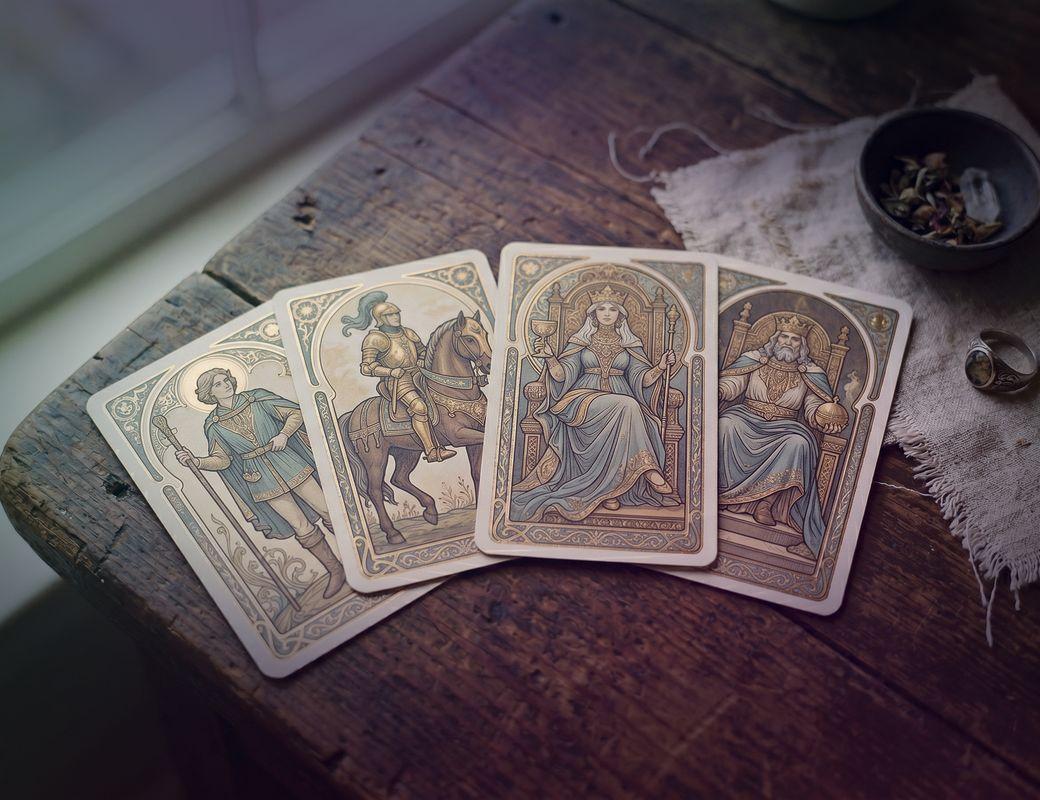
Sixteen court cards live in a standard tarot deck. Four ranks, Page, Knight, Queen, King, and four suits: Wands, Cups, Swords, Pentacles. Most tarot books will tell you the ranks represent age or social status, with a Page being young, and a King being old and powerful. I think that reading is mostly historical residue, a holdover from a deck designed in royal courts where rank actually meant something fixed. It doesn’t serve us now, and it isn’t what’s useful here.
What’s useful is knowing that the four ranks are four relationships to competence. The four suits are four arenas of life where competence gets tested.
It’s worth knowing, too, that the court cards weren’t always this set of four. The earliest tarot and playing-card decks, the Mamluk decks of the medieval Islamic world and the Italian decks that followed, sometimes carried only three court figures, a foot soldier, a horseman, and a king. The Queen is a later addition, folded into European decks over the fifteenth century, arriving slowly enough that some of the oldest surviving tarot sets simply don't have her. I find that history useful, not as trivia, but as a reminder that even the deck itself has had to learn its own internal balance over centuries. Inward mastery wasn’t always considered a register worth painting onto a card. We’re still, in a sense, catching up to her.
A Page hasn’t learned the skill yet and is still curious enough to try. A Knight has the skill enough to move fast and not enough to know when to stop. A Queen has internalized the skill so deeply it’s become a way of being, quiet, embodied, and felt from the inside. A King has taken that same mastery and turned it outward, into structure, decision, and command.
None of these is a personality. All of them are a phase you cycle through, sometimes within the same hour, depending on what you’re facing and how practiced you are at facing it.
The suits, meanwhile, just tell you where. Wands are fire: action, ambition, and the will to begin. Cups are water: feeling, intimacy, and the inner emotional weather. Swords are air: thought, conflict, and the way we cut through confusion or get cut by it. Pentacles are earth: the body, money, and the material facts of a life that has to be fed, housed, and paid for.
So a “court card” is really just a coordinate. Rank tells you how practiced you are. Suit tells you what you’re practiced in, or not.
This is where the court cards quietly diverge from most of the personality frameworks people reach for first. A sun sign is fixed at birth and stays put for life. An Enneagram number, once you’ve tested into one, tends to get treated the same way, a permanent core you spend years “working through” rather than moving past. Even Myers-Briggs, for all its caveats about growth, gets used in practice as a label you print on a name badge: I am an INFJ, full stop, forever. These systems aren't wrong to notice real patterns. They're wrong, or at least incomplete, when they let you stop at the noticing and call it identity. The court cards don’t offer that kind of rest. There’s no card you get to keep. There's only the question of which one you're holding right now, and whether you reached for it on purpose.
You aren’t one coordinate. You are sixteen of them, visited in rotation, for the rest of your life.
The Page: Before You Know What You’re Doing
Every Page, regardless of suit, shares one quality: total inexperience held without total terror. The Page hasn’t mastered anything. The Page is still asking questions out loud, still getting things a little wrong, and is still willing to be seen not knowing.
This is the energy of you this morning, recipe in hand, hands a little clumsy, paying close attention because nothing here is automatic yet. That’s Page of Pentacles energy, beginner’s mind applied to a material skill. It shows up any time you start something with your hands or your money for the first time: a new budget, a new instrument, a new exercise you’re doing wrong on purpose because wrong is how you’ll eventually do it right.
Page of Cups looks like the friend who tells you, haltingly, that they think they might be in love, and they don’t trust the feeling yet because they’ve never let themselves feel it fully before. It's emotional honesty before it has language. It’s the diary entry that doesn’t make sense to anyone but you.
Page of Swords is the person in the front row asking the question everyone else was too embarrassed to ask. It’s curiosity that hasn’t yet learned tact, the kid who says the true thing at the wrong dinner table because they don’t yet know there’s a wrong time for true things.
Page of Wands is the spark before the plan. It’s deciding, on a whim, that you’re going to learn to surf, or start the business, or move to the city, with absolutely no idea what that will actually require. It’s pure appetite, untouched by strategy.
Here’s what I want you to notice: we treat the Page as embarrassing. We apologize for not knowing things. We preface our questions with “this might be a dumb question.” We hide our budgeting spreadsheets because they’re not sophisticated yet. But the Page isn’t a deficient state. The Page is the only state in which real learning happens. Nobody skips this register. They just get better at hiding that they’re in it.
The Page asks for one specific kind of mercy from you: permission to be visibly new at something. Most adults are starved for this permission, having decided somewhere around age twenty-five that competence was now mandatory and visible learning was now shameful. The whole reason people stop trying new things in their thirties and forties isn’t lack of curiosity. It’s an allergy to being a beginner in public.
It shows up in friendship, too, more than people admit. Making a new friend as an adult is almost entirely Page work, the slightly awkward small talk, the not-yet-knowing what’s safe to joke about, the careful overture of a text you’ve rewritten twice before sending. People avoid building new friendships past a certain age partly because the Page register feels undignified once you're used to the ease of old friends who already know your shorthand. But every long friendship you have now started exactly here, clumsy and untested, and the discomfort of being new at someone isn’t a sign you're doing it wrong. It’s the price of admission.
The Knight: When the Charge Takes Over
If the Page is curiosity without skill, the Knight is motion without restraint. Every Knight has enough capability to move fast, and not yet enough wisdom to know when speed is the wrong tool. The Knight is committed, urgent, and a little bit reckless. The Knight rides toward something. The Knight rarely checks whether the bridge is out.
That heat in the meeting, the one that wanted to fire back before thought caught up, that's Knight of Swords. It's the fastest of all the court energies, the one most associated with conflict because it cuts before it considers. You feel it as the urge to send the text immediately, to win the argument in the comments, to have the last word while your blood is still hot. Knight of Swords isn't wrong to want clarity and justice. It's wrong to think those things require zero seconds of delay.
Knight of Wands is the all-in launch, the person who quits the job before the new thing is lined up because waiting felt like dying slowly. It's romantic, in the old sense, reckless devotion to a cause or a person, full conviction with incomplete information. It's also the reason so many great ideas die of exhaustion in month three: the Knight rode hard and never planned for the long haul.
Knight of Cups is the grand romantic gesture, the love letter, or the showing up at the airport. It feels deeply, says so immediately, and occasionally confuses the intensity of a feeling for the truth of a feeling. It's unfiltered.
Knight of Pentacles is the slowest and most stubborn of the four, the one who works with grinding, dogged persistence, and who finishes the marathon not because they're fast but because they won't stop moving. It's discipline without flexibility, or the person rigidly devoted to The Plan even after The Plan has clearly stopped working.
Knight energy also shows up in the friend who just discovered something, a diet, a therapist, a productivity system, or a spiritual practice, and can't stop telling you about it. It's a Knight who's found a horse worth riding and hasn't yet learned that other people are walking, on their own roads, at their own pace. The evangelism comes from a real place. It's just not yet calibrated to the room.
The Knight's gift is momentum. Nothing actually happens in this world without somebody willing to charge. But the Knight's blind spot is consequence. Knights don't ask what happens after the charge. That's not their job. Their job is the charge itself.
Most of us have at least one Knight we ride too often. Mine is Swords. I write the furious email and then, mercifully, usually don't send it for an hour. That hour is the only thing standing between my Knight and a relationship I'd have to repair for months. Find your Knight. Find the thing you do at full speed before you've checked your footing. That's a horse that needs reins, not a stable.
The Queen: Mastery That Stays Home
Somewhere past the Page's beginner hands and the Knight's reckless gallop, something settles. The skill stops being something you do and starts being something you are. This is the Queen, and her defining quality is that her mastery lives inward. She doesn't need an audience. She doesn't need to prove anything. She simply is the thing, fully, quietly, from the inside.
That stillness on the phone with your crying friend, the part of you that knew exactly how to hold space without rushing to fix anything, that's Queen of Cups. It's emotional mastery so complete it doesn't look like effort. It looks like ease. People mistake this ease for passivity sometimes, not understanding that holding steady while someone else falls apart is one of the hardest things a nervous system can do.
Queen of Pentacles is the person whose home, however modest, always feels like it has enough in it. It's the friend who can stretch a small budget into a meal that feels abundant, who tends a body and a bank account and a garden with the same unfussy competence. It's resourcefulness that has become identity.
Queen of Swords is clarity without cruelty, the rare person who can tell you the hard truth in a way that doesn't leave a scar, because they've done the internal work of separating honesty from the desire to wound. It's discernment that's been seasoned by enough pain to be gentle with other people's pain.
Queen of Wands is charisma with roots. It's the person who walks into a room and the energy shifts, not because they performed anything, but because their own conviction is so settled it's contagious. They don't need to announce their confidence. It's simply present, the way warmth is present near a fire.
Queen energy at work tends to go unrewarded precisely because it's quiet. It's the colleague who's been doing the job so long and so well that nobody notices her anymore, because crisis doesn't visit her desk the way it visits everyone else's. Organizations are built to reward visible firefighting, the dramatic save, and the Knight who charges in at the last minute. They're far worse at noticing the Queen who simply never let the fire start. If you're that person, it's worth saying out loud sometimes that the calm wasn't an accident. It was built, and it counts.
Here's the trap with the Queen register, and it's a trap I see constantly in spiritual and self-help spaces: people perform Queen energy before they've earned it. They post the serene caption. They claim the steady, unbothered tone. But the Queen's calm isn't a vibe you adopt. It's a residue left behind by actually surviving the thing the Page was scared of and the Knight charged through. You can't skip to Queen. You can only arrive there, late, having paid for it.
The King: Mastery That Steps Outside
If the Queen holds her mastery inward, the King takes that same mastery and points it at the world. The King's job isn't to feel the skill. It's to structure it, decide with it, build something other people can stand on. Where the Queen is competent, the King organizes competence into systems, rules, and decisions that affect more than one person.
Standing in the kitchen, setting the terms of the homework meltdown, holding the line without yelling, that's King of Pentacles, or King of Wands depending on whether the moment called for stability or direction. It's the parent, the manager, the person who has to make the call and live with having made it. It's authority that has earned the right to be obeyed, at least in that moment, at least by the small kingdom currently melting down at the table.
King of Swords is the person who can make an unpopular decision because they've thought it through completely and they're willing to be the one who's accountable for it. It's leadership through clarity, not charm.
King of Cups is emotional leadership, the person who can hold an entire grieving family together at a funeral, not by suppressing the grief but by being a structure sturdy enough for everyone else's grief to lean against.
King of Wands is vision turned into direction, the founder, the organizer, or the person who doesn't just have the idea but builds the conditions for other people to execute it.
It shows up in friend groups, too, usually as the one person who books the restaurant, sets the group chat poll, and quietly absorbs the logistical weight that would otherwise sink the plan entirely. Every friend group has a King somewhere, the one who turns "we should all get together sometime" into an actual date on an actual calendar. It's a real form of care, organizing care, even though it rarely gets thanked the way more visibly emotional gestures do. If you're that person, notice whether you're choosing it or just the only one who will. Those are different things, and only one of them is sustainable.
The King's particular danger is the one everyone already suspects: command can calcify into control. A King who forgets that authority is a temporary, situational thing, not a permanent personality trait, becomes the boss who can't delegate, the parent who can't let a teenager make a single mistake, or the partner who needs every decision to run through them. The healthy King steps into command because the moment requires it, and steps back out of it the moment it doesn't.
When a Face Gets Stuck
Every register has a gift and a shadow, and the shadow isn't the opposite of the gift. It's the gift, overused, past the point where it's still serving anyone.
This is also why the language of "your card" gets dangerous fast. The moment you decide you're fundamentally a Queen of Cups person, you've handed yourself a permanent excuse to avoid the Knight's urgency when urgency is actually required, or the King's hard decision when somebody needs you to just decide already. Shadow isn't usually the dramatic stuff therapists warn you about. It's mostly this: the quiet, respectable habit of only ever reaching for the card that's already comfortable in your hand, and calling that consistency, when what it actually is, is avoidance with better branding.
A Page who never leaves Page energy becomes someone who's perpetually starting over, perpetually new at everything, never building the muscle memory that would let them stop apologizing for not knowing. A Knight who never dismounts becomes exhausting to be around, always mid-crusade, unable to rest because resting feels like losing. A Queen who never steps outward becomes beautifully composed and quietly invisible, holding everyone else together while nobody holds her. A King who never steps back becomes a tyrant in miniature, running a household or a team like it's a hostile takeover.
The healthiest version of a person isn't someone who's found their one true court card and settled there forever. It's someone who can move through all four registers depending on what the actual moment requires, and who can feel, fairly quickly, when they're stuck in the wrong one.
You'll know you're stuck when the register stops matching the moment. Knight energy in a conversation that needed Queen energy looks like steamrolling someone who needed to be held, not won. Queen energy in a crisis that needed King energy looks like staying gently present while the house is actually on fire and someone needed to just call 911. Page energy in a job you've done for ten years looks like chronic self-doubt that has nothing to do with your actual competence and everything to do with an old story about not being allowed to be good at things.
This is where the work gets honest. Ask yourself which register you default to under stress, not which one you'd like to default to. Most people have a home base, the place they retreat to when they're overwhelmed, regardless of whether it fits. Mine is Knight of Swords. Under pressure, I want to cut, fast, and be right about it. Knowing that about myself doesn't eliminate the impulse. It buys me the half-second of awareness I need to ask whether this moment actually requires a blade, or whether it requires me to dismount and just listen.
A lot of the friction in close relationships comes from two people stuck in mismatched registers at the same time, each one convinced the other is being unreasonable. A partner who defaults to King under stress, organizing, deciding, taking charge of the logistics, can read as cold or controlling to a partner who defaults to Cups energy and just wants the moment held, not managed. Neither person is doing anything wrong, exactly. They're both reaching for their home base. But home base isn't always what the room needs, and it's almost never what the other person needs at the exact same time. The fights that repeat in a relationship, the ones that feel like the same argument wearing different clothes, are often just two stuck registers colliding on a loop, with neither person aware there's a register to name, let alone change. If a pattern like this has been running for a long time and naming it here doesn't loosen it, a couples counselor or therapist can help in ways a framework like this one can't.
A Practice: Naming Today's Court
You don't need a tarot deck for this, though it helps to have one nearby if you've got one. What you need is five minutes at the end of a day and a willingness to be specific rather than flattering.
Walk back through your day, hour by hour if you can remember it that clearly, and name the register you were in during each significant moment. Not the register you wish you'd been in. The one you were actually in.
Ask, for each moment: was I a Page here, genuinely new at something and a little unsteady? Was I a Knight, moving fast and maybe too fast, toward something I wanted badly? Was I a Queen, settled and steady in a way that didn't require effort? Was I a King, having to organize, decide, or hold a structure other people were standing on?
Then ask the harder question: did the register I was in match what the moment actually needed? Where there's a mismatch, that's not a failure. That's information. It tells you where you're defaulting to comfort instead of responding to the room.
One more layer, if you want it: notice which suit kept showing up. If every moment of friction today was a Swords moment, conflict, decision, communication, that tells you something about where your week's actual battlefield is. If every moment of ease was a Cups moment, that tells you where your nourishment is actually coming from, which might not be where you'd guess.
Do this for a week and you'll stop seeing yourself as one fixed type and start seeing yourself as a deck. Some days you'll deal mostly Pages. Some days, mostly Kings. The goal isn't to land on a favorite card and call it home. The goal is to know your own deck well enough that you can reach for the right card instead of the reflexive one.
Here's what that Tuesday looks like written out this way. Morning: Page of Pentacles, new at the recipe, hands unsteady, paying attention because nothing's automatic. Ten o'clock: Knight of Swords, rising, unsent, a register I noticed before I rode it, which is the entire point of noticing. Two o'clock: Queen of Cups, no effort required, just presence, which told me that particular friendship has reached a place where my steadiness there is no longer a performance. Six o'clock: King of Pentacles, a structure someone smaller than me needed to lean on. Match, match, near-miss caught in time, match. Three out of four isn't a bad day. It's actually most days, once you start counting.
Reading the Room: Naming Other People's Court
Once you can name your own registers, you'll start noticing them in everyone else, and this is where the practice becomes genuinely useful rather than just personally interesting. Most conflict between people isn't a disagreement about facts. It's two people stuck in different registers, each one certain the other is malfunctioning.
When someone you love comes to you in Knight energy, fast, urgent, talking before they've finished thinking, the instinct is often to meet them there, to match their speed with your own defensiveness or your own urgency. What they usually need instead is a Queen across from them, someone steady enough that the Knight's gallop has somewhere safe to slow down. You don't have to agree with everything they're saying at full speed. You just have to not add more speed to a system that's already overheating.
When someone comes to you in Page energy, tentative, unsure, asking a question they've clearly rehearsed before working up the nerve to say it out loud, the worst response is King energy back at them, brisk, decisive, here's-what-you-should-do. A Page doesn't need a verdict. A Page needs enough safety to keep being new at the thing without flinching. The kindest response to a Page is usually another, gentler Page: I don't fully know either, let's figure it out together, rather than a solution delivered from on high.
When someone comes to you already in King or Queen energy, settled, decisive, not asking for help so much as informing you of a decision, resist the urge to challenge it with Knight energy just because their certainty makes you uncomfortable. Sometimes a King has, in fact, thought it through. Sometimes a Queen really has earned her stillness. Not every confident person is overcompensating, and treating settled competence as something to be suspicious of is its own kind of unkindness.
This is also where boundaries get clearer. If someone consistently approaches you in Knight energy, urgent, charged, wanting an immediate reaction, and you consistently find yourself depleted afterward, that's not a character flaw in either of you. It's a mismatch you're allowed to name out loud. I can hear that this feels urgent to you. I need a little time before I respond well to it. That sentence doesn't reject the relationship. It just declines to let someone else's Knight conscript you into matching speed you didn't choose.
You will misread people sometimes. You'll meet someone's genuine Page-level fear with Knight-level impatience because you were tired and didn't have the bandwidth to notice what register they were actually in. This isn't a reason to abandon the practice. It's a reason to keep a light hand on it. The point was never to become a flawless reader of other people's internal weather. The point was to have a vocabulary for the mismatch once you notice it, so the repair conversation afterward has somewhere to land besides I guess I was wrong about you or I guess you're impossible. "I met your Page energy with my Knight energy, and that wasn't fair to either of us" is a sentence that actually repairs something. Most arguments never get a sentence that good.
You Contain the Whole Deck
Back to Tuesday. The recipe, the heat in the meeting, the stillness on the phone, the line you held in the kitchen. Four faces, one day, one person, none of them a costume.
The personality industry, astrology included, tarot included, the whole self-help economy of "find out which type you are," sells a tempting lie: that somewhere underneath the noise is one true, stable, nameable you, and once you find it, you can stop the exhausting work of figuring out who to be in any given moment. I understand the appeal. Certainty is restful.
But it's not how a person actually works, and pretending otherwise costs you something real. It costs you the Page's right to keep learning past the age where learning is supposed to be finished. It costs you the Knight's fire, talked out of urgency by people who confuse calm with maturity. It costs you the Queen's stillness, performed before it's earned, instead of let to arrive in its own time. It costs you the King's willingness to actually decide, deferred in the name of staying humble.
You aren't the Queen of Cups, holding her shape forever, certain and serene. You aren't the Knight of Swords either, riding hot into every disagreement for the rest of your life. You're the whole deck, shuffled daily, dealt out card by card depending on what the day asks of you.
There's a reason this kind of cyclical thinking sits more comfortably in ritual practice than in personality science. The moon doesn't get accused of being inconsistent for waxing and waning. The seasons aren't considered a character flaw for refusing to pick one temperature and hold it. We've simply gotten more comfortable extending that grace to weather than to ourselves. The court cards are an invitation to extend it a little further inward: to stop treating your own daily variation as a problem to be solved, a true self to be excavated from underneath all this shifting, and start treating it as exactly what it is. Weather. Cyclical, responsive, never identical two days running, and not in need of fixing.
The work isn't finding your card. The work is learning to read your own hand, quickly, honestly, and often enough that by the time the moment actually arrives, you already know which version of you it needs to meet it.
More essays like this one live at The Feathered Chronicles. If you want a place to talk through what came up for you here, the Modern Grimoire community on Facebook is open and welcoming.
Responses (2)