How to read Tarot triplets
From simple spreads to deep insights
Article · 3 min read · ·
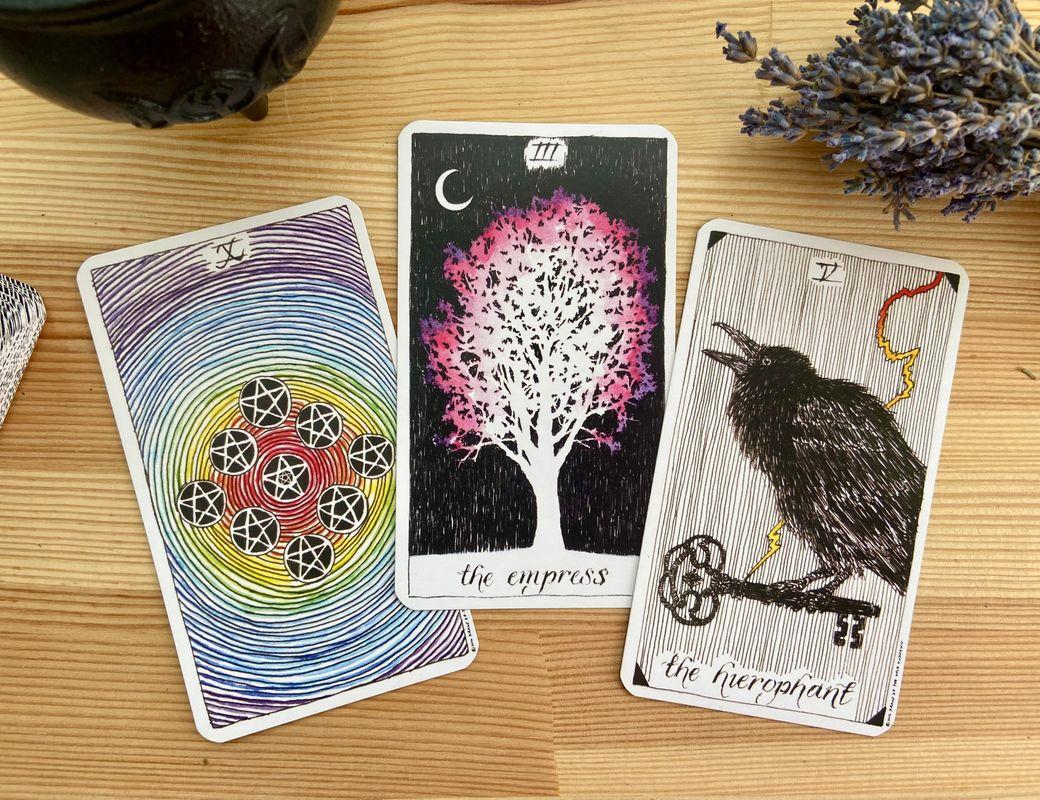
Tarot is the language of symbols, images, and the Universe’s guidance. But you don’t always need a big spread of ten or more cards to gain deep understanding of a situation. Sometimes three cards speak louder than an entire deck. That’s why triplets are one of the most popular and convenient formats for working with Tarot.
What is a triplet?
A triplet is a spread of three cards. It’s universal: simple enough for beginners, yet able to reveal deep nuances for experienced readers. Three cards reveal a journey with its opening, unfolding, and conclusion. In this simple form lies great depth: you don’t just see a static “snapshot” of a situation, but its movement and dynamics.
Core principles of reading triplets
There are several basic patterns that help structure the spread:
- Past – Present – Future. A classic spread to trace the flow of events.
- Situation – Action – Outcome. Shows what’s happening, what action is worth taking, and what to expect.
- Problem – Advice – Potential. Perfect for inner work or relationship analysis.
- Self – Others – Result. Helpful in interacting with people dynamics.
Each pattern is a tool to help the cards tell a story. The key is to choose the one that best aligns with your intention.
How the cards interact
In a triplet, cards are rarely read in isolation. They merge into a unified flow of meaning. Pay attention to:
- Reinforcement or contradiction. If two cards show similar energy, it becomes dominant. If they contradict each other, it signals conflict or tension.
- Suits and elements. For example, many Swords may point to excessive rationality or stress, while Cups emphasize emotions.
- Major Arcana. These always stand out, highlighting key lessons and life themes.
- Number progressions. A sequence (e.g., 5 → 6 → 7) can signal growth, transformation, or vice versa.
Practical tips for reading triplets
1. Ask a clear question. The sharper your query, the clearer the spread.
2. Look at connections. Don’t stop at the meaning of each card separately - find the links and weave them into one story.
3. Trust your intuition. Sometimes a card sparks unexpected associations - that’s part of the interpretation, too.
4. Keep a journal. Record your spreads to track how your interpretations manifest and evolve over time.
Example triplet spreads
• For romantic relationships:
(1) Your attitude toward the relationship, (2) your partner’s influence, (3) the potential outcome.
(1) What brings you together, (2) what pulls you apart, (3) what needs your attention.
• For career:
(1) Current situation, (2) your resource or strategy, (3) the outcome.
(1) Career opportunities, (2) career challenges, (3) the result you can achieve.
• For self-discovery:
(1) What’s happening inside you now, (2) the lesson you’re going through, (3) what will help integrate the experience.
(1) Where you are now, (2) where you want to be, (3) how to get there.
These simple spreads help you quickly receive answers while also working with deeper processes.
Conclusion
Triplets are small doors into big discoveries. They teach you to see connections, trust your intuition, and develop inner awareness. With regular practice, you’ll learn to understand not only the cards but also yourself. Each spread is more than a “prediction” - it’s a dialogue between your subconscious and the Universe.
Try pulls three cards today. Ask a question, lay them out, and see what story they reveal. You may be surprised at how much wisdom can be found in just three cards.
Responses (8)