Death
The Shadow of the Unreleased Grip
Article · 10 min read · ·
I avoided this card for years.
Not consciously—I was too sophisticated for that. I didn't flinch when Death appeared in a reading. I'd nod sagely, say something about "transformation" and "endings being natural," and move quickly to the next card.
But beneath the performance, I was terrified. Not of dying. Of losing.
I had lost so much already. My childhood. My family. My home. My sense of safety. Every time I had finally, finally built something that felt stable, the cosmic rider would appear on the horizon, and I would watch another structure crumble into dust.
So I learned to grip. Tightly. Desperately. Permanently.
Relationships that had expired years ago—I gripped. Identities that no longer fit—I gripped. Dreams that had already died but I refused to bury—I gripped. I treated endings as personal failures, as evidence that I was cursed, as proof that I could never truly have anything without eventually losing it.
I didn't realize that my grip was the very thing preventing me from receiving what was trying to arrive.
Death was never my enemy. My unwillingness to release was.
The Traditional Blueprint: The Great Unmaker
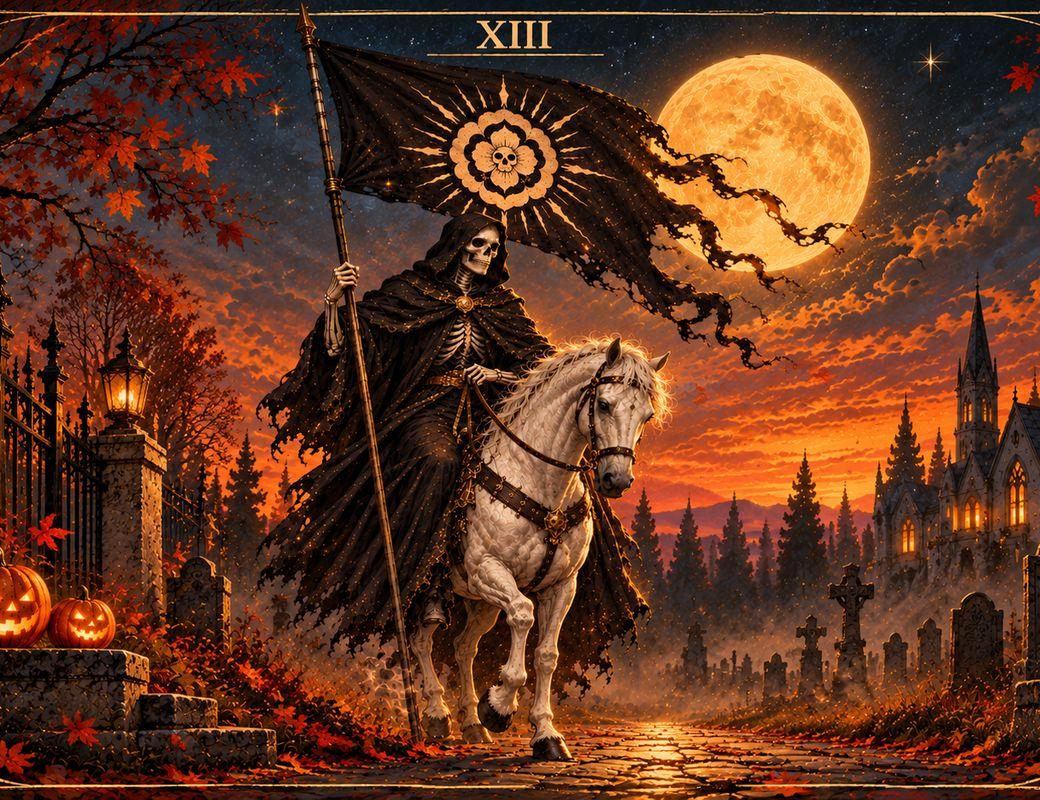
Death is Card XIII—the number that western culture has spent centuries trying to avoid . No thirteenth floors. No thirteenth rows. No thirteenth cards named anything other than something gentler, softer, more palatable.
But the card itself is not frightening. Not truly.
In the Rider-Waite-Smith deck, Death rides a white horse—the color of purity, of transcendence, of the blank page . He carries a black standard emblazoned with a white rose, the symbol of life emerging from dissolution . At his feet, a king lies fallen, his crown tumbled beside him. A bishop raises his hand in futile supplication. A child, innocent and unwitting, offers flowers to the advancing hooves .
No one is being punished. No one is being judged. Death does not discriminate between king and child, believer and skeptic. He simply… arrives. For what is ready. What has completed its purpose. What is now compost rather than structure .
Astrologically, Death is associated with Scorpio—the sign of depth, of the unseen, of the phoenix who does not rise from the ashes until she has first consented to burn .
This card is not about destruction. It is about decay as prerequisite for growth. The fallen king is not a tragedy; he is a man who outlived his reign and refused to abdicate. The child with flowers is not a victim; she is the future, unafraid of the rider because she has not yet learned to fear endings .
Death comes not to take what you love. Death comes to take what you have already outgrown.
The Shadow Reflection: The Clinger and The Preemptive Gravedigger
When Death appears in your shadow, it reveals your relationship with the one thing you cannot outrun: impermanence.
Your "Death Shadow" manifests in two directions, both rooted in the same terror:
1. The Clinger.
This shadow refuses to release anything. Relationships that ended years ago are still carried like stones in a pocket, worn smooth from constant handling. Identities that no longer fit are still worn like a coat three sizes too small, the seams straining. Grief is not processed; it is curated.
The Clinger believes that if it stops holding on, it will be admitting that the loss was real. And if the loss was real, then the pain was real. And if the pain was real, then it might never stop hurting.
So it never lets go. It mistakes endurance for healing, permanence for safety.
2. The Preemptive Gravedigger.
This shadow has been so wounded by unexpected loss that it now tries to outrun Death by beating him to the punch. It ends relationships before they can end it. It sabotages success before success can be taken away. It refuses to want anything too much, because wanting makes losing hurt more.
The Preemptive Gravedigger is not detached; it is terrified into paralysis. It tells itself it doesn't care about promotions, partnerships, dreams—but beneath the performance of non-attachment is a child sobbing, "You can't take it if I never let myself have it."
Both shadows are terrified of the same thing: the vulnerability of loving what will not last.
But nothing lasts. And the tragedy is not that we lose things—it is that we spend so much energy trying to prevent loss that we never fully inhabit what we have.
What I Learned When I Finally Let Something Die
It was a dream. Not a metaphor—an actual, specific, decade-long dream about who I was supposed to become.
I had carried this dream since I was nineteen, cold and hungry and convinced that if I could just achieve this one thing, I would finally feel safe, whole, worthy. I built my entire identity around its pursuit. I deferred happiness, connection, rest—after this, after this, after this—and the dream absorbed my life like water into sand.
And then, slowly, terribly, I began to suspect: I didn't want it anymore.
Not because it was bad. Not because I had failed. Because the person I had become no longer recognized the dream the nineteen-year-old had packed in her bindle. I had outgrown it. It was no longer my future; it was my luggage.
But how do you set down a dream you've carried for a decade? How do you admit that the destination you've been marching toward for ten years is not, actually, where you want to arrive?
I couldn't. Not at first. I tried to reinflate it, reanimate it, retrofit it to my new shape. I performed desire I no longer felt. I clung to a corpse and called it loyalty.
Until one night, journal open, candle burning, I wrote:
"I release you. You were not wrong. You were just… earlier. Thank you for carrying me this far. You can rest now."
I didn't burn the page. I didn't perform a dramatic ritual. I just… set the dream down. On paper. In ink. And closed the book.
I stopped gripping. And the rider, patient as always, simply moved on.
The Sanctuary Question:
"What in my life is already complete—already finished, already outgrown, already compost—that I am still gripping, mistaking permanence for safety?"
And the question beneath it, the one that trembles on the edge of the exhale:
"If I released it, what might finally have room to arrive?"
The Integration Prompt: The "Compost List" Ritual
Your task is not to perform a dramatic, one-time release of everything you've ever lost. It is to identify one thing that is already dead, and stop pretending it's just resting.
1. Inventory Your Grip.
Make a list. Not of what you want to release—that pressure creates a second grip. Just a neutral inventory of what you are currently holding:
-
A relationship that ended but you're still emotionally entangled in.
-
A career identity you've outgrown but still list on your internal resume.
-
A grief you haven't stopped performing because you're afraid of what comes after.
-
A goal you no longer want but can't admit you've abandoned.
2. The Discernment.
For each item, ask: "Is this still alive in me, or is this a corpse I'm cradling?"
This is not a test of worthiness. Some grief takes years to process, and that's not "clinging"—that's integration. But some grief becomes a costume. Some identities become a comfortable prison. Some dreams become a reason to avoid the terrifying freedom of not knowing what's next.
Be honest. Not cruel. Just honest.
3. The One Sentence Release.
For one item—just one—write a sentence of release. Not a dramatic farewell, not a poetic eulogy. Just a simple, adult acknowledgment:
"This is complete."
"I no longer need this to define me."
"I release you from the duty of being my future."
4. The Empty Space.
Do not immediately fill the vacancy. The Clinger panics at empty space and rushes to install new furniture. The Preemptive Gravedigger uses emptiness as proof that hope is dangerous.
Just let the space be empty. For a day. For a week. For as long as it takes to feel that emptiness is not annihilation—it is anticipation.
Death Is Not the Enemy. The Unreleased Grip Is.
I have watched so many brilliant, sensitive souls spend years trying to outrun this card.
They keep the dead relationship on life support, mistaking comfort for love. They continue performing the identity they outgrew a decade ago, mistaking consistency for integrity. They pursue the dream they no longer desire, mistaking momentum for purpose.
And they wonder why they feel so heavy.
You are not heavy because you have too much to carry. You are heavy because you are still carrying what was never meant to travel with you this far.
Death does not arrive to punish you for your attachments. Death arrives to relieve you of them.
The rider does not hate the king whose crown falls in the dust. The rider simply recognizes what the king cannot admit: his reign is over. The throne belongs to whoever is ready to sit in it next. And the king's refusal to abdicate does not halt the turning of time—it just means he spends his final years guarding an empty room.
You are not the king. You are not the child with flowers. You are not even the rider.
You are the one who decides, each day, what to carry forward and what to finally, gratefully set down.
The Sanctuary Was Built for Those Ready to Release
I know how heavy your arms are.
I know you didn't choose to carry most of what you're holding. Some of it was placed there before you had the strength to refuse it. Some of it you picked up because no one else would. Some of it was once so vital, so precious, so necessary—and now it's just… tired.
You don't have to release it all today. You don't have to release it beautifully or gracefully or with a perfectly composed eulogy.
You just have to admit it's complete.
The Cornerstone taught me how to stay in my body while setting down what I had outgrown—how to breathe through the phantom limb pain of a released identity, how to feel my feet on the floor even when the ground beneath me was shifting.
The Blueprint gave me the language to dialogue with the parts of me that were terrified of empty space—the Clinger who believed that release was abandonment, the Preemptive Gravedigger who had stopped wanting anything at all.
The Rendering showed me that new dreams cannot take root in soil still occupied by the roots of the old ones. You do not build the future on top of the past. You clear the ground. You compost what was. You trust the empty space.
And The Inhabitation—The Inhabitation taught me that living in your sanctuary means periodically walking through its rooms, running your hand along the walls, and asking:
"Does this still serve who I am becoming? Or is this a shrine to who I used to be?"
If you are ready to set something down—
I won't tell you it won't hurt. Release is grief, and grief is love with nowhere to go. But I will tell you this:
The grip is hurting you more than the release ever could.
Your arms were not designed to carry corpses. Your sanctuary was not meant to be a mausoleum. Your one, wild, precious life is happening now—not after you achieve the dream you no longer want, not after you finally heal the loss you've been curating for years.
Now.
The rider is patient. He has been waiting for you to notice that your hands are empty, and have been empty for some time, and that what you thought you were holding was only the memory of its weight.
You can set it down. The world will not end. Something new will grow in the compost of what you release.
This is the promise of the Death card. Not an ending. A clearing.
For the ones who are ready to stop gripping. For the dreams that need a gentle, honorable burial. For the empty space that is not an ending, but a beginning so new it doesn't have a name yet.
The rider waits. Not impatiently. Just… present.
Whenever you're ready to open your hands.
With you in the sacred release,
Star
Responses (1)