Witchcraft in the Pines
Lore, History, and My Nights in the Barrens
Article · 3 min read · ·
If you’ve never been in the Pine Barrens after dark, let me tell you, those woods don’t just get quiet, they get alive in a way that makes the hair on your arms stand up. It’s not the silence of an empty place it’s the silence of something watching.
The Pine Barrens stretch over a million acres of tangled forest, cedar swamps, and sugar sand, wild land that’s been dodging civilization for centuries. The soil is too acidic for most crops, so early settlers didn’t tame it… they just learned to live with it. And wherever land refuses to be controlled, superstition blooms.
The Pine Barrens have always been a cauldron of folklore, witch tales, and whispered curses. In the colonial era, isolated homesteads dotted the sandy roads, and those who lived too far from towns were often branded “witches” or “conjure women.” Some practiced European folk magic brought over by settlers, herbal remedies, charms for good hunting, wards against illness. Others mixed these old-world traditions with Indigenous Lenape spiritual practices, creating a unique blend of forest magic.
Then there’s the Jersey Devil, born of the infamous Leeds family and their matriarch, Deborah Leeds, who locals swore was a witch. Legend says she cursed her thirteenth child, and it was born a monster… half-beast, half-human… and fled into the Barrens. But beneath the campfire stories, there’s a deeper truth: the Leeds were political outcasts, accused of witchcraft to ruin their name, a common trick in colonial times.
By the 18th and 19th centuries, Pineys (as locals are called) were known for “powwowing”… a kind of backwoods magic rooted in Pennsylvania Dutch folk traditions. Powwow doctors would cure illness, protect livestock, and even lift curses, sometimes for coin, sometimes for trade. The forest itself became part of the ritual… the resin of the pines, the iron-rich water of cedar streams, the herbs that only grew in the sandy soil.
The first time I went into the Barrens alone at night, I thought I was just going to clear my head. I parked on the edge of a fire road, the air thick with the smell of pine pitch, and stepped into the sand. No flashlight, just the moon cutting silver lines between the branches.
There’s this thing that happens when you walk in those woods long enough, you stop hearing the world you came from. No traffic, no hum of power lines. Just the crunch of sand under your boots and the occasional snap of a twig that you didn’t step on.
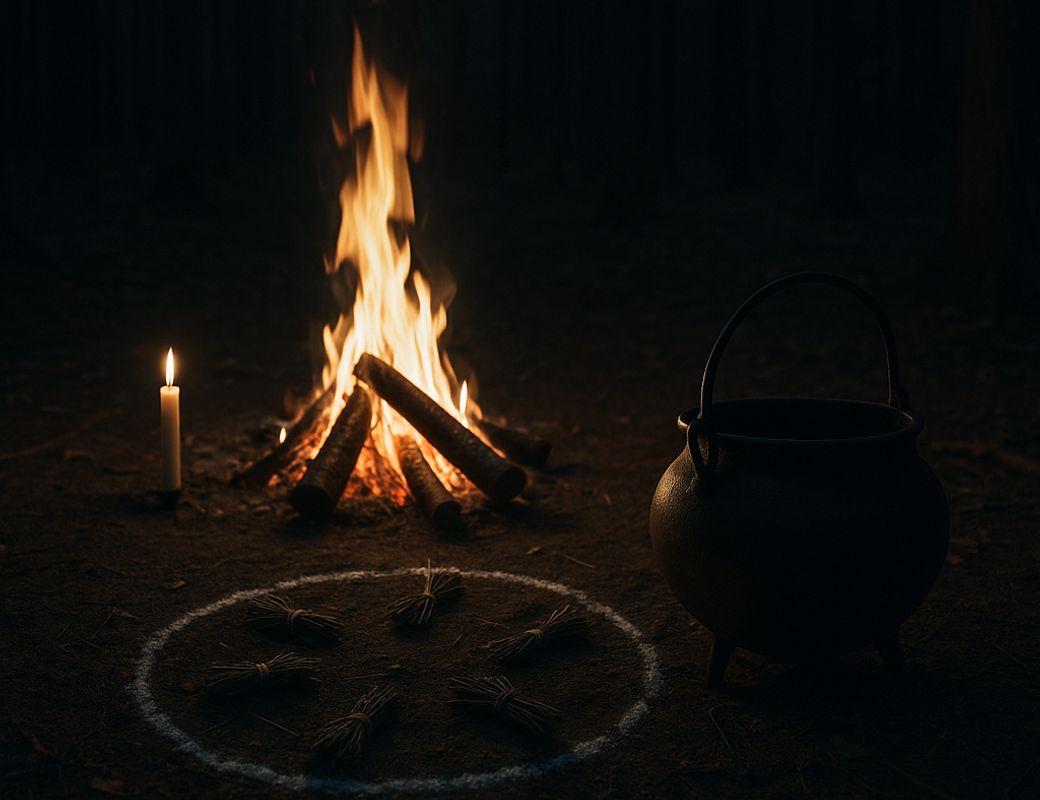
I’ve done small rituals there, nothing elaborate. A circle of cedar branches, a candle that barely stayed lit in the damp air, a handful of herbs crumbling between my fingers as I whispered intentions into the soil. You can feel the Barrens respond. Not in some Hollywood “trees start moving” way, but in the shift of the air, the way the wind holds still for a second too long.
One night, I swear I saw eyes…far off, low to the ground, reflecting back at me. Could’ve been a fox. Could’ve been something else. But I didn’t feel afraid. I felt… noticed. Like the forest was deciding if I belonged there.
The Pine Barrens are one of those rare places where the line between history, folklore, and living magic is paper thin. The old witchcraft of the region isn’t gone—it’s just under the surface, in the cedar smoke curling out of chimneys, in the bundles of herbs hung in old kitchens, in the whispered stories kids still tell about the Devil in the woods.
For me, it’s a place where I’ve felt more spiritually connected than any building ever gave me. The Barrens don’t care who you are or what you believe—only that you respect the land, walk softly, and understand that some things in this world can’t be explained.
I’ve gone there to ask questions I couldn’t voice anywhere else. And more often than not, I’ve left without an answer… but with a feeling. And sometimes, in witchcraft, that’s more important than words.
Responses (7)

More from the Magazine
21 DE OCTUBRE
LA VELA DE MIEL, UN RITUAL PARA ABRIR LAS PUERTAS A LA ABUNDANCIA
Stop Healing and Start Living
What if your biggest obstacle to moving forward wasn’t your past, but the need to keep going back to it?
EL APOCALIPSIS HA LLEGADO… Y MUY POCOS SE HAN DADO CUENTA
No habrá necesariamente trompetas en el cielo ni señales de fuego en el horizonte.