The Surprisingly Twisted History of Oracle Cards
Ancient Roots: Before They Were Cards, They Were Stones. And Bones.
Article · 5 min read · ·
So let me tell you a story. It starts with me, sitting cross-legged on my floor, surrounded by crystals, a candle that smells like “forest witch with a side of anxiety ,” and a deck of oracle cards I pulled off Etsy that promised to unlock my soul’s destiny. Seemed legit.
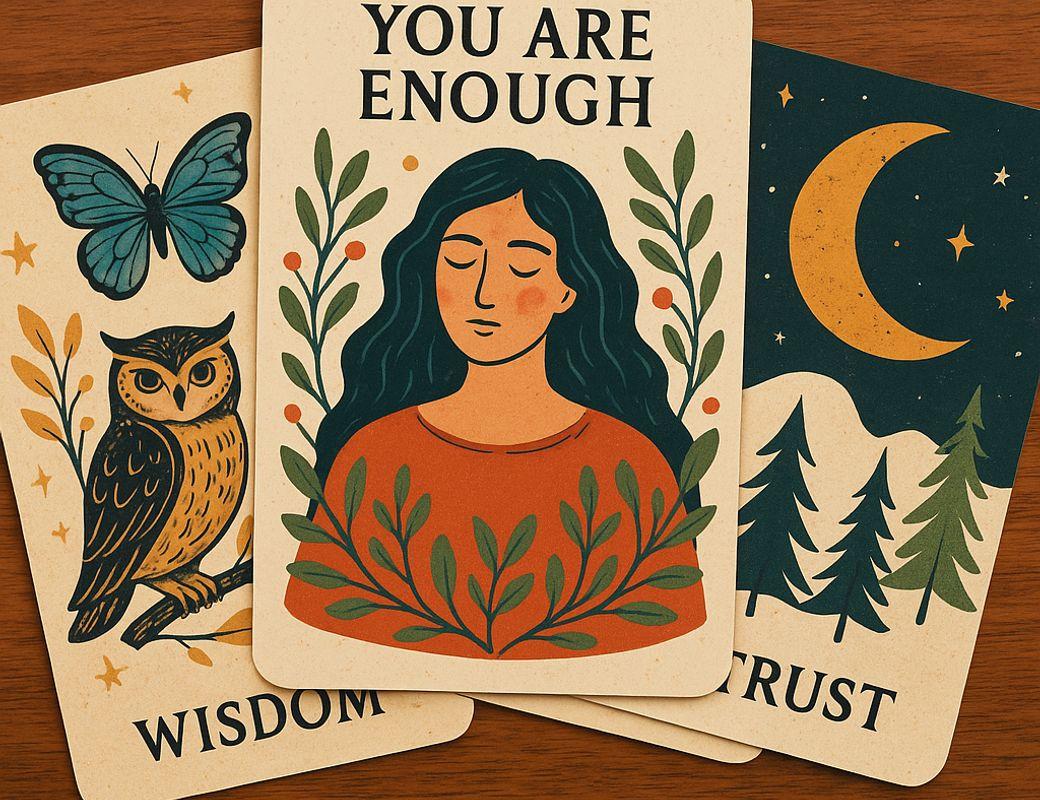
I shuffled those cards like I was summoning the ancient spirits of wisdom… and pulled “You Are Enough.” And I thought: wow. Either this deck is magic… or it’s emotionally profiling me like a psychic therapist with glitter. So I did what any rational, spiritually nosy person would do, I went down a rabbit hole looking into where these magical little cards actually came from.
And holy ancient insight, the history is wilder than a Mercury retrograde during a full moon in Scorpio.
Oracle cards are like tarot’s weird cousin who dropped out of college to start an intuitive art collective. They’re divination tools, sure, but they don’t follow a strict structure like tarot (with its 78 cards, Major and Minor Arcana, and enough rules to make your third eye twitch). Oracle decks can have 10 cards, 144 cards, or some chaotic number in between. Each deck is basically a channeled download of someone’s inner spiritual Pinterest board, but they work.
And they’ve been working… for centuries. Possibly even millennia. But not in the form we think.
Long before oracle cards came with gilded edges and poetic affirmations, people were divining the future with… whatever they had lying around. Tossing bones, reading animal guts (yep), cracking turtle shells (China, ~3000 BCE), or watching the way smoke curled from the fire. Basically, ancient folks saw signs in everything…because they didn’t have Instagram or anxiety meds.
Egyptians used cartouches, sacred oval shapes with divine names, and many believe their hieroglyphic inscriptions were early symbolic systems used for ritual and divine guidance.
The Greeks? Oh, they really kicked off the oracle thing. The Oracle of Delphi was less about cards and more about a trippy priestess high on volcanic fumes mumbling cryptic messages that kings would take as gospel. Basically the ancient version of vague Twitter horoscopes: “A great victory will come… unless it doesn’t.”
By the 1300s, playing cards had made their way into Europe from the Islamic world. At first, they were just for games and gambling… until mystics, bored nobles, and that one guy in the corner with crystals in his pockets started saying, “Hey, what if these could talk to spirits?”
By the 1700s, cartomancy (divination using playing cards) became a full-blown vibe. People were reading fortunes using basic playing decks, clubs, hearts, spades, and diamonds. But it wasn’t until Madame Lenormand, a spicy little French mystic in Napoleon’s era, came stomping onto the scene that oracle decks really started to form.
Madame Lenormand read for empresses, revolutionaries, and weirdos alike, and her style became so iconic that after her death, people started publishing “Lenormand decks” in her name. These had 36 cards with symbols like riders, coffins, anchors, and snakes. Dark, right? That’s how you know it worked.
Around the same time, secret societies like the Hermetic Order of the Golden Dawn were popping off. These were magical nerd collectives where everyone wore robes and argued about Egyptian gods and how to properly charge a wand. They were obsessed with the mystical properties of symbols and cards, and many of them started designing their own intuitive decks.
While tarot was getting standardized, oracle-style decks were quietly developing alongside them…less structure, more vibes.
The Victorians, meanwhile, were hosting séances, speaking to ghosts, and inventing talking boards (Ouija, anyone?). Some of the lesser-known decks from this era were printed with hand-painted symbolism meant to channel angels, spirits, or even fairies. There’s even record of “angel cards” used in England in the late 1800s, each one painted with an etheric being and a message of guidance, which sounds suspiciously like the modern-day “Angels and Ancestors” decks sitting on every metaphysical shelf today.
Oracle cards stayed a little underground until the late 20th century. That’s when things got real woo.
In the 1970s, fueled by flower power and the collective need to escape capitalism through incense and reincarnation, people started creating hand-drawn decks based on personal spiritual systems. The Medicine Cards (1988), drawing from Native American animal teachings, became a foundational modern oracle deck (though it raised big cultural appropriation questions later on).
Then Doreen Virtue floated onto the scene in the late ’90s with her cherub cheeks and an army of pastel angels. Her decks exploded in popularity…angel cards, fairy cards, unicorn cards. If it had wings, she put it in a deck. Suddenly oracle cards were everywhere, from Barnes & Noble to your aunt Cheryl’s nightstand.
Fast-forward to now, and it seems like everyone and their intuitive barista has their own oracle deck. Shadow work decks, inner child decks, moon decks, womb healing decks, decks specifically to read your houseplants’ energy. No rules. Just vibes.
Here’s the deal. Oracle cards don’t have a singular lineage. They evolved out of every culture’s need to understand the unknown using signs, symbols, and stories. They’re a collage of spiritual curiosity, ancestral wisdom, mystical rebellion, and artistic expression. They’re a tool…not for predicting the future like a slot machine from the divine, but for triggering something deeper inside you. Reflection. Clarity. Permission. Direction.
They’re mirrors for the soul, with sass, sparkle, and sometimes a questionable amount of glitter.
And honestly? That’s what makes them magic.
Responses (6)