Stoicism: The Ancient Philosophy That Conquered
Why a school of thought born over two thousand years ago continues to offer answers for modern life.
Article · 4 min read · ·
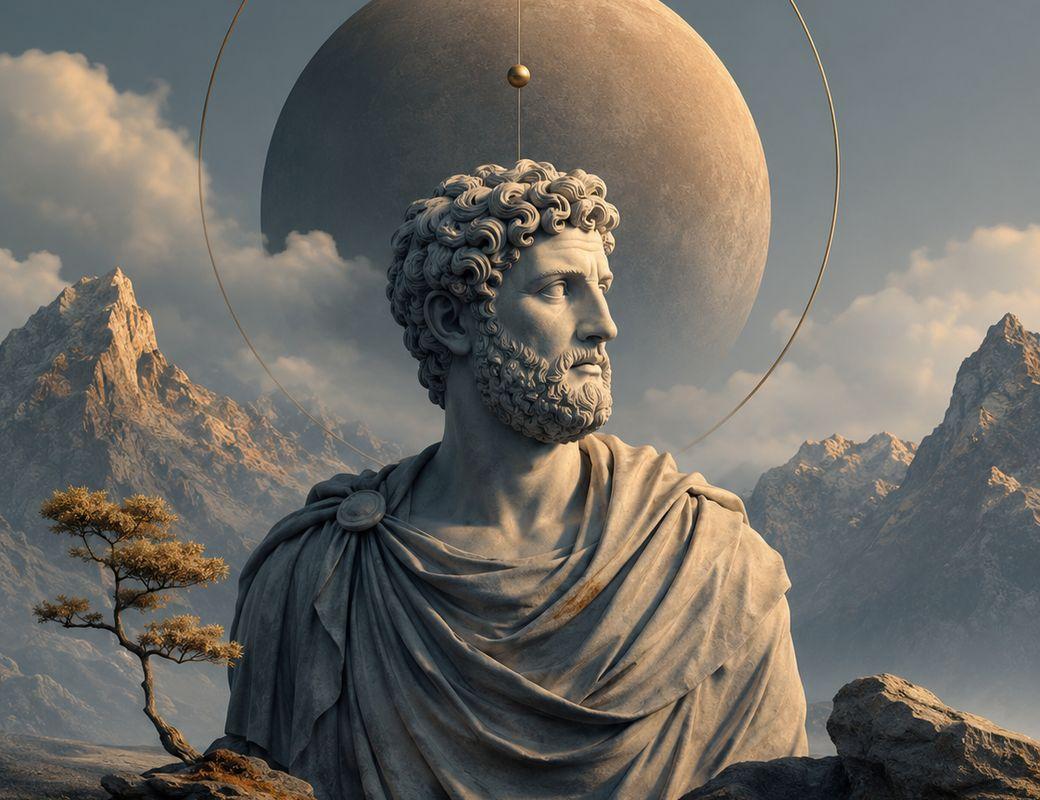
We live in an age of hyperconnectivity, constant information flow, and dizzying change. Never has it been easier to communicate with any corner of the world and, paradoxically, never has it been more common to feel overwhelmed. Amid this landscape, a philosophy born over two thousand years ago has once again taken center stage in conversations, books, and conferences: Stoicism.
Far from being an invitation to suppress emotions or accept suffering with resignation, Stoicism proposes something far deeper: learning to distinguish between what we can control and what lies entirely beyond our power. Within that simple idea resides one of the most powerful tools for facing uncertainty.
A philosophy born for everyday life
Stoicism emerged in Athens around the third century BCE, founded by Zeno of Citium. It would later be developed by figures like Seneca, Epictetus, and the emperor Marcus Aurelius, whose reflections continue to be read throughout the world.
Unlike other philosophical schools focused exclusively on knowledge, Stoicism always had an eminently practical purpose. Its teachers didn't seek to train scholars, but rather people capable of living with wisdom, integrity, and serenity.
For a Stoic, true wealth doesn't depend on money, prestige, or power, but on character. Happiness springs from acting in accordance with reason and virtue, not from pursuing external circumstances that constantly shift.
The power of accepting the inevitable
Perhaps the most well-known teaching of Stoicism is the so-called "dichotomy of control." According to Epictetus, some things depend on us: our decisions, our thoughts, our actions. Others, however, don't depend on our will: the weather, other people's opinions, the economy, the past, or even death.
Much of contemporary anxiety arises precisely from trying to control what proves uncontrollable. Stoicism proposes releasing that energy and concentrating it on the only thing truly within our grasp: our response to events.
This doesn't mean resignation, but rather acting with determination where we can make a difference and accepting with serenity what cannot be changed.
Success doesn't always mean victory
In a society that tends to measure personal worth by results, Stoicism offers a different perspective. Genuine success doesn't consist solely in reaching a goal, but in having acted with excellence throughout the process.
An athlete can lose a final and still have given their best. A businessperson can fail at a project and preserve their integrity. A student can fail an exam after having studied with discipline.
For Stoics, the outcome never completely defines the person. What truly matters is the quality of the decisions made.
A philosophy for difficult times
It's no coincidence that Stoicism resurfaces in times of uncertainty. Its principles find application in situations as diverse as an economic crisis, an illness, a romantic breakup, or the constant pressure of social media.
Practicing Stoicism doesn't mean ceasing to feel sadness, fear, or frustration. It means preventing those emotions from governing our actions. The goal isn't to become someone unfeeling, but to develop an inner strength that allows us to respond with balance even in the most adverse circumstances.
The legacy of Marcus Aurelius
Among all representatives of Stoicism, Marcus Aurelius occupies a special place. He ruled the Roman Empire while facing wars, epidemics, and political conflicts. Yet his personal writings, compiled in Meditations, reveal a man who struggled daily to be more just, humble, and aware of his own limitations.
His words continue to resonate with surprising relevance:
"The happiness of your life depends upon the quality of your thoughts."
Far from being a simple aphorism, this phrase encapsulates a truth supported today by numerous studies on psychology and well-being: the interpretation we make of events often influences our experience more than the events themselves.
Stoicism in the twenty-first century
In recent years, entrepreneurs, elite athletes, military personnel, psychologists, and leaders from different fields have rediscovered the practical value of Stoic thought. Its influence can be found in leadership programs, mental training, and even in some cognitive-behavioral therapy techniques.
However, reducing Stoicism to a tool for increasing productivity would be oversimplifying it. Its purpose was never to manufacture more efficient people, but freer human beings.
Free from the fear of failure.
Free from the constant need for approval.
Free from the slavery of endless desires.
An invitation to live better
Stoicism doesn't promise a life without difficulties. It promises something more realistic and, perhaps for that reason, more valuable: the possibility of facing any circumstance with dignity, clarity, and strength.
In a world obsessed with changing everything, this philosophy reminds us of a simple but transformative truth: before attempting to control the world, we should learn to govern ourselves.
Perhaps that's why, more than twenty centuries after its birth, Stoicism continues to inspire millions of people. Not because it has all the answers, but because it teaches us to ask the right questions.
And in times of uncertainty, that may be the greatest form of wisdom.
Mayau Wicca 🌸
Responses (2)