Persephone and the Power of Transformation
Explore the Greek goddess whose myth connects the changing seasons with loss, return, and renewal.
Article · 5 min read · ·
===
Some myths endure because they give shape to experiences that are difficult to explain. The story of Persephone is one of them.
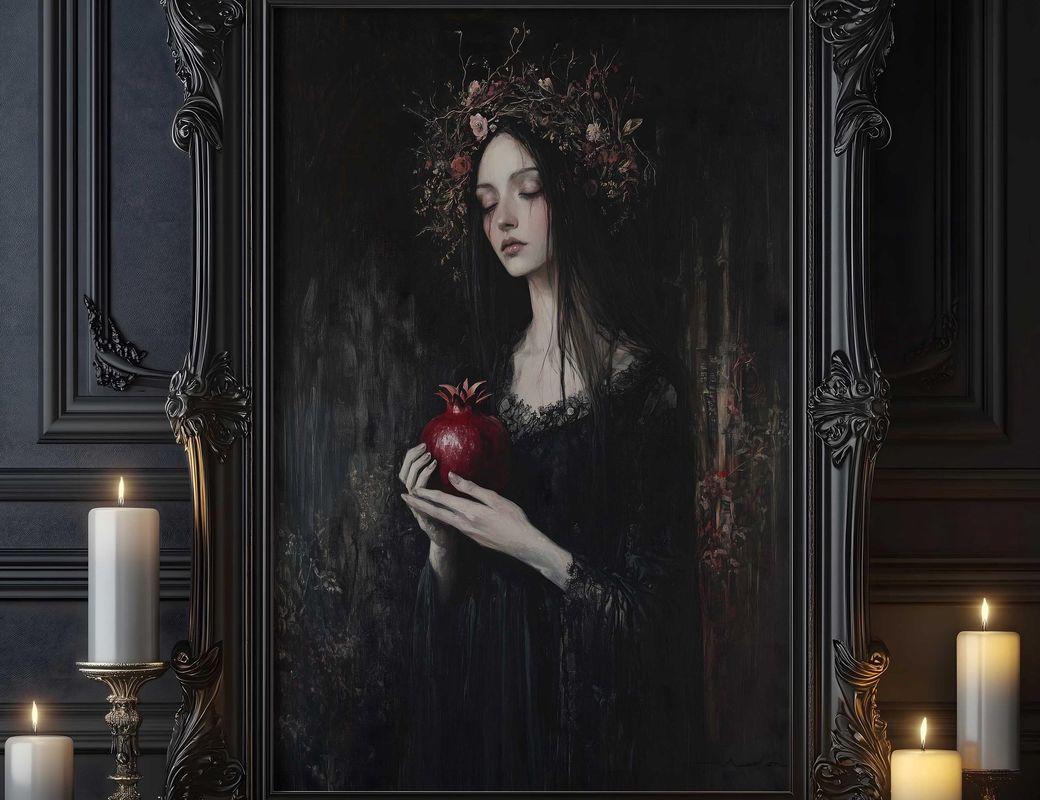
In Greek mythology, Persephone is associated with the changing seasons, the underworld, and the relationship between life and death. Her story is often interpreted as a tale of transformation, separation, and return, making her an important figure in ancient religion and a compelling symbol in contemporary spiritual practice.
Yet her myth is more complex than a simple story about spring arriving after winter. It also raises questions about power, loss, autonomy, and the transitions that change how we understand ourselves.
Who Is Persephone?
Persephone is the daughter of Demeter, the Greek goddess associated with agriculture and the fertility of the earth. She is also the queen of the underworld, where she reigns alongside Hades.
One of the best-known accounts of her story appears in the Homeric Hymn to Demeter, an ancient Greek religious poem.
In this account, Persephone is taken to the underworld by Hades. Demeter searches for her daughter, grieving her disappearance and neglecting the earth's fertility. As the situation unfolds, a resolution is negotiated, allowing Persephone to spend part of the year with her mother and part in the underworld.
The details and interpretations of the myth vary across ancient sources and later retellings.
The Connection Between Persephone and the Seasons
The myth is commonly associated with the cycle of the seasons. Persephone's return is connected with the earth's renewed fertility, while her time in the underworld is associated with the period when growth becomes less visible.
This is a symbolic explanation rather than a scientific account of seasonal change. Its significance lies in the way it connects the natural world with human experiences of absence, anticipation, and return.
The changing landscape becomes a reminder that visible growth is not constant. Periods of dormancy can exist alongside the possibility of renewal.
A Goddess of the Underworld
Persephone is sometimes portrayed primarily as a maiden associated with spring. However, her role as queen of the underworld adds another dimension to her mythology.
The underworld in Greek mythology is the realm of the dead. It is not simply a synonym for evil, and Persephone's association with it does not mean she should be reduced to a symbol of darkness.
Her dual role connects her with different aspects of existence: growth and decline, the visible and the hidden, beginnings and endings.
In modern interpretations, this complexity can inspire reflection on the parts of life that are uncomfortable but necessary to acknowledge.
The Meaning of Transformation
Transformation is often imagined as a dramatic moment when everything changes at once. Persephone's story offers a different image: a life shaped by movement between different worlds.
Sometimes, change involves learning to exist in circumstances we did not choose. Sometimes, it means returning to familiar places with a different understanding of ourselves.
Transformation does not automatically make painful experiences worthwhile, nor does it require someone to be grateful for suffering. It can simply describe the reality that our experiences influence who we become.
Persephone in Modern Witchcraft
Some contemporary pagans and practitioners of witchcraft honor Persephone through seasonal observances, devotional practices, offerings, or personal rituals.
Her associations with spring, the underworld, and transition make her meaningful to people reflecting on grief, change, boundaries, and renewal.
Practices vary, and there is no single ritual that represents every modern devotee's relationship with her. Anyone interested in working with Persephone can begin by studying her mythology, ancient Greek religious context, and the different interpretations that have developed over time.
It is useful to distinguish what ancient sources tell us from modern spiritual meanings that people have created around the myth.
A Reflection Inspired by Persephone
You can explore the symbolism of Persephone without performing a devotional ritual.
Find a quiet place and write about a transition you are experiencing or have recently completed.
Consider these questions:
-
What part of my life has changed in a way I did not expect?
-
What am I still grieving or learning to accept?
-
What parts of myself have become stronger or clearer?
-
What would returning to myself look like now?
You do not need to turn your answers into a lesson or force yourself to find meaning immediately. Some changes require time before their effects become clear.
A Small Ritual for Renewal
Choose an object that reminds you of growth, such as a dried flower, a seed packet, or a leaf you have collected responsibly.
Place it somewhere you can see it while writing one sentence about what you want to nurture in your life.
You might choose patience, creativity, self-respect, or a willingness to begin again.
Let the object serve as a reminder to support that quality through a practical action. If you want to nurture creativity, set aside time to make something. If you want to strengthen self-respect, identify one boundary you need to maintain.
Returning Is Not the Same as Going Back
Persephone's story continues to resonate because it does not remain in one place. Her mythology moves between worlds and holds together images of growth, loss, and return.
In a symbolic reading, transformation does not mean returning to the person you were before a difficult experience. It means discovering how to continue living with everything you have learned.
Some seasons are visible and full of growth. Others are quieter, and their changes are harder to recognize.
Both can be part of the same story.
Responses
No responses yet — start the conversation.
More from the Magazine

VENUS RETRÓGRADO: EL REGRESO AL CORAZÓN
Cuando el amor deja de mirar hacia fuera y se atreve a descubrir la verdad que habita dentro.

AMOR FATI: LOVE YOUR FATE💫
THE ART OF LOVING YOUR FATE, EVEN WHEN LIFE SHATTERS YOUR PLANS.
PLANETARY CHANGE IS HAPPENING
You didn't come to this life to repeat what's familiar, but to discover what you're capable of creating.