Notes From the Molting Season
It's uncomfortable to become new.
Article · 13 min read · ·
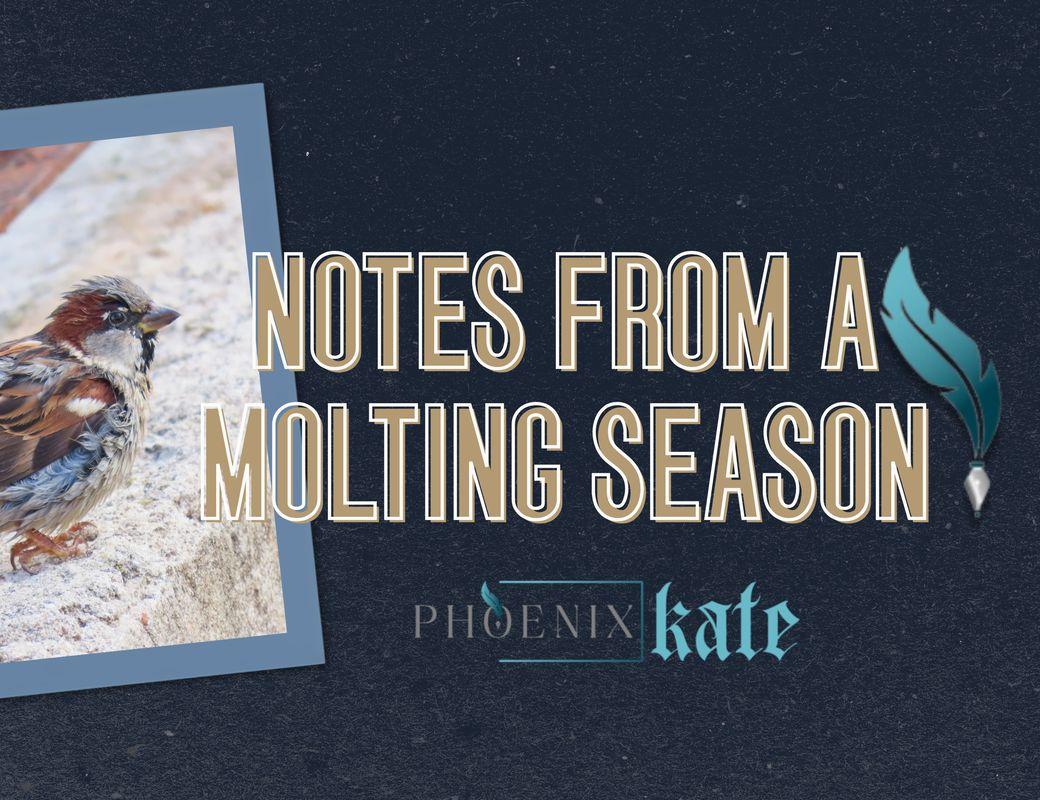
I found the first feather on the porch steps, a long barred primary with the shaft still waxy at the base. Then another by the gate. Then a whole soft drift of them along the fence line where the wind piles everything it can't carry. Late September in coastal Texas, and the birds are coming undone. If you know what to look for, the whole yard is telling you the same thing. Something is ending, and something else is already pushing up underneath it.
I'd been out there just before, for a ten-minute sit spot with no agenda beyond stillness. The yard gave me two unlikely birds, a kingbird and a phoebe that had no business being here yet, and a farewell performance from a mockingbird at full volume, loud and rude as ever, heckling me all the way back to the porch. The feathers were waiting on the steps when I got there.
Molting season doesn't announce itself the way spring does. There's no dawn chorus building toward it, and no bright arrival. It's a quiet unmaking. One morning a bird looks like itself, and a few weeks later it looks like a rumor of itself, patchy and ragged and vaguely embarrassed, and then one morning it's whole again in a way you can't quite date. The change happens in the gaps between your noticing.
I've been thinking about molting the way I think about most animal things: as a mirror I'm not always brave enough to look into directly. So let's look at it sideways, the way you watch an eclipse, and talk about feathers.
What molting actually is
A bird can't just drop all its feathers at once and grow a new set, the way you'd swap a coat. Feathers are flight, insulation, waterproofing, camouflage, and identity all at once. Lose them all and you lose everything. So birds molt sequentially, a few feathers at a time, in a precise order mapped across the wing and body. The old feather loosens as the new one, the pin feather, pushes up beneath it, still wrapped in its waxy sheath, still fed by blood. For weeks the bird flies a little worse, looks a little worse, and spends an enormous amount of energy growing replacements out of its own body.
It itches. Anyone who's handled a molting bird will tell you that they are cranky, preoccupied, and constantly picking at themselves. It's uncomfortable to become new.
I've held molting raptors at the rescue that looked like they'd lost a fight, great bare patches under the wings, tail feathers arriving one at a time like late guests. They still had to hunt. They still had to fly with a hand missing cards. There is no pause button on a wild life. The molt happens in the middle of everything else, which is the part I keep coming back to. You don't get to stop your life to transform it. You transform it while you're still using it. The bird doesn't get a sabbatical, and neither do we.
This is the piece the phoenix story gets wrong, or at least the piece it leaves out for drama. We love the fire. We love the clean break, the ash, and the single cinematic moment of becoming, but most transformation isn't combustion. It's slow and sequential and itchy and unphotogenic, losing one feather at a time, while you keep flying anyway.
The fire we were promised
I created my pen name, Phoenix Kate, from a bird that burns. It's a good name for a woman who's spent her life walking into hard things like wildlife rehabilitation, rescue work, and the slow grief of conservation in a century that keeps asking the wild to be smaller. The phoenix promises that destruction can be total and renewal can be instant, ash to wing in one clean arc.
But I've lived long enough to notice that I have never once actually transformed that way. Every real change in my life has been a molt, not a fire. The fire is the story we tell afterward, when we've forgotten the itchy weeks. Nobody writes ballads about the pin feathers.
There's a reason for that. The in-between is hard to narrate. When you're mid-molt, you don't look like the person you were and you don't look like the person you're becoming. You look patchy. You feel raw. People who loved your old plumage get nervous. People who want the new version get impatient. And you, in the middle of it, are just trying to keep flying with missing flight feathers, spending energy you don't have on growth you can't yet see.
If you're in that season right now, I want you to hear this from someone with thirty years of watching animals do it. The ragged middle is not failure. It's the mechanism. The bird that looks half-undone is doing exactly what it's supposed to do.
What I'm shedding
Shadow work asks an impolite question, so let me ask it of myself first, this time. What am I molting right now?
The first feather is the easy yes. I have spent years, maybe my whole working life, saying yes too fast and charging too little, especially to people I love. I tell myself it's generosity, and sometimes it is, but there's a shadow under it, and the shadow is that I am afraid that if I ask for what my work is actually worth, I'll be told I'm not worth it. So I set the price low myself, before anyone else can. I call it helping people on tight budgets. Sometimes that's true, and sometimes it's just armor.
A feather doesn't come out cleanly if you yank it. It comes out when the new one is ready underneath. So I'm not ripping this pattern out. I'm growing something under it, with the belief that I can love people and still name a fair price, that kindness and sustainability can share a nest. The old feather is loosening, and it itches like hell.
The second feather is the grief I carry like a second spine. Conservation work will break your heart on schedule, and this season has been heavy even by those standards, with species slipping, habitats carved up, and policy moving backward while the wild pays the bill. I've been holding that weight so long I've started to think of it as part of my skeleton, but grief was never meant to be structural. It's weather, and it is supposed to move on.
Molting birds drop the feathers that are broken, worn, or infested, the ones that can't carry them anymore. They did their work, flew thousands of miles, and now they're just done. Some of my grief has done its work too. It taught me what I love and what I'll fight for. I don't need to carry all of it into the next season. I can honor it and let it go, the way the wind takes the old primaries off the fence line.
The third feather is subtler, and it is the performance of being fine, appearing to be the competent woman, or the one who has handled everything for decades, so surely she can handle this too. There's a version of me that performs unshakeability the way some birds perform injury to draw predators from the nest, loud and convincing and entirely for someone else's benefit. Underneath it, the real bird is tired.
I'm molting that too, though not the competence itself, which is real and earned. What's coming off is the performance of it, and the need to look unruffled while the pin feathers come in bloody and tender. New growth is vascular. It bleeds if you bump it. I'd rather be honest about the tenderness than impressive about the armor.
The naked mockingbird
Years ago, during a molt that must have been scheduled by a comedian, we had a mockingbird at the rescue with half its chest bare and one wing missing three primaries in a row. It looked like something the cat dragged in and then reconsidered, and it was, without question, the loudest animal in the building.
It scolded the volunteers. It scolded the red-tail in the next enclosure, a bird that could have eaten it like an olive. It scolded the rain. Bald patches, missing flight feathers, tail like a bad haircut, and it had opinions about everything, delivered at full volume from the highest perch it could still reach.
I think about that bird every molting season, because it understood something I keep forgetting. Your attitude is not your plumage. You do not need to look whole to be whole. The mockingbird didn't wait until its feathers grew back to have a personality. It didn't file its opinions away for when it looked respectable again. It was fully, rudely, magnificently itself in the middle of falling apart, and the falling apart didn't diminish it one bit. If anything, the contrast made it funnier, tougher, and even more itself.
We get this backward so often. We think transformation means going quiet until we're presentable. We hide the patchy parts, cancel plans, stop writing, stop showing up, waiting for the day we emerge sleek and finished, but the mockingbird school of molting says otherwise. Keep singing with the feathers you've got. Be loud in the gaps. Let people see the bare patches and the opinions both.
There's a dignity in refusing to be embarrassed by your own becoming. The bird knew. I've spent years trying to learn what it never had to be taught.
A small descent
Every mythology worth its salt has a version of the in-between. Persephone goes down. Inanna hangs her robes on seven gates. The phoenix, for all its fire, still has to pass through ash, which is to say through nothing, through the total absence of bird.
Molting is a small, ordinary descent through the weeks when you are less than you were and not yet what you'll be. The old stories treat the descent as the price of transformation, and I've come to think they're right, but not in the punishing way it's usually framed. The descent isn't punishment for growing. It's the shape of growing. You can't get new feathers without the bare patches. You can't get the new self without the days you don't recognize yourself.
What the myths also say, if you read them closely, is that you don't do the descent alone and you don't do it empty-handed. Persephone eats the seeds. Inanna's sister meets her at the gate. The molting bird still has its flock, still roosts close, and still gets by with a little help from birds who aren't mid-molt. If you're shedding right now, let people see the patchy parts. The ones who matter won't mistake molting for dying. They know the difference between a bird that's broken and a bird that's becoming, usually better than we do ourselves.
Pin feathers
Here's what nobody tells you about new growth: it hurts before it helps.
A pin feather is a live thing. The shaft is full of blood, feeding the vane as it unfurls. Brush it wrong and it bleeds, really bleeds, the way only a small thing with a big blood supply can. Rehabbers learn to handle molting birds like blown glass. Everything new here is tender, and the tender parts are exactly the ones holding weight.
This is the part of transformation I'd put on a warning label if I could. The new boundaries will feel awful before they feel strong. The first time you charge what you're worth, your hand will shake. The first time you set down a grief you've carried for years, you'll feel guilty for the lightness, like you've betrayed the thing you lost. The first time you admit you're tired instead of performing fine, you'll feel naked. That's the blood in the shaft, doing exactly what it's supposed to do.
Don't bump your own pin feathers. Don't let anyone else bump them either. They need a few weeks, and then the blood recedes, the sheath flakes away, and what's left is stronger than what fell out. Every bird knows this. Every bird just waits, itchy and patient, preening the sheaths off one at a time, doing the maintenance of becoming.
There's a patience in molting that I've never managed to learn any other way. You can't rush a feather. You can only feed yourself well, rest when you can, and keep the old ones coming out in order. The body knows the sequence. Trust it.
A practice for molting season
If you want to work with this season instead of just enduring it, here's a small practice. Go outside and find a feather, any feather. A downy underfluff from a sparrow counts as much as a hawk primary. Take its photo, and leave it where it lay. Under the Migratory Bird Treaty Act, picking up feathers from native birds can land you in real trouble, so admire, photograph, and leave them be. (Feathers from your own chickens are fair game.) The photo is yours to keep.
Look at the photo and ask the impolite question: what am I molting?
Write down the first three things that come, without editing. The easy yes, the carried grief, the performance, whatever yours are. Nobody has to see this list. It's between you and the feather.
Then, for each one, write what might be growing underneath. Not what you wish were growing, not the aspirational self from the vision board, but what's actually pushing up, itchy and half-formed, in real life? Name it plainly. "I'm learning to charge fairly." "I'm letting some of the grief move through." "I'm admitting I'm tired." Keep it plain. Feathers are plain before they're beautiful, too.
Keep the photo somewhere you'll see it. Phone background, altar, taped to the bathroom mirror. Let it remind you that the ragged middle is the mechanism, not the malfunction.
If you want to go one step further, give the list itself a little ceremony. Read it aloud once, all the way through, and then put it away somewhere you won't reread it for a month. A drawer, a sealed envelope, the back of a journal. You're not burying it out of shame. You're composting it. Old feathers break down into the soil that grows the next season's insects that feed the next season's birds. Nothing in nature wastes the shed things. Your old patterns fed you for years, even the ones that hurt. They get to become soil now.
When the season turns and you find yourself whole in a way you can't quite date, you'll know what happened in the gaps between your noticing, and if you find a second feather, send its photo to someone else who's mid-molt. Tell them what it's for. Flocks get through this together.
A Simple Benediction
May your old feathers loosen in order, and not all at once.
May you be cranky about the itch without apologizing for it.
May your pin feathers bleed only when bumped, and may you learn, gently, to stop bumping them yourself.
May you keep flying with missing flight feathers, a little worse at altitude and entirely still airborne, because the molt happens in the middle of everything else and so do you.
May the fire stories rest for a season. You don't need to burn. You just need to shed, and wait, and preen, and trust the sequence.
May you emerge ragged no longer, whole in a way you can't quite date, with new primaries strong enough for whatever sky comes next.
And may the last word belong to something loud and rude and fully alive, a heckler with feathers, reminding you on your way back inside that life, gloriously, goes on.