The Tilt of the Moon’s Crescent
How to “read” the sky and feel the rhythms of nature
Article · 4 min read · ·
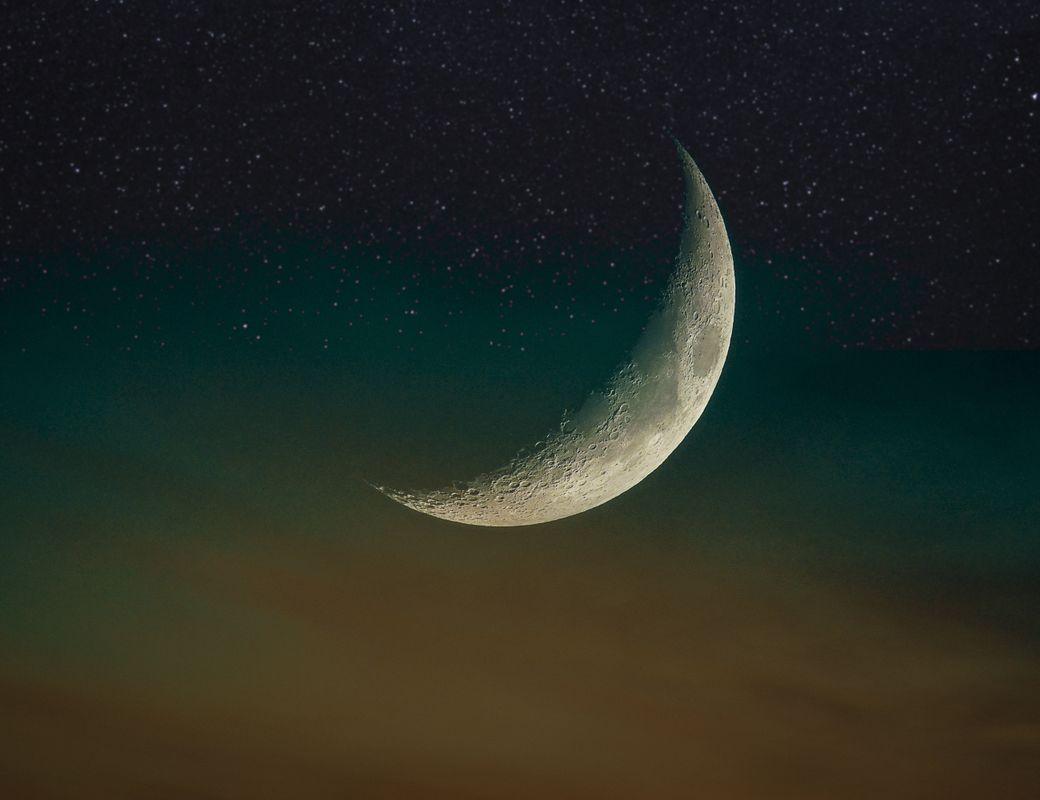
Sometimes, when you look up at the night sky, you may notice that the Moon appears different each time. On some nights, its crescent seems to “lie” on its side, on others it stands more upright, and sometimes it even looks like a gentle smile. It may feel unusual or even magical - but in reality, it’s the beautiful interaction between the Sun, Earth, and Moon.
The illuminated part of the Moon always “points” toward the Sun. In other words, we only see the side that is lit by sunlight. The angle of the crescent depends on where you are on Earth, the season, and the time of day you’re observing the sky.
For example, when the Moon is low above the horizon, its crescent often appears more horizontal, as if it’s “lying down.” When it rises higher, the shape becomes more vertical. It’s like looking at a lit sphere from different angles - the object doesn’t change, only your perspective does.
One of the key factors behind this is the tilt of the Earth’s axis - about 23.5 degrees. This tilt changes the Sun’s path across the sky throughout the year, and with it, the path of the Moon.
In summer, the Sun sets at a shallower angle, and the Moon follows a similar path. That’s why the crescent often looks more horizontal, almost like it’s resting. In winter, the path is steeper, and the Moon appears more upright.
Interestingly, the same Moon can look very different depending on where you are in the world. Near the equator, for example, the crescent often looks like a bowl or a smile. This shows how much our perception depends on our point of view.
But observing the Moon is not just about astronomy - it’s also a practical tool that people used long before clocks and compasses existed.
The crescent Moon can help you orient yourself in space. Since it “points” toward the Sun, you can roughly determine where the Sun is - and therefore where east or west might be - even after sunset.
The Moon’s phase and position can also give you a sense of time. A waxing Moon is usually visible in the evening, a full Moon at night, and a waning Moon in the morning. This is an ancient way of “reading the sky” that has been used for centuries.
The tilt of the crescent can even reflect the feeling of the seasons. A more horizontal Moon is often associated with summer, while a more vertical one feels closer to winter. It’s a subtle way to sense the rhythm of nature beyond the calendar.
In magical practice, the shape of the crescent carries even deeper meaning. It can be seen as a kind of “vector of energy.”
If the horns of the Moon point upward, forming a bowl shape, it symbolizes receiving, gathering, and intuition. This is a time to turn inward, to listen, and to nurture your inner world.
If the crescent tilts sideways, it relates more to movement, action, and manifestation. This shape supports taking steps, making decisions, and bringing intentions into reality.
The height of the Moon also matters. When it’s low near the horizon, its energy feels more grounded, slower, and more connected to the Earth. When it’s high in the sky, the energy feels clearer, lighter, and more active.
You can use this awareness in your practices - choosing the right time for rituals, setting intentions, or journaling. Simply observing the Moon helps you sense when it’s time to act and when it’s time to release.
Interestingly, similar observations exist in many cultures. In Slavic traditions, a “lying” crescent was called a “boat” and was believed to signal rain. In England, there’s the concept of a “wet moon” - when the crescent looks like a bowl that could “hold water.”
In tropical regions, a “smiling” Moon is often seen as a symbol of harmony and blessing. In seafaring cultures, the crescent was associated with journeys and direction.
All these beliefs were born from a simple desire to understand the world. People looked at the sky and learned to “read” its language.
And that language is still available to us today.
The tilt of the Moon’s crescent is a reminder that we are part of a greater natural rhythm. Sometimes, all it takes is to look up at the sky to feel that connection.
By observing the Moon, we return to a more intuitive way of living - one that includes not only knowledge, but also feeling.
And perhaps, that is where the real magic lives.
Responses
No responses yet — start the conversation.