Our beautiful Moon
Did you know there are nano diamonds on the moon?
Article · 5 min read · ·
The Moon is, by every measure we have to hold, absolutely absurd. It is a celestial anomaly, a witness that has been staring down at us since before we had the language to describe its silver light. We treat it as a familiar lamp hung in the night sky, but if you sit with the truth of it, you realize we are living alongside a mystery that defies simple categorization.
It is, first and foremost, too big. While other moons in our solar system are little more than wayward, captured rocks, our Moon is a quarter of the diameter of the Earth. Planetary scientists sometimes quietly speak of the Earth-Moon system as a double planet, then quickly look away, as if acknowledging the truth might unravel our understanding of how worlds are made. The prevailing story suggests a violent origin, a Mars-sized body named Theia slamming into our young Earth, vaporizing both into a molten cloud that eventually cooled into the orb that governs our tides, our dreams, and a vast, shimmering library of human poetry.
We have accepted this story, but the Moon remains an active, restless participant in our existence.
The Face That Stays Hidden
We are locked in a cosmic embrace. Because the Earth and Moon are tidally locked, their rotations are so finely synchronously tuned that we only ever see one side of the moon. For all of human history, we stared at this one face, unaware that there was a far side that is more rugged, more scarred, more hidden, until a Soviet spacecraft finally slipped behind the curtain in 1959.
This is not a romantic coincidence, though we have spent centuries painting it as one. It is a slow, relentless, mechanical truth. The Moon rotates on its axis at the exact speed it orbits us, perpetually offering its "good side" while the other remains in shadow. And this is not the end of the story. The gravitational pull is working on us, too. One day, billions of years from now, our rotation will catch up, and the Earth and Moon will face one another in a permanent, locked gaze. We are, quite literally, being pulled into an eternal intimacy.
The Bones of the Moon
The Moon is not a dead, barren rock. It is a world with a crust, a mantle, and a small iron core, a miniature reflection of the Earth itself. Its surface is blanketed in regolith—a fine, sharp dust that smells of spent gunpowder and traps the memory of every impact it has ever endured. Because there is no wind to soften the edges, the bootprints left by the Apollo astronauts in 1969 remain exactly as they were the moment they were made, waiting in the silence.
And there is more. We once thought the Moon went quiet eons ago, but missions have revealed volcanic eruptions from a mere two billion years ago. We have discovered that it harbors water ice in the dark, frozen craters at its poles—places that haven’t seen the sun in billions of years. It is no longer just a distant light; it is becoming a destination, a piece of vital, cryogenic real estate.
The Stardust in the Stone
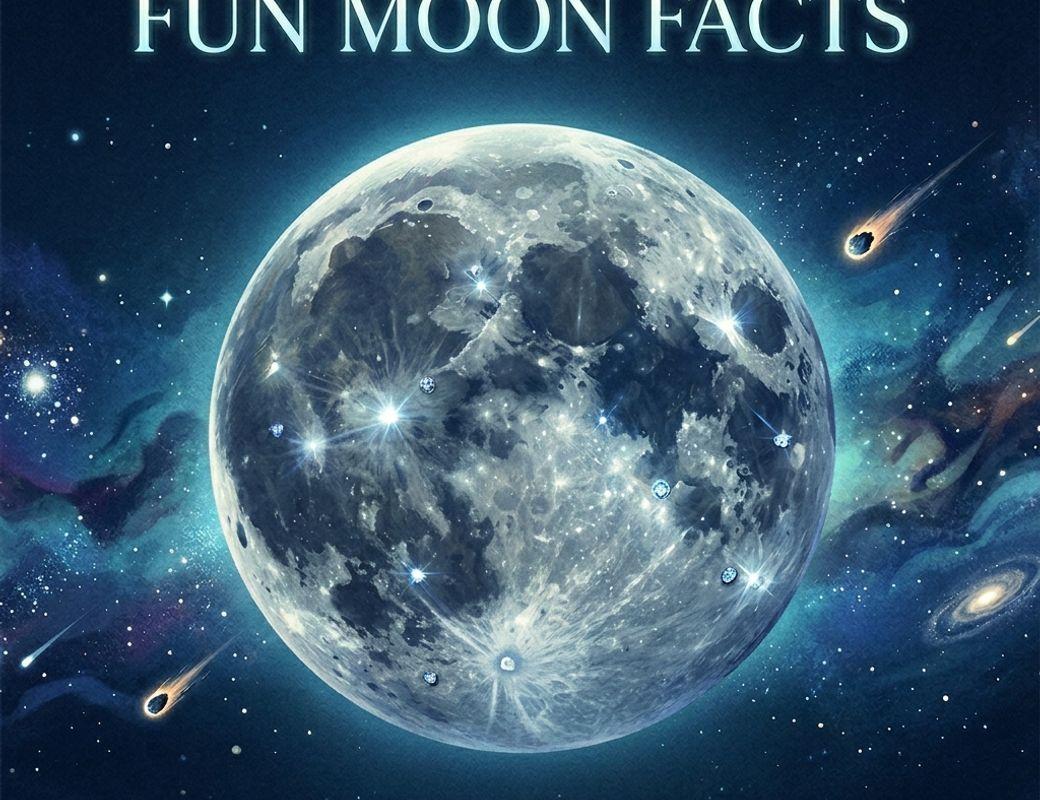
Did you know there are diamonds on the Moon. Not the kind you find in a jeweler’s window, but nanodiamonds, forged in the violent, searing heat of meteoritic impacts. They are scattered through the lunar crust, remnants of the cataclysmic energy that has shaped the Moon for over four billion years.
There is a profound beauty in this. Those diamonds are made of carbon, and that carbon came from the same source as everything else in this universe: the ancient, dying cores of stars. We are made of the same stardust as the Moon. The diamond in the lunar soil and the person standing on the Earth looking up at the sky share an ancestry that predates the creation of either. It is a truth that is as scientific as it is sacred—we are truly and physically woven from the same thread.
What the Myths Understood
Every culture that has ever walked this earth has looked up and felt the weight of the Moon. They saw the cycles, the tides of the body, and the boundary between what is revealed and what remains in the dark. The Greeks called on Selene and Artemis; the Norse looked to Máni; the Māori saw a vessel carrying souls to the beyond.
They did not have the physics, but they had the phenomenology, and there is a deep, ancient wisdom in that. They knew that the light was borrowed. They knew that the Moon governed the rhythm of our lives. They understood that the boundary between the visible and the hidden is thin.
The Moon is slowly drifting away from us, an inch further each year. In the distant future, the tides will fade, the nights will grow darker, and the total eclipses that define our current sky will be a memory lost to time. We are living in a rare, fleeting window where the geometry of our universe makes such beauty possible.
Whether that is luck, or some deeper unfolding, is for you to decide. But let us not take it for granted. The Moon is older, stranger, and more deeply connected to the rhythm of our own hearts than we dare to admit. It has shaped our calendars, our oceans, and our imaginations. Every time you step outside on a clear night and look up, remember that you are looking at a reflection of your own origin—and for a brief, quiet moment, it is almost as if the universe is looking back.
Responses
No responses yet — start the conversation.