How the Moon Changes Your Mood
Why different moon phases may influence emotions, energy, and inner reflection.
Article · 3 min read · ·
For centuries, people have looked at the moon and felt that it carried a certain emotional energy.
Even today, many people notice subtle changes in their mood during different lunar phases. Some nights feel calm and reflective, while others feel emotionally intense, restless, or strangely energizing.
Whether viewed spiritually, emotionally, or symbolically, the moon has long been connected to human feelings and inner awareness.
But how exactly can the moon affect your mood?
The Moon and Emotional Energy
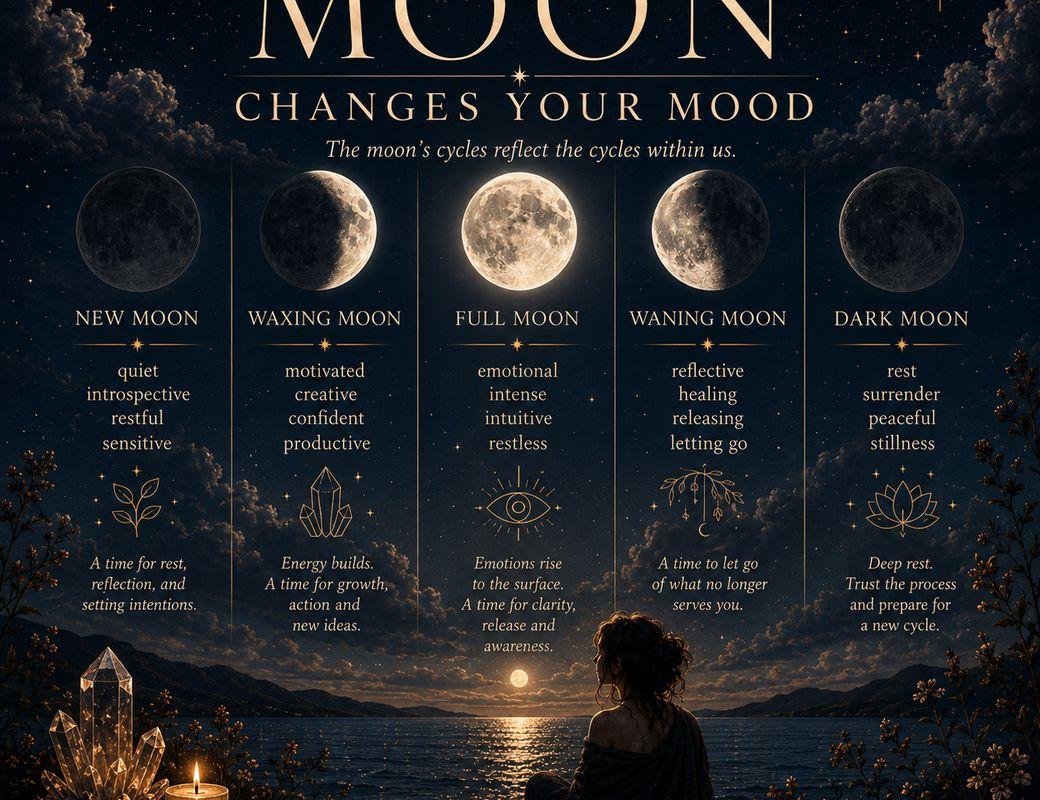
The moon constantly changes phases, moving through cycles of darkness, growth, fullness, and release. In spiritual traditions, these phases are often associated with different emotional states and energies. Rather than seeing emotions as random, many people use the lunar cycle as a way to better understand their inner world.
The moon becomes a mirror for emotional change.
🌑 New Moon: Quiet and Introspective
The New Moon is often linked to stillness and inward energy.
During this phase, many people feel:
-
quieter
-
more reflective
-
emotionally sensitive
-
mentally tired or withdrawn
Because the sky is darker, the New Moon is symbolically associated with rest, beginnings, and reflection. Spiritually, it is often considered a good time to slow down and reconnect with yourself.
🌓 Waxing Moon: Motivation and Growth
As the moon begins to grow brighter, energy is believed to become more active.
This phase is often associated with:
-
motivation
-
creativity
-
confidence
-
productivity
Many people feel more inspired during this time, as if ideas and emotions begin moving forward more easily.
🌕 Full Moon: Emotional Intensity
The Full Moon is the phase most commonly linked to heightened emotions.
People often describe feeling:
-
emotionally overwhelmed
-
restless
-
nostalgic
-
deeply intuitive
-
unusually energized
Spiritually, the Full Moon is associated with illumination. Emotions and thoughts that were hidden or ignored may suddenly feel impossible to avoid.
For this reason, many people use the Full Moon for reflection, emotional release, and spiritual rituals.
🌘 Waning Moon: Letting Go
As the moon begins to fade again, energy becomes softer and more reflective.
This phase is often connected to:
-
emotional release
-
healing
-
closure
-
rest
It can feel like a natural moment to let go of stress, habits, or emotions that no longer feel necessary.
Why the Moon Feels So Personal
Part of the moon’s emotional power may come from symbolism.
Humans have observed lunar cycles for thousands of years. The moon became connected to emotion, mystery, femininity, intuition, and transformation in cultures all over the world.
Even today, seeing a bright moon in the night sky can instantly create a feeling of comfort, nostalgia, calm, or emotional intensity.
The connection feels personal because the moon has always been part of human emotional experience.
Final Thoughts
The moon may not control emotions, but it often reflects them in powerful ways.
Its cycles remind us that emotions are also cyclical. There are moments for rest, moments for growth, moments for intensity, and moments for release.
Perhaps that is why so many people feel emotionally connected to the moon. It changes constantly, and so do we.