Did the Moon Really Make People Go Crazy?
Moonstruck: The truth behind ‘Lunatics.’
Article · 5 min read · ·
For centuries, people believed the Moon could disturb the human mind. The idea was so widespread that it shaped language itself. The word “lunatic” comes from the Latin lunaticus, which literally means “moonstruck.” Ancient physicians, philosophers, and even early legal systems believed certain people behaved strangely during the Full Moon.
-Author’s note: Imagine explaining to a judge in the year 1200, “It wasn’t me… it was the Moon.” Surprisingly, that sometimes worked!
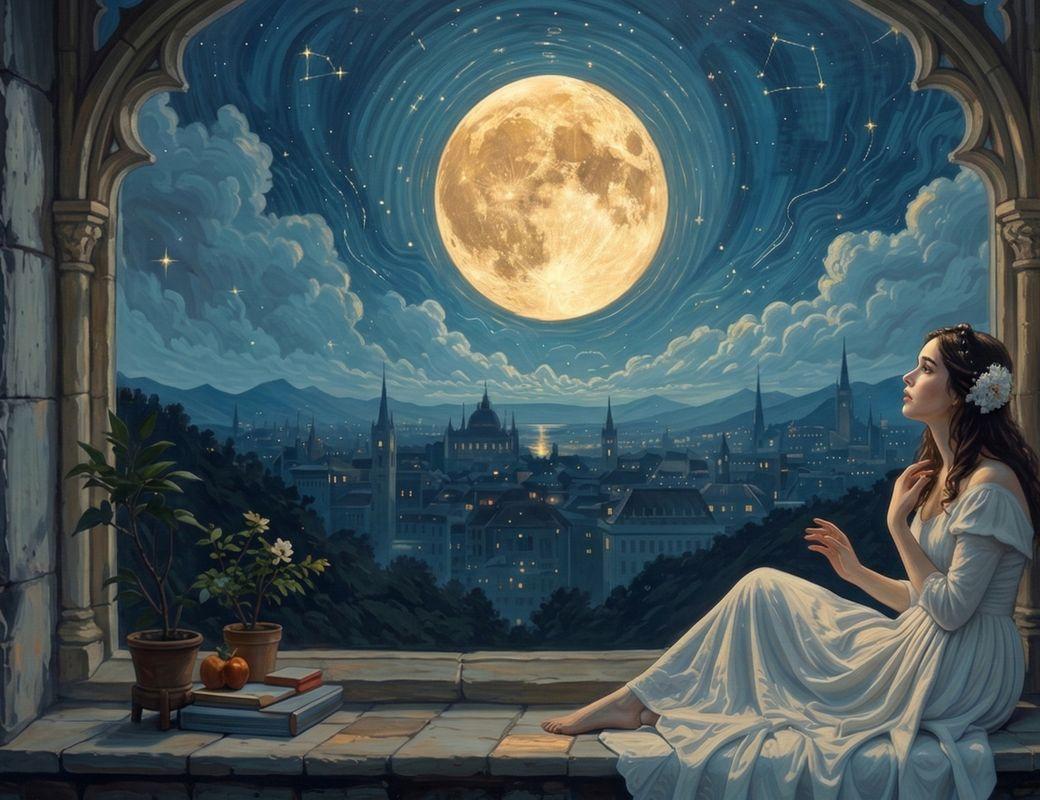
But was this just superstition?
Or is there something real behind the myth?
To understand where the idea comes from, we have to go back to a time when the Moon was not just a romantic object in the sky. It was a clock, a compass, and a powerful natural force that visibly affected the Earth. Everyone could see that the Moon controlled the tides of the oceans. When the Moon reached its full or new phase, the gravitational pull between the Earth and the Moon caused the seas to rise and fall dramatically. Coastal communities lived by this rhythm.
So naturally, people began asking an intriguing question: If the Moon can move entire oceans… could it also move something inside us?
After all, the human body is made of roughly 60 percent water. Ancient thinkers wondered whether the Moon might subtly influence the fluids of the body and, by extension, the mind.
-Author’s note: Humans have always been good at noticing patterns. Sometimes too good. But curiosity is how science begins.
Greek philosopher Aristotle speculated about this. Later, the Roman naturalist Pliny the Elder wrote that the brain, being “the moistest organ,” might be particularly sensitive to lunar cycles. In medieval Europe, the belief became so strong that people accused of unusual behavior could sometimes receive lighter punishments if their actions occurred during a Full Moon. The logic was simple: the Moon had temporarily affected their mind. Even today, many emergency room nurses, police officers, and teachers will tell you—half jokingly, half seriously—that Full Moon nights feel different: More chaos. More agitation. More strange behavior.
-Author’s note: Ask any nurse working a night shift. They may roll their eyes… but they will also check the lunar calendar.
But what does modern science say?
Researchers have studied this question for decades. Many large statistical studies looking at hospital visits, psychiatric admissions, crime rates, and accidents during Full Moons have found little consistent evidence that the Moon directly causes people to behave irrationally. In other words, the dramatic “lunatic effect” is probably not as powerful as folklore suggests.
However, the story does not end there. While the Moon may not magically drive people insane, it does influence biological rhythms more than we once thought.
For example, the Moon affects nighttime light levels, which historically influenced human sleep patterns. Before electric lighting, a Full Moon could illuminate the night enough for people to stay awake longer, socialize, or travel. Changes in sleep can absolutely affect mood, decision-making, and emotional regulation.
-Author’s note: Imagine living before streetlights. A bright Full Moon would feel like someone dimmed the lights on the planet instead of turning them off.
Recent sleep research has also found something fascinating: in some controlled studies, participants slept slightly less and had reduced deep sleep around the Full Moon, even when they could not see the Moon or did not know what phase it was. Scientists are still debating why this happens. Some believe our circadian rhythms may retain ancient sensitivity to lunar light cycles. Others think the effect may be subtle but real, interacting with our hormonal systems and sleep cycles.
From an astrological or symbolic perspective, the Full Moon has long been associated with emotional amplification rather than madness. The Full Moon occurs when the Sun and Moon stand opposite each other in the sky, symbolically illuminating what is normally hidden.
-Author’s note: The Full Moon doesn’t create emotions. It just seems very good at putting a spotlight on them.
In psychological terms, it can feel like a moment when emotions rise to the surface.
If you think about it, the metaphor is surprisingly accurate for human behavior. When people are tired, overstimulated, or emotionally overwhelmed, they may react more strongly than usual. The Moon may not cause the reaction directly, but the environment surrounding lunar cycles: light, sleep, attention, and cultural expectation, can shape how we experience those nights.
And there is another powerful factor at play: human perception.
Psychologists call it confirmation bias. When people expect something unusual to happen during a Full Moon, they are more likely to notice and remember the strange events that occur while forgetting the many ordinary nights when nothing happens.
Author’s note: The Moon gets blamed for a lot. Probably more than it deserves. But it also deserves more credit for keeping Earth stable in the first place.
Yet despite the lack of definitive scientific proof for “lunacy,” the Moon still holds a profound psychological presence in human culture. It appears in myths, poetry, spiritual traditions, and modern astrology not because it controls us, but because it reflects something deeply human. The Moon changes shape every night. It disappears, returns, grows bright, and fades again. It mirrors cycles we experience within ourselves… phases of clarity, confusion, energy, rest, emotion, and renewal.
So perhaps the ancient idea of the “lunatic” was never entirely about madness. Maybe it was an early attempt to describe something we still feel today: the subtle way natural rhythms influence the human mind. And this leads to something interesting about the moment humanity is living right now:
For a long time, modern culture tried to explain reality only through what we could immediately measure and see. Anything invisible was often dismissed as imagination, superstition, or coincidence. But the more science advances, the more we discover that invisible forces are everywhere.
Gravity is invisible. Magnetism is invisible. Radio waves, brain signals, and dark matter are invisible. Even the majority of the universe itself appears to be made of things we cannot directly observe.
The truth is, much of reality has always been operating quietly behind the scenes. Perhaps the real lesson is not whether the Moon makes people “lunatic.” Perhaps the lesson is that paying attention to subtle forces — rhythms, patterns, cycles — helps us understand the world in deeper ways.
Ignoring them is no longer enough. Because slowly, across science, psychology, and consciousness studies, something fascinating is happening: things that once seemed mysterious are beginning to reveal their structure.
Hidden Patterns are becoming visible. Truth, in many forms, has a strange habit of eventually coming to light. Just like the Moon.
— Emma Jaramillo
Responses (1)