Chang’e, Goddess of the Moon
The Immortal Lady of the Moon and Her Enduring Legacy in Chinese Culture
Article · 15 min read · ·
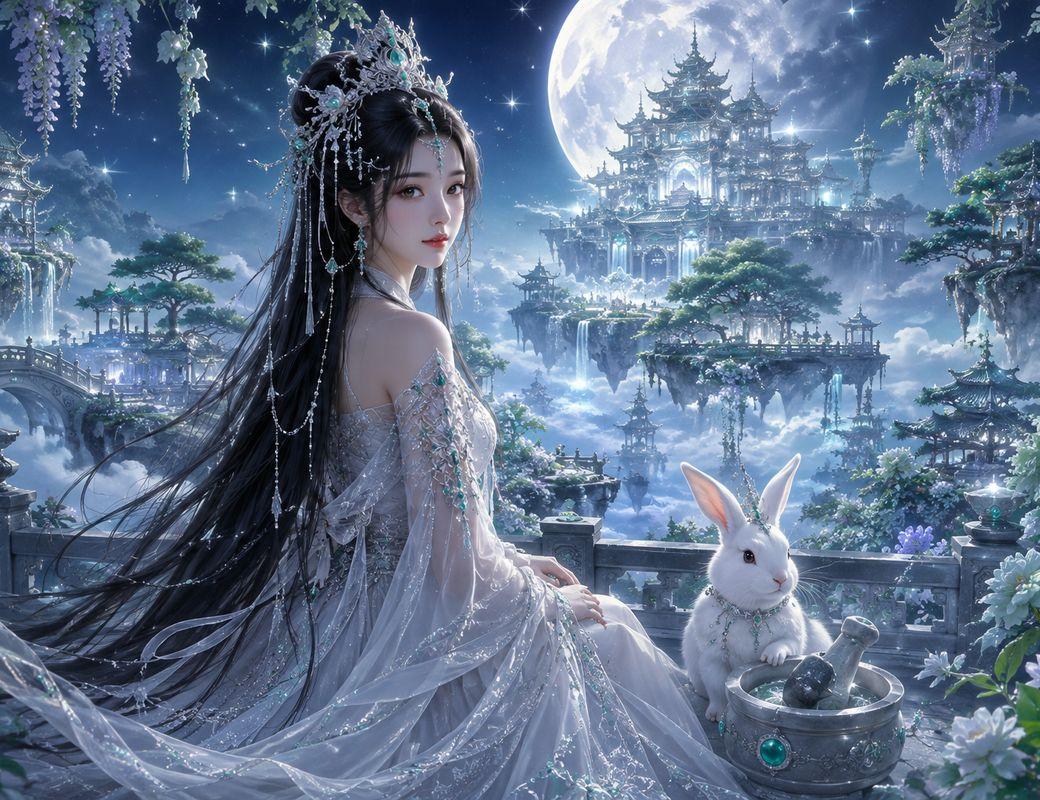
On the fifteenth night of the eighth lunar month, families gather beneath the brightest full moon of autumn. Mooncakes are divided and shared. Lanterns glow. Those separated by distance look upward, comforted by the thought that the people they love are standing beneath the same light. And somewhere within that luminous circle is Chang’e, the immortal woman whose ascent to the moon became one of the most enduring stories in Chinese culture.
Her legend begins with scorched earth, ten blazing suns, a heroic archer, and an elixir that could grant eternal life. It ends with a woman alone in a celestial palace, close enough to see the world she loved but unable to return to it. Across more than two thousand years of retelling, Chang’e has been portrayed as a thief, a victim, a selfless protector, a grieving wife, and a goddess of quiet resilience. Each version asks the same haunting question: what would immortality mean if it cost us everything that made life worth living?
Yet Chang’e did not remain confined to an ancient myth. She entered poetry, painting, family ritual, and the Mid-Autumn Festival. The Jade Rabbit became her companion, mooncakes became offerings and symbols of reunion, and China’s lunar spacecraft carried her name into the modern age. Her story now travels between heaven and earth in a way its earliest tellers could never have imagined.
To understand how one woman came to embody longing, sacrifice, reunion, and the moon itself, we must begin before Chang’e’s ascent, when the lunar world already held a sacred place in the Chinese imagination.
Before Chang’e: The Sacred Moon in Ancient China
Long before Chang’e’s legend took shape, the moon was already one of the most revered symbols in ancient China. More than a light in the night sky, it served as a keeper of time, a guide for agriculture, and a bridge between the earthly and spiritual realms. Life followed the rhythms of a lunisolar calendar, with each new moon marking the beginning of a new month and each full moon signaling moments of celebration, reflection, and communal gathering.
The moon also embodied yin, one half of the philosophical principle of yin and yang that lies at the heart of traditional Chinese thought. While the sun represented yang, associated with brightness, activity, and masculine energy, the moon reflected yin, symbolizing coolness, intuition, stillness, and feminine power. Because of this connection, it became closely associated with women, fertility, renewal, and the natural cycles of life.
Archaeological evidence suggests that moon veneration dates back to the Shang Dynasty (c. 1600–1046 BCE). Over the centuries, the moon became the setting for an increasingly rich body of folklore. People imagined a celestial rabbit preparing the Elixir of Immortality, a towering cassia tree growing across the lunar landscape, and a magnificent palace suspended among the stars. Eventually, these traditions converged around a single graceful figure who would become the moon’s eternal guardian.
By the Warring States period (475–221 BCE) and the Han Dynasty (206 BCE–220 CE), Chang’e’s story had entered the written record. She transformed the moon from a distant heavenly body into something deeply personal, giving it a face, a voice, and a story that reflected both the beauty and the heartbreak of the human experience.
Chang’e Before the Moon: Name, Origins, and Identity
Chang’e is remembered not as a distant or fearsome deity, but as an immortal whose story is deeply human. Her legend speaks of love and loss, sacrifice and longing, making her one of the most relatable figures in Chinese mythology. Unlike many divine beings who remain remote from human experience, Chang’e’s tale is rooted in difficult choices and their lasting consequences.
Even her name reflects China’s long and fascinating history. Today she is most commonly known as Chang’e (嫦娥), though older English texts often use the Wade-Giles spelling Ch’ang-O, and some ancient sources refer to her as Heng’e (姮娥). According to tradition, the character Heng was changed to Chang during the Han Dynasty because it appeared in the personal name of Emperor Wen of Han. In keeping with the ancient practice of naming taboo, scholars avoided using characters found in an emperor’s name, and the form Chang’e eventually became the standard.
The earliest surviving references to Chang’e appear during the Warring States period (475–221 BCE), with one of the best-known accounts preserved in the Huainanzi, compiled during the early Han Dynasty. There, her ascent to the moon is already linked to the legendary archer Hou Yi and the Elixir of Immortality. As Taoist ideas about immortality and transcendence grew in influence, later generations enriched her story with deeper spiritual meaning, connecting her to harmony with the Dao, the pursuit of eternal life, and the mysteries of the heavens.
Although Chang’e is widely known as the Moon Goddess, she never occupied the same formal place in the Chinese pantheon as deities such as the Jade Emperor. Instead, she exists in a unique space between religion, folklore, and literature. She is honored through seasonal traditions, celebrated in poetry and art, and remembered as a figure of compassion, beauty, and quiet melancholy rather than supreme divine authority.
By the Tang Dynasty, Chang’e had become one of the most beloved figures in Chinese literature. Poets imagined her gazing down from her lonely palace on the moon, watching the lives of those she had left behind. Her celestial home became a powerful symbol of both paradise and isolation, capturing the bittersweet truth that even immortality can come at a profound personal cost.
When Ten Suns Rose: Hou Yi and a World Out of Balance
Every great myth begins with a world out of balance. According to one of the oldest legends in Chinese mythology, ten suns, the sons of the heavenly deity Dìjùn, once rose into the sky together. Their combined heat scorched the earth, dried up rivers, withered crops, and set forests ablaze. What had once sustained life now threatened to destroy it.
To restore order, the gods called upon Hou Yi, a legendary archer renowned for his extraordinary skill. Standing upon the earth, he drew his bow and shot down nine of the ten suns, leaving only one to continue its daily journey across the heavens. His actions saved the world from devastation and restored the natural balance between heaven and earth.
Hou Yi’s triumph, however, came at a price. In some versions of the legend, his extraordinary feat stirred jealousy among the heavenly beings. Others claim that by shedding celestial blood, he forfeited his place among the immortals. Whatever the reason, Hou Yi and his beloved wife, Chang’e, were destined to live as mortals, their lives forever changed by his heroic act.
Longing to reclaim the immortality they had lost, Hou Yi journeyed to seek the Queen Mother of the West, one of the most powerful and mysterious deities in Chinese mythology. Moved by his courage and his service to humanity, she rewarded him with the Elixir of Immortality. The potion, however, came with an important condition. There was only enough for a single person to ascend to the heavens and live forever.
Faced with an impossible decision, Hou Yi chose not to drink the elixir. Rather than gain eternal life without the woman he loved, he entrusted it to Chang’e for safekeeping until they could decide their future together. That single act of love and trust would soon alter both of their destinies and give rise to one of the most enduring legends in Chinese mythology.
The Choice That Changed the Heavens
What happened next depends on which version of the legend is told. Like many ancient myths, Chang’e’s story evolved over centuries, with each generation adding its own interpretation. Yet one version has become the most widely known and remains at the heart of her enduring legacy.
Hou Yi entrusted the Elixir of Immortality to Chang’e while he continued teaching his students. During his absence, one of those students, often identified as Peng Meng, learned of the elixir and attempted to steal it. Faced with an impossible choice and unwilling to let such a powerful gift fall into the wrong hands, Chang’e drank the potion herself.
The effects were immediate. Her body became weightless, and she began to rise into the sky, drifting farther from the earth with each passing moment. According to tradition, she chose the moon as her eternal home because it was the closest place to the world she was leaving behind. From there, she could still look upon the life and the husband she loved, even though she could never return.
When Hou Yi came home and discovered what had happened, he was overcome with grief. Looking toward the bright full moon, he laid out Chang’e’s favorite foods as an offering, hoping that, somehow, she would know she was not forgotten. Over time, this poignant gesture became associated with the Mid-Autumn Festival, when families gather beneath the full moon to celebrate reunion while remembering those who are far away.
Not every version of the myth portrays Chang’e as a selfless heroine. Some older accounts suggest she drank the elixir out of a desire for immortality, transforming the story into a cautionary tale about ambition and its consequences. As the legend evolved, however, later storytellers increasingly portrayed her with sympathy, emphasizing sacrifice over selfishness. In these retellings, Chang’e becomes a tragic figure, a woman caught between love and destiny, who gained eternal life only by surrendering the life she cherished most.
Perhaps that is why her story has endured for more than two millennia. It reminds us that every choice carries a cost, and that even the greatest gifts may demand profound sacrifice. Ancient poets returned again and again to the image of Chang’e gazing down from the moon, watching separated lovers, distant families, and lonely travelers look up at the same luminous sky. Across the centuries, she became not only the Lady of the Moon, but also a timeless symbol of longing, devotion, and hope.
Life in the Lunar Palace: The Jade Rabbit
Although Chang’e is the moon’s most celebrated resident, she is rarely imagined as being alone. For centuries, Chinese tradition has placed a faithful companion at her side: the Jade Rabbit, one of the most recognizable and beloved figures in East Asian folklore.
On clear nights, many people have looked at the markings on the full moon and imagined the silhouette of a rabbit. In Chinese tradition, that rabbit lives with Chang’e in the Guanghan Palace, where it spends eternity preparing the Elixir of Immortality with a mortar and pestle. References to the Jade Rabbit appear as early as the Han Dynasty, making it one of the oldest and most enduring symbols associated with the moon.
Another cherished legend explains how the rabbit earned its place among the immortals. According to the story, three celestial beings disguised themselves as weary travelers and asked several woodland animals for food. While the others offered what they could, the rabbit had nothing to give except itself. In an act of complete selflessness, it leaped into a fire so the strangers could eat. Moved by its compassion and willingness to sacrifice everything for others, the celestial beings revealed their true identities and rewarded the rabbit with immortality, sending it to live on the moon beside Chang’e.
The tale reflects a recurring theme found throughout Chinese mythology: true greatness is measured not by strength or power, but by kindness, humility, and self-sacrifice. Those virtues, rather than force or conquest, are often what earn a place among the immortals.
The image of a lunar rabbit is not unique to China. Similar traditions appear throughout East Asia, including Japan’s Tsuki no Usagi and Korea’s Dal Tokki, or Moon Rabbit. While their stories differ, these celestial rabbits are often depicted pounding rice cakes rather than the Elixir of Immortality, illustrating how a shared symbol evolved into distinct cultural traditions across the region.
Today, the Jade Rabbit continues to bridge ancient mythology and modern science. China’s lunar rovers bear the name Yutu, meaning “Jade Rabbit,” a tribute to the legendary companion said to watch over Chang’e from the moon. It is a fitting reminder that even as humanity explores the lunar surface with advanced technology, the stories that first inspired our fascination with the moon still travel with us.
Between Goddess and Legend: Chang’e in Spiritual Tradition
Chang’e occupies a unique place in Chinese spiritual tradition. Unlike many deities with formal temples, organized priesthoods, or extensive systems of worship, she exists at the intersection of mythology, folk belief, literature, and religious symbolism. Her enduring influence stems less from formal religion than from the role she has played in the cultural imagination for more than two thousand years.
Her association with the moon naturally connected her to Taoist philosophy, which emphasizes harmony with nature, balance, and living in accordance with the Dao, the underlying order of the universe. As a lunar figure, Chang’e embodies yin, the feminine principle associated with stillness, intuition, reflection, and receptivity. Together with the sun’s yang, these complementary forces represent the balance that sustains the natural world.
Over the centuries, Chang’e became a symbol of beauty, longevity, and family harmony. During the Mid-Autumn Festival, families traditionally place offerings of mooncakes, fruit, tea, and incense beneath the full moon. These offerings are less acts of formal worship than expressions of gratitude, remembrance, and hope for unity among loved ones.
As a feminine lunar figure, Chang’e has also come to represent grace, resilience, and quiet strength. Rather than ruling from grand temples or demanding elaborate rituals, she lives on through poetry, paintings, seasonal festivals, and the stories passed from one generation to the next. Her legend continues to remind people that the deepest spiritual traditions are often preserved not only in sacred places, but also in shared memories, family customs, and the stories that endure across the centuries.
Under the Same Moon: Chang’e and the Mid-Autumn Festival
No celebration is more closely associated with Chang’e than the Mid-Autumn Festival, known in Chinese as Zhōngqiū Jié. Celebrated on the fifteenth day of the eighth lunar month, when the moon is at its fullest and brightest, it is one of China’s most important and widely observed traditional holidays.
The festival itself predates Chang’e’s legend, with origins in ancient harvest celebrations dating back to the Shang and Zhou dynasties. As her story became more widely known during the Han and Tang periods, however, Chang’e gradually became the festival’s most enduring symbol, transforming an ancient harvest celebration into a timeless story of reunion, gratitude, and remembrance.
The full moon’s perfect circle represents unity and completeness, making it a powerful symbol of family togetherness. Loved ones gather to share mooncakes, drink tea, admire the moon, and celebrate with family and friends. Children carry colorful lanterns, while many families retell the legend of Chang’e, ensuring that each new generation inherits the story along with the tradition.
For those separated by distance, the festival carries an even deeper meaning. Looking at the same full moon has long been seen as a way of remaining connected, even when loved ones are far apart. This idea inspired some of China’s greatest poets, including Li Bai and Su Shi, whose verses transformed the moon into a lasting symbol of homesickness, love, and hope.
Today, the Mid-Autumn Festival is celebrated not only across China but also in Chinese communities around the world. While traditions have evolved over the centuries, the heart of the festival remains unchanged: a celebration of family, gratitude, and the enduring belief that even across great distances, we are united beneath the same moon.
From Moon Palace to Moon Landing
Few ancient legends have found such a remarkable place in the modern world. In 2004, the China National Space Administration named its lunar exploration program Chang’e, honoring the legendary Moon Goddess whose story has inspired generations.
The missions have steadily expanded China’s exploration of the moon. Chang’e 1 entered lunar orbit in 2007, laying the foundation for future exploration. Chang’e 3 achieved China’s first soft landing on the lunar surface in 2013 and deployed the rover Yutu, or “Jade Rabbit.” In 2019, Chang’e 4 became the first spacecraft in history to land on the far side of the moon. More recently, Chang’e 5 and Chang’e 6 successfully returned lunar samples to Earth, with Chang’e 6 accomplishing the world’s first return of samples collected from the moon’s far side.
The choice of these names is more than symbolic. It reflects the enduring connection between China’s cultural heritage and its scientific ambitions. Thousands of years after storytellers imagined Chang’e ascending to the moon, robotic explorers bearing her name now travel across its surface, transforming an ancient legend into a modern story of discovery.
Why Chang’e Endures
For more than two thousand years, Chang’e has remained one of the most enduring figures in Chinese mythology. Her story has been told and retold because it speaks to experiences that transcend time and culture: love, sacrifice, hope, and the difficult choices that shape our lives.
Whether she is remembered through ancient poetry, honored during the Mid-Autumn Festival, imagined alongside the faithful Jade Rabbit, or celebrated through the lunar missions that bear her name, Chang’e continues to connect China’s past with its future. She reminds us that myths are more than entertaining stories. They preserve the values, dreams, and questions of the people who first told them.
Long before humanity reached the moon with rockets and spacecraft, people reached it with their imagination. They looked into the night sky and found meaning in its quiet light. In China, that meaning took the form of a woman who sacrificed everything, yet whose story continues to inspire millions beneath every autumn moon.
Perhaps that is the true legacy of Chang’e. While science has revealed the moon’s mountains, valleys, and craters, mythology reminds us why we looked up in the first place.