The Year of the Fire Horse
Lunar New Year Traditions, Mythology, and Chinese Astrology
Article · 19 min read · ·
Each year the moon turns the great wheel of time and invites the world to begin again. The Lunar New Year is not simply a date on a calendar but a sacred threshold, a moment when past cycles close and new possibilities are awakened beneath the waxing light of the moon. Across Asia this turning is marked with ritual and reverence, with fire and feasting, remembrance and renewal, all guided by ancient systems that understand time as alive, rhythmic, and deeply intertwined with cosmic order.
Unlike the solar calendar, which moves forward in measured lines, the lunar calendar breathes. It expands and contracts. It listens to the sky. Rooted in agricultural necessity and celestial observation, lunar time reflects humanity’s earliest relationship with the heavens, when the movements of the moon governed planting and harvest, fertility and fate, life and loss. The Lunar New Year emerged from this sacred relationship, carrying with it layers of myth, ancestral wisdom, and astrological meaning that have endured for thousands of years.
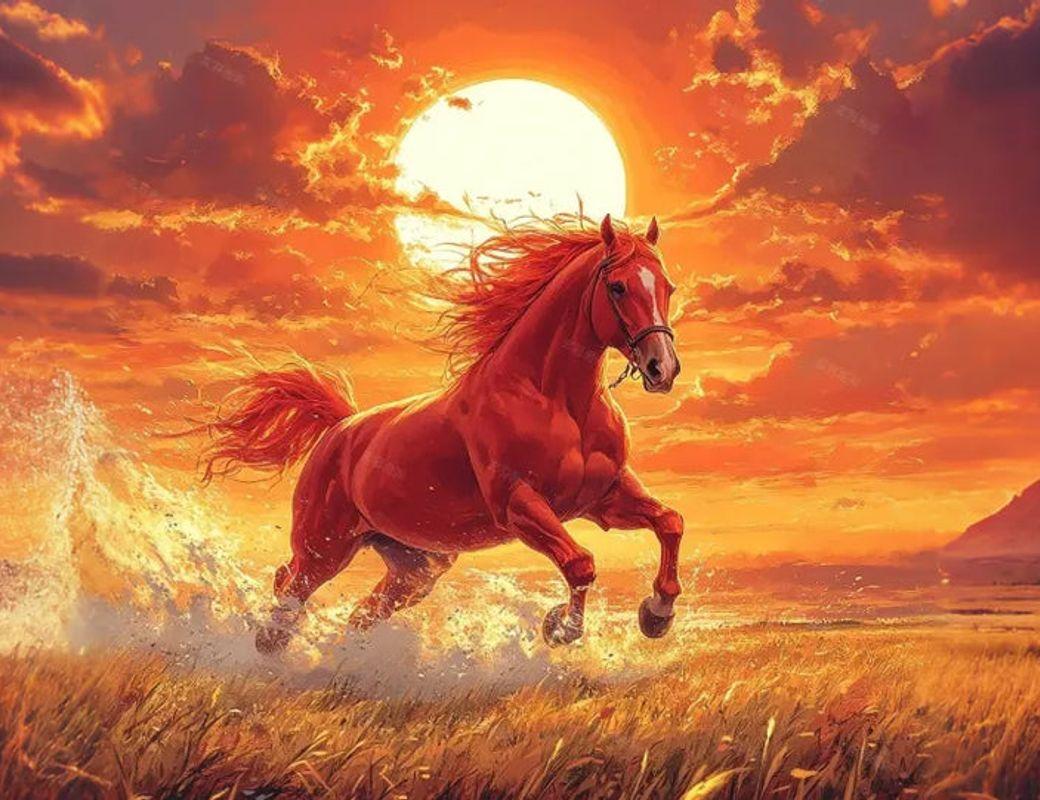
Central to Chinese Lunar New Year traditions is the zodiac, a living cycle of twelve animal archetypes woven together with the elemental forces of nature. Each year is shaped not only by an animal spirit but by one of the Five Elements, creating a unique energetic signature that influences the collective rhythm of the world. In this cycle the Horse appears as a symbol of movement, freedom, vitality, and untamed momentum, a creature born to travel between worlds, carrying messages of change and forward motion.
When the Horse is joined with the element of Fire, that energy intensifies. Fire brings illumination and passion, transformation and volatility, destruction and rebirth. Together the Fire Horse marks a year of acceleration and awakening, a time that favors bold action over hesitation, truth over comfort, and renewal over stagnation. It is an energy that cannot be contained, only understood and consciously engaged.
This article explores the Lunar New Year as both a cultural tradition and a cosmological event, tracing its mythological origins, astrological foundations, and spiritual significance. From the shared lunar celebrations across Asia to the deeper symbolism of the Horse and the transformative power of Fire, the Year of the Fire Horse invites us to step into motion with intention, to honor the past while riding boldly into the future, guided by the ancient wisdom of moon, myth, and flame.
The Lunar New Year Across Asia
The Lunar New Year is a shared inheritance across much of Asia, shaped by geography and history yet unified by a common understanding of time as cyclical rather than linear. Long before modern borders existed, lunar calendars governed the rhythms of daily life. Farmers watched the moon to determine planting seasons. Families aligned ritual and remembrance with celestial movement. Communities understood that renewal did not arrive all at once but unfolded in phases, guided by the waxing and waning of lunar light.
In China, the Lunar New Year is known as the Spring Festival, a name that reflects its deeper purpose. Even when winter still clings to the land, the festival announces the coming of growth and vitality. Homes are thoroughly cleaned to sweep away stagnant energy from the previous year. Red banners bearing auspicious phrases are hung on doors and windows, invoking protection, prosperity, and happiness. Firecrackers are ignited not for spectacle alone but to awaken the world, to drive away lingering malevolent forces, and to signal that a new cycle has begun.
Similar themes appear throughout East and Southeast Asia, each culture adapting lunar observance to its own spiritual landscape. In Korea, Seollal emphasizes ancestral veneration and familial continuity. Elders are honored through deep bows, traditional clothing is worn to symbolize renewal, and ancestral rites reaffirm the unbroken line between past and present. In Vietnam, Tết marks one of the most spiritually charged moments of the year. Homes are adorned with flowering branches and symbolic plants, food offerings are prepared for ancestral spirits, and the boundary between the living and the dead is believed to grow thin, allowing blessings to pass between realms.
In Tibet and Mongolia, lunar celebrations take on a more overtly cosmological dimension. Rituals focus on purification, protection, and the balancing of unseen forces. Smoke offerings, prayers, and ceremonial foods are offered to appease local spirits and deities, ensuring harmony between human communities and the natural world. Across these traditions the same core principles endure, cleansing the old, honoring ancestors, inviting fortune, and aligning human life with celestial order.
Fire, sound, color, and food form the ritual language of the Lunar New Year. Fire represents transformation and protection. Loud noises disrupt harmful energies. Red symbolizes vitality, luck, and life force. Communal meals reinforce bonds of kinship and continuity. These acts are not symbolic gestures alone but participatory magic, repeated year after year to reaffirm humanity’s place within the cycles of heaven and earth.
Though expressions vary from region to region, the Lunar New Year remains a moment when time itself feels malleable. It is a pause and a beginning, a closing and an opening. In this liminal space tradition and transformation meet, preparing the way for the zodiacal energies of the coming year to take root. Within this sacred framework, the arrival of the Fire Horse carries particular significance, amplifying the ancient promise of renewal with speed, passion, and unstoppable motion.
Mythological Origins of the Lunar New Year
At the heart of the Lunar New Year lies a mythic understanding of the world, one in which unseen forces move alongside the visible and human ritual acts as a bridge between chaos and order. Ancient societies did not separate myth from daily life. Stories explained the turning of the seasons, the temperament of nature, and the fragile balance between safety and destruction. The Lunar New Year emerged from this worldview as both a spiritual safeguard and a cosmic negotiation.
One of the most enduring legends associated with the festival is that of Nian, a primordial beast said to rise at the end of each year to terrorize villages. Nian was described as ancient and ravenous, a creature embodying famine, disease, and the unpredictability of winter’s end. It emerged in darkness, when stores were low and survival felt uncertain. Yet the monster was not invincible. Over time the people learned that Nian feared bright light, loud sound, and the color red. Torches were lit. Drums were beaten. Red cloth was displayed at thresholds. What began as survival instinct evolved into ritual, transforming fear into communal power.
This legend reveals a deeper truth about the Lunar New Year. Renewal was never passive. It required intention, participation, and courage. Fire was not only a deterrent but a symbol of transformation. Noise was not chaos but a declaration of presence. Color became a protective charm. Each action affirmed humanity’s ability to influence fate through alignment with cosmic principles rather than submission to terror.
Beyond Nian, the Lunar New Year is populated by celestial figures and ancestral spirits who oversee the transition from one cycle to the next. The Jade Emperor, a central figure in Chinese cosmology, presides over the ordering of heaven and earth. Household deities such as the Kitchen God were believed to report the moral conduct of families before the turning of the year, reinforcing the idea that ethical balance and cosmic harmony are inseparable. Offerings of sweet foods were made not merely as devotion but as symbolic persuasion, ensuring favorable judgment and continued protection.
The moon itself occupies a quiet but powerful role in these myths. As a regulator of time and tide, it governs fertility, memory, and return. Lunar phases mirror the human experience of loss and renewal, disappearance and reappearance. To begin the year beneath a new moon is to embrace potential rather than certainty, trusting in the gradual unfolding of light.
Through these stories the Lunar New Year becomes more than a celebration. It becomes a mythic reenactment of creation itself. Darkness is acknowledged, not denied. Chaos is confronted, not ignored. Order is restored through collective action and sacred observance. In this mythological framework, each new year carries a spirit shaped by both memory and possibility, preparing the ground for the zodiacal forces that will soon step forward and claim their influence over the unfolding cycle.
Foundations of Chinese Astrology
Chinese astrology arises from a worldview in which the cosmos is not distant or abstract but intimately involved in the unfolding of human life. It is a system built on observation rather than speculation, shaped by centuries of watching the skies, recording seasonal patterns, and tracing the subtle relationship between celestial movement and earthly change. Time, within this framework, is not merely counted but interpreted, each cycle carrying a distinct quality that influences the rhythm of the world.
At its core Chinese astrology is governed by the lunisolar calendar, which harmonizes the phases of the moon with the progression of the sun. Months follow the moon’s cycle, while years remain anchored to the solar seasons. This balance reflects a broader philosophical principle, the interplay of Yin and Yang. Yin embodies receptivity, rest, and inward motion. Yang represents action, expansion, and outward force. Neither exists without the other. Together they form the dynamic tension through which all things arise, flourish, decline, and are reborn.
Interwoven with Yin and Yang is the doctrine of the Wu Xing, the Five Elements of Wood, Fire, Earth, Metal, and Water. These elements are not static substances but living processes. Wood grows and reaches outward. Fire transforms and illuminates. Earth stabilizes and nourishes. Metal contracts and refines. Water flows and adapts. Each element generates the next in a continuous cycle, while also restraining another to maintain balance. This elemental dance underpins not only astrology but medicine, philosophy, and spiritual practice, reinforcing the belief that harmony is achieved through relationship rather than dominance.
The zodiac itself consists of twelve animal archetypes, each representing a year within a repeating cycle. These animals are not chosen at random. They embody observable qualities drawn from nature and human experience, offering a symbolic language through which time can be understood. The twelve animals and a key characteristic for each are:
-
Rat – clever and resourceful
-
Ox – diligent and dependable
-
Tiger – bold and courageous
-
Rabbit (sometimes interpreted as the Cat) – gentle and intuitive
-
Dragon – powerful and charismatic
-
Snake – wise and mysterious
-
Horse – energetic and free-spirited
-
Goat – compassionate and creative
-
Monkey – intelligent and playful
-
Rooster – observant and confident
-
Dog – loyal and protective
-
Pig – generous and honest
Crucially, no zodiac year exists in isolation. Each is colored by its elemental pairing, creating sixty unique combinations that unfold across time. This is why a Horse year is never simply a Horse year. A Wood Horse moves differently than a Metal Horse. A Fire Horse burns with greater intensity, carrying a charge of momentum that can catalyze profound change. Chinese astrology thus resists simplification. It demands attention, patience, and context, mirroring the complexity of life itself.
Within this system astrology is not destiny carved in stone but a map of potential. It reveals prevailing currents rather than fixed outcomes, inviting individuals and communities to move with awareness rather than resistance. By understanding the foundational principles of Chinese astrology, the arrival of the Fire Horse can be seen not as a force to fear or control but as a powerful seasonal wind, one that rewards those who recognize its nature and learn how to ride its movement with intention and respect.
The Horse in Chinese Astrology
Within the Chinese zodiac, the Horse emerges as a symbol of movement and momentum, a living expression of vitality that resists stillness. Where other animals embody patience, strategy, or introspection, the Horse is defined by motion itself. It carries the energy of open roads and distant horizons, of muscles in flight and wind against the skin. In astrological terms, the Horse represents the impulse to move forward, to seek freedom, and to answer an inner call that cannot be ignored.
The Horse is aligned with strong Yang energy, reaching one of its most expansive expressions within the zodiac cycle. This is not quiet growth or gradual unfolding but active force, the kind that propels change through decisive action. Horse years tend to emphasize visibility, ambition, and independence. They encourage individuals and societies alike to step out of confinement, whether physical, emotional, or ideological, and reclaim a sense of personal agency.
Historically and mythologically, the Horse has occupied a sacred and practical role in Chinese culture. Horses were essential to communication and warfare, carrying messengers across vast distances and determining the rise and fall of dynasties. They were symbols of strength and loyalty, yet also of unpredictability, requiring respect and skill rather than domination. In spiritual lore, the Horse often appears as a bridge between realms, a creature capable of traversing the human world and the unseen with equal ease.
Astrologically, those born under the sign of the Horse are often described as charismatic, energetic, and fiercely independent. They thrive in environments that allow movement and expression, struggling when constrained by routine or rigid expectations. Yet the same qualities that grant the Horse its power can become sources of imbalance. Restlessness, impulsivity, and burnout are common shadow traits, particularly when the Horse is pushed beyond its natural rhythm.
On a collective level, Horse years tend to accelerate social and cultural change. They favor innovation over tradition and action over contemplation. Old systems may feel suddenly restrictive, prompting reform or rebellion. Travel, communication, and ideological shifts often intensify, reflecting the Horse’s role as a bearer of movement and exchange. Progress during these periods can be swift, though not always gentle.
The Horse teaches that freedom is not the absence of responsibility but the alignment of purpose and motion. Its energy asks for honesty, stamina, and respect for the body and spirit alike. As a zodiacal force, the Horse does not promise comfort. It promises momentum. In the context of the Lunar New Year, the arrival of the Horse signals a cycle where standing still is no longer an option, where the path forward reveals itself only through the act of movement, preparing the way for the elemental fire that will soon ignite its stride.
The Element of Fire
Fire is the most volatile of the Five Elements, a force that cannot exist without transformation. Where Wood grows, Earth stabilizes, Metal refines, and Water adapts, Fire consumes and illuminates. It changes the state of whatever it touches, turning substance into energy, matter into ash, darkness into light. In Chinese cosmology Fire represents life at its most animated, the spark of consciousness, passion, and will that propels all movement forward.
Within the cycle of Wu Xing, Fire is born from Wood and gives rise to Earth, reflecting a natural progression rather than unchecked destruction. Fire is the height of Yang expression, associated with summer, midday, and the south. It governs warmth, expansion, and visibility. In the human body and spirit, Fire corresponds to the heart and the blood, to emotion, vitality, and the capacity for connection. When balanced, Fire brings joy, charisma, and clarity of purpose. When unbalanced, it can manifest as agitation, excess, or exhaustion.
Culturally and spiritually, Fire has long been regarded as both sacred and dangerous. Ancient rituals honored flame as a living presence, capable of carrying prayers upward and consuming impurities. Lanterns, candles, and ceremonial fires served as points of contact between the human and the divine, illuminating the unseen and warding off harmful influences. Fire was never approached casually. It demanded attention, respect, and intention, reinforcing its role as a teacher rather than a servant.
Astrologically, Fire infuses time with urgency. Years governed by Fire tend to feel faster, brighter, and more emotionally charged. Truth surfaces more readily, often through confrontation or revelation. Passion rises, creativity surges, and long-suppressed desires seek expression. Yet Fire also exposes what cannot endure heat. Structures built without integrity weaken. Illusions burn away. What remains is what can withstand intensity.
Fire’s relationship to transformation is inseparable from its relationship to risk. To work with Fire is to accept uncertainty. It offers no guarantee of comfort, only the promise of change. This duality is central to its power within Chinese astrology. Fire does not ask whether one is ready. It asks whether one is willing to be reshaped.
When Fire enters the zodiac cycle, it does not operate in isolation. It amplifies the nature of the animal it accompanies, intensifying both strength and shadow. In the presence of the Horse, Fire does not merely burn. It runs. It surges forward with speed and momentum, preparing the energetic terrain for a year defined by motion, courage, and irreversible transformation.
The Fire Horse: A Convergence of Power
When the Horse and the element of Fire unite, the result is not subtle. This pairing brings together two forces already inclined toward motion, expansion, and intensity, creating a year charged with momentum and amplified purpose. The Fire Horse does not whisper its presence into the world. It arrives with heat and speed, demanding engagement and discouraging hesitation. In this convergence, movement becomes transformation, and intention becomes action.
The Horse lends Fire a direction. Without form, Fire can scatter, consuming indiscriminately and leaving exhaustion in its wake. The Horse channels that heat into forward motion, turning raw energy into purposeful drive. This union favors courage over caution, initiative over deliberation. It is a year that rewards those willing to act decisively, to follow instinct rather than wait for perfect certainty. Opportunities may arise suddenly, requiring trust in one’s own momentum.
Historically, Fire Horse years have carried a reputation for disruption. In some cultural narratives, they were viewed with apprehension, associated with upheaval, rebellion, or social volatility. These perceptions reflect not superstition but an intuitive recognition of Fire Horse energy as destabilizing to stagnant systems. Structures that rely on complacency or rigid hierarchy struggle under its influence. Change, whether welcomed or resisted, tends to arrive quickly and with lasting consequences.
On a personal level, the Fire Horse often marks periods of profound self-redefinition. Identity becomes fluid. Old roles feel constrictive. There is a heightened desire for freedom, authenticity, and self-expression. This can manifest as creative breakthroughs, bold life changes, or the sudden need to sever ties that limit growth. Yet without grounding, this same energy can lead to burnout or impulsive decisions that outpace reflection.
Collectively, Fire Horse years tend to accelerate cultural and ideological shifts. Movements gain traction. Voices long suppressed push into visibility. Innovation thrives, particularly in realms connected to communication, travel, and technology. The pace of life quickens, and with it the demand for discernment. Not every flame leads to illumination. Some exist only to test resilience.
The Fire Horse is neither benevolent nor destructive by nature. It is catalytic. Its purpose is to break inertia and reveal truth through action. To move with this energy requires stamina, self-awareness, and respect for the power of momentum. Those who resist movement may feel dragged forward regardless. Those who listen, adapt, and align with its rhythm may find themselves carried farther than they ever imagined possible, transformed not by force alone but by the courage to ride the flame rather than flee from it.
Working With Fire Horse Energy
To work with Fire Horse energy is to engage with movement consciously rather than be carried by it unconsciously. This is not a year for passive wishing or distant intention. It favors deliberate action, embodied practice, and rituals that acknowledge both power and restraint. The Fire Horse responds to clarity of purpose. Vague desires scatter under its intensity, while focused intention gains momentum and form.
Rituals aligned with this energy often emphasize fire, motion, and breath. Candle work becomes especially potent, not as a symbol alone but as a living focal point for transformation. Lighting a flame at the Lunar New Year marks a commitment to forward motion, an acknowledgment of what must be released and what must be pursued with courage. Movement-based practices such as walking meditations, dance, or ritual travel reflect the Horse’s need for expression through the body. Stillness may be incorporated, but only as a moment of recalibration before action resumes.
Ancestral honoring remains essential during Fire Horse years. The speed of transformation can create the illusion that the past is irrelevant. In truth, ancestral wisdom provides grounding, offering continuity amid rapid change. Offerings of food, incense, or written prayers help anchor momentum in lineage and memory, ensuring that progress does not sever connection to origin.
Intention-setting during this cycle benefits from specificity. Fire magnifies what is fed into it. Naming goals with precision, writing them down, and revisiting them regularly helps maintain direction. Equally important is discernment. Not every impulse deserves pursuit. The Fire Horse tests the ability to distinguish authentic calling from restless distraction.
On a personal level, working with this energy often involves tending the body and nervous system. Fire generates heat, and without care it can lead to depletion. Rest, hydration, and periods of quiet reflection serve as counterbalances rather than contradictions to action. Strength is sustained not by constant motion but by rhythmic engagement and release.
To align with the Fire Horse is to learn how to ride intensity without being consumed by it. This is the art offered by the year, mastery through awareness rather than control. Those who approach the Fire Horse with respect, discipline, and courage may find that its energy does not burn them away but forges them into something more resilient, purposeful, and alive.
Conclusion: Riding the Flame Into the New Cycle
As the Lunar New Year opens the gate to the Fire Horse, the world steps into a cycle defined by motion, intensity, and choice. This is not a year that unfolds quietly or waits for permission. Its energy presses forward, inviting transformation through engagement rather than contemplation alone. The Fire Horse reminds us that time is not merely something we pass through but something we participate in, shaped by how we respond to its currents.
Throughout the traditions of the Lunar New Year, renewal has never been presented as effortless. It requires ritual and remembrance, intention and action. The myths, the astrology, and the elemental forces that govern this turning of the year all point toward the same truth. Change is inevitable, but transformation is intentional. The Fire Horse amplifies this lesson, illuminating both possibility and consequence with equal clarity.
To move through this year with awareness is to accept its dual nature. There will be moments of acceleration and moments of reckoning, breakthroughs and burnings away. What cannot endure heat will fall aside. What is aligned with purpose will gain strength through movement. In this way, the Fire Horse serves not as a force of chaos but as a catalyst for refinement, shaping the path forward through momentum rather than stagnation.
As the lunar cycle begins anew, the invitation is clear. Honor what has come before. Tend the flame without fear. Step forward with courage and discernment. The Fire Horse does not promise ease, but it offers clarity through action and renewal through motion. Those willing to ride its energy with intention may find themselves carried into the next cycle not only changed, but awakened, aligned, and ready to meet what comes next.
Responses (5)