The Wolves’ Feast
Saint Andrew’s Night and the Romanian Myth of the Moon
Article · 7 min read · ·
On November 30th, as the season fades into winter and the last traces of autumn disappear beneath the breath of frost, Romania enters one of its most mysterious nights — the Eve of Saint Andrew, or Noaptea Sfântului Andrei. To the Church, it honors the Apostle Andrew, brother of Saint Peter, who brought Christianity to these lands. But to the people who dwell among the Carpathian forests and along the Black Sea, this night belongs to both saint and spirit, man and wolf, the holy and the haunted. It is said that on this night, the wild awakens and the old gods stir in their sleep, mingling with prayers whispered in candlelight.
The legend of Saint Andrew in Romania begins not only in scripture, but in the rugged wilderness of ancient Dacia. When Andrew arrived to preach the word of Christ, the land was untamed, the people still devoted to their ancestral gods, and the nights alive with the cries of unseen beasts. The apostle sought refuge in a cave near the village of Ion Corvin, in the Dobruja region by the Black Sea — a cave that today bears his name, Peștera Sfântului Andrei. There, tradition tells, he struck the rock with his staff and a spring of water flowed forth, a sign of divine blessing. From that place he baptized his first followers, healed the sick, and lit the first flame of Christianity in the soil of what would one day become Romania. Pilgrims still come to this holy site, where candles flicker against the stone walls and prayers echo through the ancient chamber, as though the saint himself still listens.
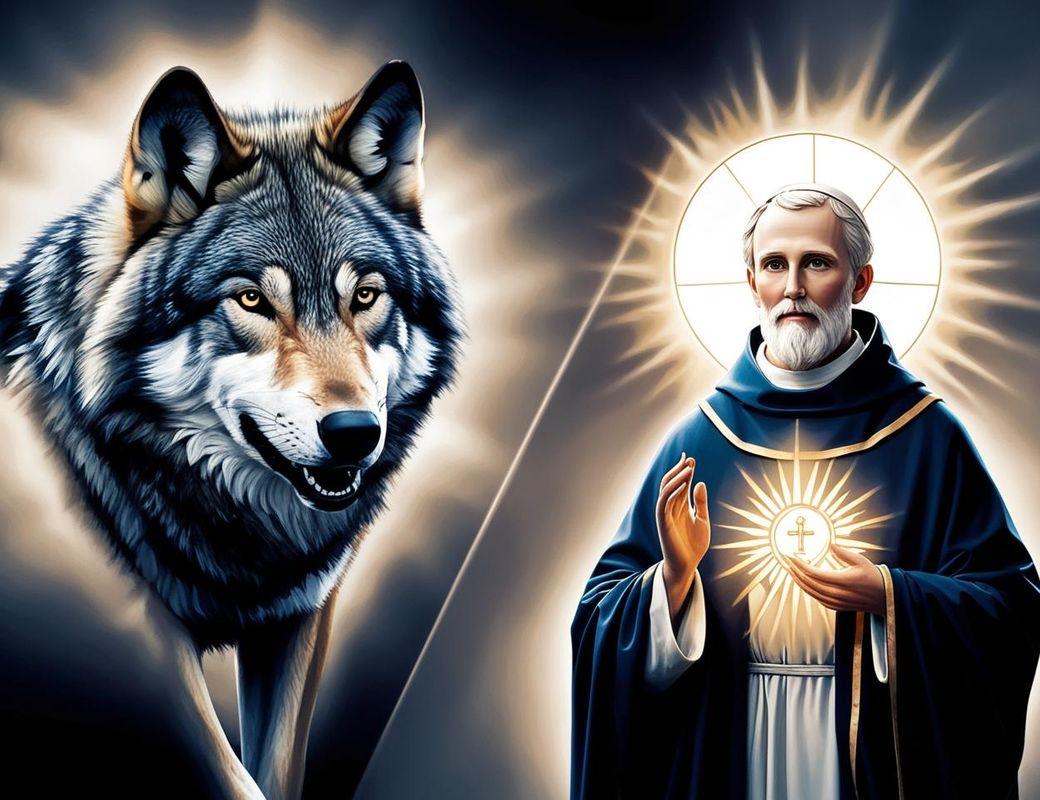
Yet the figure of Saint Andrew took on another face in the memory of the people — one older, wilder, and closer to the heart of the land. In the hills and forests, he became known not only as apostle and protector, but as Ocrotitorul lupilor, the Guardian of the Wolves. Folklore tells that when he first entered Dacia, the forests were filled with wolves that attacked travelers and terrorized the villages. One night, as he prayed for guidance, a great white wolf appeared from the shadows. Its fur glowed silver under the moonlight, and its eyes burned with quiet wisdom. The saint recognized it as no ordinary creature but a spirit of the land, sent to guide him. The white wolf led him safely through the forests and over the frozen plains, guarding him from danger. Some say it was the spirit of Zamolxis, the ancient Dacian god who once took the form of a wolf to lead his followers beyond death. Others believe it was an angel in disguise, sent to show that the Christian faith could live in harmony with the old spirits rather than destroy them. From that night forward, Saint Andrew was said to hold command over the wolves, blessing and taming them as part of God’s creation.
Because of this, the eve of Saint Andrew became a sacred night for the beasts of the wild. The people believed that on this night, the saint gathers the wolves and divides among them the prey of the coming winter. It is a time when the wolves’ powers awaken — when they can see through the darkness, speak in human tongues, and understand the world of men. But their wisdom is dangerous. Those who hear a wolf speak may be frozen in place until dawn, trapped between worlds. And woe to anyone caught outside after midnight, for whoever wanders beyond the safety of the hearth before the wolves receive their portion risks being chosen as prey. Thus, when twilight falls on the eve of Saint Andrew, villagers hurry home, seal their doors, and light the hearth that will burn through the long, mystical night.
The customs of the evening are a blend of Christian faith and ancestral magic. Garlic, long regarded as a sacred protector, plays a central role. Families rub it along the doorframes, window sills, and even the horns of their cattle, for it is said that spirits and wolves alike cannot cross a threshold blessed with garlic. In some regions, small wax crosses are placed upon the horns of oxen and sheep, sealing them against evil and marking them under Saint Andrew’s protection. Barns and stables are circled with prayers, and a bit of garlic is placed in pockets or tied with red thread for good luck. Mirrors are covered so that wandering spirits, drawn to reflections, cannot enter the home through the glass. The household becomes a fortress of light and faith, guarded by the scent of garlic and the glow of candles.
Outside, the night belongs to the unseen. It is said that the strigoi — restless spirits of the dead — wander the earth on this night, seeking warmth and remembrance. The living leave small offerings of bread, salt, and water upon the windowsill to appease them, whispering prayers that they may return peacefully to their graves before dawn. But darker things also stir: the pricolici, cursed souls who rise as spectral wolves, and the moroi, shadows of the wicked dead. These beings, it is said, cannot cross into sanctified ground, and so they prowl the forests, howling alongside the living wolves who serve Saint Andrew.
High above, the moon watches — not always safely. Romanian mythology speaks of the vârcolac, a monstrous werewolf spirit that climbs into the sky to devour the moon. On Saint Andrew’s Night, when the veil between worlds grows thin, the vârcolac builds a ladder of shadow and mist, rising toward the heavens to bite the lunar orb. When the moon turns red, it is said to bleed from the creature’s fangs. Villagers once banged pots and clanged iron tools to frighten it away, pleading for the moon’s release. The waxing and waning of the moon became, in this way, a living story: a cycle of wounding and healing, death and rebirth, as the moon restores itself after each attack. For the people of old, even the heavens reflected the eternal dance between darkness and light.
Within the home, the night is far gentler. After sunset, families gather for supper — a meal simple yet symbolic. Bowls of beans, loaves of bread brushed with garlic, smoked meats, and cups of red wine or țuică warm the table. Each dish carries meaning: the beans represent endurance, the bread abundance, and the wine the blood of life that will sustain them through the cold season. Children are warned not to whistle or laugh too loudly, for it might draw the wolves’ attention. As the meal ends, the fire is fed and the room glows gold with its light. Elders tell the old stories — of Saint Andrew and his white wolf, of the wolves that speak beneath the moon, and of the moon that bleeds but never dies. The youngest listen in rapt silence, their faces bathed in the flicker of firelight, their imaginations threading together faith and myth.
Once the hearth quiets, young women perform rites of divination, a tradition that survives from ancient fertility rituals. Some place a sprig of basil beneath their pillows to dream of their future husband. Others plant a handful of wheat grains on a plate and water them until Christmas; if the shoots grow green and tall, the coming year will bring prosperity. These rituals blend hope, love, and superstition into one gentle prayer for the future.
As midnight passes, the night deepens. The wolves howl in the distance — not as a threat, but as a song of the season’s turning. They call to Saint Andrew, their unseen master, as he stands at the threshold of the divine and the wild, counting out the winter’s bounty. The people, huddled in their warm homes, cross themselves and whisper blessings for their flocks. Beyond the village, the forests stand vast and dark, the moon glimmering through the branches as though watching over both man and beast.
When dawn finally breaks, the world feels new, purified by faith and shadow alike. The people greet the morning with gratitude, for they have survived the longest night of wolves and spirits. In the cave at Ion Corvin, pilgrims kneel and offer prayers to Sfântul Andrei, thanking him for his protection. Though centuries have passed, the traditions endure — the garlic on the windows, the wax crosses on the animals, the whispered legends of the Great White Wolf. For in Romania, Saint Andrew’s Night is more than a date on the calendar; it is a living memory, where ancient belief and Christian devotion coexist in harmony. It is a reminder that even in the darkest nights, faith glows like the hearthfire — warm, steadfast, and eternal.