The Wild Hunt
Ghostly Riders Across Myth and Legend
Article · 5 min read · ·
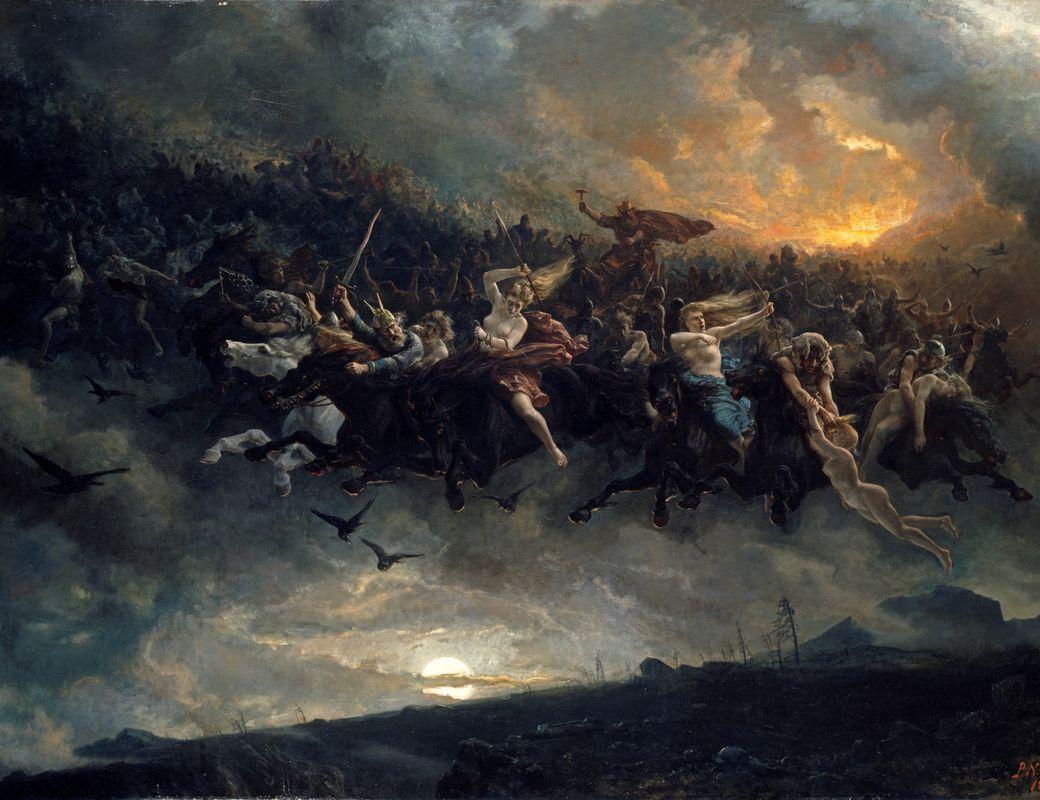
On storm-dark nights when the wind moans through the trees and the clouds gallop across the moon, folklore warns of an omen unlike any other. A great host thunders through the heavens, spectral horses striking sparks in the night sky, hounds baying with unearthly voices, and riders pale as mist sweeping in their wake. This is the Wild Hunt, a vision of the dead in motion, a supernatural cavalcade that has haunted European imagination for centuries. To see the Hunt was to brush against the thin veil between worlds, for these ghostly riders were believed to be an army of the dead, a procession of restless spirits who rose most powerfully during the liminal nights of the year, especially at Samhain, when the boundaries between living and dead grow perilously thin.
Ancient Roots of the Hunt
The origins of the Wild Hunt can be traced to the shadowed realms of Norse and Germanic tradition, where the god Odin, or Woden, was said to ride with his wolves and ravens, leading a host of fallen warriors and wandering souls. His procession surged most fiercely during winter’s long nights, when storms howled across the land. People believed these spectral riders were more than myth, they were the dead unbound, moving across the sky in a terrifying display of power. This early vision of the Hunt may have grown from ancestral rites and beliefs about the souls of the departed roaming at midwinter, yet in time the spectral procession became a force of dread rather than reverence, a reminder that human life is fragile before the storm of the unseen world.
The Hunt Across Europe
As the tale spread across Europe, each land gave the Hunt its own face, yet always its riders remained terrifying and otherworldly. In Wales, the procession belonged to Gwyn ap Nudd, ruler of the Otherworld, whose white hounds with ears as red as flame hunted the souls of the dead. In England, Herne the Hunter, a ghostly figure crowned with stag’s antlers, was said to charge through Windsor Forest with his hounds at his heels. In Brittany, villagers feared the Mesnée d’Hellequin, a phantom host that swept across the countryside like a storm, bringing terror to all who heard its approach. In Scandinavia, the Asgårdsreien was remembered as the ride of the gods themselves, a divine and unrelenting surge across the winter skies. Despite the differences, the image remained the same, spectral riders and their hounds tearing through the night as if the very army of the dead had been unleashed.
Omens, Warnings, and the Army of the Dead
The Wild Hunt was never just a story to entertain by the fire. It carried deep warnings and heavy symbolism. To hear or see the Hunt was to court disaster, for a mortal could be swept into the procession and carried away into the Otherworld. The Hunt was often considered an omen of war, plague, or death. Some tales describe it as a gathering of the unquiet dead, soldiers doomed to ride forever because of their sins, forming a restless army that could not find peace. The spectral hounds and horses were not ordinary beasts, but psychopomps, guides that ferried souls from the world of the living to the land of the dead. In this way, the Wild Hunt reflects a primal fear: that the boundaries between life and death are thinner than we wish to believe, and that the dead, in their multitudes, may one day come thundering back.
Medieval Shaping of the Hunt
With the rise of Christianity, the old stories were reshaped and given a moral edge. What had once been Odin’s riders or Gwyn ap Nudd’s hounds became reimagined as a cursed host of the damned. Chronicles from the twelfth century describe villages that swore they had seen spectral armies moving through the night sky, often interpreted as punishment for sin. Witnessing the Hunt could mean illness, misfortune, or a spiritual warning, a reminder to remain faithful lest one join the cursed procession after death. The Hunt thus became a morality tale, reinforcing Christian ideas of judgment, even as it preserved the ancient awe of the restless dead in motion.
Echoes in Literature and Culture
The legend endured, resurfacing in later centuries in poetry, opera, and art. Romantic writers, fascinated by storms and the sublime, found inspiration in the imagery of the Hunt. Richard Wagner wove its echoes into his operas, while William Morris and others brought it into their storytelling. Today the Hunt remains alive in literature and fantasy, appearing in novels and films, most famously in The Witcher, where it takes the form of a terrifying otherworldly army. Its modern incarnations keep alive the central vision: spectral riders charging across the sky, embodying chaos, death, and the relentless power of the Otherworld.
The Hunt in Modern Spirituality
In contemporary pagan and witchcraft traditions, the Wild Hunt has been reimagined not only as a symbol of death but as an expression of ancestral power. At Samhain, when the veil between worlds is thinnest, many believe the Hunt rides again, a procession that clears away the old so that new life may emerge. Its terror is also its sacred gift, for the Hunt embodies the eternal cycle of death and rebirth, reminding us that endings are necessary for beginnings. In parts of Europe, festivals still reenact the Wild Hunt, with masked riders and howling processions that bring the myth to life once more, ensuring the sound of ghostly hooves will not be forgotten.
Conclusion
The Wild Hunt has endured because it captures something primal in the human imagination. It is the storm of the dead against the living, the reminder of mortality, and the awe of forces beyond our control. It embodies both chaos and renewal, terror and reverence. When we envision ghostly riders tearing across the heavens with spectral hounds at their side, we recognize not only our fear of death but also our fascination with mystery, the unknown, and the eternal cycles that bind us all. The Wild Hunt is more than folklore, it is a mirror of humanity’s relationship with life, death, and the vast shadowed world that waits just beyond the veil.