The Samhain Candle Ritual
Honoring the Past & Welcoming the Darkness
Article · 7 min read · ·
There is a certain quality to the waning days of October: the evenings turn cooler, daylight is in short supply, and nature makes its move toward winter. For those of us who are folk witches, it is a time for some spiritual renewal and remembrance. Central to our observances is Samhain, the old Gaelic festival that ushers in the colder months.
One need not be overly complicated to have a meaningful ritual, even if modern Samhain is often associated with elaborate altars and ceremonies. A quiet evening and a single candle will do. I find my own Samhain candle ritual quite straightforward, built on three intentions: to give thanks for what has come before, to let go of what is no longer useful, and to make ready for the darker times to come.
To put this in context, it helps to know something of the history behind the practice.
The Historical Origins of Samhain
In medieval Ireland, Samhain was no ordinary affair. Observed from the evening of October 31 through November 1, the first day of winter, according to the National Museum of Ireland, the festivities proper took place on Oíche Shamhna, the night before. For an agricultural people whose very survival hinged on the seasons, the shift from summer to winter was a major turning point, affecting everything from livestock to food stores. It was also a staple of the day's literature, often the backdrop for encounters with the supernatural.
But some of the popular lore surrounding Samhain warrants a closer look. You will often hear it called the Celtic New Year or a pre-Christian rite for the dead. In his 2024 piece “The Celtic New Year and Feast of the Dead,” historian Ronald Hutton puts these notions to the test. He shows how scholars like John Rhys and James George Frazer shaped much of what we now take for granted, yet the hard evidence for a universal ancient New Year or a dedicated festival of the dead is not as clear-cut as one might think. Graham Harvey, in the field of religious studies, would agree. At the same time, the seasonal importance of Samhain is well documented in medieval sources; a link to organized ancestor worship in its earliest form is open to question.
It is a useful distinction to keep in mind from an anthropological standpoint. Traditions change, and there is value in contemporary spiritual practices without having to replicate an ancient ceremony.
Fire, Protection, and the Changing Seasons
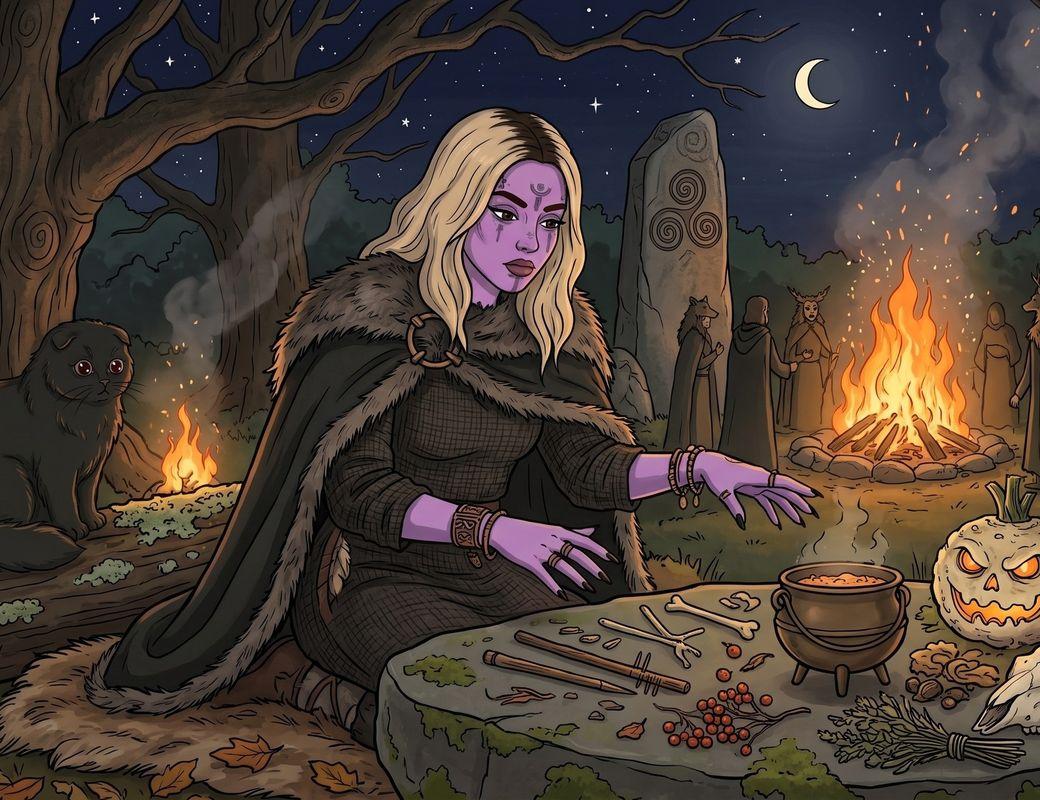
Then there is the matter of fire, which has always been part of Irish Halloween folklore. The National Museum of Ireland records the use of community bonfires, carved turnips, and candles in windows for their symbolic and protective value. Before electricity, the long nights demanded the warmth and security of a flame. One might also put up a wooden cross by the door to ward off misfortune.
Lighting a candle for Samhain today is a way of continuing that old relationship with fire. That said, if you see black candles used for endings or orange for the harvest, consider it a modern spiritual interpretation rather than an antique custom. The symbolism is personal.
A Simple Samhain Candle Ritual
What follows is a ritual from my own Folk Witchcraft Grimoire meant to prompt some reflection and release.
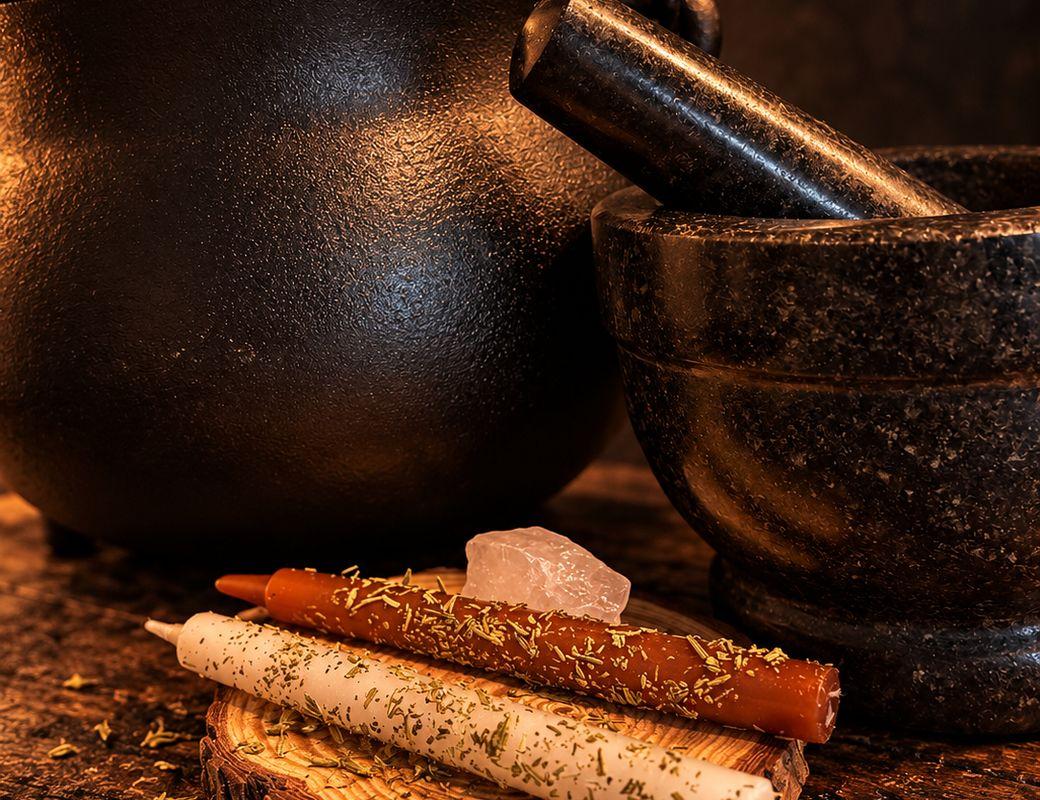
You will require a fire-resistant holder, a pen and paper, and perhaps some herbs or photographs of loved ones if you wish. And a candle – any color will do, though I prefer black, white, or an autumn hue. Black can stand for an ending, white for clarity, but these are your associations to make, not historical dictates.
Step 1: Prepare Your Space
Seek out a spot where you will not be disturbed. An ornate altar is unnecessary; a clean table and a good chair are sufficient. Sit down, take a few slow breaths, and be present.
Step 2: Light Your Candle
Make note of the season as you set the wick alight. You may offer a word to that effect:
“The year grows dark, and the harvest is done. I welcome this with gratitude for the past and an open mind to what is yet to come.”
Watch the flame for a moment.
Step 3: Reflect on the Passing Year
Put pen to paper and list three things for which you are thankful, three lessons the year has taught you, and one thing you are prepared to put behind you. In a manner of speaking, you are reaping the experiences and relationships that have defined your year.
Step 4: Let Go of What Is No Longer of Use
Turn your attention to the last thing on your list. It could be a hard experience, an old fear or resentment that has not let go, or some other unhealthy habit. Take the part of the paper with those words and tear it off. You can make small pieces of it and set them aside; in doing so, you are putting your resolve to move on into action. Make no mistake, this is a form of reflection for today, not some rite from an ancient Samhain ceremony.
Step 5: The Flame
Settle in for a few minutes and watch your candle in silence. Think on what you want to take with you in the months ahead. It is also a good time to give thanks to one’s ancestors, to recall a loved one who has passed, or just to be present with the turn of the season. When the moment is right, put out the flame and consider the ritual done.
A Variation for Household Protection
Those who wish to offer a blessing to their home can put a protective spin on the ritual. There is precedent for such practices; the National Museum of Ireland notes Irish Halloween customs such as placing protective crosses over doors to ward off misfortune (National Museum of Ireland, “Traditions”). This might inspire a folk witch of the modern persuasion to set an unlit candle next to a jar of rosemary or bay leaves by the front door. Once the candle is on a fire-safe surface well clear of the herbs and the doorway, light it and give thought to the well-being of all in the house. One might offer a simple benediction:
May this home remain a place of peace. May love and protection surround those who dwell here, and may any who enter find comfort.
The herbs are there as a symbol in a contemporary practice, not as proof of an old Samhain rite. And of course, do not leave a lit candle to its own devices, nor put anything combustible near the fire.
Remembering Our Ancestors
In my view, the beauty of folk witchcraft lies in the ordinary things we imbue with personal significance. Modern Samhain offers a chance to think of those who have gone before. While Irish folklore speaks of the return of the dead and of supernatural beings, and while anthropologists see value in remembrance rituals for maintaining one’s cultural identity, one should not assume these are prehistoric practices carried down unchanged. A story, a photo, or even a family recipe will suffice to pay respects.
Finding Meaning in the Practice
There is no need to insist that every ritual has been performed in the same way for millennia. We can respect the historical record while allowing our spiritual life to evolve. The candle ritual described above is a product of the present day, drawing on the themes and household lore of Samhain rather than being a re-creation of something Celtic. As the candle goes out, we are left with the thought that life has its seasons of growth and decline, and that we must occasionally make room for what is to come. We do not have to be afraid of the dark. It is simply another season to be understood, and sometimes a quiet evening with one’s thoughts is all that is required.
Works Cited
Harvey, Graham. "The History of Halloween." OpenLearn, The Open University, 18 Oct. 2013, updated 18 Oct. 2022, https://www.open.edu/openlearn/history-the-arts/culture/religious-studies/the-history-halloween.
Hutton, Ronald E. "The Celtic New Year and Feast of the Dead." Folklore, vol. 135, no. 1, 2024, pp. 69–86. https://doi.org/10.1080/0015587X.2023.2282282.
National Museum of Ireland. "Ghost Turnips, the Púca, Fortune-Telling and Evil Abductions... How Our Ancestors Inspire Our Halloween Celebrations Today." National Museum of Ireland, 2023, https://source.museum.ie/en-IE/News/2023/Ghost-turnips,-pucas,-fortune-telling-and-evil-abd.
National Museum of Ireland. "Traditions and Customs of Halloween / Samhain." National Museum of Ireland, https://source.museum.ie/en-IE/Collections-Research/Folklife-Collections/Folklife-Collections-List-(1)/Religion-and-Calendar-Customs/Hallowe-en-Samhain. Accessed 26 Oct. 2026.
Responses
No responses yet — start the conversation.