Samhain: The Ancient Festival of the Dead
Exploring the history, traditions, spiritual meaning, and enduring magic of Samhain.
Article · 17 min read · ·
Introduction: What Is Samhain?
Samhain is an ancient Celtic seasonal festival traditionally celebrated around October 31 through November 1. It marks the transition from the light half of the year into the dark half, symbolizing the end of the harvest season and the beginning of winter.
For many modern Pagans, Wiccans, and practitioners of witchcraft, Samhain is one of the most spiritually significant celebrations of the year. It is a time for honoring ancestors, remembering loved ones who have passed away, reflecting on the cycles of life and death, and embracing the mysteries of the unseen world.
Often described as the Witch's New Year, Samhain represents an ending that makes room for a new beginning. As the natural world becomes quieter and the days grow shorter, practitioners are encouraged to turn inward, release what no longer serves them, and prepare spiritually for the season ahead.
Although Samhain is frequently associated with Halloween, the two celebrations are not identical. Halloween developed through a complex history of seasonal customs, Christian observances, and popular traditions, while Samhain retains a distinct place in Celtic cultural history and contemporary Pagan spirituality.
At its heart, Samhain invites us to recognize that endings are not necessarily losses. Sometimes, they are simply the beginning of a different chapter.
1. The Ancient Celtic Origins of Samhain
Samhain has its roots in the seasonal traditions of the ancient Celtic-speaking peoples, particularly those of Ireland and other parts of the Celtic world.
In the traditional agricultural calendar, the festival marked the end of the harvest and the beginning of winter. Livestock might be brought in from summer pastures, and some animals were slaughtered to provide food for the colder months. Communities prepared for a season associated with darkness, scarcity, and survival.
Unlike the modern calendar, which divides the year into four familiar seasons, traditional Celtic seasonal reckoning placed particular importance on the transitions between the brighter and darker halves of the year.
Samhain was one of four major seasonal festivals commonly associated with Irish tradition, alongside Imbolc, Beltane, and Lughnasadh.
These festivals reflected the changing rhythms of agricultural life, the movement of the seasons, and the relationship between human communities and the natural environment.
Samhain was especially significant because winter represented a profound change in daily life. The harvest was ending, the landscape was becoming dormant, and communities faced the uncertainty of the months ahead.
The festival therefore carried practical as well as spiritual importance.
Samhain in Irish Mythology
Samhain also appears in medieval Irish literature and mythology.
Some traditional stories associate the festival with gatherings, supernatural encounters, and events involving the Otherworld, a realm inhabited by supernatural beings and figures from Irish myth.
In these stories, Samhain can be a time when ordinary boundaries become less secure and extraordinary events occur.
However, it is important to distinguish between what medieval texts actually describe and what modern spiritual traditions have developed. Ancient Celtic beliefs were not recorded in one complete, uniform religious system, and our understanding of them comes from a combination of archaeology, historical scholarship, folklore, and later written accounts.
Nevertheless, Samhain's association with seasonal transition, supernatural encounters, and the changing relationship between the living and the dead has remained influential in contemporary Pagan practice.
2. The Spiritual Meaning of Samhain
For many modern practitioners, Samhain is a sacred time for contemplation, remembrance, and transformation.
Its spiritual meaning is closely connected to the natural world's transition into winter. Trees shed their leaves, gardens become dormant, and the landscape enters a period of apparent stillness.
Yet this stillness does not necessarily represent an ending without hope.
Beneath the surface, nature continues its cycles. Seeds rest in the soil, bulbs wait beneath the ground, and living systems prepare for another season of growth.
Samhain encourages practitioners to recognize a similar process within themselves.
We all experience periods of change. Relationships end, circumstances shift, people move away, and loved ones pass on. We may also outgrow old habits, beliefs, fears, and versions of ourselves.
The symbolism of Samhain provides an opportunity to acknowledge these changes without pretending that every ending is easy.
Honoring Life and Death
Death is one of Samhain's most recognizable themes.
For many Pagans, the festival offers an opportunity to contemplate mortality and honor those who came before them. This may include deceased relatives, beloved friends, spiritual ancestors, or people whose lives made a meaningful difference.
Remembering the dead does not have to involve elaborate ceremonies or complicated rituals.
Lighting a candle, preparing a favorite family recipe, looking through old photographs, or sharing stories about someone who has passed away can all become meaningful acts of remembrance.
Different traditions understand the afterlife in different ways. Some practitioners believe in reincarnation, others in an ancestral realm, and others hold beliefs that do not fit neatly into any single framework.
Samhain does not require every practitioner to share the same understanding of death.
Instead, it provides a meaningful seasonal opportunity to reflect on life's impermanence and the ways in which those who came before us continue to influence the present.
Embracing the Darkness
In modern Pagan spirituality, darkness is not necessarily associated with evil.
It can represent rest, mystery, privacy, introspection, and the unknown.
Just as the earth needs periods of dormancy, people need time to rest and recover. The darker months can encourage us to slow down, reconsider our priorities, and reconnect with our inner lives.
Samhain reminds us that we do not have to remain productive, energetic, or outwardly focused throughout the entire year.
Sometimes, growth requires stillness.
Sometimes, healing begins when we stop running from what we feel.
And sometimes, the most important work happens quietly, beyond the view of others.
3. Why Is Samhain Called the Witch's New Year?
Many contemporary Wiccans and other modern Pagan practitioners refer to Samhain as the Witch's New Year.
This description reflects a spiritual understanding of the year as a cycle of beginnings, growth, decline, death, and renewal.
In this interpretation, the year concludes with the harvest and the symbolic death of the old cycle. The new cycle begins in the darkness, before the visible signs of renewed life return.
The symbolism is particularly meaningful because it challenges the idea that every beginning must be bright, energetic, or immediately successful.
A new beginning can start with uncertainty.
It can begin with grief, exhaustion, or a decision to leave something behind.
It can begin when we acknowledge that an old way of living no longer fits who we are becoming.
During Samhain, practitioners may review the previous year, celebrate what they have accomplished, acknowledge what they have lost, and consider what they hope to cultivate in the coming months.
Some people write down habits they want to release. Others establish intentions, meditate, perform divination, or create personal rituals marking the transition.
The title Witch's New Year is a modern spiritual interpretation rather than a universally documented ancient Celtic designation. Nevertheless, it has become an important part of Samhain's meaning within many contemporary witchcraft communities.
4. The Veil Between Worlds
One of the most enduring ideas associated with Samhain is the belief that the boundary between the living world and the spirit world becomes thinner at this time of year.
This concept appears prominently in modern Pagan and Wiccan traditions, as well as in contemporary folklore and spiritual interpretations of the season.
The idea reflects Samhain's association with death, the Otherworld, and the transition from one season into another.
For practitioners who believe in communication with spirits, this may be a time for ancestor veneration, prayer, meditation, or other spiritual practices intended to honor deceased loved ones.
Others approach the idea symbolically, treating the thinning veil as a metaphor for looking beyond everyday distractions and confronting questions that are normally avoided.
It is worth noting that the exact historical beliefs of ancient Celtic communities are difficult to reconstruct. The modern image of a universally recognized, physically thinning veil is not a belief that can be confidently attributed to every ancient Celtic group.
Nevertheless, the symbolism has become central to many modern Samhain celebrations.
Ways to Honor the Season
Practitioners may choose to:
-
Light a candle in memory of a deceased loved one.
-
Display photographs or meaningful objects belonging to family members who have passed away.
-
Spend time in quiet reflection or meditation.
-
Research family history and preserve ancestral stories.
-
Offer a prayer or blessing in accordance with their spiritual tradition.
-
Keep a journal of memories, dreams, and personal reflections.
These practices can be adapted to individual beliefs, cultural backgrounds, and comfort levels.
No one needs to attempt spirit communication to observe Samhain meaningfully.
For many people, remembrance alone is a sacred act.
5. Traditional and Modern Samhain Customs
Samhain has inspired numerous customs, some rooted in historical seasonal practices and others developed or adapted through later folklore and contemporary Paganism.
Understanding the difference helps us appreciate the festival without assuming that every modern ritual was practiced in exactly the same form thousands of years ago.
Ancestor Altars
An ancestor altar is a designated space for remembering deceased loved ones and honoring family or spiritual lineage.
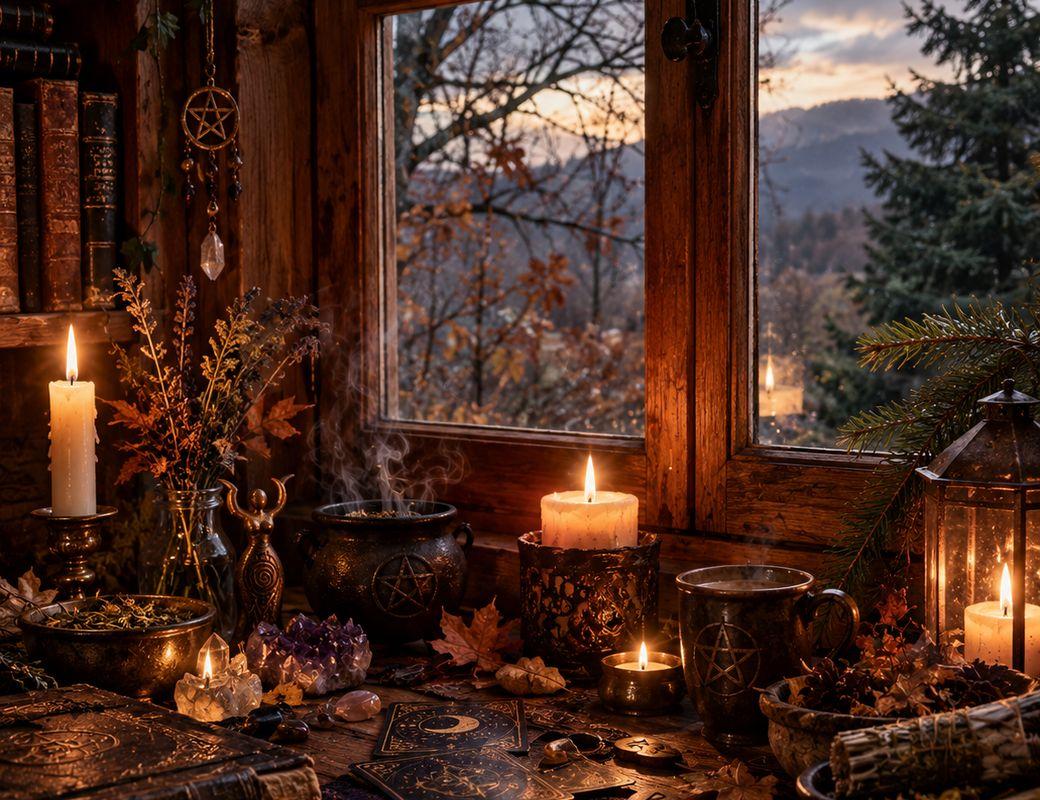
It might include photographs, letters, heirlooms, flowers, candles, or other objects associated with meaningful memories.
Some practitioners place seasonal decorations on their altars, such as fallen leaves, acorns, apples, pinecones, or small pumpkins.
An ancestor altar can be elaborate or simple. Its purpose is not to impress anyone but to create a place for remembrance and reflection.
Candlelight and Reflection
Candles are frequently used in contemporary Samhain rituals.
Their light can symbolize memory, hope, spiritual awareness, and the persistence of love through periods of darkness.
A practitioner might light a candle while speaking the name of a deceased loved one or silently reflecting on the influence that person had on their life.
For those who prefer a nonreligious approach, a candle can serve as a quiet focal point for remembering someone important.
Always place candles on stable, heat-resistant surfaces and never leave an open flame unattended.
Seasonal Foods
Food has long been important to harvest festivals, and modern Samhain celebrations often feature seasonal ingredients.
Apples, root vegetables, pumpkins, squash, nuts, breads, and warming soups are common choices.
A shared meal can honor the changing season while bringing family and friends together.
Some practitioners prepare a place setting or symbolic offering for deceased loved ones. Others prefer to donate food, cook a traditional family recipe, or share a meal while telling stories about those they remember.
Specific customs vary, and there is no single meal that every Samhain practitioner must prepare.
Divination
Some modern practitioners use Samhain as a time for divination and introspection.
Tarot cards, oracle cards, runes, pendulums, and other methods may be incorporated into personal rituals.
Questions might include:
-
What lessons have I learned this year?
-
What am I ready to release?
-
Which relationships and commitments deserve more attention?
-
What fears am I carrying into the winter?
-
What do I want to nurture in the coming year?
Divination can function as a spiritual practice or a structured method of reflection. It should not be treated as a guaranteed way to predict the future or establish supernatural facts.
Bonfires and Community Gatherings
Fire has played a role in various historical seasonal festivals, including traditions associated with Samhain.
Historical sources describe communal gatherings and fires in connection with certain Samhain observances, although customs differed by place and period.
Today, some Pagan communities celebrate with bonfires, seasonal feasts, storytelling, music, and group rituals.
Others observe Samhain privately at home.
Both approaches can be meaningful. A person's spiritual connection to the festival does not depend on having access to a large gathering or elaborate ceremonial setting.
6. Samhain and the Origins of Halloween
Samhain and Halloween are closely connected historically, but their relationship is more complex than the claim that Halloween is simply Samhain under another name.
The modern Halloween celebration developed through multiple influences, including older seasonal customs, Christian observances, Irish and Scottish traditions, and later cultural developments in North America.
In the Christian calendar, All Saints' Day is observed on November 1, while All Souls' Day follows on November 2 in the Western Christian tradition.
The evening before All Saints' Day became known as All Hallows' Eve, eventually shortened to Halloween.
The relationship between these observances and older seasonal festivals is the subject of historical discussion. Christian observances, regional customs, and pre-Christian traditions influenced the broader history of the season in different ways.
Irish and Scottish immigrants helped bring Halloween customs to North America, where the celebration gradually developed into the familiar holiday associated with costumes, trick-or-treating, carved pumpkins, and spooky decorations.
Some Halloween customs also share themes with Samhain, particularly the importance of seasonal change, supernatural folklore, and the relationship between the living and the dead.
However, not every modern Halloween custom can be traced directly to ancient Samhain practices.
For contemporary Pagans, Samhain may remain a sacred religious observance even when the surrounding culture celebrates Halloween primarily as a secular holiday.
The two can overlap, but they need not mean the same thing to everyone.
7. The Wheel of the Year and Samhain
In many modern Wiccan and Pagan traditions, Samhain is one of the eight seasonal festivals known collectively as the Wheel of the Year.
The Wheel of the Year combines four seasonal festivals commonly called the Greater Sabbats with four solar observances known as the Lesser Sabbats.
The Greater Sabbats are generally identified as Samhain, Imbolc, Beltane, and Lughnasadh. The Lesser Sabbats are the winter solstice, spring equinox, summer solstice, and autumn equinox.
Together, these festivals create a symbolic map of the year's changing seasons.
Samhain represents the transition into winter and the completion of the harvest cycle.
Imbolc, celebrated around the beginning of February, is associated in many modern Pagan traditions with the first signs of returning light and the anticipation of spring.
Beltane, around the beginning of May, celebrates the arrival of summer and is often associated with fertility, vitality, and abundance.
Lughnasadh, around the beginning of August, marks the first harvest and gives thanks for the fruits of the growing season.
The four solar observances mark important points in the astronomical year.
It is important to recognize that the modern Wheel of the Year is a contemporary Pagan framework drawing on multiple historical and seasonal influences. It should not be assumed that every ancient Celtic community celebrated all eight festivals in the same way.
Nevertheless, the Wheel of the Year provides many modern practitioners with a meaningful way to connect spiritual practice to the natural world.
8. How to Celebrate Samhain Today
There is no single correct way to celebrate Samhain.
Some practitioners follow established religious traditions, while others create personal observances based on family history, spiritual beliefs, or a connection to nature.
If you are new to Samhain, beginning with a few simple practices can be more meaningful than attempting a complicated ritual.
Create a Samhain Altar
Choose a small table, shelf, or other suitable surface.
Decorate it with seasonal objects such as fallen leaves, acorns, apples, pinecones, or pumpkins.
You might include photographs of loved ones who have passed away, a journal, or a meaningful personal object.
If you use candles, observe appropriate fire safety.
Take a few moments to reflect on the people, experiences, and lessons you want to honor.
Write a Release Letter
Find a quiet place and write about something you are ready to leave behind.
It could be an unhelpful habit, an outdated expectation, a fear, or a chapter of life that has ended.
Be honest about what the experience has taught you.
Then consider what you want to carry forward instead.
You do not need to burn the letter or perform any elaborate ritual. You can fold it away, keep it in your journal, or tear it up as a personal symbol of letting go.
Honor Your Ancestors
Spend time learning about your family history or remembering the people who helped shape your life.
If you do not know much about your biological ancestors, you can honor the mentors, chosen family members, cultural figures, or loved ones whose influence remains meaningful to you.
Ancestor veneration does not need to ignore painful family histories. You can acknowledge the past honestly while choosing which values and traditions you wish to carry forward.
Spend Time in Nature
Take a mindful walk and observe the signs of seasonal change.
Notice the falling leaves, the cooler air, the changing light, and the plants preparing for winter.
Consider what the natural world can teach you about rest, adaptation, and renewal.
If you gather natural objects, do so responsibly and avoid disturbing wildlife or protected areas.
Reflect on the Coming Year
Use Samhain as an opportunity to review the months behind you.
Write down your accomplishments, disappointments, lessons, and hopes.
Instead of creating an overwhelming list of resolutions, choose a few intentions that reflect what matters most to you.
Remember that personal transformation rarely happens all at once.
Small, consistent choices can be just as meaningful as dramatic changes.
9. Common Symbols Associated With Samhain
Modern Samhain celebrations often incorporate symbols that reflect the season, harvest, remembrance, and mystery.
Apples: Associated with autumn abundance, folklore, and seasonal food traditions.
Pumpkins and gourds: Symbols of the autumn harvest and widely used in contemporary Halloween decorations.
Fallen leaves: Represent seasonal change, impermanence, and the natural cycle of growth and decay.
Acorns: Can symbolize potential, resilience, and the promise of future growth.
Candles: Often represent remembrance, hope, contemplation, or spiritual awareness.
Black and orange: Frequently used in contemporary Halloween and Samhain decorations to evoke darkness, autumn foliage, and seasonal transition. Their meanings vary across individual practices.
Skulls and skeletons: Reminders of mortality and common symbols in modern artistic representations of the season.
The cauldron: In contemporary witchcraft, the cauldron may symbolize transformation, creation, and the mixing of different elements into something new.
These symbols do not have identical meanings across all Pagan traditions. Their significance often depends on the practitioner's beliefs, cultural background, and personal experience.
10. The Deeper Lesson of Samhain: Learning to Let Go
Perhaps the most meaningful lesson of Samhain is the recognition that life is made up of cycles.
We experience beginnings and endings, joy and sorrow, connection and separation, growth and decline.
We cannot preserve every moment forever, and we cannot prevent every change.
Yet we can decide how we respond to the changes that come into our lives.
Samhain invites us to examine the emotional burdens we carry.
Are we holding on to anger that prevents us from moving forward? Are we trying to preserve a version of ourselves that no longer reflects who we are? Are we allowing past mistakes to define our future?
These questions do not have easy answers.
Letting go is not the same as pretending something never happened. It does not require forgiving someone who harmed us, forgetting a painful experience, or abandoning the people we love.
Sometimes, letting go simply means accepting that the past cannot be changed.
It means recognizing that grief and gratitude can exist together.
It means understanding that rest is not failure and that uncertainty does not make a new beginning impossible.
The darkness of winter can remind us that periods of quiet have their own value.
Even when the world appears dormant, the possibility of renewal remains.
Conclusion: Welcoming the Darkness and Honoring the Past
Samhain is more than a seasonal festival. For many modern Pagans and witches, it is a sacred opportunity to honor the dead, reflect on the past, acknowledge the changing seasons, and prepare for the future.
Its historical roots connect it to the agricultural calendar and seasonal traditions of the Celtic world. Its modern spiritual expressions encompass ancestor veneration, divination, personal reflection, and celebrations of the natural cycle of life and death.
Although people observe Samhain in different ways, its central themes remain powerful: remembrance, transformation, mortality, and renewal.
As the leaves fall and the nights grow longer, Samhain encourages us to pause and recognize the significance of the moment between what has ended and what has yet to begin.
We can honor those who came before us without becoming trapped in the past.
We can acknowledge our losses without abandoning hope.
And we can enter the darkness of winter with the understanding that darkness, too, belongs to the natural cycle of life.
Samhain reminds us that every ending carries the possibility of transformation, and every season of darkness holds space for the promise of renewal.
Blessed Samhain, and may the season bring you reflection, remembrance, wisdom, and peace.
Responses
No responses yet — start the conversation.