Samhain: Honoring the Season of Shadows
Explore the traditions, symbolism, and quiet magic of the season between endings and beginnings.
Article · 6 min read · ·
As October draws to a close, the nights grow darker, the air begins to change, and the world seems to invite us to slow down. For many modern witches and pagans, this time of year carries a particular significance: it is the season of Samhain, a festival associated with remembrance, the cycles of nature, and the mysteries of death and renewal.
Often pronounced SOW-in, Samhain has roots in Gaelic traditions and is commonly observed around the end of October and the beginning of November. Its history is closely connected to seasonal transitions, while contemporary practices have developed in different ways across pagan and witchcraft communities.
Beyond its familiar association with Halloween, Samhain offers an opportunity to reflect on what we have lost, what we have learned, and what we are ready to leave behind.
The Origins of Samhain
Samhain is a traditional Gaelic seasonal festival marking the transition into the darker part of the year. In historical Celtic societies, seasonal changes were closely connected to agricultural life, community celebrations, and the rhythms of nature.
Over time, Samhain became associated with stories and beliefs about the boundary between the living and the dead. In some traditional accounts, this was understood as a time when the otherworld was especially close to the human world.
It is important to remember that ancient traditions were not identical across every Celtic-speaking community, and modern Samhain celebrations do not all follow the same customs.
Today, some contemporary pagans observe Samhain as a spiritual festival, while others approach it as a seasonal moment for remembrance, reflection, and connection with ancestors.
The Meaning of the Dark Season
Darkness often receives a negative interpretation, but in nature, it is not simply the opposite of life. Trees shed their leaves, fields rest between growing seasons, and many living things adapt to changing conditions.
The darker months can therefore offer a powerful metaphor for periods when growth is less visible.
Not every chapter of life is meant to be productive, exciting, or full of new beginnings. Some periods ask us to rest, reconsider our priorities, and accept that change sometimes happens quietly.
Samhain can serve as a reminder that endings are part of life’s cycles. Letting something end does not erase its importance. It allows us to acknowledge what has changed and decide how we want to move forward.
Honoring Those Who Came Before Us
Remembrance is an important theme in many contemporary Samhain observances. Some people use this time to remember deceased relatives, friends, or loved ones, while others reflect on family histories and the people whose lives helped shape their own.
A remembrance practice does not need to be elaborate.
You might look through old photographs, write down a favorite memory, prepare a dish associated with someone you miss, or spend a few quiet minutes thinking about the lessons they left behind.
If you choose to create a remembrance space, a photograph, a written note, or a meaningful object can be enough. Participation is personal, and there is no single correct way to remember someone.
You do not need to believe in communication with spirits to find meaning in remembrance. The memories, stories, and values we carry can remain important parts of our lives.
A Simple Samhain Ritual for Release
Samhain is often used in contemporary witchcraft as a time to reflect on what has reached its natural conclusion. This simple ritual offers a way to mark that transition.
What you will need:
-
A journal and pen
-
A small bowl
-
A quiet space
-
A candle, optional
Step 1: Create a moment of stillness.
Find a comfortable place where you can spend a few uninterrupted minutes. If you use a candle, place it on a stable, heat-resistant surface and never leave it unattended.
Take a few slow breaths and allow yourself to settle into the moment.
Step 2: Reflect on the past year.
Write down three things you have experienced since the previous autumn. They might include a challenge, a change in your relationships, a personal achievement, or something you learned about yourself.
There is no need to judge these experiences as good or bad. Simply acknowledge that they have been part of your journey.
Step 3: Identify what you are ready to release.
Complete the sentence: “I am ready to stop carrying…”
Your answer could be an unrealistic expectation, a habit that no longer helps you, or guilt about something you cannot change.
You do not have to force yourself to let go of grief or difficult emotions before you are ready. Sometimes, acknowledging what you feel is enough.
Step 4: Choose what you want to carry forward.
Write a second sentence: “As I enter a new season, I want to make room for…”
Consider qualities such as patience, courage, rest, creativity, or stronger boundaries.
Step 5: Close the ritual.
Read your reflections quietly. Fold the page and place it somewhere safe in your journal.
You might finish by saying: “I honor what has passed, accept what is changing, and make space for what comes next.”
Let the ritual end without demanding an immediate transformation. You can return to your intentions whenever you need to.
Creating a Samhain Altar
For those who enjoy altar work, a Samhain-inspired arrangement can reflect the colors and textures of autumn.
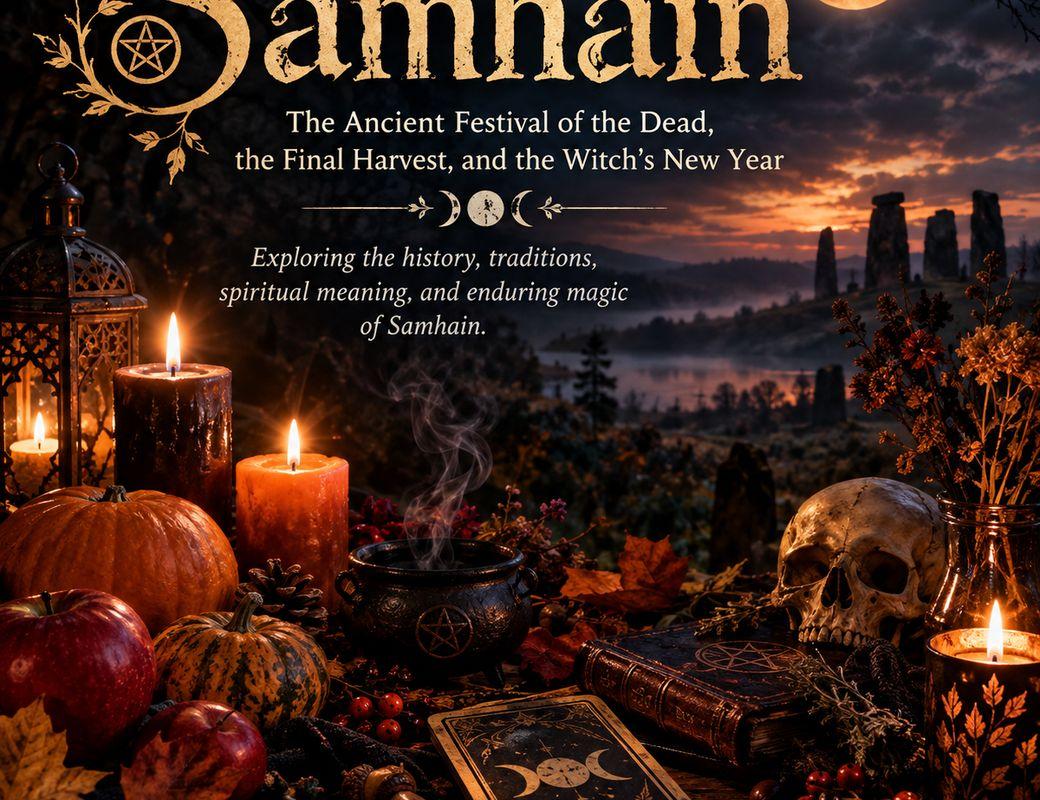
Dried leaves, seasonal flowers, dark fabrics, photographs, handwritten reflections, and natural objects can help create a space for contemplation. Some people include symbols of ancestors or items that remind them of the changing seasons.
There is no required list of objects. Choose items that have meaning to you, and avoid collecting plants or natural materials from protected areas without permission.
If you include food or drink as a symbolic offering, remember to dispose of it safely and keep it away from pets. Never leave food outdoors in a way that could harm wildlife.
An altar can be a spiritual focal point, a creative arrangement, or simply a place to pause and reflect.
Samhain and the Modern Halloween
Samhain and Halloween are connected through a complex history, but they are not interchangeable in every context.
Halloween developed through a combination of historical influences, including traditions associated with All Hallows’ Eve and older seasonal customs. Modern Halloween celebrations also include practices that developed much later.
For some people, October 31 is a night of costumes, parties, and playful encounters with the supernatural. For others, it is a meaningful spiritual observance. Some people enjoy both approaches, while others observe neither.
Understanding these differences allows us to appreciate the season without assuming that every celebration has the same origins or meaning.
Finding Meaning in the Turning of the Year
Samhain reminds us that the year does not move in a straight line. Nature changes through cycles of growth, decline, rest, and renewal, and human lives also contain periods of transition.
You do not need to celebrate Samhain in a particular way to reflect on its symbolism. You can use this time to remember someone important, acknowledge a difficult chapter, or give yourself permission to rest before deciding what comes next.
The darker season does not ask you to have every answer. It simply offers a moment to pause, look back with honesty, and make room for the unknown.
“Even in the darkest season, there is meaning in remembering what has passed and trusting that change is still unfolding.”
Responses
No responses yet — start the conversation.