Lughnasadh: Origins of the Sacred Harvest 🌾
Discover Lugh, Tailtiu, Lammas, and the origins of the ancient Celtic harvest festival.
Article · 5 min read · ·
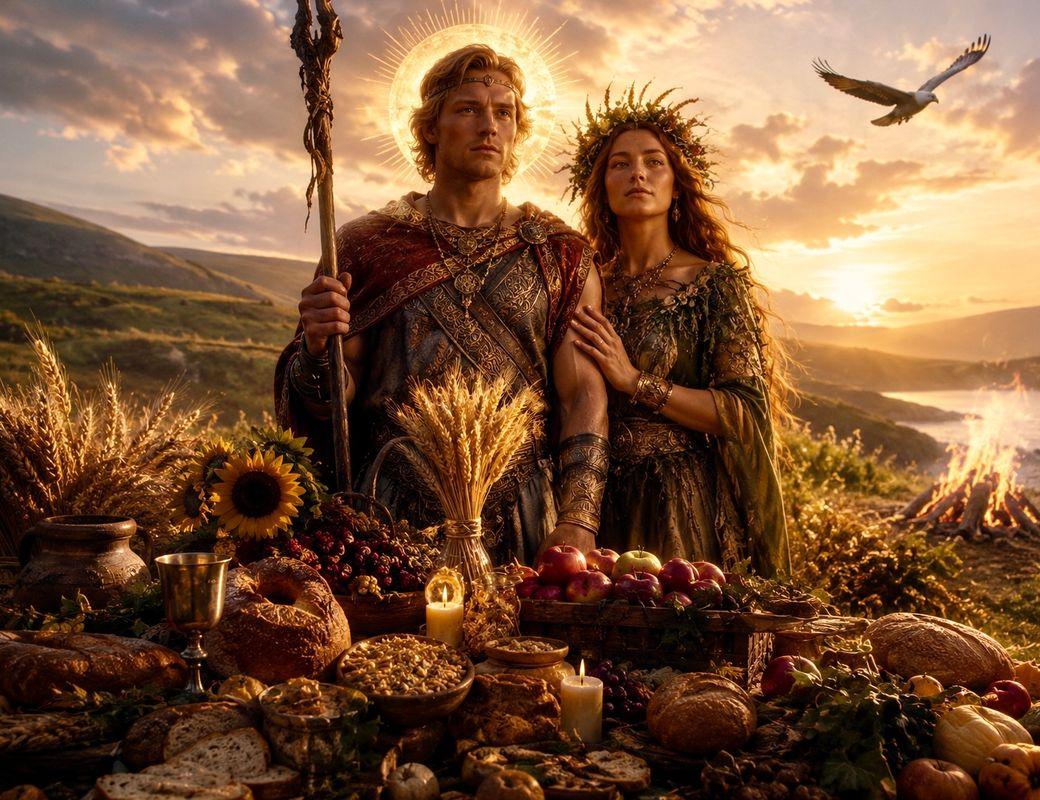
This sacred celebration became known as Lughnasadh (loo-nah-sah), one of the oldest harvest festivals in the Celtic calendar and a day many modern witches affectionately call their Thanksgiving.
But long before modern holidays, ancient Celtic communities paused at the first harvest not simply to celebrate—but to give thanks.
Because...
🍞 Every loaf carried a story.
🍞 Every grain carried a sacrifice.
🍞 Every offering was a promise to the Earth that had sustained them.
🌞 What Is Lughnasadh?
Lughnasadh is a traditional Gaelic festival, pronounced loo-nah-sah, also known as Lammas, and celebrated every 1 August.
It is one of the four Gaelic seasonal festivals, marking the first grain harvest and the beginning of the harvest season.
Behind this ancient celebration lies a story of mythology, sacrifice, gratitude, and remembrance that has echoed across Celtic lands for centuries.
⚔️ The Origins of Lugh
The story begins with Lugh.
His name reaches back long before Irish mythology was ever written. It evolved from the ancient pan-Celtic deity Lugus, whose influence spread across Celtic Europe before developing into different regional traditions.
In Wales, he appears as Lleu Llaw Gyffes, whose name means "Lleu of the Skilful Hand."
In Ireland, he became Lugh—the brilliant Celtic god of light, craftsmanship, skill, kingship, and victory.
Although the names changed across cultures, they all trace back to the same ancient divine figure whose legacy shaped one of the Celtic world's greatest celebrations.
Historical & Regional Names 🇮🇪
Lugus
The reconstructed Proto-Celtic name of the deity worshipped across continental Celtic Europe before local traditions evolved.
Lleu Llaw Gyffes
The Welsh mythological counterpart to Lugh, sharing the same linguistic origins and many of the same qualities associated with skill, heroism, and mastery.
💛 The Story of Lugh & Tailtiu
Before there was a harvest, there was a sacrifice
The festival bears Lugh's name, but its heart belongs equally to his beloved foster mother, Tailtiu—an Earth Goddess and queen remembered for one extraordinary act of devotion.
According to Irish tradition, Tailtiu tirelessly cleared Ireland's forests so fertile land could nourish future generations.
Her labour became her sacrifice.
She gave everything she had and ultimately died from exhaustion.
To honour her memory, Lugh established funeral games and annual celebrations, transforming grief into gratitude and remembrance into harvest.
Communities gathered for:
- Harvest markets
- Athletic games
- Music
- Storytelling
- Matchmaking
- Feasting
- Thanksgiving for the land
Every celebration became a living reminder that abundance is often born from sacrifice.
🍞 Historical & Religious Meanings
⭐️ Lammas (Loaf Mass)
The word Lammas comes from the Old English hlāfmæsse:
• Hlāf meaning loaf or bread
• Mæsse meaning mass or feast
Together, they form "Loaf Mass," a celebration of the season's first bread.
⭐️ Christian Tradition
Early Christian churches blessed the first loaf baked from the newly harvested wheat each 1 August, giving thanks for the harvest that would sustain communities through the coming winter.
⭐️ Festival of First Fruits
For Anglo-Saxon farmers, Lammas became a day of gratitude for the crops that promised survival during the colder months ahead.
⭐️ Pagan & Celtic Meaning
Within the older Celtic tradition of Lughnasadh, the festival honours both Lugh and the enduring legacy of Tailtiu.
It also marks the first of three harvest festivals on the Pagan Wheel of the Year.
Above all, it reminds us that every season carries its own lesson:
Abundance requires effort.
Growth requires patience.
And even the warmth of summer must eventually surrender to autumn.
🌿 The Origins of the Harvest Festival
Although often used interchangeably today, Lughnasadh and Lammas come from two different traditions.
💚 Lughnasadh
The older Gaelic and Celtic name honouring the god Lugh and celebrating the first harvest through community gatherings, remembrance, and gratitude.
💚 Lammas
The later Anglo-Saxon Christian tradition centred around the blessing of the first loaf baked from the new wheat harvest.
💚 Lughnasadh Customs
- Baking bread from newly harvested grain
- Harvest feasts
- Community gatherings
- Music and storytelling
- Bonfires lit upon the hills to honour the sun and the harvest
💚 Lammas Customs
• Blessing the first loaf during church services
- Offering prayers of gratitude for the harvest
- Breaking the blessed loaf into four pieces and placing them within the corners of barns to symbolically protect the remaining grain
Though their customs differ, both traditions celebrate the same enduring truth:
The harvest is a gift.
🌎 Ways to Celebrate Today
Honouring Lughnasadh can be beautifully simple.
🌾 Bake fresh bread.
🥫 Preserve seasonal food.
🌱 Plant something.
🌼 Tend a garden.
🤝 Volunteer at a community kitchen.
🌍 Support environmental organisations.
🕯️ Offer gratitude to the Earth.
📖 Reflect upon everything you've harvested emotionally, spiritually, and personally throughout the year.
✨ The Spiritual Inner Harvest
Lughnasadh asks a different question than most sabbats.
Perhaps your greatest harvest isn't found upon a table...
But within yourself.
Ask yourself:
🌱 What has finally blossomed?
🌱 What prayers became reality?
🌱 What dreams quietly ripened while you weren't looking?
🌱 Not every harvest grows in a field.
🌱 Some grow within us.
🌬️ Closing Reflection
The greatest harvest isn't measured by overflowing baskets.
It's measured by...
✨ The life you've cultivated.
✨ The lessons you've survived.
✨ The love you've shared.
✨ And the gratitude you've remembered to offer before asking for more.
Whether you call it Lughnasadh...
Or Lammas...
May your heart remain as abundant as the golden fields that first inspired this ancient celebration.
Because every harvest tells a story.
And every story begins with a seed.
Until our paths cross again...
Sending you healing moondust & love.
🌝
Responses
No responses yet — start the conversation.