Green Svyatki
when nature whispers and ancestors are near
Article · 7 min read · ·
Shortly after the spring equinox, when the earth turns fully green and the air fills with the fragrance of blooming grasses, one of the most poetic and mysterious periods in the Slavic calendar arrives—Green Svyatki.
In church tradition, this time is connected to the feast of Holy Trinity (in 2026—May 31st) and Whit Monday. But long before Christianity, our ancestors celebrated Rusalka Week—days when the boundary between worlds grew especially thin, nature blossomed, and the spirits of water, forest, and field came out to meet people.
This was a time not of fear, but of reverence, play, and renewal. A time when young women wove birch trees together, danced in circles, told fortunes, and honored their ancestors—not with sorrow, but with joy, with blini and festive breads.
Today, we invite you to connect with these ancient customs—not as museum pieces, but as living practices that can fill your spring with gentle magic, a bond with nature, and care for ancestral memory.
🌿 What is Green Svyatki
Green Svyatki is an entire cycle of rituals tied to the beginning of summer. In different regions, they had different names: Rusalka Week, Klechalnaya Week, Semitskaya Week. The main celebration days fall on the Thursday before Trinity (Semik), Trinity Parental Saturday, Trinity Sunday itself, and Whit Monday (the Day of the Holy Spirit).
Why "green"? Because at this time, everything around—from birch branches to meadow grasses—becomes a symbol of living, triumphant life. Homes were decorated with greenery, young women wove wreaths, and young people walked in the groves.
Why "svyatki"? Like the winter svyatki, this period was considered liminal—the world of people and the world of spirits drew closer. Unlike the winter svyatki's scary tales, Green Svyatki was brighter, yet no less mysterious. It was believed that during these days, rusalki emerged from the waters—not terrifying monsters, but rather nature spirits with whom one needed to know how to get along: appease them, avoid offending them, and if lucky—learn your fate from them.
🍃 The holiday's symbol—the birch
The main tree of Green Svyatki was the birch—a symbol of purity, tenderness, feminine power, and the transition from spring to summer.
What people did with it:
-
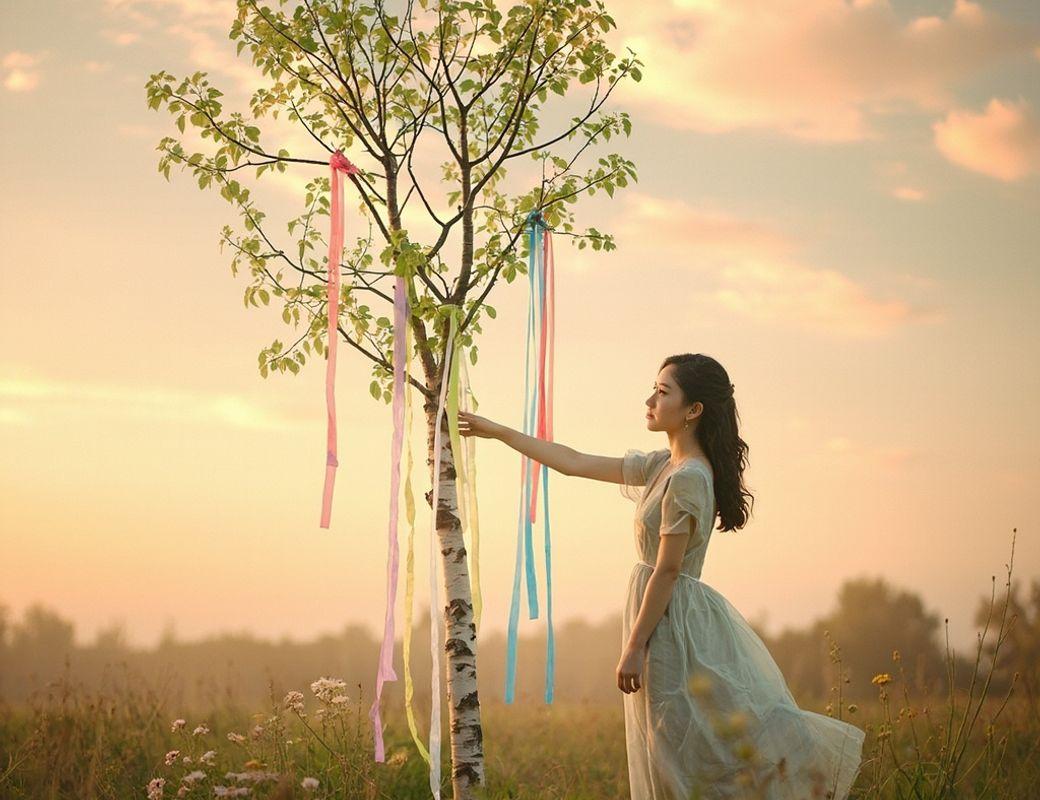
Wove the birch. Young women would choose a young tree in a grove, bend its branches to the ground, tie them with grass, and decorate them with ribbons. This was a ritual of "weaving"—sealing fate, wishes, connection with nature.
-
Became ritual friends. Through birch wreaths, young women would kiss, exchange crosses, and call each other "kuma" (ritual friend). This sealed their friendship for a year. It was believed that kumas who had quarreled should make peace on this very day.
-
Unwove the birch several days later—a symbolic releasing of vows, completion of the cycle.
-
Carried birch branches with them—they were considered protection against dark forces and illness.
In urban settings, we can replace the birch with any green plant: a willow branch, a bouquet of wildflowers, even a houseplant. The point isn't the exact tree, but the intention to connect with living nature.
💧Rusalki—spirits of water and fields
The image of the rusalka today often frightens people. But among the Slavs, rusalki were not so much evil as they were elemental beings—young women who died before marriage, or souls of children who were not baptized. They lived in water, in fields, in forests, and returned to the human world precisely during Green Svyatki.
To avoid angering the rusalki, people followed special rules:
-
No working in the fields (so as not to damage the crops where, it was believed, rusalki walked).
-
No leaving unfinished spinning or cloth out overnight (rusalki could ruin them).
-
No swimming in open bodies of water—rusalki could "tickle you to death."
-
Leaving offerings on the shore: bread, eggs, kvass, blini.
But most importantly—rusalki were respected, not feared. You could make agreements with them: leave a piece of bread at the field boundary, sing a song by the river, hang a ribbon on a tree.
For us today, this is a reminder: respect the elements. Don't pollute rivers, don't pick plants needlessly, and if you go to nature—go with gratitude. Rusalki aren't literal beings, but embodiments of that living force we so often suppress.
🌸Honoring ancestors—without grief, with joy
Green Svyatki is a time of remembrance, but not a gloomy one. Trinity Parental Saturday (the day before Trinity)—a day when people remembered the "restless" dead (those who died unnatural deaths, the unbaptized, ancestors who passed young). Unlike other memorial days, there was less weeping here, and more—communal feasting at the cemetery, rolling eggs, songs.
People believed that on these days, the souls of ancestors came to the living—not to frighten, but to share in the joy of nature's rebirth. So they left treats on graves, and at home—set an extra place, remembered them with kind words.
What you can do today:
-
Remember those who are gone, without heavy grief—simply thank them for life, for genes, for lessons.
-
Prepare a dish that a departed relative loved, and eat it in silence, remembering something warm.
-
Light a candle in memory of ancestors—not only "your own," but also those whose names history hasn't preserved.
🌾 Rituals for harvest, health, and love
Green Svyatki was also a time of magic for the future. People sought to "help" the earth yield a good harvest, themselves—health, and young people—find their betrothed.
-
Rolling eggs—not just an Easter game. Eggs were rolled across green fields so the grain would grow tall.
-
Funeral of Kostroma or the rusalka—a doll made of grass was drowned or burned, symbolically bidding farewell to spring and welcoming summer.
-
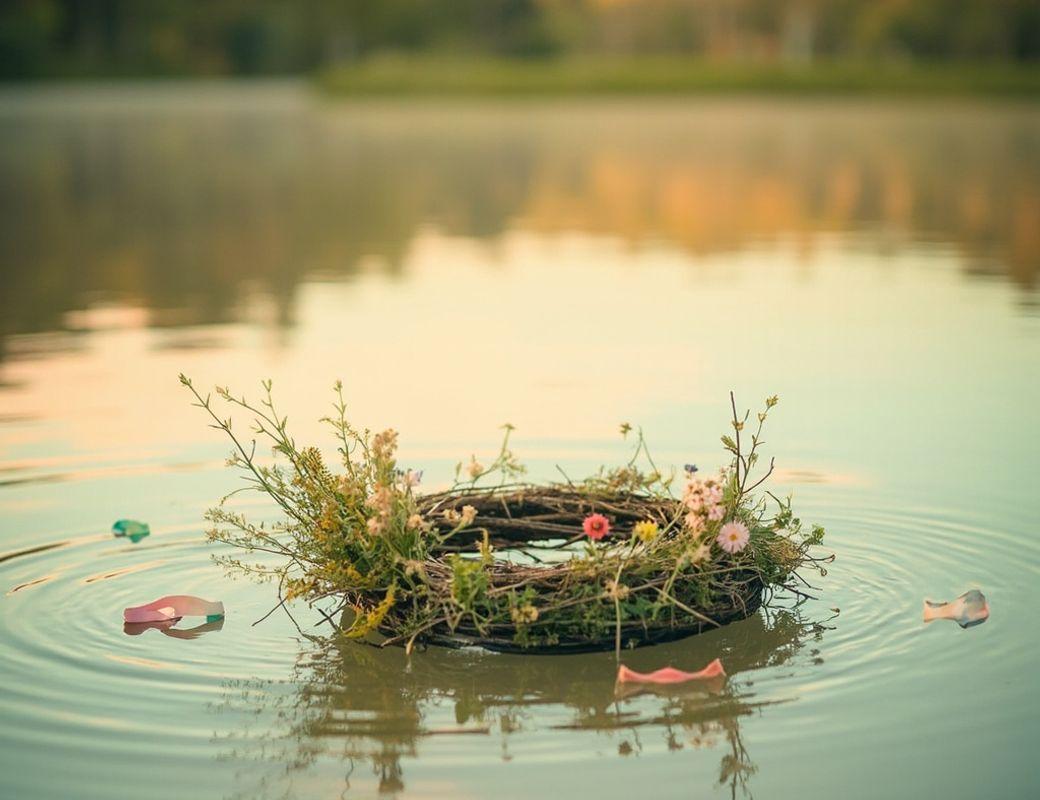
Fortune-telling with wreaths—young women floated wreaths on water and watched: if it sank—trouble ahead, if it floated—marriage, if it washed ashore—a peaceful life.
-
Gathering medicinal herbs—it was believed that during Green Svyatki, herbs possessed special power. They were dried for winter, made into charms, added to baths.
Modern interpretation: you can simply go out to a park or forest, gather a few beautiful leaves, flowers—not for spellcasting, but for contact with nature. Press them in a book, hang a branch above your door "for beauty and luck." This isn't magic, but a gentle attunement to cycles.
🌿 Practice "Birch in the city"
You may not have a birch grove, but you can conduct a small, very personal ritual—in your apartment, in a park, on your balcony.
You'll need: any plant (branch, flower, even a houseplant in a pot), a ribbon or thread, 10 minutes of quiet.
Step 1. Find your plant. This could be a cut branch (if you can go for a walk), a houseplant, or simply a green leaf you found outside.
Step 2. Tie a ribbon or thread on it—making a wish related to growth, renewal, love, health. Not a grand goal ("a million dollars"), but a state: "I want to feel lightness," "I want to meet someone who makes me feel warm."
Step 3. Place the branch in water (or leave the pot somewhere visible). Let it sit for several days—until you feel it's time to "let go." Observe it: have buds opened? have roots appeared? This isn't divination, but a conversation with nature in the language of slow changes.
Step 4. After 3–4 days (or when the plant begins to wilt), remove the ribbon, thank the branch, and take it outside—to a tree, into grass, to a park. Say mentally: "I release this wish, return it to nature, what I've sown—that I'll reap."
This simple gesture helps you feel part of the great green cycle, even in the heart of a megalopolis.
🌻 In closing
Green Svyatki isn't about "doing everything right." It's about slowing down for a few days and noticing how green everything is, how birds sing, how grass smells after rain. About remembering ancestors not with horror, but with gratitude—for having lived, loved, grown grain, and us. And about allowing yourself a bit of play, a bit of mystery, a bit of faith that the world isn't made only of facts and deadlines.
May your spring be not only productive, but also alive—with wreaths, green branches, and quiet conversations with a birch tree.
P.S. If you decide to perform the ritual with a branch or simply go for a walk in the park—share in the comments what you felt. Sometimes one "I did this" becomes the beginning of a great tradition. 🌿