The Forbidden Drafting Table
Where Your Daydreams Become Blueprints
Article · 4 min read · ·
For most of my life, my imagination was my secret sanctuary and my private torture chamber.
It was the lush, inner world I’d escape to when the outer one was too harsh—a place where I was loved, successful, safe. But the return was always a crash. The contrast between the vivid fantasy and my reality felt like a cruel joke, proof that my dreams were just… fantasies. My sensitivity, my ability to render worlds in my mind, seemed like a taunt. A beautiful defect.
I was a master passive dreamer. I didn’t understand that the same mind that could build a prison of lack could also draft the blueprint for a palace.
The turning point came when I realized I was using my imagination backwards. I was using it to escape from my reality, not to create it. I was daydreaming from a place of longing, which only reinforced the feeling of not having. I had to learn to daydream from a place of assumption—from the felt reality of already being who I wished to be.
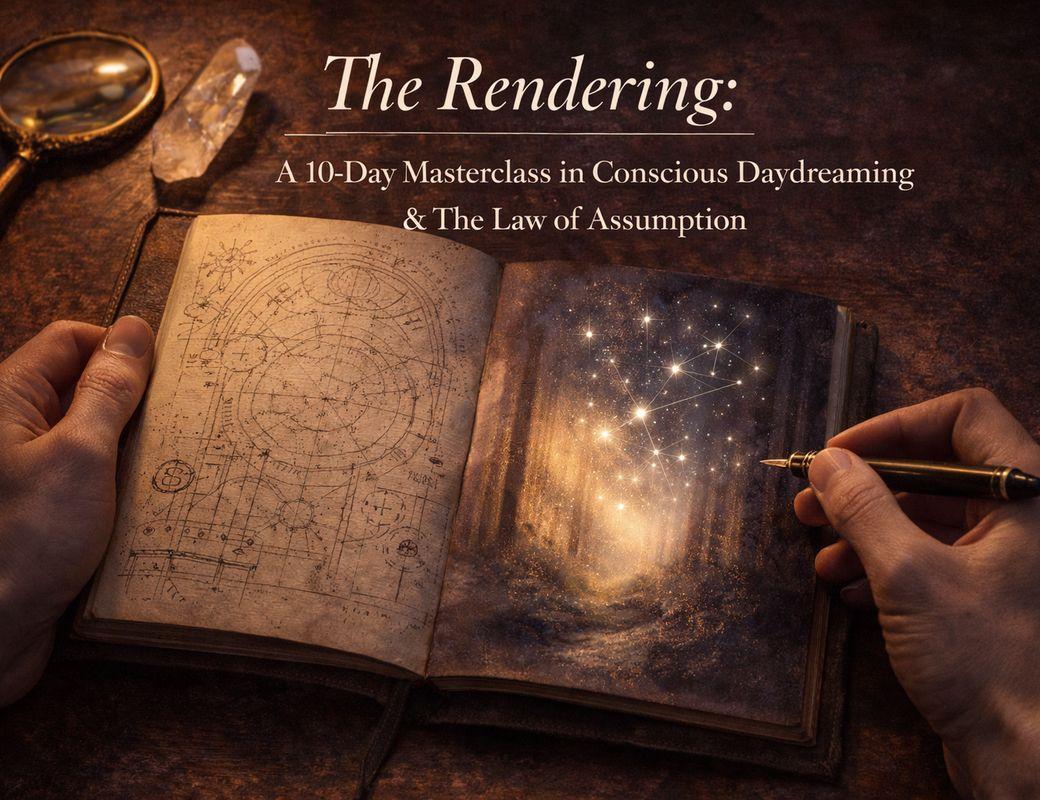
This is the precise, radical work of The Rendering. It is not positive thinking. It is architectural thinking. It’s a 10-day masterclass in using your innate sensitivity as the ultimate design software for your life.
Phase One: The Dream Audit — Mapping the Old Blueprint
You cannot build a new structure on a cluttered, outdated site. The first step is becoming a forensic architect of your own inner world.
This phase is a systematic excavation of your daydreams. What are you actually fantasizing about? Is it recognition? A specific quality of peace? A feeling of being chosen? We don’t judge the dream; we decode its emotional core. Simultaneously, we personify the "Old Story"—the dominant narrative of lack (e.g., "The Beggar," "The Outsider") that has been unconsciously running the construction project. The "addictive hit" here is shocking clarity: seeing the direct link between your hidden assumptions and your lived experience.
Phase Two: Demolition & Declaration — The Conscious Uncoupling
With the old blueprint identified, you don’t just build over it. You perform a ritualized, somatic demolition.
This is where you actively, vocally uncouple from the past identity. It’s a daily practice of stating "I am not that story anymore," not as an affirmation, but as a decree from the architect who has reviewed the plans and found them faulty. Then, you begin drafting the new ones. You craft core "I Am" statements that are not flowery wishes, but the foundational identity codes of your new self. You launch a "Mental Diet," a disciplined practice of catching and redirecting thoughts that contradict your new design. Finally, you write the "Script"—a first-person, present-tense, sensory-rich narrative of a single day in the life of your wish, already fulfilled.
This phase is the active construction site. The "addictive hit" is the tangible sense of power that comes from no longer being a victim of your thoughts, but a director of them.
Phase Three: Embodiment & Bridge-Building — Inhabiting the New Structure
A blueprint is useless if you never move into the building. This final phase is about psychological occupancy.
You engage in "Somatic Blueprinting"—specific exercises to generate the physical feelings (the ease, the confidence, the security) of your new state in your body now. You train your perception through "Sign-Seeking" not as validation, but as bridge-building—noticing how the external world begins to subtly reconfigure to match your new internal frequency. The journey culminates in the "Sabbath"—a day of resting in divine indifference, the serene knowing that the creation is already complete within you, and the external manifestation is simply catching up.
The "addictive hit" is peace. It’s the end of desperate reaching and the beginning of grounded, assured receiving.
The Architecture of Creation
This ten-day arc—Audit, Demolition, Embodiment—is engineered to transform your most potent gift, your sensitivity, from a source of pain into your primary creative tool. It moves you from Passive Dreamer → Conscious Architect → Embodied Creator.
I structured it this way because creation without a stable foundation is just more anxious fantasy. This guide is for those who have done the groundwork of safety and self-knowledge. Their inner sanctuary is stable. Now, it’s time to design the view from its windows.
Your imagination is not an escape hatch. It is your drafting table. The Law of Assumption isn’t a mystical secret; it’s the principle that whatever you assume to be true within becomes the blueprint for what configures without.
The tools are on the table. The blank page is waiting.
What will you render?