The old gods
How stories of life, loss, and triumph became the stories of ancient life
Article · 4 min read · ·
Before they were carved into stone or reduced to footnotes, the old gods were people shaped by weather, hunger, and memory. They were not born in temples. They were born around fires, in mud, in bloodied hands that had learned the cost of survival the hard way.
Celtic and Norse gods didn’t arrive as distant, flawless beings. They emerged the same way stories always do, from someone doing something remarkable enough that no one could let it go quiet.
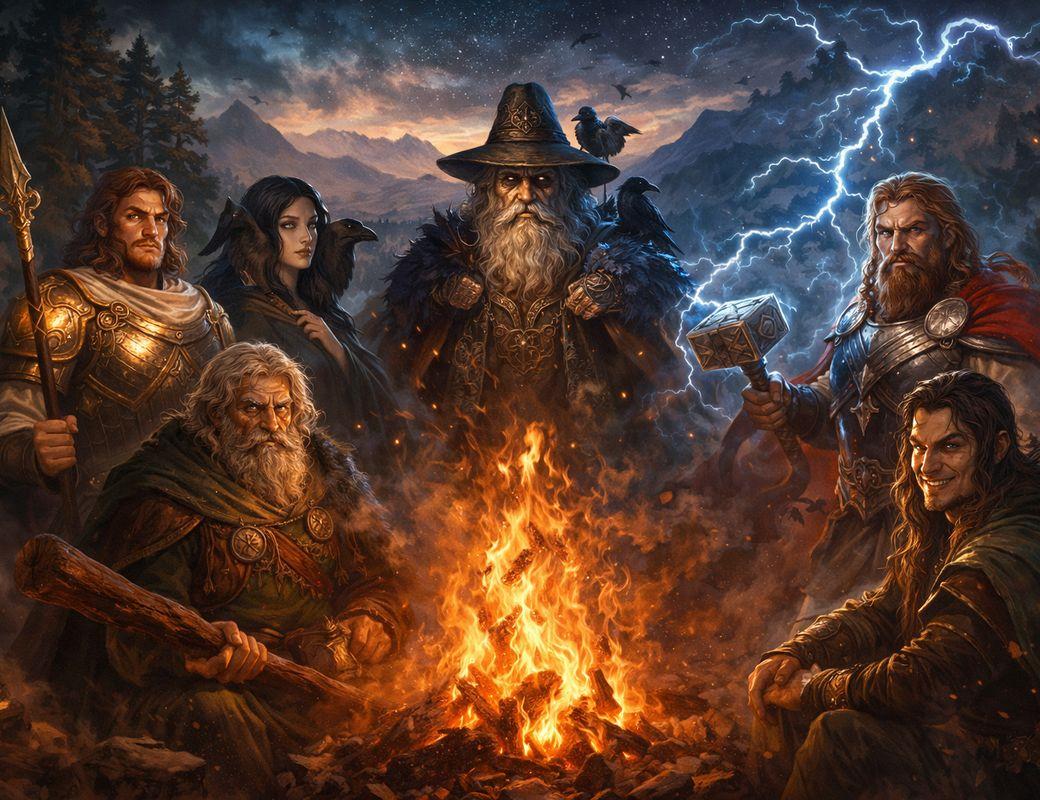
Take the Celts first. Their world was thick with forest, river, and fog. Land that refused to be dominated politely. So their gods reflected that. They weren’t rulers above nature. They were entangled with it. Lugh, the many-skilled one, wasn’t just a god of light and craft. He feels like the memory of a prodigy, the kind of person who could fight, build, sing, lead, and survive. Someone so capable that later generations couldn’t explain him without turning him divine.
The Dagda, often painted as a bumbling giant with a club and a cauldron, reads less like a cartoon god and more like an old tribal chieftain remembered through exaggeration. A man who fed his people, protected them, buried their dead, and carried authority heavy enough to break the ground when he walked. Over time, responsibility turns into legend. Legend turns into a god.
The Morrígan is even more telling. War, prophecy, sovereignty. Not gentle qualities. She feels like the echo of a woman who understood the cost of conflict and refused to romanticize it. Possibly a seer. Possibly a queen. Possibly someone whose presence on the battlefield meant things were already past the point of mercy. History doesn’t forget those people. It mythologizes them because it doesn’t know what else to do.
The Norse gods came from harsher land and harsher math. Short summers. Long winters. Survival that depended on strength, preparation, and a willingness to die well if it came to that. Their gods are flawed, loud, sometimes reckless, and painfully aware that even they don’t win forever.
Odin is not a gentle sky father. He’s a warlord-scholar hybrid who trades comfort for knowledge and pays for wisdom with pieces of himself. One eye. Endless wandering. Hanging from the world tree for insight. That doesn’t feel like fantasy. It feels like a real leader who sacrificed safety and certainty to understand the world well enough to keep his people alive.
Thor isn’t subtle. He’s strength with a job. Protector of the common folk. The one who shows up when things get ugly. He feels like the legend of a warrior whose presence alone turned the tide of a fight. A man remembered not for clever speeches, but for being there when the roof was caving in. Over time, the hammer gets heavier. The thunder gets louder. The man becomes a god.
Even Loki, chaos incarnate, makes more sense when you stop treating him like a cartoon villain. Every tribe remembers someone clever enough to break the rules and dangerous enough to prove why rules exist in the first place. Tricksters don’t come from nowhere. They come from lived consequences.
Here’s the part that rarely gets said out loud.
These gods didn’t replace reality. They preserved it.
They were memory systems. Cultural hard drives. Ways to teach survival, values, warnings, and identity without textbooks or central governments. If you wanted your children to remember that arrogance leads to ruin, you told them a story about a god who fell. If you wanted them to understand sacrifice, you told them about one who paid dearly for wisdom. If you wanted them to respect the land, you made the land sacred and alive.
The old gods were not imaginary in the way we mean it now. They were symbolic truth. History with teeth.
Eventually, time moved on. New systems arrived. New gods promised cleaner narratives and fewer moral gray areas. The old ones were labeled pagan, primitive, dangerous. Not because they were false, but because they were too honest. They reminded people that life is cyclical, violent, beautiful, unfair, and sacred all at once.
And that’s uncomfortable.
But if you listen closely, they’re still there. Not as beings demanding worship, but as echoes of what it meant to be human before we outsourced meaning to institutions. They live in craftsmanship. In honoring seasons. In facing hardship without pretending it’s polite. In understanding that strength, wisdom, and sacrifice are earned, not gifted.
The old gods weren’t asking to be believed in.
They were asking to be remembered.
Because long before they were gods, they were us.
Responses
No responses yet — start the conversation.
More from the Magazine
Your Witchcraft Doesn't Need to Cost More Than Your Grocery Bill
Build a meaningful practice with ordinary objects, intentional actions, and what you already own.
The Owl - Secrets of Wisdom
The symbolism of the nocturnal bird in mythology, magic, and spiritual practices

How to Attract and Maintain Positive Energy
In Your Home and Other Spaces