Honoring Hecate
Goddess of the Crossroads, Magic, and the Night
Article · 6 min read · ·
Celebrating the Festival of Hecate on August 13
As the warmth of late summer begins its gradual shift toward the coming autumn, August 13 offers a meaningful opportunity to reflect upon one of the ancient world’s most mysterious and enduring goddesses, Hecate. Revered as the guardian of crossroads, magic, spirits, and the hidden places between worlds, Hecate has inspired devotion for more than two thousand years. Her image has evolved through the centuries, yet she remains a symbol of wisdom, protection, intuition, and transformation.
Although history does not record a single, universally observed ancient festival dedicated to Hecate on August 13, many modern witches, Hellenic pagans, and spiritual seekers have embraced the date as a special time to honor her. It has become a day for quiet contemplation, personal growth, and reconnecting with the mysteries that lie just beyond ordinary perception. Whether approached as an act of devotion or as an appreciation of ancient mythology, the festival invites us to pause, reflect, and embrace the paths that lead us toward change.
The Ancient Goddess of Thresholds
Hecate’s origins reach back beyond classical Greece, with many scholars tracing her earliest worship to Anatolia, in what is now modern-day Türkiye. Unlike many of the Olympian gods and goddesses, Hecate occupied a unique place within Greek religion. In Hesiod’s Theogony, she is described as a powerful deity who retained great honor and authority under Zeus, possessing influence over the heavens, the earth, and the sea.
As Greek religion developed, Hecate became increasingly associated with the unseen world. She was revered as the goddess of magic and witchcraft, the protector of travelers, the keeper of sacred knowledge, and a guide through places of transition. She was believed to stand at the boundaries between life and death, light and darkness, the familiar and the unknown.
Rather than representing fear or malevolence, Hecate embodied wisdom born from experience. She reminded her followers that true understanding often comes from walking through uncertainty rather than avoiding it.
The Sacred Symbols of Hecate
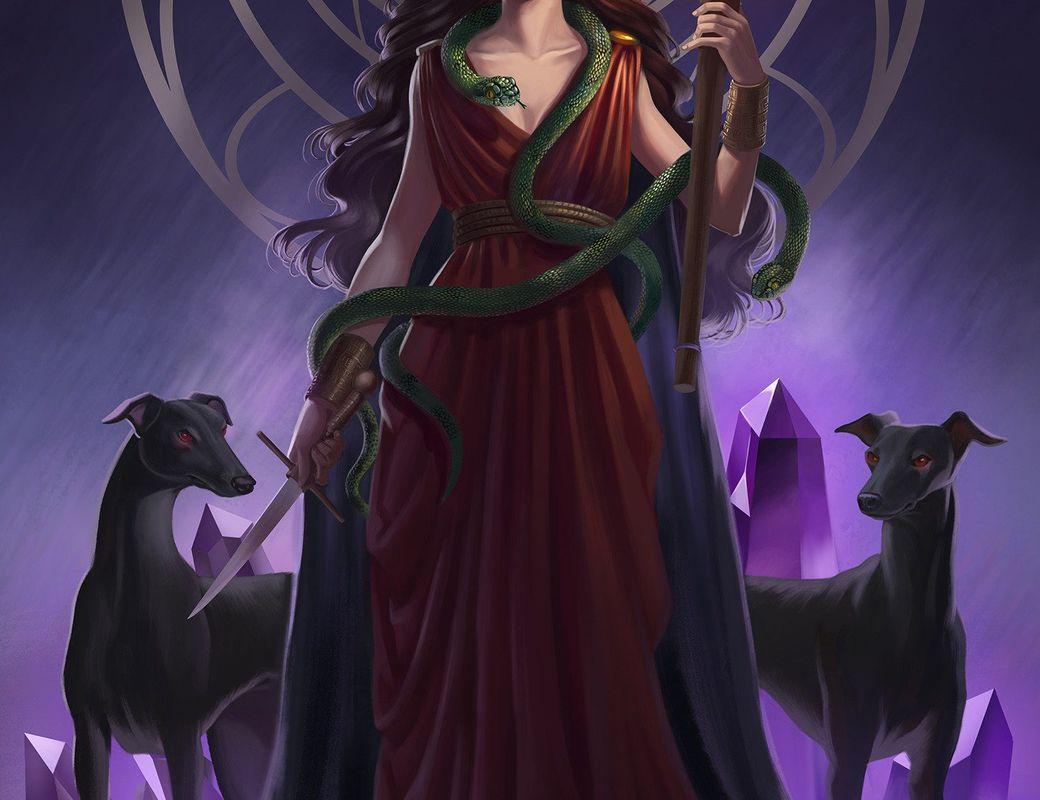
Every symbol associated with Hecate tells part of her story. Perhaps her most recognizable emblem is the torch, whose steady flame represents illumination during life’s darkest moments. The torch reminds us that even when the road ahead is uncertain, wisdom can still light the way.
The key is another enduring symbol of the goddess. It represents access to hidden knowledge, spiritual mysteries, and opportunities that reveal themselves only when we are prepared to receive them. For many practitioners today, the key serves as a reminder that personal transformation begins by unlocking doors within ourselves.
The crossroads have long been sacred to Hecate, representing those moments when important decisions shape the course of our lives. Rather than seeing uncertainty as something to fear, Hecate teaches that every crossroads offers the possibility of growth.
Animals also carry deep meaning within her mythology. Black dogs were considered sacred companions of the goddess and were believed to sense the presence of spirits. Serpents symbolize renewal, wisdom, and transformation through the continual shedding of old layers, while the crescent Moon reflects Hecate’s enduring connection to the mysteries of the night and the intuitive wisdom found in darkness.
Keeper of the Crossroads
Few images capture Hecate’s essence more completely than the crossroads.
In the ancient world, crossroads were viewed as places where different realms seemed to meet. Travelers paused there to make decisions, merchants changed direction, and many believed the boundaries between the physical and spiritual worlds became especially thin. These liminal spaces naturally came under Hecate’s protection.
Offerings were often left at three-way crossroads as acts of gratitude or petitions for guidance. Such gifts acknowledged Hecate’s role as both guardian and guide, asking her to illuminate uncertain paths and offer protection during life’s many transitions.
Even today, the symbolism remains remarkably relevant. Every major life decision, every ending, and every new beginning can be understood as standing at one’s own crossroads, where courage and wisdom become essential companions.
Offerings to the Goddess
Ancient traditions speak of offerings known as Hecate’s Supper, which were typically placed outside the home or at crossroads near the close of the lunar month. These gifts honored the goddess while also serving an important social purpose, as food left behind was often collected by those experiencing poverty.
Traditional offerings frequently included simple foods such as bread, eggs, garlic, honey, cakes, olive oil, wine, and fish. Incense was commonly burned as prayers rose toward the heavens, creating an atmosphere of reverence and devotion.
Today, many practitioners choose offerings that feel personally meaningful. A candle lit in quiet reflection, fresh flowers gathered with gratitude, devotional artwork, handwritten prayers, or acts of kindness dedicated in Hecate’s name all honor the spirit of these ancient customs. What matters most is not the value of the offering itself, but the sincerity with which it is given.
Honoring Hecate Today
The Festival of Hecate can be observed in many different ways, each shaped by personal belief and intention. Some spend time in meditation, allowing the stillness of the day to deepen their intuition. Others journal about important crossroads in their lives, reflecting on where they have been and where they hope to go.
Many choose to perform a cleansing ritual, releasing old fears or limiting beliefs before welcoming new opportunities. Reading the ancient myths, working with tarot or oracle cards, or simply walking beneath the evening sky can all become acts of quiet devotion.
For others, the day is dedicated to shadow work, the practice of honestly examining the parts of ourselves that often remain hidden. In Hecate’s presence, darkness is not viewed as something to conquer, but as a place where healing, wisdom, and transformation quietly begin.
Hecate’s Enduring Legacy
Across the centuries, Hecate has become one of the most beloved figures in modern Paganism, Wicca, Hellenic polytheism, and contemporary witchcraft. Her enduring appeal lies not in fearsome imagery, but in the comfort she offers those navigating uncertain times.
She reminds us that change is a natural part of life, that endings often prepare us for new beginnings, and that the courage to continue forward is one of the greatest forms of magic. Standing at the threshold between what has been and what may yet become, Hecate encourages us to trust both our intuition and our inner strength.
As summer slowly yields to the approaching harvest season, the Festival of Hecate offers a beautiful opportunity to honor the goddess whose torch has illuminated the paths of seekers for countless generations. Whether celebrated through prayer, meditation, ritual, or quiet reflection, August 13 reminds us that every crossroads holds the promise of transformation, and that even in the deepest night, there is always a light waiting to guide us home.
Comments