When the Sky Went Wrong
How the Ancient World Explained the Unexplainable
Article · 28 min read · ·
Author’s Note
This article explores how ancient civilizations understood and responded to one of nature’s most awe-inspiring phenomena: the solar eclipse. In doing so, it discusses historical beliefs, religious traditions, and cultural practices that include themes of sacrifice, death, violence, and divine judgment.
These accounts are presented solely to provide historical and cultural context. They are not intended to sensationalize or glorify the customs or beliefs of the societies that practiced them. Many of these traditions emerged in worlds profoundly different from our own, where eclipses were often interpreted as existential threats to the survival of kingdoms, communities, and even the cosmos itself.
As with any study of history, understanding the past requires viewing these cultures within the context of their own beliefs and values rather than through a modern lens. By examining how our ancestors sought to explain the unexplained, we gain a deeper appreciation not only for the remarkable diversity of human cultures but also for the enduring sense of wonder that the heavens continue to inspire.
From sun-devouring monsters and sacrificial kings to sacred rituals and the mystery of the darkness at Golgotha
On August 12, 2026, a total solar eclipse will sweep across parts of Greenland, Iceland, and northern Spain. Millions of people will gather beneath the Moon’s shadow, cameras in hand, eager to witness one of nature’s most spectacular displays. Scientists can predict the eclipse down to the second, while astronomers understand precisely why the Sun will briefly disappear from the daytime sky.
For our ancestors, however, a solar eclipse was something entirely different.
Imagine standing beneath a clear afternoon sky when the sunlight begins to fade. Birds suddenly fall silent. Animals retreat as though night has arrived hours too early. The air grows cooler, shadows sharpen, and an unsettling darkness spreads across the land. The brilliant Sun, the giver of warmth, light, and life itself, slowly vanishes.
Without astronomy to explain the phenomenon, the experience was nothing short of terrifying.
For thousands of years, civilizations across the globe believed an eclipse signaled that the natural order had been disrupted. Some feared monstrous beasts were devouring the Sun. Others believed the gods were expressing their anger, warning of war, famine, plague, or the death of kings. Entire communities gathered to beat drums, clash metal, light sacred fires, recite prayers, or perform elaborate rituals in the hope of restoring the heavens before darkness became permanent.
Remarkably, these beliefs emerged independently across continents separated by vast oceans. From the dragon legends of China and the immortal demon Rahu of India to the celestial wolves of Scandinavia and the sacrificial substitute kings of ancient Mesopotamia, humanity repeatedly searched for meaning in the same extraordinary event. Though the stories differed, they shared a common purpose: to explain the unexplainable and restore a sense of order when the sky itself seemed to betray the world below.
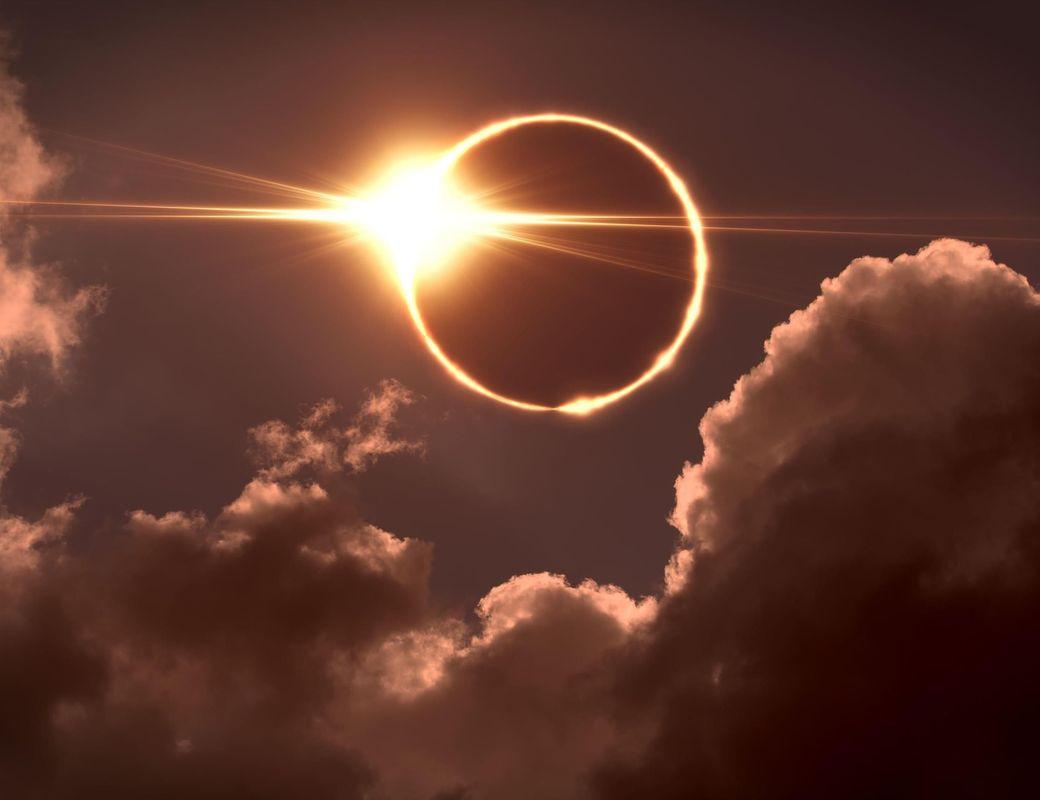
Today, we understand that a solar eclipse occurs when the Moon passes directly between the Earth and the Sun, temporarily blocking the Sun’s light. Yet even armed with centuries of scientific knowledge, standing beneath the Moon’s shadow remains a deeply emotional experience. The sudden darkness, the eerie silence, and the appearance of the Sun’s glowing corona still inspire awe much as they did thousands of years ago.
This is the story of how ancient civilizations interpreted those moments of darkness, the myths they created, the rituals they performed, and the remarkable ways a few fleeting minutes of shadow shaped religion, politics, and human imagination throughout history.
When the Sun Vanished: Why Eclipses Inspired Fear
To modern observers, a solar eclipse is a rare and predictable celestial event. Ancient civilizations, however, had no way of understanding the precise movements of the Earth, Moon, and Sun. Although some cultures eventually learned to recognize eclipse cycles, the sudden disappearance of the Sun remained one of the most unsettling experiences imaginable.
The Sun was far more than a bright object in the sky. It governed nearly every aspect of daily life. Its rising and setting marked the passage of time, guided planting and harvesting, regulated religious festivals, and symbolized life, fertility, justice, and divine order. In many societies, the Sun was worshipped as a god or regarded as the visible manifestation of divine power. Its dependable journey across the heavens represented stability, while its warmth ensured the survival of crops, livestock, and entire communities.
When that dependable rhythm was suddenly interrupted, the consequences felt catastrophic.
During a total solar eclipse, daylight gradually fades into an eerie twilight. Temperatures can drop noticeably within minutes. Birds cease singing and return to their nests, while nocturnal animals may emerge, convinced that night has arrived. Shadows become unusually sharp, and an uncanny stillness settles over the landscape. Even today, witnesses often describe the experience as both beautiful and deeply unsettling.
For ancient peoples, these dramatic changes confirmed that something extraordinary, and often dangerous, was unfolding in the heavens. If the Sun represented order, then its disappearance suggested that chaos had broken through the fabric of the cosmos. Was a god expressing divine anger? Had a monstrous creature attacked the heavens? Was this a warning that a king would die, an empire would fall, or famine and disease would soon follow?
Such questions gave rise to some of humanity’s most enduring myths and rituals.
Rather than accepting an eclipse as a random occurrence, cultures around the world sought explanations that reflected their own religious beliefs and worldviews. Some imagined celestial dragons, wolves, serpents, jaguars, or demons consuming the Sun. Others believed the heavens were communicating with rulers, warning them to change their ways or prepare for disaster. Across continents separated by thousands of miles, remarkably similar ideas emerged, each attempting to restore meaning to a sky that had suddenly become frighteningly unfamiliar.
In time, these stories evolved into elaborate traditions. Sacred ceremonies, thunderous drums, ritual fasting, royal sacrifices, prayers, and acts of communal devotion all became ways of confronting the darkness. Although the details differed from one civilization to another, the message remained remarkably consistent: when the Sun disappeared, humanity believed it had a role to play in bringing it back.
Sun-Eaters: The Monsters That Devoured the Sun
Long before astronomers understood orbital mechanics, ancient peoples looked toward the darkening sky and reached a remarkably similar conclusion: something was consuming the Sun.
Separated by oceans and centuries, civilizations that never encountered one another created myths in which celestial beasts, demons, or supernatural predators attacked the life-giving star. Although the names of the creatures differed, the fear they inspired was universal. An eclipse was not simply an astronomical event. It was a cosmic battle unfolding overhead.
Among the oldest and most enduring eclipse traditions comes from ancient China, where a mighty celestial dragon was believed to swallow the Sun. Dragons in Chinese mythology were not merely destructive monsters. They were powerful beings associated with rain, rivers, imperial authority, and the forces of nature. Yet during an eclipse, the dragon’s immense power became a threat to the very balance of heaven and earth.
People responded with urgency. Families rushed outside to beat drums, clash bronze gongs, strike pots and pans, and shout toward the heavens in hopes of frightening the dragon into releasing its prey. In some accounts, soldiers fired arrows into the sky to drive the creature away. The emperor’s court regarded eclipses with equal seriousness. Imperial astronomers were expected to predict these celestial events accurately because they were believed to reflect Heaven’s judgment upon the emperor and the state. One famous tradition tells of the royal astronomers Hsi and Ho, who were executed after failing to foresee an eclipse, a story that illustrates just how closely political authority and celestial order were intertwined in ancient China, whether the account is entirely historical or partly legendary.
Neighboring cultures developed similar explanations. In Korea, eclipse legends tell of the Bulgae, fearsome fire dogs sent by the King of the Dark Kingdom to steal the Sun and Moon. Each time the fiery hounds seized the Sun, they discovered it was too hot to hold. Unable to keep their prize, they released it, allowing daylight to return. The story offered an elegant explanation for why eclipses were always temporary, no matter how frightening they appeared.
In Vietnam, many traditions describe a giant celestial frog or toad swallowing the Sun. Frogs and toads were often associated with rain, fertility, and the rhythms of nature, making them fitting participants in cosmic events. Other regional traditions speak of a heavenly dog devouring the Sun before eventually releasing it, once again emphasizing that the disappearance of daylight was the result of a living, supernatural force rather than an impersonal natural phenomenon.
Far to the north, the peoples of Scandinavia envisioned an altogether different threat. In Norse mythology, the Sun was guided across the heavens by the goddess Sól, who was relentlessly pursued by the monstrous wolf Sköll. His brother, Hati, chased the Moon with equal determination. Every eclipse served as a terrifying reminder that the wolves were drawing ever closer to their quarry. According to the Poetic Edda and later Norse traditions, their pursuit would one day end at Ragnarök, the cataclysmic battle that would bring about the destruction and eventual rebirth of the world. During that final reckoning, Sköll would finally catch and devour the Sun, plunging creation into darkness before a new world emerged.
Eastern Europe preserved its own terrifying predator in the form of the vârcolac, a wolf-like demon of Romanian folklore. Often described as a werewolf spirit or restless soul, the vârcolac was believed to ascend into the heavens and attack the Sun or Moon. Some traditions claimed the creature gnawed away at the celestial bodies, while others suggested the reddish glow of a lunar eclipse was the blood dripping from its jaws after the assault. Villagers responded with prayers, church bells, and loud noises intended to drive the creature away before permanent darkness could fall.
Despite the differences in geography, language, and religion, these myths reveal a striking pattern. Again and again, humanity imagined eclipses not as random occurrences but as living dramas, moments when order and chaos collided above the world. The Sun was rarely thought to vanish on its own. Instead, it was pursued, captured, swallowed, or wounded by powerful supernatural beings whose defeat depended, at least in part, upon the actions of those watching from below.
For ancient civilizations, making noise, offering prayers, or performing sacred rituals was more than symbolic. It was an act of participation in a cosmic struggle, one in which the fate of the world seemed to hang in the balance until the Sun finally returned.
The Immortal Pursuer: Rahu, Ketu, and India’s Eternal Eclipse
Among the world’s eclipse traditions, few are as elaborate or enduring as the story of Rahu and Ketu, whose celestial pursuit of the Sun and Moon remains deeply woven into Hindu mythology, astrology, and religious practice.
The legend begins with one of Hinduism’s most celebrated myths, the Samudra Manthana, or the Churning of the Ocean of Milk. According to the ancient Puranas, the devas, the gods, and the asuras, powerful beings often described as demons or anti-gods, joined forces to churn the cosmic ocean in search of amrita, the nectar of immortality. Using the great serpent Vasuki as a rope and Mount Mandara as the churning rod, they stirred the primordial sea until countless divine treasures emerged, including the precious nectar that promised eternal life.
Fearing the asuras would seize the nectar for themselves, the god Vishnu assumed the enchanting form of Mohini and began distributing the amrita exclusively to the devas. One clever asura, named Svarbhanu, disguised himself as a god and quietly slipped into the line. As the nectar touched his lips, the Sun god Surya and the Moon god Chandra recognized the deception and alerted Vishnu.
Without hesitation, Vishnu hurled his divine discus, the Sudarshana Chakra, severing Svarbhanu’s head from his body.
It was already too late.
Because the nectar had touched him, Svarbhanu could not die. His head became Rahu, while his body became Ketu. Though forever separated, both were transformed into immortal celestial beings whose destinies would shape the heavens.
Rahu never forgot the betrayal of Surya and Chandra.
Filled with eternal resentment, he relentlessly pursues the Sun and Moon across the sky. When he finally catches them, he swallows them whole, plunging the world into darkness. Yet because Rahu possesses only a head and no body, the Sun and Moon inevitably pass through his severed neck and emerge once again, explaining why eclipses are always temporary.
Unlike many eclipse myths that portray a single catastrophic event, the story of Rahu and Ketu explains why eclipses occur again and again throughout history. Each eclipse represents another chapter in an endless cycle of vengeance, pursuit, and release that has continued since the dawn of creation.
The influence of Rahu and Ketu extends far beyond mythology. In Hindu astrology, known as Jyotisha, they are not considered physical planets but chhaya grahas, or “shadow planets.” These mathematical points correspond closely to what modern astronomy identifies as the Moon’s ascending and descending nodes, the very locations where solar and lunar eclipses occur. Long before telescopes revealed the mechanics of eclipses, Indian astronomers had recognized the profound relationship between these celestial points and the movements of the Sun and Moon, allowing mythology and astronomical observation to exist side by side.
Traditional eclipse customs continue to be observed by many Hindus today. Some choose to fast before and during an eclipse, believing it is a period of heightened spiritual sensitivity. Temples may suspend certain rituals until the eclipse has passed, while devotees chant sacred mantras, meditate, or recite prayers dedicated to Vishnu, Shiva, or the Gayatri Mantra. Many avoid cooking or eating during the eclipse, and afterward, ritual bathing in rivers or other bodies of water symbolizes purification and renewal before daily life resumes.
Whether understood through the lens of mythology, astrology, or astronomy, the story of Rahu and Ketu illustrates humanity’s enduring desire to find meaning in extraordinary celestial events. Rather than viewing an eclipse as random or meaningless, ancient India transformed it into a timeless story of justice, deception, cosmic balance, and the unending dance between light and shadow.
When the Heavens Judged Kings: Mesopotamia’s Eclipse Omens and the Substitute King
While many cultures imagined monsters swallowing the Sun, the civilizations of ancient Mesopotamia believed something even more unsettling: an eclipse was not an attack on the heavens but a message from them.
To the Assyrians and Babylonians, the sky was a vast divine manuscript. Every unusual event, whether a comet, an unusually bright planet, a meteor shower, or a solar eclipse, carried meaning. The gods were communicating with humanity through the heavens, and it was the responsibility of royal scholars to interpret those messages before disaster struck.
For centuries, Mesopotamian astronomer-priests meticulously observed the night sky, recording celestial events on clay tablets. These observations were compiled into vast collections of omens, most notably the Enūma Anu Enlil, a series of more than seventy tablets containing thousands of celestial interpretations. An eclipse occurring in a particular month, on a specific day, or in a certain region of the sky could foretell invasion, famine, rebellion, plague, crop failure, or, most ominously, the death of the king.
The fate of an empire, they believed, could be written in the shadow crossing the Sun.
No omen inspired greater concern than one directed at the ruler. The king was more than a political leader. He served as the earthly representative of the gods, responsible for maintaining order between heaven and earth. If an eclipse signaled his death, the stability of the entire kingdom was thought to be at risk.
Rather than accept that fate, the Assyrians devised one of history’s most extraordinary political and religious rituals.
Known as the šar pūḫi, or the “substitute king ritual,” the ceremony sought to redirect the gods’ judgment. If the omen foretold the death of a king, then another king could fulfill the prophecy instead.
A stand-in, often a prisoner, condemned criminal, court servant, or occasionally a political rival, was dressed in royal robes and ceremonially installed upon the throne. For days, weeks, or even several months, depending on the astrologers’ interpretation of the omen, the substitute was treated as the true monarch. He wore the crown, received royal meals, accepted gifts, and in some cases was even assigned a woman to serve as his ceremonial queen.
Meanwhile, the real king quietly disappeared from public life.
Hidden within the palace, he abandoned the symbols of kingship and waited while the substitute publicly bore the weight of the gods’ anger. The ritual was not intended to deceive the people as much as it was to satisfy the divine decree itself. If fate demanded that a king should die, then the substitute would become the king destined to meet that fate.
When court astrologers determined the period of danger had passed, the ritual reached its grim conclusion.
The substitute king and, in many cases, his temporary queen were executed. Their deaths were believed to absorb the evil foretold by the eclipse, allowing the true monarch to emerge safely and resume his reign. To modern readers, the practice seems both shocking and cruel, yet within the Assyrian worldview it represented an act of statecraft, religious devotion, and cosmic protection.
Far from being legend alone, the ritual is documented in surviving correspondence between Assyrian kings and their scholars. Letters from the reign of King Esarhaddon in the seventh century BCE reveal anxious discussions about eclipses, ominous celestial signs, and the careful implementation of substitute kings. These remarkable records offer a rare glimpse into a civilization where astronomy, religion, and politics were inseparable, and where the shadow of the Moon could determine the fate of an empire.
Ironically, the same civilization that feared eclipses also laid the foundation for understanding them. Babylonian astronomers spent centuries recording celestial patterns with extraordinary precision, eventually recognizing that eclipses repeated in predictable cycles. Their observations contributed to the discovery of what is now known as the Saros cycle, a period of approximately 18 years after which similar eclipses recur. Although they still interpreted eclipses as divine omens, their meticulous record-keeping would ultimately help transform eclipse prediction from sacred divination into scientific astronomy.
In Mesopotamia, then, an eclipse represented both humanity’s deepest fears and one of its earliest scientific achievements. The same shadow that inspired kings to hide from the gods also inspired generations of scholars to study the heavens with unprecedented care.
Saving the Sun: Rituals, Prayers, and Sacred Ceremonies Around the World
While kings consulted astrologers and priests searched the heavens for divine meaning, ordinary people faced a more immediate question: What could they do to help?
Across the ancient world, remarkably similar answers emerged. An eclipse was not something to be watched in silence. It was a crisis that demanded action.
In China, entire communities rushed outdoors as the Moon’s shadow spread across the land. Bronze gongs rang through villages and imperial cities alike. Drums thundered, bells clanged, and families beat pots and pans together in a deafening chorus intended to frighten the celestial dragon into releasing the Sun. Soldiers were sometimes said to fire arrows toward the heavens, joining the battle against the unseen creature.
Thousands of miles away, similar traditions appeared among cultures that had never encountered China. In parts of India, devotees gathered in prayer, chanting sacred mantras while fasting until the eclipse had passed. Rivers, particularly the sacred Ganges, became places of purification where ritual bathing symbolized spiritual renewal after the shadow had lifted. Many households avoided eating, cooking, or beginning important tasks during the eclipse, believing it was a period when the normal order of the cosmos had been temporarily suspended.
Among the Inca of the Andes, the Sun was revered as the great god Inti, the divine ancestor of the emperor himself. An eclipse was often interpreted as a sign that Inti had become angry or that a celestial jaguar was attacking him. People shouted toward the heavens, shook spears, blew horns, and made as much noise as possible to frighten the predator away. In some accounts, llamas were sacrificed in hopes of restoring harmony between the gods and humanity.
The Aztecs viewed eclipses with equal apprehension. They believed the universe existed only through the continued sacrifice and strength of the Fifth Sun. An eclipse threatened that fragile balance, raising fears that darkness might prevail forever. Ceremonies and prayers sought to reinforce the Sun’s power, while pregnant women often remained indoors, believing the eclipse’s supernatural influence could affect unborn children.
The Maya possessed some of the most sophisticated astronomical knowledge in the ancient world. Their scribes recorded eclipse cycles in the famous Dresden Codex, allowing priests to anticipate many eclipses with remarkable accuracy. Yet prediction did not erase fear. Instead, foreknowledge allowed ceremonies to be prepared in advance. Rulers performed bloodletting rituals, offerings were made to the gods, and communities gathered to ensure the cosmic order remained intact. Knowing an eclipse was coming did not diminish its spiritual significance; it made careful preparation all the more important.
Among several Indigenous peoples of North America, eclipses inspired stories that reflected harmony rather than conquest. Oral traditions vary widely from nation to nation, but many describe the Sun and Moon as living beings whose temporary meeting or struggle carried spiritual meaning. Some communities observed eclipses quietly and respectfully, while others offered songs or prayers instead of loud demonstrations. Among the Navajo, for example, eclipses were regarded as sacred moments when the natural order was undergoing renewal. Traditional teachings encourage people to remain indoors, refrain from eating or working, and spend the eclipse in prayer and reflection rather than watching it directly.
Elsewhere, eclipses inspired stories that emphasized compassion instead of conflict. In the Andes, some Aymara traditions described the Sun as becoming ill rather than being attacked. Fires were lit on surrounding hillsides to provide warmth and strength until it recovered. In parts of Eastern Europe, church bells rang as villagers prayed that God would restore the light, blending older folklore with Christian belief.
Although the rituals varied dramatically, they shared a profound common thread. Ancient people did not see themselves as passive spectators beneath an indifferent sky. They believed humanity had a responsibility to respond. Whether through prayer, music, sacrifice, fasting, silence, or thunderous noise, people sought to participate in the restoration of cosmic order.
Today, we gather beneath eclipses with telescopes, cameras, and eclipse glasses instead of drums and sacred fires. Yet in many ways, we are still participating in a ritual. We stop what we are doing, look to the heavens together, and share in a moment that reminds us how small we are beneath the vast machinery of the cosmos.
The difference is that our ritual is one of wonder rather than fear.
When the Sun Turned Away: Darkness as Divine Judgment
Not every civilization believed the Sun disappeared because it had been swallowed.
For many cultures, the darkness of an eclipse carried a far more personal message. The Sun had not been attacked. It had chosen to turn away.
In Japan, one of the most beloved stories in Shinto tradition tells of the Sun goddess Amaterasu, whose brilliance illuminated the world. After enduring repeated cruelty and destructive behavior from her brother, the storm god Susanoo, Amaterasu retreated into the Heavenly Rock Cave, sealing the entrance behind her. Without the Sun goddess, the world was plunged into darkness. Crops failed, evil spirits emerged, and chaos spread across the land.
The other gods tried desperately to lure her back. They hung a sacred mirror outside the cave, adorned the trees with jeweled ornaments, and held a joyous celebration. Curious about the unexpected laughter echoing outside, Amaterasu cautiously emerged from her hiding place. Catching sight of her own radiant reflection in the mirror, she stepped forward just enough for the other gods to pull away the stone blocking the cave. Light returned to the world, restoring order to heaven and earth.
Although this is not an eclipse myth in the strict sense, it reveals a powerful idea shared by many ancient cultures: darkness descended when divine harmony was broken, and only through restoring that harmony could the light return.
Similar beliefs appeared across parts of Eastern Europe. In Romanian and Transylvanian folklore, some traditions held that the Sun covered her face in sorrow after witnessing humanity’s wickedness. Rather than being devoured by a monster, she withdrew from the world in grief or disgust, refusing to shine upon people who had abandoned righteousness. An eclipse became a solemn warning, urging communities to pray, repent, and mend their ways before the light was restored.
Among several Indigenous traditions in the Americas, eclipses were also understood as moments when the relationship between humanity and the natural world required renewal. Rather than responding with panic, some communities observed the event with reverence and quiet reflection, recognizing it as a sacred interruption in the ordinary rhythm of creation. The temporary darkness reminded people that balance between the heavens, the Earth, and human beings could never be taken for granted.
The ancient Egyptians viewed the universe through a similar lens. Their world depended upon Ma’at, the divine principle of truth, justice, and cosmic order. Every sunrise symbolized the triumph of order over chaos as the Sun god Ra completed his nightly journey through the underworld. Although the Egyptians left no single myth explaining eclipses, unusual darkness would almost certainly have been understood as a disturbance in that sacred balance, a moment when Isfet, the forces of chaos embodied by the great serpent Apophis, threatened to overcome the ordered universe. Through prayers and temple rituals, priests sought to strengthen Ra’s eternal victory and preserve the harmony upon which all life depended.
Across these traditions, the lesson was strikingly different from tales of dragons and wolves. The danger did not always come from an external monster. Sometimes the greatest threat came from humanity itself.
An eclipse became a mirror held up to society, asking whether people had drifted too far from justice, reverence, or harmony with the divine. If the Sun could withdraw its light because of human failings, then restoring that light required more than noise or sacrifice. It required reflection, repentance, and the hope that the heavens might once again look kindly upon the world below.
When History Met the Heavens: The Darkness at Golgotha
Among the countless stories of darkened skies, none has inspired more discussion than the darkness described during the crucifixion of Jesus.
Unlike the myths of dragons, wolves, or celestial demons, this account appears within a historical setting, naming real people, real places, and a specific period under Roman rule. For nearly two thousand years, theologians, historians, and astronomers have debated the same question: Was the darkness at Golgotha a real astronomical event, a supernatural miracle, or a literary symbol conveying the significance of Christ’s death?
The three Synoptic Gospels, Matthew, Mark, and Luke, each record that darkness fell over the land from about the sixth hour until the ninth hour, roughly noon until three o’clock in the afternoon, as Jesus hung upon the cross. To those witnessing the crucifixion, the sudden darkness echoed language long associated with divine judgment throughout the Hebrew Scriptures. The prophet Amos, for example, wrote, “I will make the sun go down at noon and darken the earth in broad daylight,” a passage many Christians have long viewed as foreshadowing the events at Calvary.
For centuries, some readers naturally assumed the darkness was caused by a solar eclipse.
There is, however, an important astronomical problem.
The crucifixion occurred during Passover, a festival celebrated at the time of the full moon. A solar eclipse is only possible during a new moon, when the Moon passes directly between the Earth and the Sun. Because of this, modern astronomers agree that an ordinary total solar eclipse could not have occurred on the day traditionally associated with Jesus’ crucifixion.
Interestingly, this objection is not a modern discovery.
More than eighteen centuries ago, the Christian historian Julius Africanus addressed the same issue while discussing the writings of the first-century historian Thallus. Although Thallus’s original work has been lost, Africanus quotes him as apparently explaining the darkness as a solar eclipse. Africanus rejected that explanation on astronomical grounds, arguing that an eclipse of the Sun during Passover was impossible because of the Moon’s phase. Whether Thallus truly intended to describe the crucifixion or another event remains uncertain, since his original text no longer survives.
Another intriguing reference appears in the writings of Phlegon of Tralles, a Greek historian of the second century. Phlegon described an extraordinary darkening of the Sun accompanied by a significant earthquake during the reign of the Emperor Tiberius. Later Christian writers, including Origen, cited his account as possible corroboration of the Gospel narrative. Yet Phlegon never explicitly mentioned Jesus or Judea, leaving historians to debate whether he referred to the same event or an entirely different phenomenon.
As with many questions from antiquity, certainty remains elusive.
Some scholars have proposed that the darkness resulted from an unusually severe dust storm, perhaps one of the hot desert winds known in the region. Others suggest dense storm clouds or volcanic aerosols could have produced an extraordinary midday gloom. Still others argue that the Gospel writers employed the imagery of darkness as a profound theological symbol, expressing that creation itself mourned the death of Christ. For believers, the darkness may represent a miraculous act of God that lies beyond ordinary scientific explanation.
None of these possibilities can be proven conclusively.
What we do know is that the darkness at Golgotha became one of the most enduring celestial mysteries in history. Long after the crucifixion, Christians, Jews, Greeks, and Romans continued discussing, interpreting, and debating what had occurred. Whether understood as miracle, atmospheric phenomenon, symbolic language, or an event remembered through centuries of retelling, the story reflects the same instinct that has accompanied eclipses and darkened skies throughout human history.
When daylight unexpectedly vanished, people searched for meaning.
In that respect, the darkness at Golgotha belongs to the same long tradition as the dragons of China, the wolves of Scandinavia, the immortal Rahu of India, and the substitute kings of Mesopotamia. Across cultures and centuries, a darkened Sun has never been merely an astronomical curiosity. It has been a canvas upon which humanity has painted its deepest fears, greatest hopes, and most enduring questions about the relationship between heaven and earth.
From Omens to Orbit: Why Eclipses Still Captivate Us
For thousands of years, humanity looked skyward in fear when the Sun disappeared.
Then, slowly, something remarkable happened.
The same civilizations that once saw eclipses as divine warnings began noticing patterns in the heavens. Ancient Babylonian astronomers, whose kings once hid from eclipse omens, spent centuries recording the movements of the Sun and Moon with extraordinary precision. Their observations eventually revealed that eclipses were not random acts of the gods but followed repeating cycles. One of the most important of these is the Saros cycle, a period of about 18 years, 11 days, and 8 hours after which similar solar and lunar eclipses occur.
The Greeks built upon this knowledge. Philosophers such as Anaxagoras argued that eclipses were natural events caused by the Moon passing before the Sun, challenging supernatural explanations that had persisted for generations. Centuries later, Claudius Ptolemy refined mathematical models of the heavens, while astronomers in the Islamic Golden Age expanded those calculations with even greater accuracy. By the Renaissance, the movements of celestial bodies could be predicted with astonishing precision, and Isaac Newton’s laws of gravity finally provided the physical explanation that generations of skywatchers had sought.
Today, astronomers can predict a total solar eclipse centuries before it occurs. We know the exact path of totality, the precise second totality will begin, and how long darkness will last at nearly every location on Earth. What once inspired terror has become one of the most predictable events in nature.
And yet, prediction has not diminished wonder.
Anyone who has stood beneath the Moon’s shadow during totality knows that science explains the mechanics of an eclipse, but it does not lessen the experience. As daylight fades, the temperature drops, birds grow quiet, and the Sun’s ghostly white corona emerges around the black silhouette of the Moon, the world feels strangely transformed. For a few unforgettable minutes, the familiar becomes extraordinary.
Perhaps that is why eclipses continue to captivate us.
The dragons have disappeared. The wolves no longer chase the Sun across the sky. Kings no longer surrender their thrones to sacrificial substitutes, and few believe an immortal demon is swallowing the light. Yet the emotions these stories sought to explain remain remarkably familiar. We still stop what we are doing. We still gather together. We still look upward in shared amazement.
On August 12, 2026, millions of people will once again pause beneath a darkening sky. Some will photograph the corona. Others will quietly absorb the moment in silence. Most will understand exactly why the Sun has vanished.
Even so, for those few fleeting minutes, they will experience something their ancestors would have recognized instantly.
Not fear.
Wonder.
Across thousands of years of human history, our understanding of eclipses has changed beyond recognition. Our fascination with them has not. In the brief shadow cast by the Moon, we are connected to every civilization that has ever looked skyward and asked the same timeless question: What does it mean when the light goes away?