The Turning of the Wheel
The Oak King, the Holly King, and the Myth of Litha
Article · 7 min read · ·
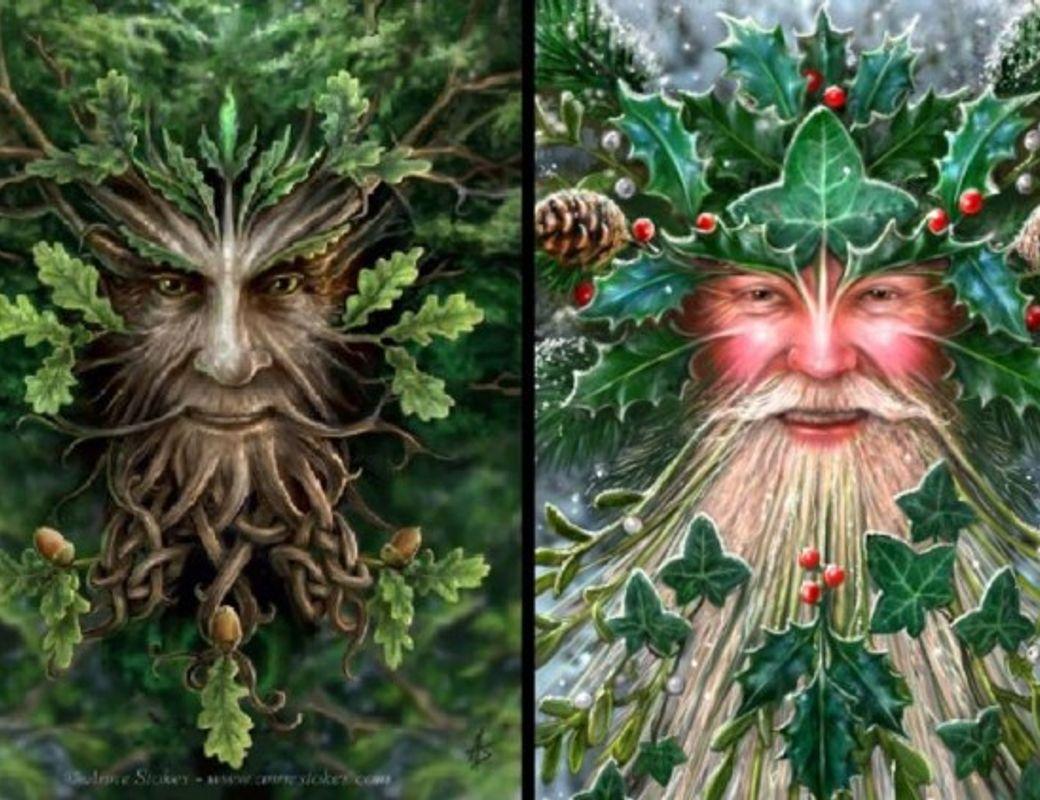
There is a moment every year when the sun seems invincible.
The fields are green, the forests stand in full leaf, wildflowers cover the hillsides, and daylight lingers long into the evening. It is the longest day of the year, the summer solstice, a time of celebration across much of Europe for thousands of years. Bonfires burn atop hills, songs fill the night air, and communities gather to honor the height of the growing season.
Yet hidden within this joyful celebration is an ancient truth that many cultures instinctively understood. The moment the sun reaches its greatest height is also the moment it begins to decline. The longest day carries within it the first shadow of winter.
Modern Pagan tradition expresses this paradox through one of its most beloved myths, the story of the Oak King and the Holly King. Locked in an eternal cycle of conflict and renewal, these two rulers embody the waxing and waning of the sun, the endless turning of the seasons, and the delicate balance between life and death. Although often presented as an ancient Celtic legend, the story itself is better understood as a modern myth woven together from much older traditions, symbols, and seasonal customs.
Its enduring appeal lies not in historical certainty but in its remarkable ability to capture the rhythm of nature itself.
The forests of Britain and Ireland have always been places of mystery. Long before written history, certain trees acquired sacred significance, standing as symbols of endurance, wisdom, and divine power. Among them, none were more revered than the mighty oak.
The oak dominates the landscape during the warm months of the year. Strong, long-lived, and deeply rooted, it became a symbol of kingship and authority throughout Europe. Classical writers described Druids gathering beneath oak groves to perform sacred rituals, and the tree’s frequent attraction to lightning linked it with sky gods and celestial power. Even the etymology of the word “Druid” may derive from an ancient root associated with the oak, although scholars continue to debate the exact linguistic origins.
The holly tells a different story.
While deciduous trees surrender their leaves to autumn winds, holly remains green throughout the coldest months of the year. Its glossy leaves and brilliant red berries bring life to an otherwise barren landscape, making it a natural emblem of resilience and survival. For centuries people planted holly near their homes for protection, believing it could ward away misfortune and evil spirits during the dark months.
These two sacred trees eventually became symbols for opposing halves of the year. The oak represented growth, expansion, warmth, and vitality. Holly represented endurance, preservation, and the quiet strength needed to survive winter.
From these older symbols emerged the modern myth of two kings who share a single throne.
Unlike many myths of good triumphing over evil, the Oak King and Holly King are not enemies in the moral sense. Neither is wicked, and neither deserves permanent victory. Instead, they represent complementary forces that sustain the natural order. One cannot exist without the other.
The Oak King governs the waxing year, from the winter solstice until midsummer. Under his reign, daylight steadily lengthens, seeds germinate, forests awaken, and life returns to the earth after winter’s sleep. His kingdom is one of abundance, fertility, warmth, and growth.
The Holly King governs the waning year, from midsummer until the return of winter. His reign brings harvest, falling leaves, cooling temperatures, and eventually the quiet stillness that blankets the land. Though often associated with darkness, his season is equally necessary, allowing the earth to rest before life begins anew.
Rather than opposing life itself, the Holly King preserves the balance that makes renewal possible.
The great drama unfolds at Litha, the summer solstice.
The sun stands at its highest point in the heavens. Daylight reaches its maximum length, and the world seems overflowing with vitality. Crops stretch toward maturity, flowers bloom in abundance, and the forests hum with life.
Yet nature is never static.
The day after the solstice is slightly shorter than the one before it. Almost imperceptibly, the light begins its long retreat toward winter.
Within the symbolism of the Oak King and Holly King, this subtle astronomical change becomes a cosmic battle.
The Oak King stands at the height of his glory, yet his reign has reached its inevitable conclusion. From the shadows emerges the Holly King, not as a destroyer but as the next rightful ruler of the Wheel of the Year. Their contest is not one of violence but of succession, each king surrendering power when his appointed season ends.
This understanding transforms the summer solstice into something far more profound than a simple celebration of sunlight. It becomes a meditation on impermanence itself. Every triumph contains the seed of its own ending, and every ending prepares the way for another beginning.
This idea echoes through countless agricultural societies that depended upon the changing seasons for survival. Farmers understood that endless summer would bring drought and exhaustion just as endless winter would bring starvation. The earth requires cycles, and so too does human life.
Across Britain and northern Europe, midsummer celebrations reflected this understanding through fire.
Great bonfires blazed across hilltops and open fields, visible for miles across the countryside. Some communities rolled burning wheels downhill to imitate the sun’s movement across the sky. Others danced around the flames, leaped over them for good fortune, or carried torches through fields to encourage healthy harvests.
Many of these customs survived into Christian Europe through the Feast of Saint John the Baptist, celebrated near the summer solstice. Older traditions blended with newer religious observances, allowing ancient seasonal rituals to persist beneath changing cultural landscapes.
Fire itself carried multiple meanings. It purified, protected, blessed, and symbolically strengthened the sun as it began its slow descent toward winter. Within the modern Oak King myth, these bonfires become farewell fires, honoring the king of summer even as his reign comes to an end.
Six months later, the wheel turns once more.
At the winter solstice the sun reaches its lowest point in the sky. Darkness seems complete, and the nights are at their longest. Yet once again the turning point contains its opposite. From that day forward the light slowly begins to return.
Here the Oak King rises again.
The Holly King, who has ruled faithfully through autumn and winter, yields his throne as daylight lengthens once more. The reborn Oak King ushers in spring, growth, and the gradual awakening of the earth.
This perpetual exchange gives the myth its enduring emotional power. Neither king truly dies, and neither is ever permanently defeated. Each simply waits for his appointed season to return.
Although many books describe the Oak King and Holly King as ancient Celtic deities, historians remain cautious about such claims. No surviving medieval Welsh or Irish text recounts their battle, nor do ancient sources describe two seasonal kings exchanging sovereignty at the solstices. The familiar narrative largely emerged during the twentieth century through modern Paganism, ceremonial traditions, and the influential writings of Robert Graves, who sought to reconstruct a poetic vision of prehistoric European religion.
That historical reality does not diminish the myth. If anything, it demonstrates mythology’s remarkable ability to evolve. Ancient symbols continue to acquire new meanings as each generation reinterprets them through its own spiritual imagination.
The image of a dying and returning ruler has appeared across civilizations for millennia, from Osiris in Egypt to Adonis in the ancient Mediterranean and numerous agricultural deities throughout Europe and the Near East. The Oak King and Holly King belong to this broader family of seasonal archetypes, expressing humanity’s enduring fascination with the cycles of death and renewal that govern both nature and our own lives.
Perhaps that is why the story continues to resonate today.
Whether one views it as poetry, symbolism, folklore, or spiritual truth, the myth reminds us that nothing remains fixed. Summer inevitably yields to autumn, winter eventually surrenders to spring, and every ending carries within it the promise of another beginning.
At Litha, when the sun lingers above the horizon and bonfires illuminate the shortest night of the year, the Oak King shines with unmatched brilliance. Yet somewhere beyond the light, patiently waiting for the wheel to turn once again, stands the Holly King, guardian of the season yet to come.
Responses (6)
More from the Magazine

Your Witchcraft Doesn't Need to Cost More Than Your Grocery Bill
Build a meaningful practice with ordinary objects, intentional actions, and what you already own.
The Owl - Secrets of Wisdom
The symbolism of the nocturnal bird in mythology, magic, and spiritual practices
How to Attract and Maintain Positive Energy
In Your Home and Other Spaces