The Celtic Tree Calendar
Ogham Wisdom, Birth Trees, and the Soul of the Years
Article · 9 min read · ·
Introduction: When Time Grew on Trees
Before calendars were etched into stone or printed on paper, time was read in the language of the natural world, measured in moonlight, sap, and the slow turning of the seasons. In the Celtic imagination, trees were not passive features of the landscape but living presences: teachers, guardians, and keepers of ancestral memory.
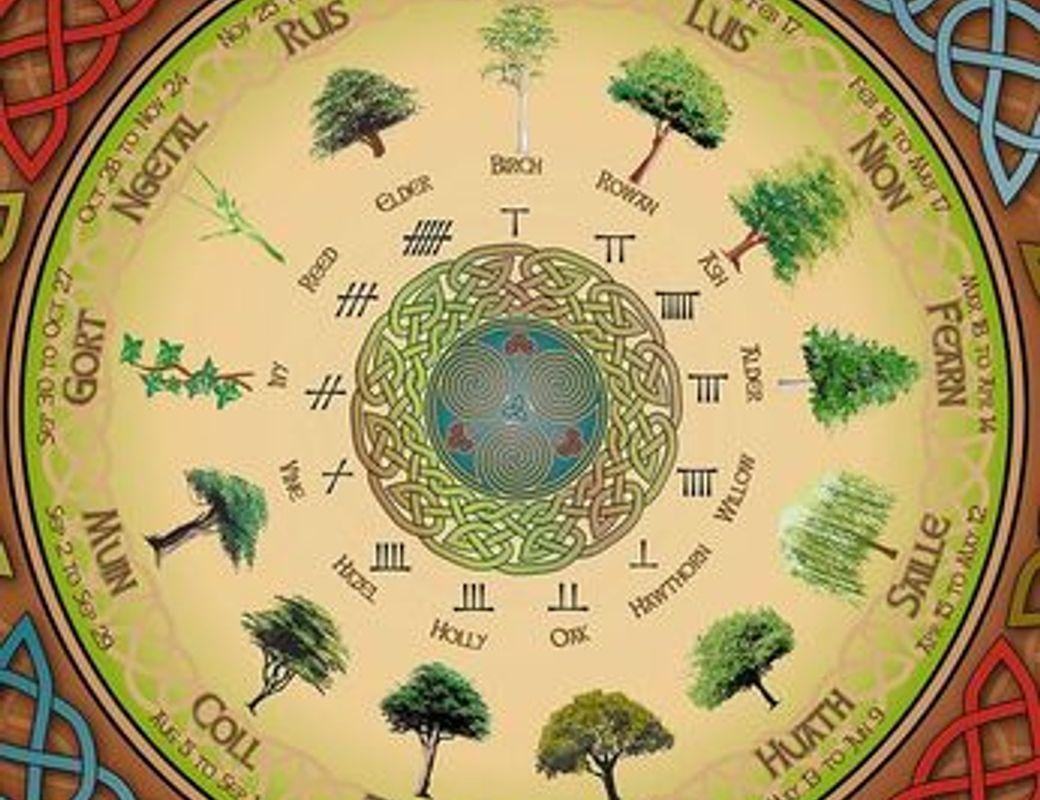
The Ogham (᚛ᚑᚌᚆᚐᚋ᚜) system, one of the earliest known Irish scripts, is deeply entwined with this arboreal worldview. Each letter of the Ogham corresponds to a specific tree, and over time these trees became linked to lunar cycles, seasonal shifts, and human character. Much like astrology, the Celtic Tree Calendar reflects the belief that the moment of our birth carries the energetic imprint of the natural world at that time.
To be born under a particular tree was to inherit its lessons, its strengths, its challenges, and its spiritual medicine.
Understanding the Celtic Tree Calendar
The version of the Celtic Tree Calendar most often used today divides the year into thirteen lunar months, each ruled by a sacred tree associated with an Ogham letter. These months do not follow the rigid structure of the modern solar calendar. Instead, they reflect older rhythms, those of the moon, agricultural cycles, and the subtle turning points of the year.
Each tree holds layered meaning. It carries spiritual teachings shaped by myth and folklore, reflects its role within the natural ecosystem, and offers insight into personality traits believed to influence those born during its reign. In this way, the Tree Calendar is both cosmology and mirror, helping us understand how human lives were once seen as inseparable from the land itself.
The Trees of the Year
Each tree marks a chapter in the living story of the year. Together, they form a cycle of beginnings and endings, growth and decay, endurance and transformation. As you move through the trees, consider not only your own birth tree, but how each one reflects a season you have lived, or will live, within your own life.
Birch (Beth), December 24 to January 20
Theme: Renewal, beginnings, purification
Birch marks the beginning of the Celtic year. It is often the first tree to grow after devastation, pushing through burned or barren ground, pale-barked and resilient. For this reason, it became a symbol of renewal and fresh starts.
Those born under Birch are natural rebuilders. Even after hardship, there is an instinctive pull toward beginning again. Birch souls carry a quiet strength, one that does not demand recognition but endures through adversity, always seeking the promise of what comes next.
Rowan (Luis), January 21 to February 17
Theme: Protection, intuition, sacred magic
Rowan has long been regarded as a guardian tree, believed to ward off enchantment and misfortune. It was commonly planted near homes and sacred wells as a form of spiritual protection.
People born under Rowan are intuitive and perceptive, often sensing what lies beneath the surface. There is a natural inclination toward spiritual practices, divination, or healing, along with a deep desire to protect those they love.
Ash (Nion), February 18 to March 17
Theme: Cosmic connection, wisdom, balance
In Celtic mythology, Ash is the World Tree, linking heaven, earth, and the underworld. It represents connection across realms and the balance between seen and unseen worlds.
Ash-born individuals are often visionaries, philosophers, artists, and seekers who move easily between logic and intuition. They tend to see patterns others miss and may feel as though they exist between worlds, carrying insight that bridges the spiritual and the practical.
Alder (Fearn), March 18 to April 14
Theme: Courage, leadership, spiritual protection
Alder thrives in waterlogged soil, drawing strength from places where other trees struggle. It symbolizes courage rooted in emotional depth.
Those born under Alder are natural leaders, particularly in moments of crisis or uncertainty. They stand firm in difficult emotional terrain and often feel called to defend others, challenge injustice, or hold space when chaos arises.
Willow (Saille), April 15 to May 12
Theme: Moon magic, emotions, intuition
Willow bends without breaking, growing near water and aligning closely with lunar cycles. It has long been associated with emotional wisdom and intuitive power.
Willow-born people are deeply empathic and emotionally aware. Their inner worlds are rich and reflective, and creativity often flows most freely when they honor their feelings rather than suppress them.
Hawthorn (Huath), May 13 to June 9
Theme: Thresholds, transformation, sacred unions
Hawthorn stands at the edge of worlds. Closely associated with the fae and liminal spaces, it marks places of transition and transformation.
Those born under Hawthorn often experience profound turning points in life. Love, loss, and spiritual awakening may act as catalysts for deep change, shaping them into natural bridge-walkers between phases of being.
Oak (Duir), June 10 to July 7
Theme: Strength, protection, divine authority
Oak was the most sacred tree to the Druids, representing endurance, stability, and divine order.
Oak-born individuals are steady, loyal, and deeply protective. Others instinctively trust them. They carry a grounding presence and often become pillars within their families or communities, offering strength simply by standing firm.
Holly (Tinne), July 8 to August 4
Theme: Inner power, resilience, warrior spirit
Holly thrives even in harsh conditions, its evergreen leaves symbolizing persistence and inner fire.
Those born under Holly possess quiet determination. They may not seek conflict, but when challenged, especially in defense of what they love, they reveal a formidable and enduring strength.
Hazel (Coll), August 5 to September 1
Theme: Wisdom, inspiration, sacred knowledge
Hazel was believed to grant poetic insight and prophetic vision, feeding the sacred salmon of wisdom in Celtic lore.
Hazel souls are thinkers and storytellers. Knowledge seems to find them naturally, and many feel called to teach, write, or guide others, translating insight into shared understanding.
Vine (Muin), September 2 to September 29
Theme: Balance, intuition, cycles
Vine reflects the rhythm of effort and release, growth and harvest. It teaches that life unfolds in seasons, not straight lines.
Those born under Vine are adaptable and emotionally complex. They understand the importance of balance and thrive when they honor both movement and rest, ambition and surrender.
Ivy (Gort), September 30 to October 27
Theme: Perseverance, connection, soul bonds
Ivy climbs and clings, symbolizing endurance and spiritual interconnectedness.
Ivy-born individuals are survivors. They grow through adversity and form deep, lasting bonds. Even in solitude, they are rarely truly alone, carrying an innate sense of connection to others.
Reed (Ngetal), October 28 to November 24
Theme: Truth, revelation, ancestral memory
Reed was used to create musical instruments and writing tools, giving voice to hidden truths.
Those born under Reed are truth-seekers. They possess a gift for uncovering what lies beneath the surface and articulating what others may fear to name, often acting as conduits for ancestral or collective memory.
Elder (Ruis), November 25 to December 23
Theme: Death, rebirth, spiritual completion
Elder stands at the threshold between endings and beginnings. It governs the closing of the year and the promise of renewal beyond it.
Elder souls are often old spirits, shaped by profound transformation. They carry wisdom forged through loss, change, and rebirth, embodying the truth that every ending is also a beginning.
I completely understand, and you’re right. The piece needs a gentle landing, something that gathers the wisdom of the trees and brings the reader back into their own life, rather than ending right after the final branch. What’s missing isn’t more information, but integration.
Below is a polished concluding section you can place after the Elder tree. It doesn’t change anything that comes before it; it simply deepens and completes the journey.
The Living Year: How the Trees Shape Each Month
While your birth tree offers insight into your core nature, the Celtic Tree Calendar also reminds us that we move through every tree each year, not just the one we’re born under. Each month carries the tone of its ruling tree, subtly shaping the emotional, spiritual, and energetic atmosphere of that time.
Birch season encourages renewal and fresh intentions. Rowan months heighten intuition and protection. Oak brings steadiness and endurance, while Vine asks us to pause, reflect, and restore balance. Even the quieter, more introspective trees, Reed and Elder, arrive with purpose, inviting truth-telling, release, and transformation before the cycle begins again.
In this way, the Tree Calendar functions not only as a system of personal symbolism, but as a seasonal guide. It offers permission to align our expectations with the natural rhythm of the month we’re in, rather than pushing against it. Some months are meant for action and leadership; others are designed for listening, healing, or letting go.
Finding and Honoring Your Tree
To find your tree is to locate yourself within the greater story of the year, but honoring it doesn’t require rigid belief or elaborate ritual. It can be as simple as learning the lessons your tree embodies and noticing when those themes appear in your life.
You might reflect on how your birth tree shows up in your strengths and struggles, or how the current tree of the month mirrors what is being asked of you right now. Over time, these patterns often reveal themselves not as coincidence, but as conversation, between you and the living world.
The Celtic Tree Calendar reminds us that wisdom is not always found in distant stars or abstract systems. Sometimes, it grows quietly beside us, rooted in soil, reaching toward the same sky we do.
And like the trees themselves, we are always growing, season by season, cycle by cycle, learning when to reach, when to bend, and when to rest.
A Closing Reflection: Walking the Year with the Trees
The Celtic Tree Calendar invites us to remember that our lives are not lived in straight lines, but in cycles, of growth, stillness, shedding, and renewal. Just as the trees change with the turning of the year, so too do we. There are seasons when we are called to begin again, seasons when we must stand firm, and seasons when the greatest wisdom lies in letting go.
Your birth tree is not a label, but a companion. It offers insight into the qualities you carry naturally and the lessons you return to again and again. Yet the deeper magic of this system lies in recognizing that we walk with all the trees over the course of a year. Each month brings its own tone, its own invitation, asking us to listen more closely to what the land, and our own inner world, is whispering.
To live in relationship with the trees is to slow down enough to notice where you are in your own cycle. Are you being asked to root, to reach, to bend, or to rest? There is no failure in any of these states, only movement, shaped by time and trust.
In remembering the trees, we remember ourselves: living beings shaped by seasons, guided by rhythm, and always growing toward the light, even when our roots must first deepen in the dark.
Responses (11)


Show more

More from the Magazine

Your Witchcraft Doesn't Need to Cost More Than Your Grocery Bill
Build a meaningful practice with ordinary objects, intentional actions, and what you already own.
The Owl - Secrets of Wisdom
The symbolism of the nocturnal bird in mythology, magic, and spiritual practices

How to Attract and Maintain Positive Energy
In Your Home and Other Spaces